Face Pulls Form: Rear Delts vs External Rotation, and How to Do Each
Face pulls form made simple: pull to eyes for rear delts or rotate to the forehead for the cuff. Setup, cues, reps and mistakes explained with the research.
TL;DR. The short answer
- Face pulls form comes down to one choice: pull to eye level with elbows wide for rear delts, or finish by rotating your hands back toward the forehead to work the external rotators.
- Set the cable at about eye level, use a rope, stand tall, and keep the weight light enough that your torso does not move. Heavy, jerky face pulls turn into a lower-back and traps exercise.
- Lab studies show external rotation exercises can produce high rotator cuff activity, but they also recruit the posterior deltoid, so the two goals overlap more than most posts admit.
- Face pulls can improve how your upper back feels and performs, but they are not a proven posture fix on their own. Strength work is one tool among several.
- A practical default is 2-4 sets of 12-20 slow reps, as a finisher after pulling or pressing, 2-3 times a week.
Part of our complete guide: Complete Shoulder, Delt & Neck Training Guide: 3D Deltoid Anatomy, Rotator Cuff & Traps
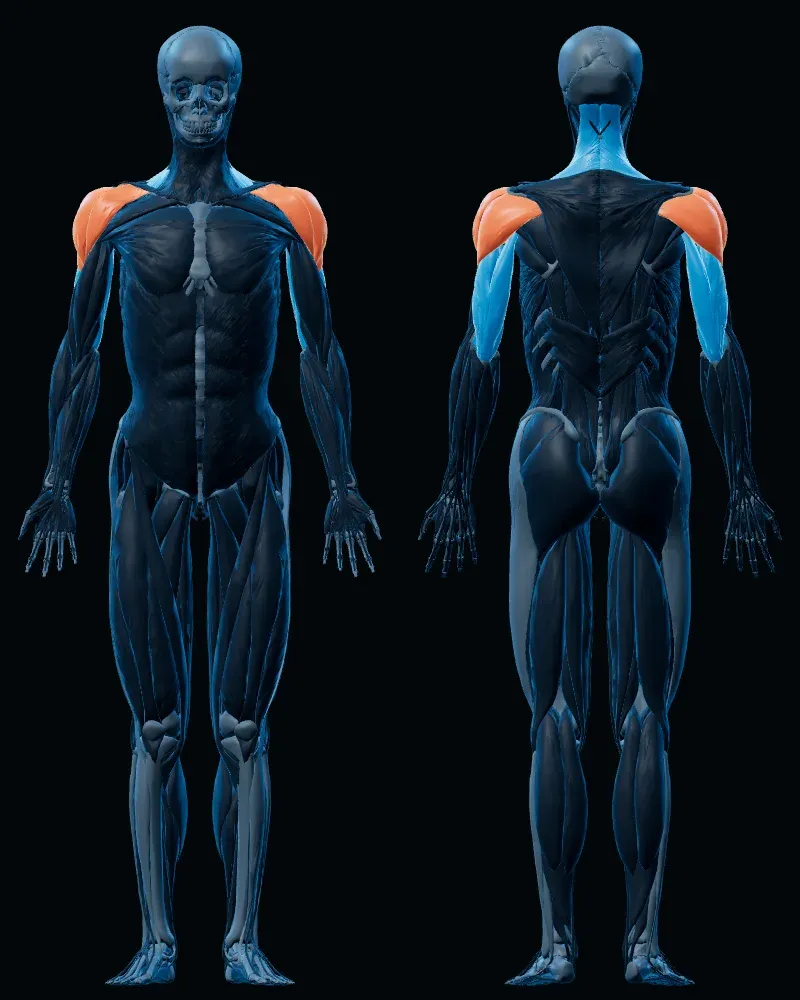
Muscles worked: shoulders
Main movers: all three heads of the deltoid
Assisting: supraspinatus, upper traps and triceps
Table of contents
Good face pulls form is simple to describe and surprisingly easy to get wrong. Set a rope on a cable at about eye level, pull toward your face with your elbows high, and either stop with your hands at eye level (more rear delt) or rotate your hands back toward your forehead (more external rotation). Both are legitimate, they just aim at slightly different targets.
This article is the full technique breakdown for the lift. For the wider picture of how rear delts fit into shoulder training, start with our complete shoulder and delt training guide.
Why do face pulls get two different explanations?
Ask three coaches and you will hear three answers. One says “go heavy, hit the rear delts.” Another says “keep it light, it is for posture and your rotator cuff.” A third says it is a shrug in disguise.
They are all describing real variations of the same movement. The difference is where your elbows go and what your hands do at the end of the pull. Once you see that, the argument mostly disappears.
How to do face pulls properly: setup and steps
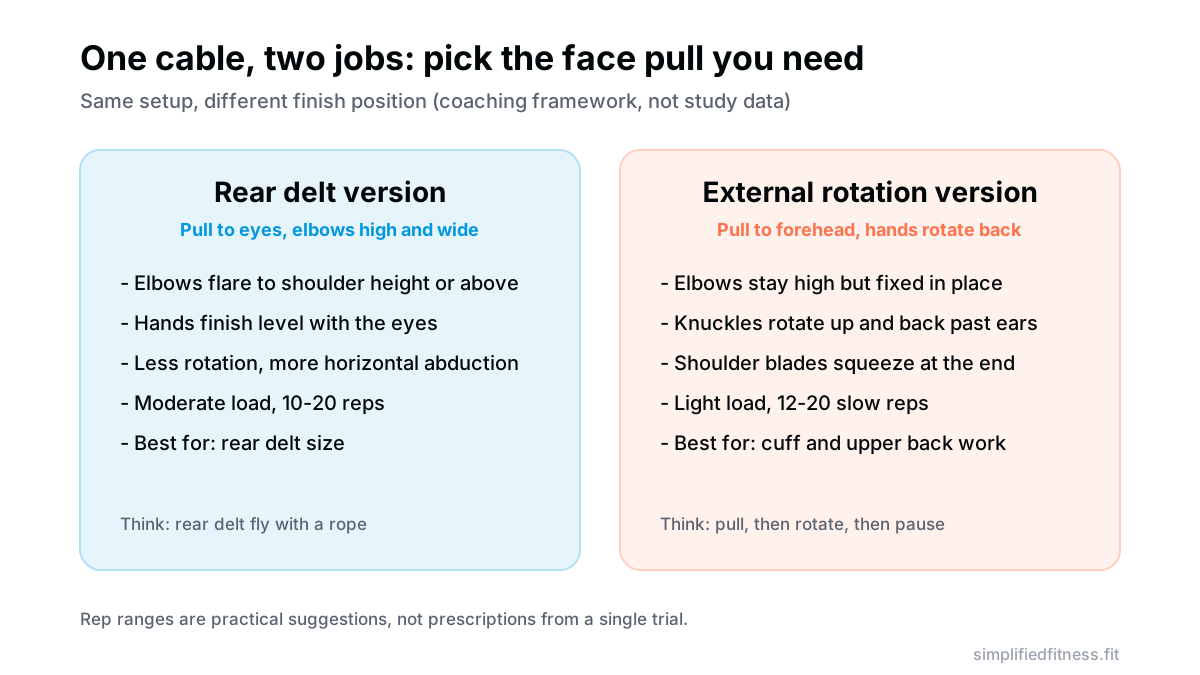
Most of the quality is decided before the first rep.
Cable height. Eye level or a little above. Too low and the pull becomes a row with a shrug. Too high and you lean back to find the line.
Attachment. A rope lets your hands separate and rotate. A straight bar locks your wrists and takes away the rotation finish. If your gym has dual ropes or a V-handle on a high pulley, those work as well.
Stance. Stand tall with a slight knee bend and your ribs down. Take two or three steps back so the weight stack is lifted before you start. Your torso should be a stable post.
The pull. Think of pulling the rope apart as it comes toward your face. Your elbows stay high, roughly in line with or slightly above your hands.
The finish. For the rotation version, your knuckles turn up and back, so your hands end beside or just behind your ears. Pause for a second and squeeze your shoulder blades gently together.
The return. Let the weight go back slowly with your arms reaching long. Do not let the stack yank your shoulders forward.
If your gym setup is awkward, our guide to cable pulley heights and angles covers how to set the line of pull properly.
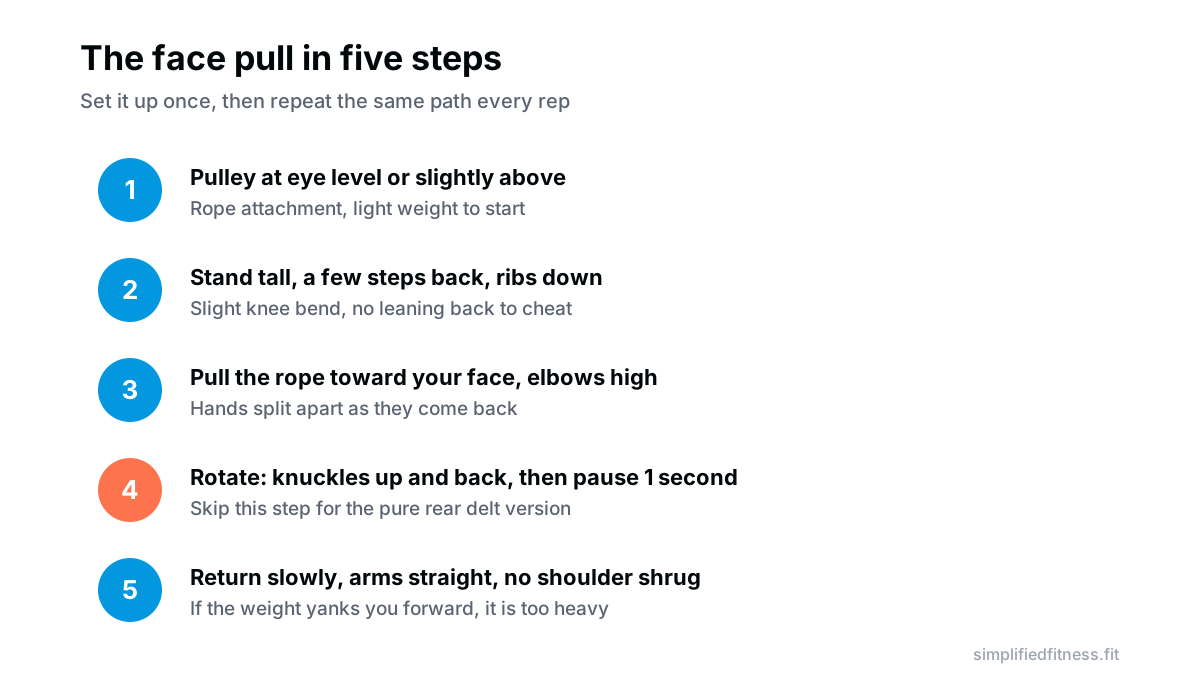
Rear delt version vs external rotation version
Here is the practical split.
| Rear delt version | External rotation version | |
|---|---|---|
| Finish | Hands at eye level, elbows wide | Hands rotate back beside the ears |
| Cue | “Pull the rope apart” | “Pull, rotate, pause” |
| Load | Moderate | Light |
| Reps | 10-20 | 12-20, slow |
| Best for | Rear delt size | Cuff and upper back work |
Treat the table as a coaching framework, not a prescription from one trial. Nobody has run a head-to-head study of these two cable variations that I could find.
What does the research say about face pulls?
I will be direct: I did not find an EMG study of the cable face pull itself in PubMed. What exists is research on exercises that share its ingredients, external rotation and horizontal abduction. So everything below is an inference from related movements, mostly in small groups of healthy young people.
In a lab study with intramuscular electrodes in 10 healthy people, side-lying external rotation with the elbow at the side produced the highest activity for the infraspinatus (62% of maximal voluntary contraction) and teres minor (67%). The highest activity for the supraspinatus (82%), middle deltoid (87%) and posterior deltoid (88%) came from prone horizontal abduction at 100 degrees with full external rotation (Reinold et al., 2004).
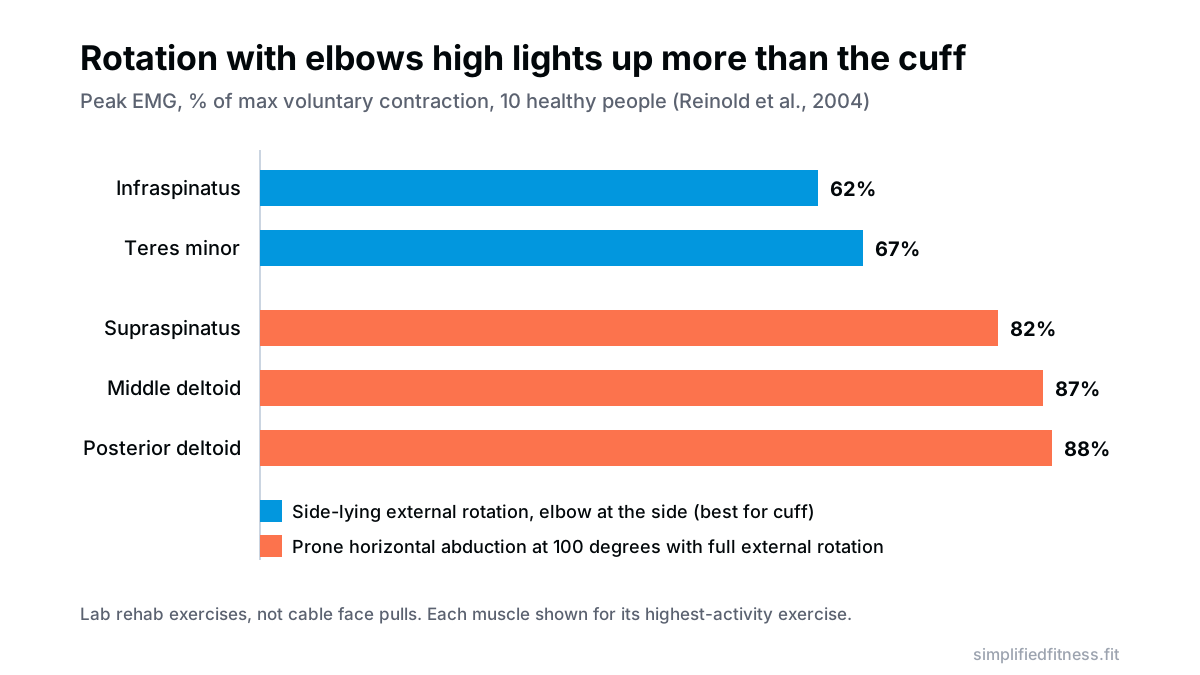
Why does that matter for you? The face pull’s finish, elbows high with the hands rotating back, looks a lot like that second exercise. So it plausibly hits the rear delts and the cuff together, which fits why people feel it in both places. That is a reasonable guess, not a measured fact for cables.
The takeaway is a trade-off. If you want maximum rotator cuff isolation, a face pull is not the cleanest tool, because high elbows invite the posterior deltoid. If you want a combined rear delt, cuff and upper back movement, the face pull is a sensible compromise. For more targeted cuff work, see rotator cuff strengthening and shoulder health.
Do face pulls fix posture?
This is the part most content overstates.
Scapular retraction, squeezing the shoulder blades back, matters in rowing and pulling patterns. An older EMG study of 9 healthy people identified rowing among the four exercises that make up a core scapular strengthening program, alongside scaption, push-up with a plus and press-up (Moseley et al., 1992). A review also notes that compared with scapular protraction, scapular retraction has been shown to increase subacromial space width and improve supraspinatus force production during elevation (Escamilla et al., 2009).
On the posture question itself, a 2024 meta-analysis of 22 studies in people with upper crossed syndrome found that therapeutic exercise, including strengthening, stretching and shoulder-based programs, was effective in improving forward head, rounded shoulder and thoracic kyphosis angles (Sepehri et al., 2024). Note what that does and does not tell us. It supports exercise in general, usually in programs that combine several things. It does not show that face pulls specifically fix posture.
My practical read: face pulls are a good part of a posture-friendly program, alongside rows, chest and lat mobility work, and not sitting hunched for eight hours. Do not expect one movement to change how you stand.
If you also want to understand the squeeze itself, our guide to scapular retraction versus depression explains what each cue does.
Should face pulls be heavy or light?
Both camps have a point, and the answer depends on your goal.
For rear delt growth, you want enough load that sets are challenging. A review of loading research argues that muscle adaptations can be obtained across a wide spectrum of loading zones, rather than only in a narrow “hypertrophy range” (Schoenfeld et al., 2021). For a small muscle like the rear delt, that supports sets of 12-20 reps taken close to failure with clean form.
For the rotation version, lighter is better. Heavy loads make you lean back, shrug and lose the rotation. Control matters more than the number on the stack.
A useful rule: if the pull would still look the same on rep 15 as on rep 1, the weight is right.
Where do face pulls fit in your week?
Think of them as a finisher or a warm-up primer, not a main lift.
- Sets and reps: 2-4 sets of 12-20 slow reps.
- Frequency: 2-3 times per week is realistic because they are light and recover quickly.
- Placement: end of push day to balance pressing, or end of pull day after rows. Our push day and pull day plans show where an exercise like this slots in.
- Progression: add reps first, then a small weight jump, and only when the rotation finish stays clean.
If your gym is crowded and the cable station is always taken, a resistance band anchored to a rack gives you a similar pattern for a few hundred rupees.
For comparing face pulls with the reverse pec deck and other rear delt choices, see rear delt training: reverse pec deck vs cables vs face pulls.
Common face pull mistakes
- Elbows dropping. When elbows fall below your hands, you lose the rear delt and rotation emphasis. Keep them high.
- Shrugging. Your upper traps take over. Lower the weight and think “shoulders away from ears.”
- Leaning back. Fix by stepping closer, ribs down, and glutes lightly braced.
- Using a straight bar. It blocks the rotation. Use a rope.
- Rushing the return. The slow return is half the exercise.
- Pain-pushing. A mild burn in the rear delts is normal. Sharp or pinching shoulder pain is not.
If face pulls or pressing leave you with a pinching shoulder, see subacromial impingement and lifting solutions for how to adjust training.
When to see a doctor
Sharp pain, pain at night, a clicking shoulder that catches, weakness, or numbness or tingling down the arm should be checked by a doctor or physiotherapist before you keep training through it. Face pulls are not a treatment for an injury, and this article cannot diagnose one.
The bottom line
Face pulls are a small exercise with an outsized reputation. Done well, with the cable at eye level, a rope, a still torso and elbows high, they train the rear delts, the external rotators and the upper back together. Choose the eye-level finish for rear delt growth and the rotate-back finish when you want more cuff and scapular control.
The research behind them is indirect: small studies of related movements in healthy people, not trials of the cable face pull. Be modest about the claims, keep the weight honest, and use them as a finisher, not a replacement for rows. If you want a plan that includes this lift, try the free training plans, and use the RIR and RPE calculator to judge how close to failure your sets are.
Frequently Asked Questions
How do you do face pulls properly?
Set a cable at about eye level with a rope, step back, and pull the rope toward your face with your elbows high. Finish with your hands beside your ears and your shoulder blades gently squeezed together. Use a light weight and control the return so your torso stays still.
Do face pulls build rear delts or fix posture?
They can do some of both, but the finish position decides the emphasis. Elbows wide and hands at eye level lean toward rear delts, while rotating the hands back leans toward the external rotators. Posture is influenced by many things, so treat face pulls as one useful tool, not a cure.
What height should the cable be for face pulls?
Eye level or slightly above is a good starting point for most people. It lets the rope travel on a line toward your face without you shrugging or leaning. If you feel your upper traps taking over, lower the pulley a notch or reduce the weight.
Should I pull to my eyes or my forehead?
Pull to eye or nose level for the rear delt version, and let your hands travel slightly higher and further back for the rotation version. The rope should move toward your face, not your chest. Try both on light sets and keep the one that gives you a clear squeeze in the back of the shoulders.
Are face pulls good for the rotator cuff?
They may help, since the rotation finish resembles external rotation work. However, research on cuff activity comes from rehab-style exercises, not cable face pulls. If you want focused cuff work, add a dedicated external rotation drill and see our rotator cuff guide.
How heavy should face pulls be?
Light to moderate, usually a weight you can move for 12-20 clean reps. Reviews on loading suggest muscle can grow across a wide range of loads when sets are taken close to failure. Stop the set when your elbows drop or your torso starts to rock.
How many sets and reps of face pulls should I do?
A solid starting point is 2-4 sets of 12-20 reps, 2-3 times per week. Small, high-rep movements recover quickly, so frequent practice is manageable. Add sets slowly if your rear delts and upper back keep progressing.
Can I do face pulls with a resistance band?
Yes. Anchor the band at eye level on a door or rack and use the same elbow-high path. Bands get harder at the end, which suits the squeeze and rotation finish. Choose a band that lets you hit 15 clean reps.
Why do face pulls hurt my shoulders or elbows?
Usually the weight is too heavy, the pulley is too low, or your elbows drop below your hands. Pain from technique errors may ease with lighter loads and a slower tempo. If pain is sharp, lasts after the session, or comes with numbness, stop and see a doctor or physiotherapist.
Are face pulls better than reverse pec deck flyes?
Neither is universally better, they are different tools. The reverse pec deck gives stable, easy-to-load rear delt work, while face pulls add a rotation and upper back element. Many lifters use one as the main rear delt exercise and the other as a lighter finisher.
Can face pulls replace rows?
No. Rows let you load the lats and mid-back heavily, which face pulls are not designed for. Face pulls work best as a supplement to rows and pulldowns. Keep your main pulling movements and add face pulls at the end.
Should I do face pulls on push day or pull day?
Either works, since they train the upper back and rear delts that balance pressing. Many people place them at the end of push day because pressing volume is high there. Put them wherever you will do them consistently.
Sources & References
Every claim above is checked against peer-reviewed research (PubMed, U.S. National Library of Medicine) or guidance from established health bodies. How we fact-check.
- Reinold MM, et al. Electromyographic analysis of the rotator cuff and deltoid musculature during common shoulder external rotation exercises. J Orthop Sports Phys Ther. 2004. PMID: 15296366
- Escamilla RF, et al. Shoulder muscle activity and function in common shoulder rehabilitation exercises. Sports Med. 2009. PMID: 19769415
- Ryan G, et al. Infraspinatus isolation during external rotation exercise at varying degrees of abduction. J Sport Rehabil. 2018. PMID: 28513278
- Lee D, et al. Changes in the electromyographic activities of the infraspinatus and posterior deltoid according to abduction angles of the shoulder joint during shoulder external rotation in closed kinetic chain exercise. J Phys Ther Sci. 2016. PMID: 27821927
- Moseley JB, et al. EMG analysis of the scapular muscles during a shoulder rehabilitation program. Am J Sports Med. 1992. PMID: 1558238
- Sepehri S, et al. The effect of various therapeutic exercises on forward head posture, rounded shoulder, and hyperkyphosis among people with upper crossed syndrome: a systematic review and meta-analysis. BMC Musculoskelet Disord. 2024. PMID: 38302926
- Schoenfeld BJ, et al. Loading recommendations for muscle strength, hypertrophy, and local endurance: a re-examination of the repetition continuum. Sports (Basel). 2021. PMID: 33671664

Umair Hazrami · Founder & Head Coach, Simplified Fitness
Umair Hazrami founded Simplified Fitness and the Simplified Lifter channel to cut through fitness noise. With 4+ years of consistent training and 10+ coaching clients, he writes every guide from the peer-reviewed research and links the sources so you can check them. Our editorial standards.
Educational content only, not medical advice. If you have a medical condition, are pregnant, or take medication, talk to a qualified doctor before changing your diet, supplements or training. Full disclaimer.
Keep reading
Exercise Technique
3D Shoulder Protocol: Weekly Volume, Frequency (2-3x/Week) and Rep Ranges
How to build 3D shoulders: how many weekly sets, how often to train side and rear delts, and which rep ranges to use, with an 8-week plan and the research.
8 min read

Exercise Technique
Are Front Raises Necessary? Why Bench Pressers Rarely Need Direct Front Delt Work
Are front raises necessary if you bench and overhead press? See what EMG and volume research says, when they can still help, and where to spend those sets.
8 min read

Exercise Technique
Behind-the-Neck Press: Shoulder Mobility, Neck Safety and Muscle Bias
Behind the neck press safety explained: who has the shoulder mobility for it, what EMG studies show for delts, and which swaps work if you do not.
10 min read

Exercise Technique
Cable Lateral Raises: Behind-the-Back vs Cross-Body Setup, Which Is Better?
Cable lateral raise behind the back vs in front: what the research says, which setup suits most lifters, and a step-by-step guide to pulley height and cuffs.
9 min read