Dumbbell Lateral Raise Hand Cues: Pouring the Pitcher Myth vs Neutral Wrist
Is the pouring the pitcher lateral raise myth true? See what MRI and EMG studies say about pinky up vs thumbs up, and the safest hand position for side raises.
TL;DR. The short answer
- Tilting the pinky up ('pouring a pitcher') is not proven to cause impingement in lifters, but in one MRI study it was the position that put the supraspinatus tendon in closest contact with the front edge of the acromion at 90 degrees.
- A neutral grip or thumbs slightly up is the safer default. It costs you little, and an ultrasound study found more subacromial room with external rotation when holding a load.
- A thumb-down, pinky-up raise (the 'empty can') did fire the middle deltoid harder in a 2007 EMG study (77% vs 52% of max). That is why the cue exists, but higher EMG has not been shown to mean more growth.
- Raise the arms slightly in front of the body (scapular plane), stop near shoulder height, and lead with the elbows. These matter more than the exact wrist angle.
- Pinching pain at the top of a raise that lasts more than a week or two, night pain, or weakness is a reason to see a physio or doctor, not to keep testing hand angles.
Part of our complete guide: Complete Shoulder, Delt & Neck Training Guide: 3D Deltoid Anatomy, Rotator Cuff & Traps
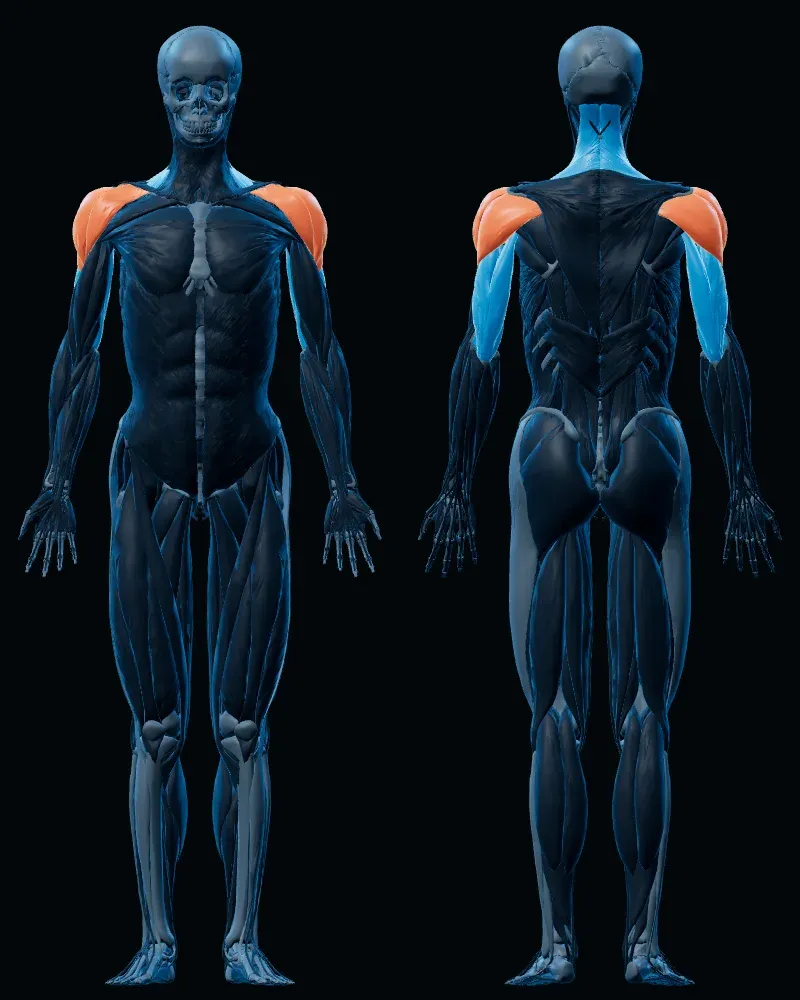
Muscles worked: shoulders
Main movers: all three heads of the deltoid
Assisting: supraspinatus, upper traps and triceps
Table of contents
The pouring the pitcher lateral raise myth says that tilting your pinky up, as if emptying a jug of water, is the “dangerous” way to do side raises. The honest answer is in between. No study shows the cue injures healthy lifters, but lab imaging does show it puts the rotator cuff tendon in a tighter spot, so a neutral grip or thumbs slightly up is the safer default.
This sits inside our complete shoulder and delt training guide. Here we only deal with one thing: what your hands should be doing, and what the research can and cannot tell you.
Where the “pouring the pitcher” cue came from
Old-school bodybuilding coaching said to tip the front of the dumbbell down, like pouring from a jug, so the lateral delt works harder. The idea was that rotating the arm inward shifts the load onto the side delt and away from the front delt and traps.
There is a kernel of truth in it, which we will get to. The problem is how the cue got sold: as a free upgrade with no downside. That part is not supported.
Why internal rotation raises the shoulder question
When you lift your arm to the side, the top of your upper arm bone passes under a bony roof called the acromion. The rotator cuff tendon (mainly the supraspinatus) and a fluid-filled bursa sit in that gap. Narrowing of that gap is one proposed reason for the pinching pain people call impingement or subacromial pain, although the exact causes are still debated.
Researchers measured this directly. A small MRI study of 12 healthy volunteers found that the minimal distance between the humerus and acromion shrank from about 7.0 mm at 30 degrees of abduction to 3.9 mm at 120 degrees (Graichen et al., 1999). So height matters before hand position does.
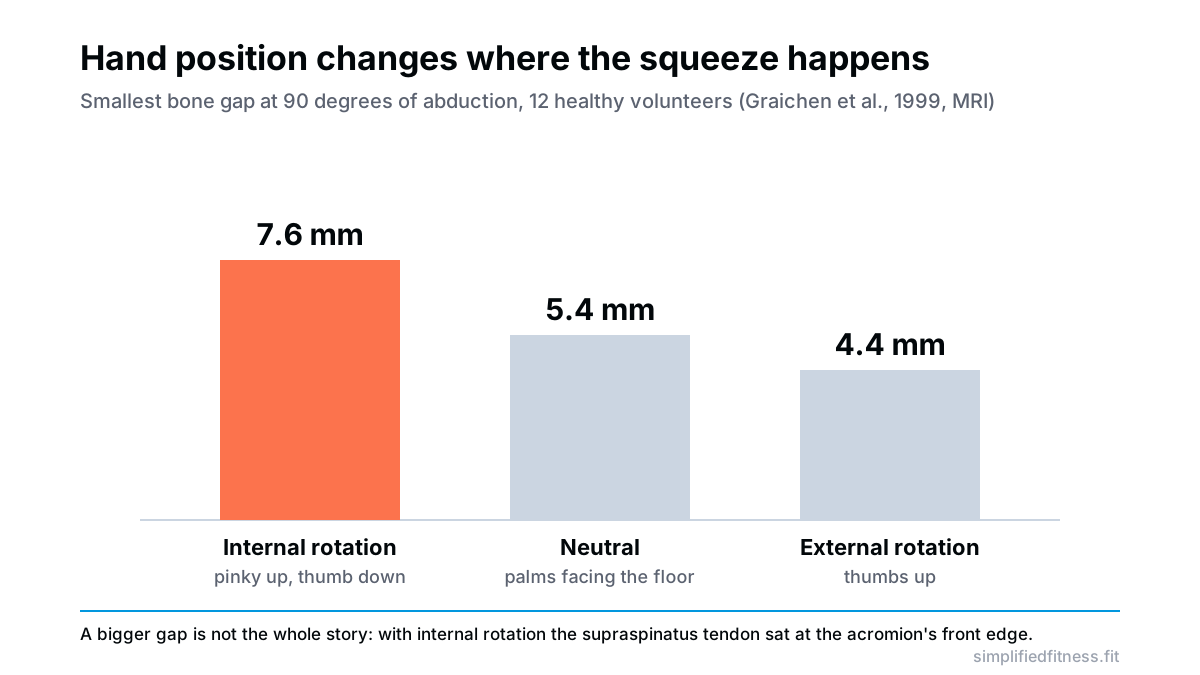
Then came the twist. At 90 degrees, the gap was 7.6 mm with internal rotation, 5.4 mm in neutral and 4.4 mm with external rotation. That is the reverse of what the myth’s critics usually claim. But the authors also noted that with internal rotation the closest point penetrated the supraspinatus tendon at its most vulnerable part, at the front-bottom edge of the acromion, and they described the tightest contact for the tendon as 90 degrees of abduction with about 45 degrees of internal rotation.
Pinky up vs thumbs up: what the studies actually found
Here is where the studies disagree, and why.
Study A (Graichen, MRI, unloaded): internal rotation gave the biggest bone gap but moved contact onto the tendon.
Study B (Longo, ultrasound, 25 healthy men): compared 90 degrees of abduction with no rotation, with maximal external rotation, and a higher upright-row position, with and without a 4 kg load. Holding the load, the space was larger with external rotation than neutral. Unloaded, neutral was smaller than external rotation (Longo et al., 2017). That study did not test internal rotation at all.
Why do they differ? Different imaging, different positions, and different questions. One measured the closest point of bone to bone on MRI, the other measured the subacromial space on ultrasound, and only one used a load. Neither study followed lifters for months to see who got hurt.
The broader review literature leans one way. A 2009 review in Sports Medicine reports that scapular internal rotation and anterior tilt, both of which narrow the subacromial space, are greater in the “empty can” (thumb down) than the “full can” (thumb up) scaption position, and that the full can carries less impingement risk (Escamilla et al., 2009). A 2018 modelling study in 20 people also found that the arm’s plane of elevation matters: the lowest modelled tendon compression occurred in flexion at lower elevation angles (Lawrence et al., 2018).
The takeaway is modest. Internal rotation is not proven harmful, but it is the position most associated with tendon contact, so there is little reason to default to it.
Why the cue exists: the middle deltoid trade-off
Here is the honest counterpoint. Pinky up does seem to make the delt work harder.
A fine-wire EMG study of 22 asymptomatic people compared raises in the scapular plane. Middle deltoid activity was 77% of maximum with the pinky-up (empty can) position and 52% with thumb up (full can). Supraspinatus activity was not statistically different (Reinold et al., 2007).
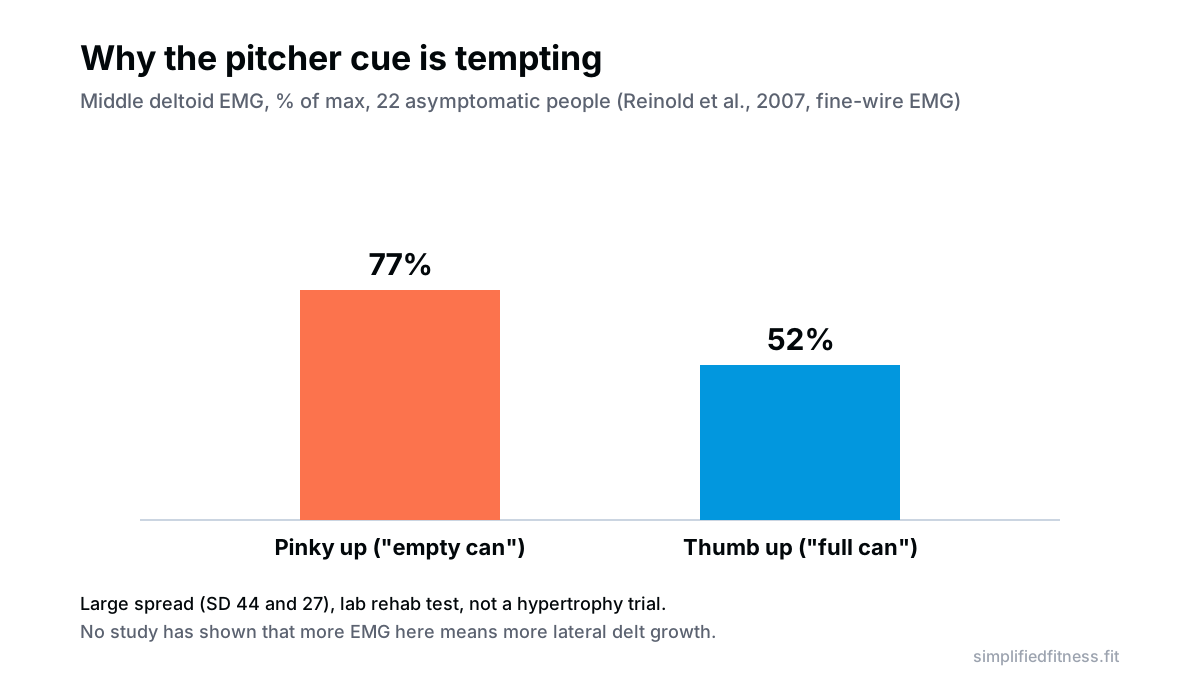
Before you rush to tilt your dumbbells, three caveats. The spread was big (77 plus or minus 44, versus 52 plus or minus 27). The people were not lifters doing 12 reps near failure. And EMG amplitude has not been shown to reliably predict how much a muscle grows.
Another small study of eight young men found that supraspinatus activity clearly exceeded the other shoulder muscles only in the thumb-up position, at the lighter load and low angles, in line with the idea that thumb up is a legitimate shoulder exercise, not a watered-down one (Yasojima et al., 2008). I would not hang much on eight people.
The safer cue: neutral or thumbs slightly up
So what do we do with all this? Here is what I would coach.
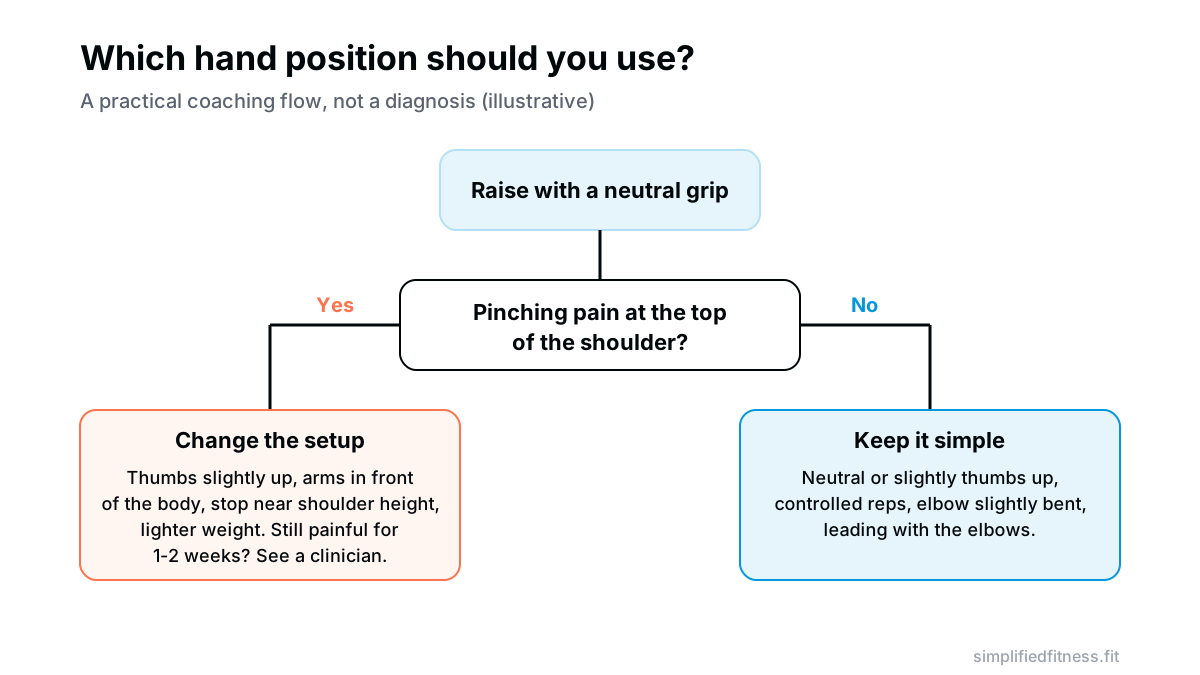
- Neutral wrist. Palms facing the floor or slightly toward each other, forearm in line with the wrist.
- Thumbs a touch higher than pinkies. Coaches often say 5-10 degrees. That number is a coaching rule of thumb, not a measured optimum, so treat it as “slightly up” not “exactly this angle.”
- Raise a few inches in front of the body. Think of the arms moving in a V, not a straight T. This is the scapular plane, and it is a comfortable place for most shoulders.
- Stop around shoulder height. The MRI data shows the space keeps closing as the arm goes higher, and there is no clear evidence you need to go higher to grow the lateral delt.
- Lead with the elbows. The hand follows. If the dumbbell rises faster than the elbow, you are doing a front raise with a wrist flick.
- Keep the elbow slightly bent and the traps quiet. Shrugging up is how most people cheat the raise.
The same logic applies to the equipment you pick. We compare the options in dumbbells vs cables vs machine lateral raises, and if you want the anatomy behind why the side delt does this job, see the three deltoid heads.
Is pinky up ever fine?
Possibly, for some people. If your shoulders feel great, you keep the weight moderate, you stay in front of the body and stop at shoulder height, then a bit of internal rotation is unlikely to be a problem. Evidence for harm in healthy lifters is lacking, not strong.
But there is a practical reason to avoid it anyway. If you ever develop a sore shoulder, a strongly internally rotated raise is one of the first things a physio is likely to change. Why build a habit you may need to unlearn?
When pinching pain is a doctor question, not a technique question
Impingement-type symptoms are common, and the research is more encouraging than most people expect. An umbrella review of 16 systematic reviews reported a strong recommendation for exercise therapy as the first-line treatment for subacromial shoulder pain (Pieters et al., 2020). A statement paper from the Danish sports physiotherapy society found that rehabilitation programmes including strengthening exercises reduced pain and disability in athletes with subacromial impingement, though the quality of evidence was very low to moderate (Liaghat et al., 2023).
That is why a sore shoulder does not mean “never lift again.” It does mean get it looked at when:
- pinching pain at the top of raises lasts more than one to two weeks;
- you wake up with night pain or cannot lie on that side;
- you notice weakness, a catching feeling, or pain that spreads down the arm;
- pain came on after a fall or a sudden pop.
A physio or sports doctor can test the shoulder properly. Nothing in this article can diagnose you.
For a deeper look at lifting around a cranky shoulder, read our guide to subacromial shoulder impingement and lifting solutions, and if you like high-pull movements, check upright row modifications. Strengthening the rotator cuff also helps; see rotator cuff strengthening for shoulder health.
How to put this into your push day
Pick one place in the week for lateral raises and do them the same way each session. Our free push day plan already slots them in. Use neutral or thumbs slightly up, 2-4 sets of 10-20 controlled reps with an elbow-led path, and stop each set a rep or two shy of form breakdown.
If you cannot tell how hard “a rep or two shy” is, the RIR and RPE calculator can help you calibrate. Then change one variable at a time (weight, reps or hand angle) and give it a few weeks.
What we still do not know
Honest limits. Every imaging study above used healthy volunteers, small samples and lab positions. None followed lifters over years. EMG studies measured short isometric or rehab-style sets, not hypertrophy training. So the best available statement is “internal rotation looks worse mechanically, with a small possible trade-off in delt activation,” not “the pitcher cue causes bursitis.” Anyone claiming certainty either way is going past the data.
Frequently Asked Questions
Does the pouring the pitcher lateral raise cause shoulder impingement?
There is no study showing it does in lifters, but there are good reasons to avoid it. MRI work in healthy volunteers found that at 90 degrees of abduction with internal rotation, the supraspinatus tendon sits at the front edge of the acromion. If you have no pain, a pinky-up raise is not a disaster, but a neutral grip gives you the same exercise with less to worry about.
Is pinky up or thumbs up better for lateral raises?
Thumbs slightly up or neutral is the safer choice, while pinky up may recruit the middle deltoid a little more. A 2007 EMG study found 77% of max middle deltoid activity with the pinky-up position versus 52% thumbs up, but it was measured in rehab-style raises, not hypertrophy training. Start neutral and only experiment with pinky up if your shoulders feel completely fine.
What is the best hand position for side raises?
A neutral grip with the thumb tilted slightly up is a sensible default, with the arms moving a little in front of the body. This keeps the humerus out of strong internal rotation, which one MRI study linked to the tendon sitting at the point of closest contact with the acromion. Try it with a lighter dumbbell for a few sessions and see how it feels.
How many degrees should my thumb be tilted on a lateral raise?
There is no research-backed number. The 5-10 degrees often quoted is a coaching rule of thumb meaning thumbs slightly higher than pinkies, not a measured optimum. Aim for a relaxed, near-neutral wrist and adjust by feel.
Why does my shoulder pinch at the top of a lateral raise?
Common reasons are lifting too heavy, swinging the weight, raising above shoulder height with the arms straight out to the sides, or letting the shoulder shrug up early. The subacromial space narrows as the arm goes higher, with one MRI study showing it shrinking from about 7.0 mm at 30 degrees to 3.9 mm at 120 degrees. Lower the weight, raise in front of the body and stop near shoulder height; if the pain persists, get it assessed.
Should I raise the dumbbells above shoulder height?
It is not necessary for most people, and it is where the subacromial space is narrowest. Stopping around shoulder height still trains the lateral delt through the range where most raises are coached. If you want to train higher ranges, see our guide to Lu raises, and only if your shoulders are pain free.
Are lateral raises bad for your shoulders?
Not inherently. Lateral raises are a light, low-load isolation exercise, and nothing in the studies cited here shows they injure healthy shoulders. Poor technique, too much weight and ignoring pain are the usual problems, so control the reps and keep the load honest.
What is the empty can vs full can position?
These are rehab terms for raising the arm in the scapular plane with the thumb down (empty can, internal rotation) or thumb up (full can, external rotation). A review reports that the full can position narrows the subacromial space less, and an EMG study found the empty can has more middle and posterior deltoid activity. The pitcher cue is basically an empty can raise.
Should I lead with my elbows or my hands on lateral raises?
Lead with the elbows. Thinking about lifting the elbows out and up keeps the tension in the delt instead of letting the wrists and traps take over. Imagine pushing your elbows toward the walls rather than throwing the dumbbells up.
Can I do lateral raises with shoulder impingement?
Sometimes, with changes, but this is a question for a physio. Exercise therapy is the first-line treatment for subacromial shoulder pain according to an umbrella review of 16 systematic reviews, and that includes carefully chosen shoulder work. Do not self-diagnose; get assessed and let the clinician pick the range and load.
Do cables or machines change the hand position problem?
Machines and cables let you set the hand and elbow path more easily, which can feel better on irritable shoulders. The same principles apply: stay a little in front of the body and avoid forcing a strong thumbs-down turn. Our comparison of dumbbells, cables and machines covers the trade-offs.
How heavy should lateral raises be to stay shoulder friendly?
Light enough that you can control the lowering phase and stop at shoulder height without shrugging or swinging. For most people that means choosing a weight you can lift for 10-20 clean reps. Chasing heavier dumbbells with sloppy form is a bigger shoulder risk than hand angle.
Sources & References
Every claim above is checked against peer-reviewed research (PubMed, U.S. National Library of Medicine) or guidance from established health bodies. How we fact-check.
- Graichen H, et al. Subacromial space width changes during abduction and rotation: a 3-D MR imaging study. Surg Radiol Anat. 1999. PMID: 10370995
- Longo S, et al. Ultrasound evaluation of the subacromial space in healthy subjects performing three different positions of shoulder abduction in both loaded and unloaded conditions. Phys Ther Sport. 2017. PMID: 27776926
- Reinold MM, et al. Electromyographic analysis of the supraspinatus and deltoid muscles during 3 common rehabilitation exercises. J Athl Train. 2007. PMID: 18174934
- Escamilla RF, et al. Shoulder muscle activity and function in common shoulder rehabilitation exercises. Sports Med. 2009. PMID: 19769415
- Yasojima T, et al. Differences in EMG activity in scapular plane abduction under variable arm positions and loading conditions. Med Sci Sports Exerc. 2008. PMID: 18317372
- Lawrence RL, et al. The effect of glenohumeral plane of elevation on supraspinatus subacromial proximity. J Biomech. 2018. PMID: 30172354
- Pieters L, et al. An update of systematic reviews examining the effectiveness of conservative physical therapy interventions for subacromial shoulder pain. J Orthop Sports Phys Ther. 2020. PMID: 31726927
- Liaghat B, et al. Diagnosis, prevention and treatment of common shoulder injuries in sport: grading the evidence. Br J Sports Med. 2023. PMID: 36261251

Umair Hazrami · Founder & Head Coach, Simplified Fitness
Umair Hazrami founded Simplified Fitness and the Simplified Lifter channel to cut through fitness noise. With 4+ years of consistent training and 10+ coaching clients, he writes every guide from the peer-reviewed research and links the sources so you can check them. Our editorial standards.
Educational content only, not medical advice. If you have a medical condition, are pregnant, or take medication, talk to a qualified doctor before changing your diet, supplements or training. Full disclaimer.
Keep reading
Exercise Technique
3D Shoulder Protocol: Weekly Volume, Frequency (2-3x/Week) and Rep Ranges
How to build 3D shoulders: how many weekly sets, how often to train side and rear delts, and which rep ranges to use, with an 8-week plan and the research.
8 min read

Exercise Technique
Are Front Raises Necessary? Why Bench Pressers Rarely Need Direct Front Delt Work
Are front raises necessary if you bench and overhead press? See what EMG and volume research says, when they can still help, and where to spend those sets.
8 min read

Exercise Technique
Behind-the-Neck Press: Shoulder Mobility, Neck Safety and Muscle Bias
Behind the neck press safety explained: who has the shoulder mobility for it, what EMG studies show for delts, and which swaps work if you do not.
10 min read
Exercise Technique
Cable Lateral Raises: Behind-the-Back vs Cross-Body Setup, Which Is Better?
Cable lateral raise behind the back vs in front: what the research says, which setup suits most lifters, and a step-by-step guide to pulley height and cuffs.
9 min read