Incline vs Flat Bench for Upper Chest: Which Angle Actually Works?
Incline vs flat bench upper chest: what EMG studies show for 0 to 60 degree angles, why around 30 is a sensible start, and how to set your bench up today.
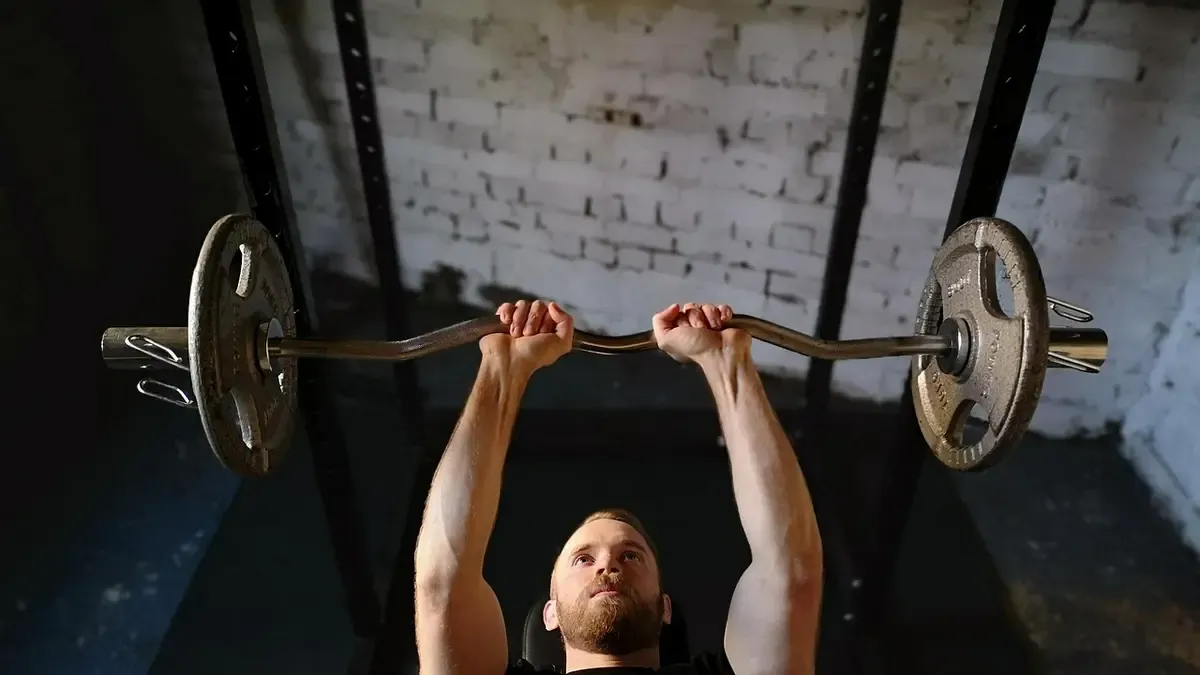
TL;DR. The short answer
- Incline pressing shifts muscle excitation toward the upper (clavicular) part of the pecs, while flat pressing favours the middle and lower (sternocostal) part. Both are useful, they are not interchangeable.
- In 30 trained adults, upper pec EMG peaked at 30 degrees, and angles above 45 degrees raised front delt activity and lowered pec performance. Other studies place the upper pec peak anywhere from about 30 to 45 degrees.
- A sensible starting point is a bench set to roughly 30 degrees. If you feel it mostly in your shoulders, lower it one notch.
- No long-term trial we found has compared bench angles for muscle growth. The best evidence is acute EMG and one short ultrasound study, so treat exact angles as a starting point, not a law.
- Most lifters do better using both: a flat or low-incline press plus a 30 degree incline press across the week.
Part of our complete guide: Muscle Length, Range of Motion and Stretch-Mediated Hypertrophy: What the Research Actually Shows
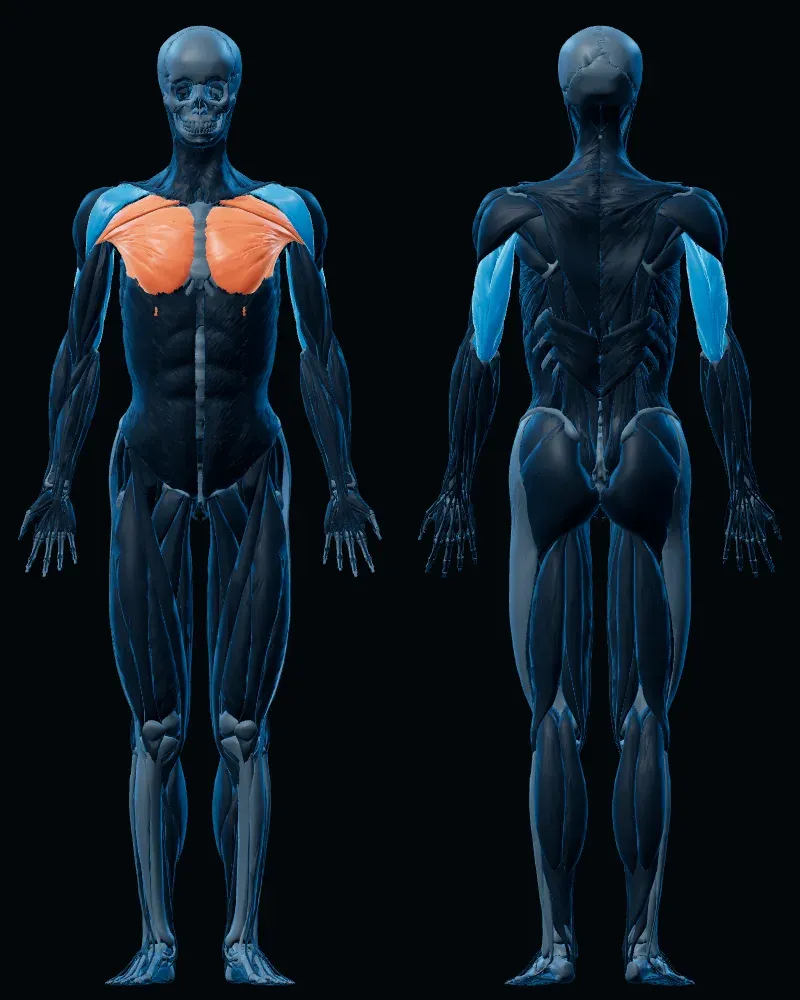
Muscles worked: chest
Main movers: pectoralis major
Assisting: front delts and triceps
Table of contents
For the upper chest, an incline press does seem to beat a flat bench, but only up to a point. Studies in trained lifters find that incline pressing excites the upper (clavicular) part of the pecs more, flat pressing favours the middle and lower part, and very steep angles hand the work to your front delts.
So the incline vs flat bench upper chest debate is not really either/or. This article sits under our guide to range of motion and stretch-mediated hypertrophy, and it focuses on one practical question: which angle should you actually set the bench to? If you want the full anatomy first, read pectoralis major functional anatomy.
Why does bench angle change which part of the chest works?
Pectoralis major is one muscle with two main heads. The clavicular head (upper chest) attaches near your collarbone and its fibres run down and across toward the upper arm. The sternocostal head (middle and lower chest) attaches along the breastbone and ribs and runs more horizontally.
Muscles do their best work when force lines up with fibre direction. When you press flat, the bar path lines up better with the sternocostal fibres. Tilt the bench back and the pressing direction moves up and away from your hips, which lines up better with the clavicular fibres. That is a simple mechanical reasoning, and the EMG data fit it.
One high-density EMG study put electrodes along 15 regions of the pec while 8 volunteers did flat and 45 degree incline presses at 50% and 70% of 1RM. The centre of EMG activity shifted toward the clavicular region on the incline, and sat over the sternocostal region on the flat bench (Cabral et al., 2022). The sample was small, but the method was careful, and the authors argue that this kind of sampling problem may help explain why older single-electrode studies disagreed.
What do EMG studies say about 0, 15, 30, 45 and 60 degrees?
The cleanest comparison used five angles in 30 trained adults at 60% of 1RM. Upper pec activity peaked at 30 degrees. Middle and lower pec activity was higher flat. Front delt activity was highest at 60 degrees, and angles above 45 degrees both raised front delt activity and lowered pec performance (Rodriguez-Ridao et al., 2020).
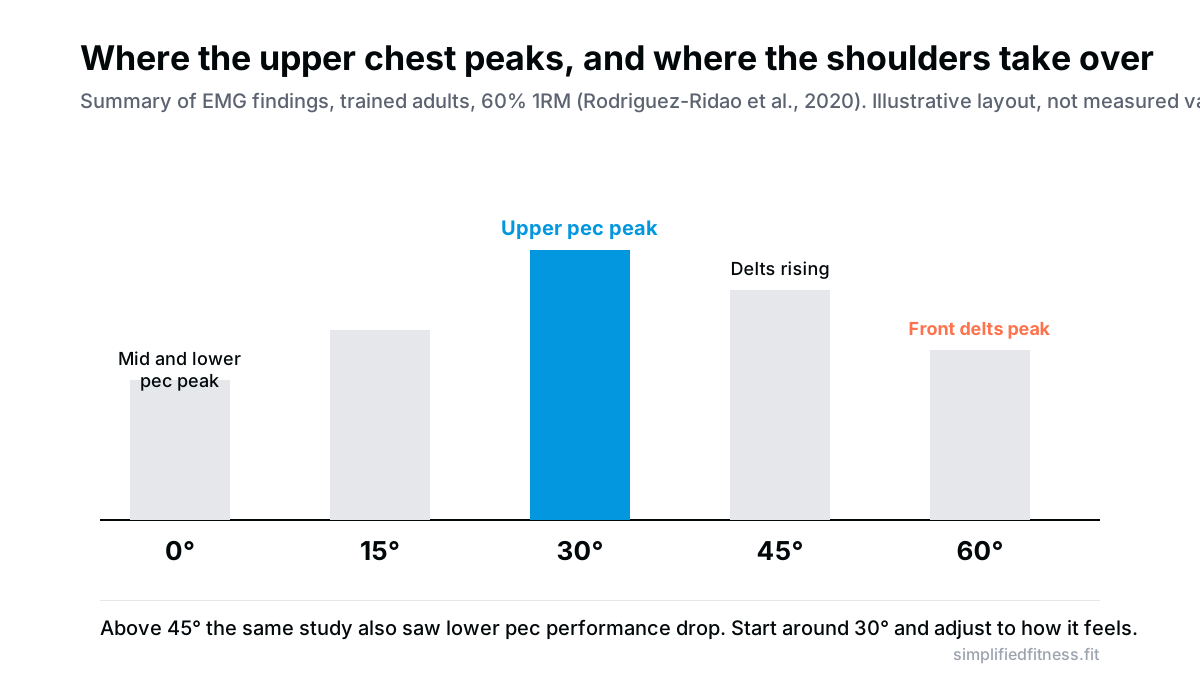
Other studies broadly agree on direction but not on the exact number.
| Study | Who | Angles | What it found |
|---|---|---|---|
| Rodriguez-Ridao et al., 2020 | 30 trained adults | 0, 15, 30, 45, 60 degrees | Upper pec peak at 30 degrees; flat best for mid and lower pec; front delts peak at 60 degrees |
| Trebs et al., 2010 | 15 healthy men | 0, 28, 44, 56 degrees | Clavicular head higher at 44 and 56 than flat, and at 44 than 28; front delts higher at all inclines than flat |
| Lauver et al., 2016 | 14 resistance trained men | -15, 0, 30, 45 degrees | No difference in upper pec over the whole lift; 30 and 45 degrees higher than flat in the 26-50% window of the push |
| Coratella et al., 2020 | 10 competitive bodybuilders | Flat, 45 degrees, -15 degrees, machine | Clavicular head most excited on the 45 degree incline; sternocostal head higher flat |
Why do the studies disagree on 15, 30 and 45 degrees?
Because they are different experiments. Three differences matter most:
- Electrode placement. Single surface electrodes sample a small patch of a large, fan-shaped muscle. Cabral and colleagues argue that this contributes to contradictory results across the literature.
- Phase of the lift. Lauver found the incline advantage showed up in part of the concentric phase, not across the whole rep.
- Load, sample and technique. Percent of 1RM, rep tempo, grip, scapular position and whether people were bodybuilders or recreational lifters all shift the numbers.
That matters for the claim you may have seen online that “15 to 30 degrees is optimal.” Trebs found a 28 degree press did not raise clavicular activation over flat, but 44 degrees did. Rodriguez-Ridao found the peak at 30. Reading these together, the honest answer is a zone of roughly 30 to 45 degrees, with 30 degrees the most defensible starting point because it keeps front delt contribution lower. We found no study showing 15 degrees is better than 30 for the upper chest.
Does incline press build more upper chest than flat bench?
This is where the evidence runs thin. We did not find a long-term training trial that compared bench angles for muscle growth. What exists is acute work.
One study combined EMG with panoramic ultrasound in 13 men doing four sets of flat and 45 degree incline presses. Right after the incline sets, the clavicular head showed a greater increase in cross-sectional area than the sternocostal head, and after flat sets the sternocostal head showed the greater increase (Albarello et al., 2022). Part of that immediate change is likely swelling from training, so it shows that the regions are loaded differently, not that they grow differently over months.
So the reasonable inference is this: if different regions are stressed more by different angles, using both angles should cover more of the muscle. That is a hypothesis built on acute data, and I would hold it loosely.
What happens to the shoulders as the bench gets steeper?
Front delt activity climbs with incline. In Trebs and colleagues, the anterior deltoid was more active at 28, 44 and 56 degrees than on a flat bench (Trebs et al., 2010). In the five-angle study it peaked at 60 degrees. And in Coratella’s bodybuilders, the 45 degree incline excited the clavicular head most but the sternocostal head less than a flat press (Coratella et al., 2020).
You do not need to fear the front delts, since they are a legitimate pressing muscle. The issue is when they dominate and the chest becomes a passenger. At steep angles the lift starts to look like an overhead press, which is a fine exercise but a different one. See our chest training guide for how a full chest week fits together.
How to set up an incline press for the upper chest
The research gives you the angle. Setup decides whether you actually use it.
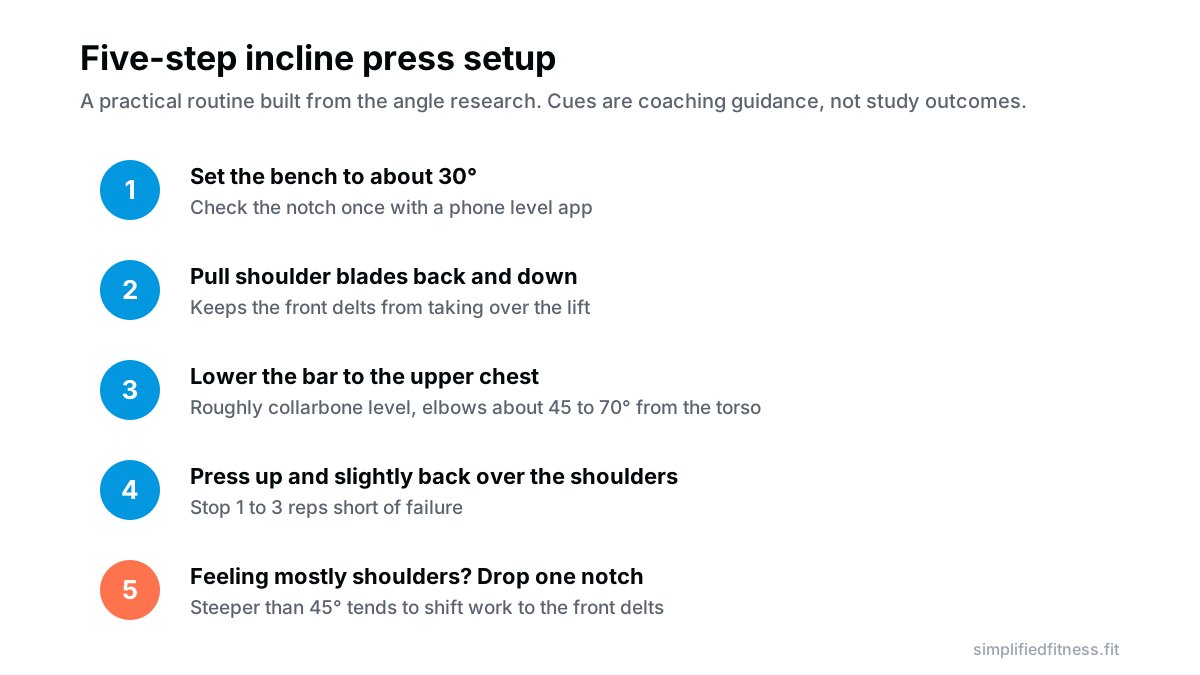
Most gym benches do not label their notches with exact angles, and the same notch can sit at a different angle on different benches. If you can, use your phone’s level app once to learn which notch is closest to 30 degrees on your gym’s bench, then remember it.
A few cues that help the pec do more of the work:
- Pull your shoulder blades back and down before you unrack, and keep them there.
- Lower the bar or dumbbells to roughly collarbone to upper chest level, with elbows tucked at a moderate angle, not flared at 90 degrees.
- Control the lowering for about 2 seconds and press with a steady drive.
- Finish most sets with 1-3 reps in reserve. Our RIR and RPE calculator helps if you are unsure how close to failure you are.
Barbell or dumbbell? Both change the bar path a little. We compare them in dumbbell vs barbell pressing and pec recruitment and look at dumbbell-specific angles in incline dumbbell press angle comparison.
How should I combine flat and incline pressing?
Pick based on your goal.
- Balanced chest growth: one flat or low-incline press session and one 30 degree incline session each week, so each head gets hit twice.
- Upper chest lagging: make the 30 degree incline press your first exercise and keep flat work as a second or third. For the full guide, see upper chest training and the clavicular pec.
- Shoulder discomfort on flat bench: a 30 degree incline with dumbbells is often more comfortable, and we cover related fixes in shoulder pain on bench press.
How many sets? A meta-analysis found a graded relationship where more weekly sets tended to bring more growth (Schoenfeld et al., 2017), so a sensible starting point for most lifters is around 8-12 hard chest sets per week, spread over two sessions, adding more only if progress stalls. Use our training volume calculator to count what you are doing now, and our push day plan for a ready-made layout. If you are unsure how limits of the flat press fit into this, read flat barbell bench press limitations.
What the evidence cannot tell you yet
Be careful with exact numbers. Most of the data come from young, trained men, usually in single sessions. We do not have long-term trials of bench angle on growth, little data in women, and almost none in older lifters. Individual anatomy (clavicle length, rib cage shape, shoulder mobility) probably shifts your own best angle by some margin.
If you have shoulder pain that does not settle, numbness, or pain at night, see a doctor or physiotherapist rather than just changing the bench angle.
The bottom line
Flat pressing loads the middle and lower pec more. Incline pressing around 30 degrees loads the upper pec more, and steeper than 45 degrees swaps pec work for front delt work. Use both across the week, start at 30 degrees, and let how it feels guide a one-notch adjustment. Then keep adding reps or load over the weeks, because progress matters more than a perfect angle.
Frequently Asked Questions
Is incline bench better than flat bench for upper chest?
For the upper chest specifically, incline pressing appears to be better. EMG studies in trained lifters find the upper (clavicular) pec is excited more on an incline, while the middle and lower pec is excited more on a flat bench. Use an incline press as your main upper chest lift and keep a flat or low-incline press for the rest of the chest.
What is the best bench angle for upper pecs?
Around 30 degrees is a sensible starting point. In a study of 30 trained adults, upper pec EMG peaked at 30 degrees, though other studies found similar or higher upper pec activity at 44 to 45 degrees. Try 30 degrees first, then adjust by one notch based on where you feel the work.
Is 45 degrees too steep for an incline press?
It can be, depending on your shoulders and setup. At 45 degrees upper pec activity is still high in several studies, but front delt activity rises too, and above 45 degrees pec performance dropped in one study. If your shoulders do most of the work at 45, move down to 30 degrees.
Is 15 degrees enough to hit the upper chest?
A 15 degree incline is a mild shift and the evidence for it is thin. In the five-angle study, the biggest upper pec response came at 30 degrees, and one older study found a 28 degree incline did not significantly raise upper pec activity over flat. Low inclines are fine for general chest work, but 30 degrees is the safer pick for upper chest emphasis.
Does incline bench build upper chest or just front delts?
Both are involved, and the balance depends on the angle. Front delt EMG rises as the bench gets steeper, but upper pec activity also rises at moderate angles. Keeping the angle around 30 degrees and your shoulder blades set back helps keep the pecs working.
Can the upper chest grow from flat bench alone?
Probably yes to some extent, since the whole pec works on a flat press. The sternocostal fibres take more of the load flat, so the upper portion may get less stimulus than on an incline. If upper chest is a weak point, add an incline press instead of relying on flat alone.
Is the upper chest a separate muscle?
No. It is the clavicular head of pectoralis major, one of two heads of the same muscle. Studies show the heads can be excited differently depending on bench angle, which is why we talk about the upper chest as a region. You cannot isolate it completely, only shift emphasis.
Should I use a barbell or dumbbells on the incline?
Either works. Dumbbells let you adjust your wrist and elbow path and often feel better on the shoulders, while a barbell makes it easier to load heavy. Pick the one you can control through a full range of motion and progress over time.
How many sets of incline press do I need per week?
There is no proven number for incline work specifically. A sensible start is a few hard sets of incline pressing within roughly 8-12 hard chest sets per week, since more weekly sets tend to bring more growth up to a point. Split them across two sessions if you can. If the upper chest lags, shift more of your chest sets to the incline rather than adding sets on top.
Does the incline press hurt my shoulders more than flat?
It can feel harder on the shoulders for some people because the front delts do more work as the angle rises. There is no strong evidence that incline pressing is inherently riskier, but pain is a signal to change something. Lower the angle, narrow your grip slightly, or switch to dumbbells, and see a clinician if pain persists.
How steep should the bench be if I use a Smith machine or machine press?
The same angle logic applies, but the fixed bar path changes how it feels. Start near 30 degrees and adjust by feel. Machine and free-weight presses also excite the chest differently, so do not assume numbers from one transfer exactly to the other.
Do I need to change the angle if I am short or tall?
Body proportions change how an angle feels even though the research angles are the same. Torso length, arm length and shoulder mobility all shift where the bar travels. Treat 30 degrees as the start and adjust by one notch until the upper chest, not the shoulder, takes the work.
Sources & References
Every claim above is checked against peer-reviewed research (PubMed, U.S. National Library of Medicine) or guidance from established health bodies. How we fact-check.
- Rodriguez-Ridao D, et al. Effect of five bench inclinations on the electromyographic activity of the pectoralis major, anterior deltoid, and triceps brachii during the bench press exercise. Int J Environ Res Public Health. 2020. PMID: 33049982
- Trebs AA, et al. An electromyography analysis of 3 muscles surrounding the shoulder joint during the performance of a chest press exercise at several angles. J Strength Cond Res. 2010. PMID: 20512064
- Lauver JD, et al. Influence of bench angle on upper extremity muscular activation during bench press exercise. Eur J Sport Sci. 2016. PMID: 25799093
- Cabral HV, et al. Non-uniform excitation of the pectoralis major muscle during flat and inclined bench press exercises. Scand J Med Sci Sports. 2022. PMID: 34644424
- Albarello JCDS, et al. Non-uniform excitation of pectoralis major induced by changes in bench press inclination leads to uneven variations in the cross-sectional area measured by panoramic ultrasonography. J Electromyogr Kinesiol. 2022. PMID: 36334406
- Coratella G, et al. Specific prime movers' excitation during free-weight bench press variations and chest press machine in competitive bodybuilders. Eur J Sport Sci. 2020. PMID: 31397215
- Schoenfeld BJ, et al. Dose-response relationship between weekly resistance training volume and increases in muscle mass: a systematic review and meta-analysis. J Sports Sci. 2017. PMID: 27433992

Umair Hazrami · Founder & Head Coach, Simplified Fitness
Umair Hazrami founded Simplified Fitness and the Simplified Lifter channel to cut through fitness noise. With 4+ years of consistent training and 10+ coaching clients, he writes every guide from the peer-reviewed research and links the sources so you can check them. Our editorial standards.
Educational content only, not medical advice. If you have a medical condition, are pregnant, or take medication, talk to a qualified doctor before changing your diet, supplements or training. Full disclaimer.
Keep reading
Hypertrophy
Active vs Passive Insufficiency: How Two-Joint Muscles Change Your Exercise Choice
Active vs passive insufficiency explained for lifters: why hamstrings, triceps, quads and calves grow differently depending on your second joint position.
10 min read
Hypertrophy
Squat Mobility With Long Femurs: Adapting Range of Motion to Your Hips
Squat mobility with long femurs is mostly a lever and hip-socket issue, not a flaw. Learn how to adjust depth, stance and heels without risking your hips.
10 min read
Hypertrophy
Dumbbell Pullovers vs Cable Lat Pull-ins: Training Lats at Long Muscle Lengths
Training lats at long muscle lengths: is the dumbbell pullover a lat or chest exercise, and why a cable lat pull-in may keep tension where you want it.
7 min read
Hypertrophy
Full vs Partial Range of Motion: What the Hypertrophy Research Shows
Full vs partial ROM hypertrophy explained: what two meta-analyses and recent trials found, where lengthened partials fit, and how to set your range of motion.
8 min read