Lengthened Partials Explained: How to Do Them, What the Research Says
Lengthened partials hypertrophy guide: what 2020-2025 trials show about stretched-position reps, how to do them safely, and where to add them in your program.

TL;DR. The short answer
- Lengthened partials are reps done only in the stretched half of an exercise. In trained people, an 8-week trial found they grew arm muscle about as well as full range of motion.
- They are not a magic upgrade. The big 12-week trial (297 participants) found arm and thigh muscle area changes were practically equivalent to full range of motion.
- They shine on exercises where the top half adds little tension, such as calf raises, and as extra reps after failure. Evidence for back, chest and big compound lifts is thinner.
- A practical start is one or two exercises per muscle, done in the bottom half with control, or 3-6 stretched-half reps after a full-range set on a stable machine or cable.
- Stop if you feel sharp or pinching pain, especially at the shoulder, knee or hamstring. Persistent pain is a reason to see a doctor or physio.
Part of our complete guide: Muscle Length, Range of Motion and Stretch-Mediated Hypertrophy: What the Research Actually Shows
Table of contents
Lengthened partials are reps done only in the stretched half of an exercise, and the research on lengthened partials hypertrophy is more nuanced than the gym hype. In trained lifters they seem to build muscle about as well as full range of motion, and they may have an edge on some muscles, like the calves. They are a useful tool, not a replacement for everything else. This is the practical side of the topic; for the big picture, see our guide to range of motion and stretch-mediated hypertrophy.
What are lengthened partials?
Take a dumbbell curl. The bottom of the rep, arm nearly straight, is where the biceps is longest. The top is where it is shortest. A lengthened partial keeps the rep in that bottom zone: lower into the stretch, come up about halfway, lower again.
Same idea for a calf raise (heel deep, then up halfway) or a pulldown (arms fully overhead, then pull partway).
There are two common ways to use them:
- Integrated: the whole set is done in the stretched half.
- Extended: you reach failure with full reps, then keep going with stretched-half reps.
Neither is a “half rep” in the lazy sense. Cutting a rep short because the weight is too heavy is different. A planned lengthened partial is about the position where the muscle is loaded hardest.
Why would the stretched position matter?
The leading idea is that muscle may respond well to tension at long lengths. Some of the supporting data comes from head-to-head comparisons of long and short lengths. In one 12-week study of 20 adults, seated leg curls (hamstrings longer) grew the whole hamstring group more than prone curls (+14% vs +9%) (Maeo et al., 2021). In another, overhead cable triceps extensions grew the whole triceps more than neutral-arm ones (+19.9% vs +13.9%) in 21 adults, even with lower loads (Maeo et al., 2023).
Those studies compared exercises, not partial reps, but they fed the idea that the stretched range is a good place to put work. We cover the mechanism in long muscle length training.
Do lengthened partials work as well as full range of motion?
The most direct evidence is recent, and it points to “about equal” in most cases.
In trained lifters. An 8-week trial gave 30 resistance-trained people lengthened partials for one arm and full range of motion for the other (same sets and effort otherwise). Elbow flexor and extensor thickness grew similarly, with Bayes factors giving moderate support for no difference (Wolf et al., 2025). The authors concluded that trainees should likely emphasize the stretched position, whether through full range or partials.
In a larger group. A pre-registered 12-week trial across 15 sites compared lengthened partials (n = 163) with full range (n = 134). Differences in arm and thigh muscle area were small and practically equivalent (Gschneidner et al., 2025). The authors noted they could not strictly rule out differences at their statistical threshold for the arm, but the estimates were close to zero.
In reviews. A 2023 systematic review of 11 studies found that training at longer muscle lengths, through either partial or full range, tended to give better growth in muscles like the quadriceps, biceps and triceps (Kassiano et al., 2023). Full range did better for the glutes and adductors than partials in the final part of the range. An earlier review concluded full range helped lower-body growth more, while upper-body evidence was limited and conflicting (Schoenfeld and Grgic, 2020).
Why do they differ? The studies used different muscles, loads, exercises and ways of defining “partial”. The takeaway: stretched-position work matters, and how you get there matters less.
Which muscles have the best support?
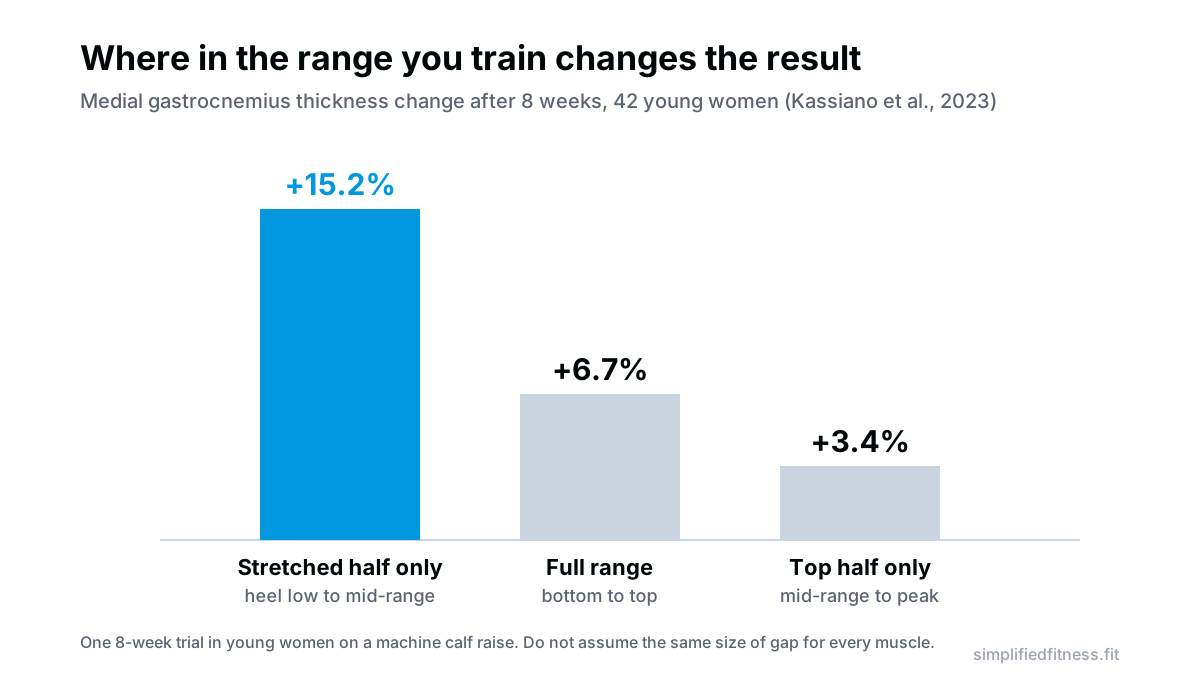
Calves have the clearest signal. In a 2023 trial, 42 young women trained calf raises for 8 weeks in one of three ranges. Stretched-half-only reps grew the medial gastrocnemius by 15.2%, versus 6.7% for full range and 3.4% for top-half reps (Kassiano et al., 2023).
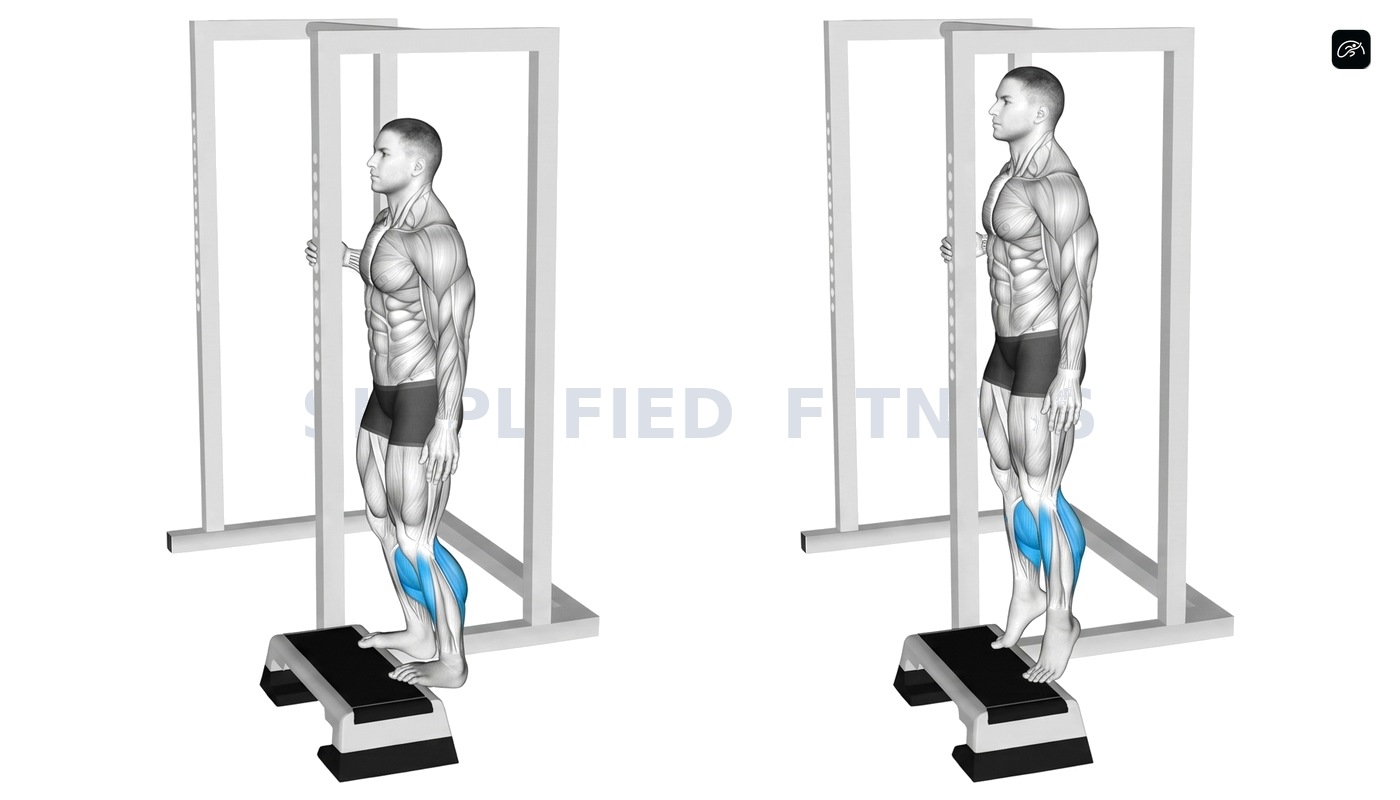
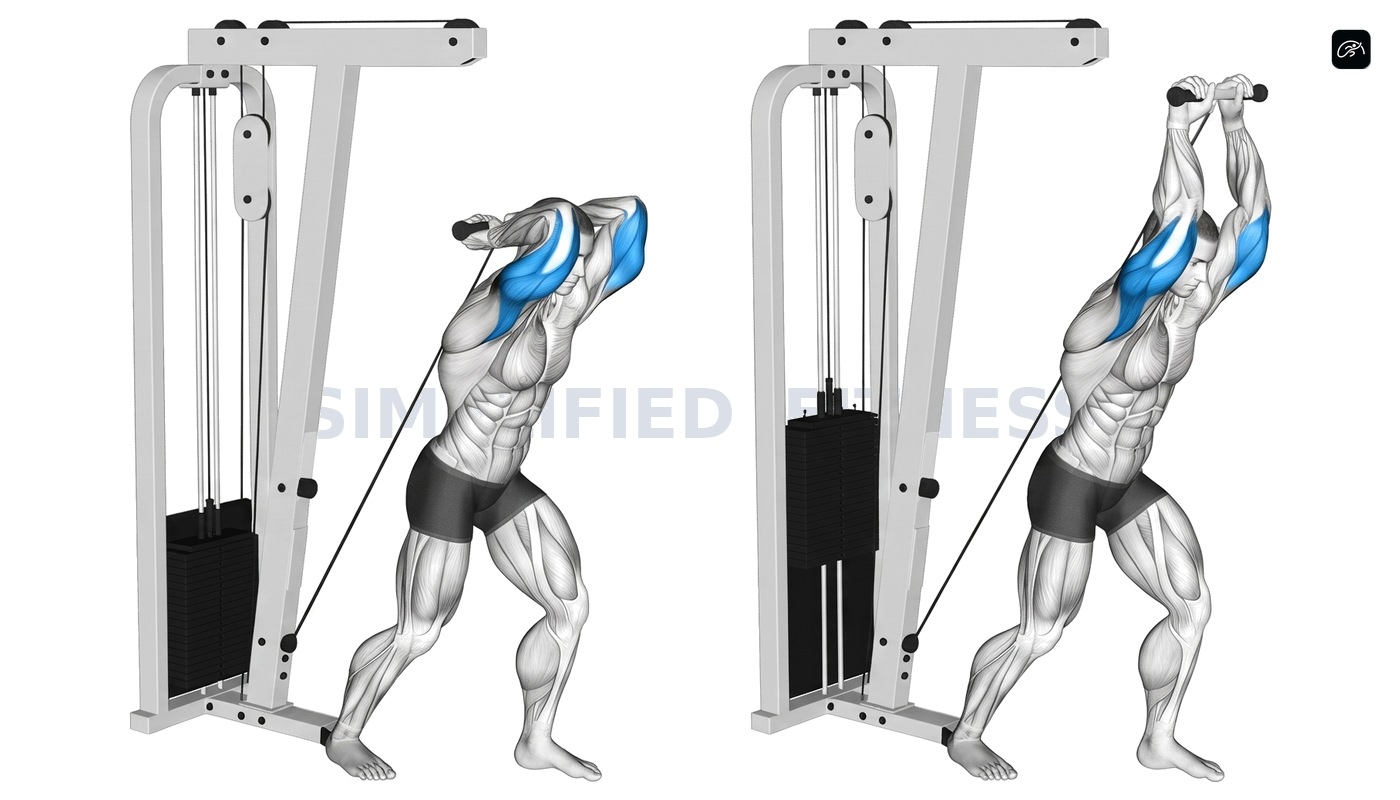
Arms look about equal between partials and full range in trained people, per the 8-week trial above. Overhead triceps work shows the stretched position matters even when the load is lower.
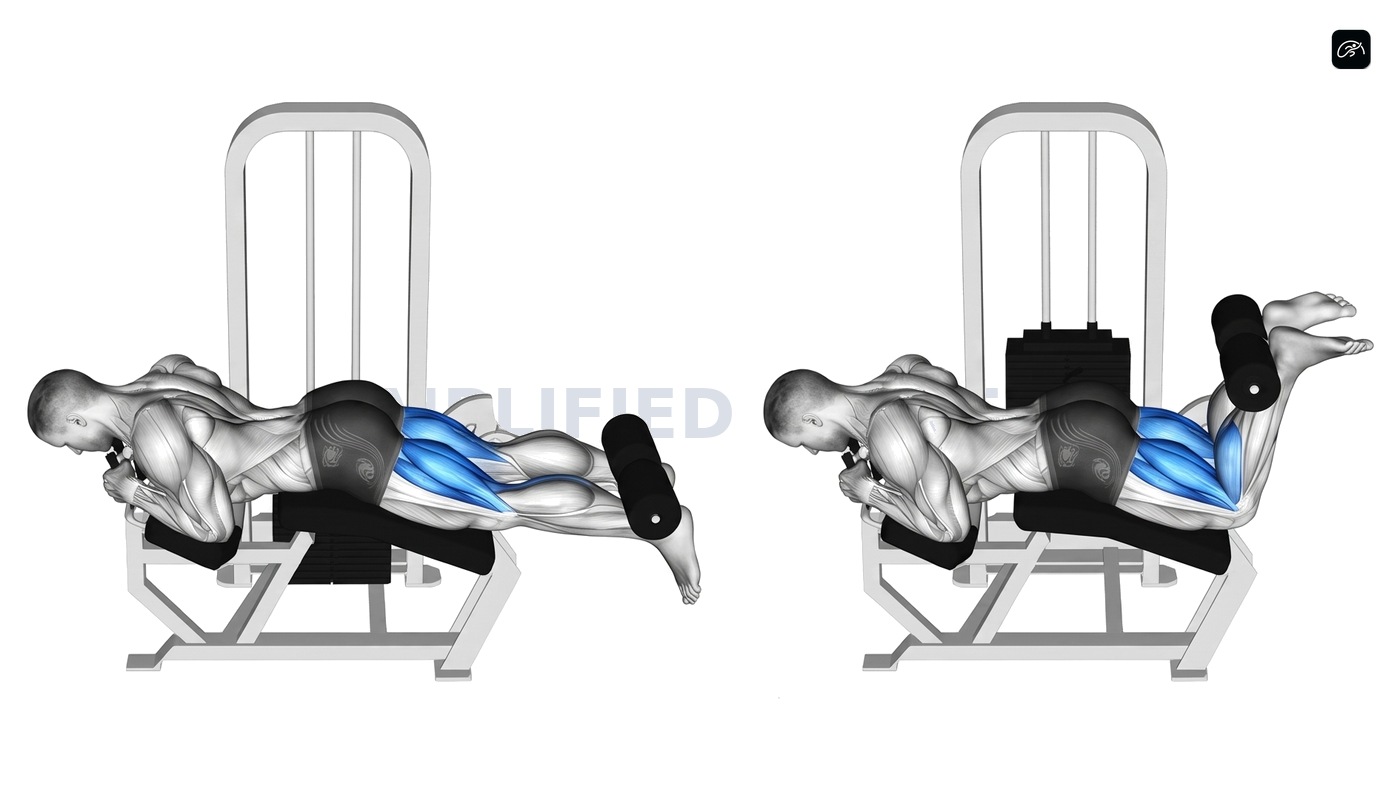
Hamstrings and quads have long-length support from exercise-selection studies, like the seated leg curl results.
Back and chest are the gaps. Few controlled trials have studied partials there, so be more tentative.
Lengthened partials after failure: do they add anything?
Here the evidence is mixed. In a 10-week study of 23 untrained men, adding past-failure partials in the lengthened position to calf raises led to more medial gastrocnemius growth (+9.6% vs +6.7%) (Larsen et al., 2025). A 2026 trial in 16 untrained men gave one leg full-range failure sets and the other half as many sets plus partials beyond failure. Total volume load was matched, and both legs grew about the same (8% on average), so the partials leg got there in half the sets (Goli et al., 2026).
So: extra partials might help, or might just let you do the same job in fewer sets. Both studies were in untrained men and only on calves, so be careful extending them to trained lifters or other muscles.
How to do lengthened partials step by step
- Pick the right exercise. Machines and cables keep tension at the bottom. Free weights can lose it.
- Set a deep but pain-free stretch. You should feel load in the target muscle, not a pinch in a joint.
- Lower slowly, about 2-3 seconds. Do not bounce out of the bottom.
- Come up through the lower half only. Stop before the muscle is fully shortened.
- Keep reps in a normal range. Roughly 8-15 reps with 1-3 reps left in reserve on early sets. Use our RIR and RPE calculator if you are unsure how close to failure you are.
- Track the load and reps. If load or reps keep creeping up over weeks, that is a reasonable sign the exercise is doing its job.
How to program lengthened partials
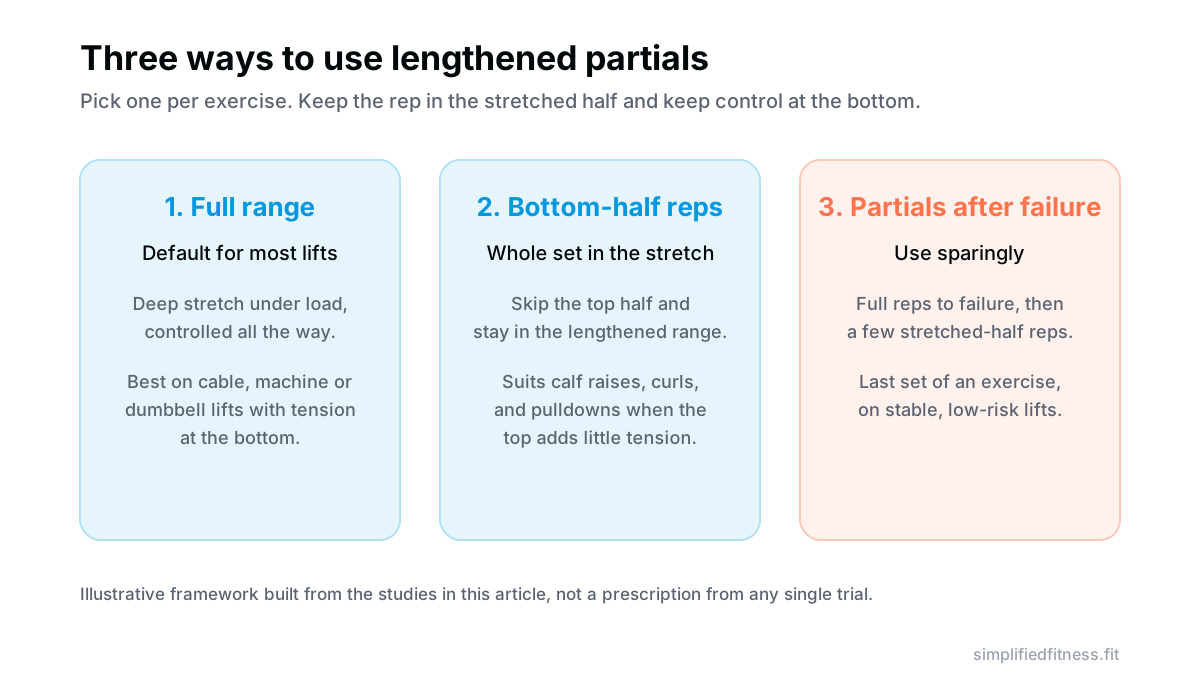
A simple starting plan:
- Keep your main compound lifts in full range.
- Choose 1-2 isolation exercises per muscle, such as calf raises, leg curls or cable curls, and do bottom-half reps for 2-3 sets.
- On the last set of one of them, add 3-6 stretched-half reps after failure.
- Keep total weekly sets in a sensible range. Our training volume calculator can help you check.
If you want a done-for-you structure, our push pull legs plan and the leg day plan give you a base to add partials to.
Injury prevention and when to avoid partials
A loaded stretch is not harmless. Be careful when:
- You feel sharp, pinching or catching pain at the shoulder, knee, hip or hamstring.
- You are coming back from a muscle or tendon injury.
- The exercise needs balance at the bottom, like heavy free-weight deadlift variations.
- Soreness is lasting more than 3-4 days.
Start lighter than you think. Add range and load over several weeks. If pain persists or is sharp, stop and see a doctor or physiotherapist rather than pushing through.
Common mistakes with lengthened partials
The most common mistake here is turning a controlled stretched rep into a bouncing half rep. If the weight rebounds off the bottom, you lose the controlled loaded stretch you were after and put more stress on the joint. The second is loading too much, so the stretch is short and shaky. The third is ignoring everything else: a partial does nothing if your sets are far from failure or your weekly protein is low.
Also remember that most trials were short, and many used machines or cables. Heavy barbell lifts such as squats and deadlifts have different demands, so treat the evidence there as unproven.
Where this fits with other topics
Full-range and partial comparisons are covered in our full vs partial range of motion review. For exercise swaps that bring in more stretch, see seated vs lying leg curls, straight-leg vs bent-knee calf raises and overhead cable triceps extensions vs pushdowns.
The bottom line
Lengthened partials work, but they are not a shortcut. In trained lifters they performed about the same as full range, and one calf trial hints they may help more where the top of the rep adds little. Use them as a controlled tool on a few exercises, protect your joints, and keep total effort, protein and sleep in order. For Indian lifters on vegetarian diets, that means dal, paneer, curd and soya doing the protein work while you train; check your target with the protein calculator.
Frequently Asked Questions
What are lengthened partials?
Lengthened partials are reps performed only through the part of the movement where the target muscle is most stretched, such as the bottom half of a curl or calf raise. The idea is that muscle may respond well to tension at long lengths, so you keep the rep where that tension is highest. Try them on one exercise per muscle before using them everywhere.
Do lengthened partials build more muscle than full range of motion?
Not reliably. An 8-week trial in trained lifters and a 12-week multi-site trial both found similar results between lengthened partials and full range of motion. One calf study showed a clear edge for stretched-half training, so the muscle may matter. Treat partials as a useful alternative, not a guaranteed upgrade.
How do you do a lengthened partial rep?
Lower into a deep, controlled stretch, then come up only through the first half of the range and lower again, without bouncing or going to the top. This keeps load on the stretched muscle rather than resting at the top of the rep. Choose a load you can control for 8-15 reps and keep the bottom position smooth.
Are lengthened partials safe?
They are generally reasonable for healthy lifters when done with control, but a loaded stretch can stress a joint or tendon that is already irritated. Position matters most for the shoulder, hip and hamstring, where a deep stretch under load is demanding. Use lighter loads at first and stop for sharp pain.
Which exercises are best for lengthened partials?
Machine and cable exercises that keep tension in the stretch work well, such as calf raises, leg curls, leg extensions, cable curls and pulldowns. The research is strongest for calves, with some support for arms and thighs. Avoid heavy free-weight partials where balance or joint position is a limiting factor.
How many lengthened partial reps should I do after failure?
There is no proven number, but trials have used extra partials after a full-range set reached failure. A practical range is roughly 3-6 extra stretched-half reps, once or twice per exercise. Keep this to the last set so you do not pile on fatigue.
Can beginners use lengthened partials?
Yes, but beginners usually grow well with plain full-range reps and good effort. Partials add complexity that many new lifters do not need. Learn a controlled full range first, then add partials to one or two exercises.
Do lengthened partials work for calves?
Calves have the clearest support. In a 2023 trial of 42 young women, training the stretched half of a calf raise gave larger medial gastrocnemius gains than full range or top-half reps. Two other 2025-2026 calf trials in untrained men looked at partials added beyond failure, with mixed results. Try slow stretched-half calf raises with a pause at the bottom.
Are partial reps cheating or ego lifting?
Partials are not cheating when they are planned, controlled and kept in the stretched range. Ego lifting is cutting range short with too much weight so the muscle is not really challenged. If you cannot control the bottom position, the load is too heavy.
Should I replace full range of motion with lengthened partials?
Not as a rule. Reviews suggest full range and stretched-position training both work, and which is better varies by muscle. Keep full range for most lifts and add partials where the stretch is the hard part.
How often should I train with lengthened partials?
There is no proven best frequency. Most research trained muscles about twice a week, so starting there is reasonable. Add partials to a few exercises, not your whole program, and track how your joints and recovery respond.
Can I use lengthened partials on a vegetarian diet in India?
Yes. Partials change how you train, not what you eat, so a vegetarian diet with enough protein from dal, paneer, curd, soya and eggs, if you eat them, supports the same adaptations. Growth still depends on total protein, calories and sleep. Check your daily protein target with our protein calculator.
Sources & References
Every claim above is checked against peer-reviewed research (PubMed, U.S. National Library of Medicine) or guidance from established health bodies. How we fact-check.
- Wolf M, et al. Lengthened partial repetitions elicit similar muscular adaptations as full range of motion repetitions during resistance training in trained individuals. PeerJ. 2025. PMID: 39959841
- Gschneidner D, et al. The effects of lengthened-partial range of motion resistance training of the limbs on arm and thigh muscle area: A multi-site randomised trial. J Sports Sci. 2025. PMID: 41055237
- Kassiano W, et al. Greater gastrocnemius muscle hypertrophy after partial range of motion training performed at long muscle lengths. J Strength Cond Res. 2023. PMID: 37015016
- Kassiano W, et al. Which ROMs lead to Rome? A systematic review of the effects of range of motion on muscle hypertrophy. J Strength Cond Res. 2023. PMID: 36662126
- Schoenfeld BJ, Grgic J. Effects of range of motion on muscle development during resistance training interventions: A systematic review. SAGE Open Med. 2020. PMID: 32030125
- Maeo S, et al. Greater hamstrings muscle hypertrophy but similar damage protection after training at long versus short muscle lengths. Med Sci Sports Exerc. 2021. PMID: 33009197
- Maeo S, et al. Triceps brachii hypertrophy is substantially greater after elbow extension training performed in the overhead versus neutral arm position. Eur J Sport Sci. 2023. PMID: 35819335
- Larsen S, et al. Resistance training beyond momentary failure: the effects of past-failure partials on muscle hypertrophy in the gastrocnemius. Front Psychol. 2025. PMID: 39995432
- Goli A, et al. Does performing partial repetitions beyond momentary failure enhance muscle hypertrophy in volume-load-equated calf-raise resistance training? Int J Exerc Sci. 2026. PMID: 42006449

Umair Hazrami · Founder & Head Coach, Simplified Fitness
Umair Hazrami founded Simplified Fitness and the Simplified Lifter channel to cut through fitness noise. With 4+ years of consistent training and 10+ coaching clients, he writes every guide from the peer-reviewed research and links the sources so you can check them. Our editorial standards.
Educational content only, not medical advice. If you have a medical condition, are pregnant, or take medication, talk to a qualified doctor before changing your diet, supplements or training. Full disclaimer.
Keep reading

Hypertrophy
Active vs Passive Insufficiency: How Two-Joint Muscles Change Your Exercise Choice
Active vs passive insufficiency explained for lifters: why hamstrings, triceps, quads and calves grow differently depending on your second joint position.
10 min read

Hypertrophy
Squat Mobility With Long Femurs: Adapting Range of Motion to Your Hips
Squat mobility with long femurs is mostly a lever and hip-socket issue, not a flaw. Learn how to adjust depth, stance and heels without risking your hips.
10 min read
Hypertrophy
Dumbbell Pullovers vs Cable Lat Pull-ins: Training Lats at Long Muscle Lengths
Training lats at long muscle lengths: is the dumbbell pullover a lat or chest exercise, and why a cable lat pull-in may keep tension where you want it.
7 min read

Hypertrophy
Full vs Partial Range of Motion: What the Hypertrophy Research Shows
Full vs partial ROM hypertrophy explained: what two meta-analyses and recent trials found, where lengthened partials fit, and how to set your range of motion.
8 min read