Overhead vs Neutral Arm Triceps Training: Why the Long Head Grows More
Triceps long head hypertrophy: a 12-week MRI trial found 1.5x more long head growth with the arm overhead than by the side. Why, the caveats, and setup.

TL;DR. The short answer
- In the one trial that compared them directly, cable elbow extensions with the arm overhead grew the triceps long head about 1.5 times more than the same exercise with the arm by the side (+28.5% vs +19.6% muscle volume over 12 weeks).
- Overhead training also grew the lateral and medial heads more (+14.6% vs +10.5%), and it did so with 34-39% lighter loads.
- The likely reason is that the long head crosses the shoulder as well as the elbow, so raising the arm stretches it more. That mechanism is a plausible explanation, not something the trial proved.
- Pushdowns still work. The evidence says overhead should be your first triceps movement, not that pushdowns are useless.
- This rests mainly on one small, within-person trial in 21 adults, so treat the size of the effect as an estimate. Persistent elbow pain is a reason to see a doctor or physio.
Part of our complete guide: Muscle Length, Range of Motion and Stretch-Mediated Hypertrophy: What the Research Actually Shows
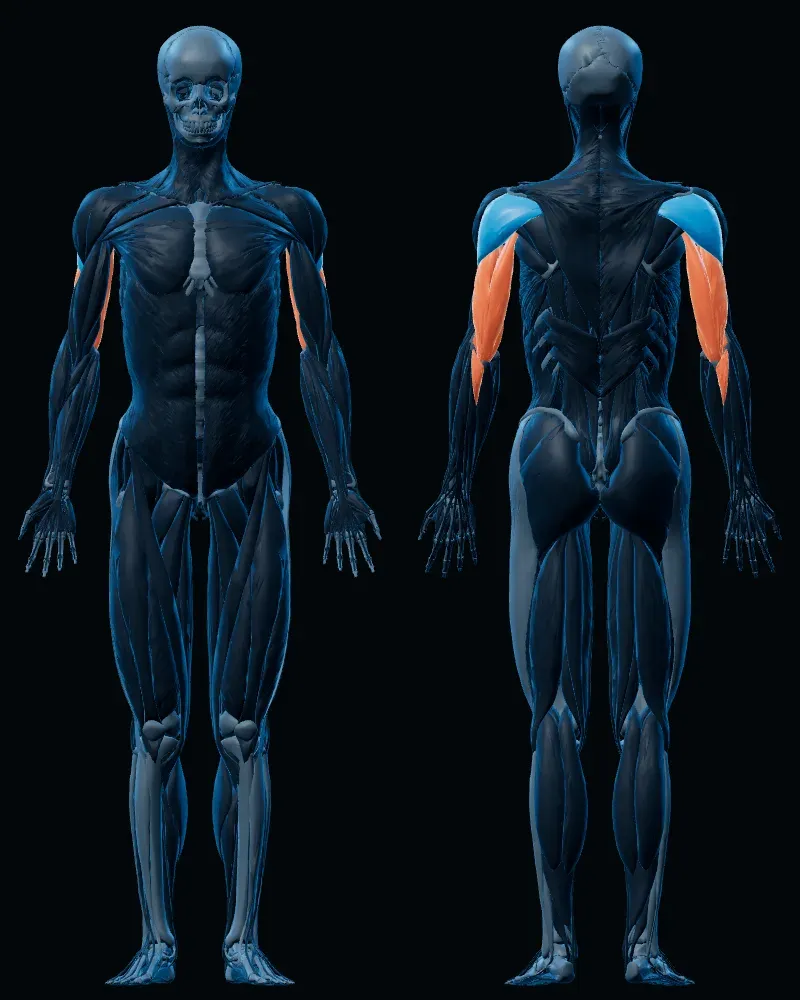
Muscles worked: triceps
Main movers: all three heads of the triceps
Assisting: rear delts
Table of contents
For triceps long head hypertrophy, the best evidence we have favours training with the arm overhead rather than by your side, as in a pushdown. In a 12-week trial, the same cable elbow extension grew the long head about 1.5 times more when the arm was overhead than when it hung by the side (Maeo et al., 2023).
That does not make pushdowns a waste of time. It means the shoulder angle you choose changes how much stretch the biggest head of the triceps gets. This is one practical application of the ideas in our guide to range of motion and stretch-mediated hypertrophy, and below we go through what the trial found, what it cannot tell us, and how to set it up.
Why the triceps long head is different
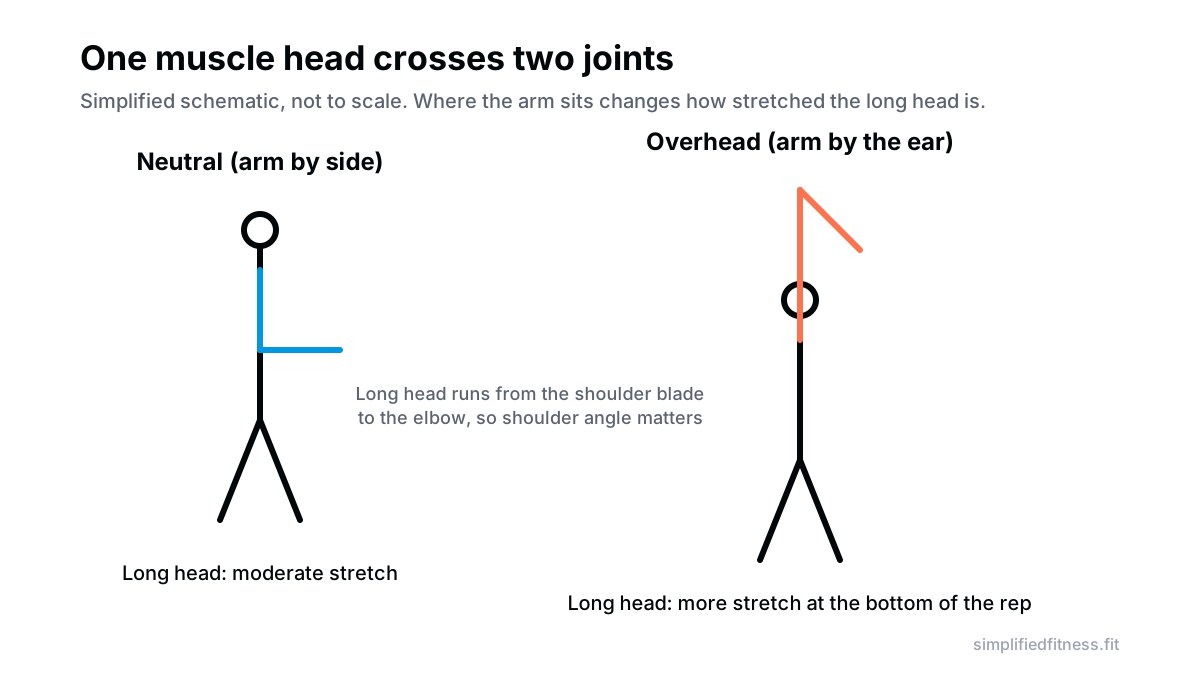
The triceps has three heads. The lateral and medial heads cross only the elbow. The long head starts on the shoulder blade, so it crosses both the shoulder and the elbow. That makes it a biarticular muscle, and for biarticular muscles joint angles at both ends change how long the muscle is. (We cover that idea in active vs passive insufficiency in biarticular muscles, and the anatomy in functional anatomy of the triceps heads.)
With your arm by your side, as in a standard pushdown, the shoulder end of the long head is not pulled far from the elbow end. Lift the arm overhead and the shoulder end moves up and away, so the muscle is lengthened before you even start the rep.
What the overhead vs neutral triceps trial found
Maeo and colleagues recruited 21 adults and trained each person’s two arms differently. One arm did cable elbow extensions overhead, the other in the neutral position (arm by the side). Everything else was matched: 70% of one-rep max, 10 reps, 5 sets per session, 2 sessions per week for 12 weeks. Muscle volume was measured with MRI before and after (Maeo et al., 2023).
The overhead arm won on every measure:
| Muscle | Overhead arm | Neutral arm | Difference |
|---|---|---|---|
| Long head | +28.5% | +19.6% | 1.5-fold greater |
| Lateral + medial heads | +14.6% | +10.5% | 1.4-fold greater |
| Whole triceps | +19.9% | +13.9% | 1.4-fold greater |
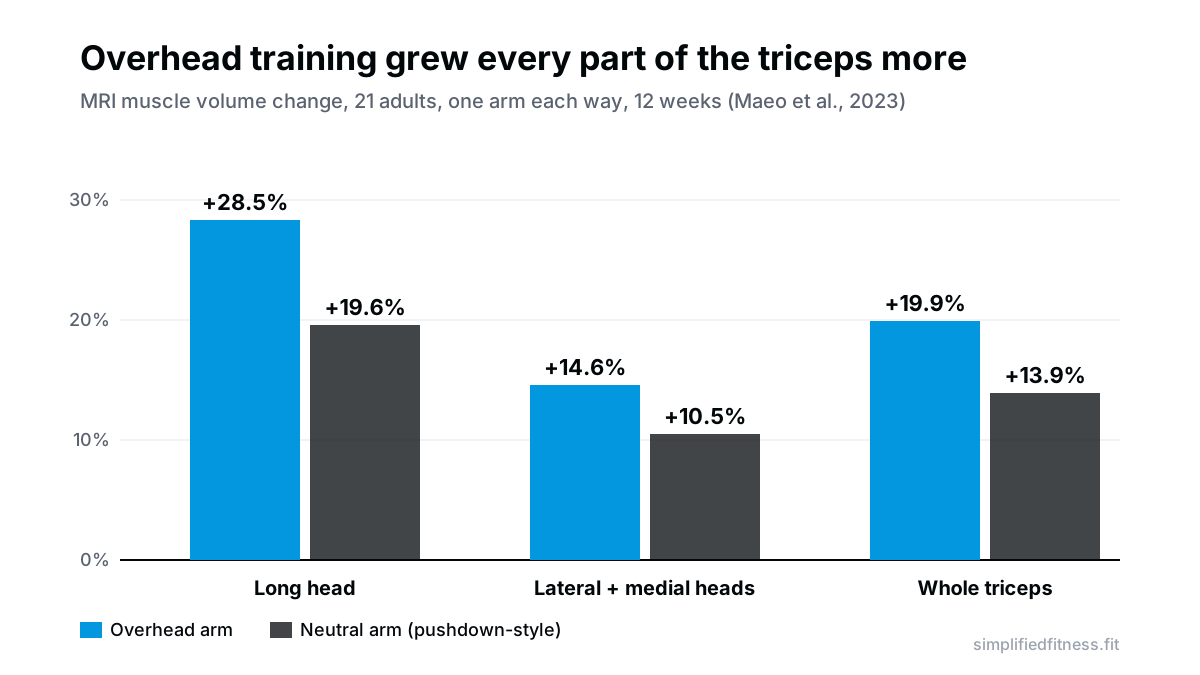
Two details matter for real life. First, training load and one-rep max rose by a similar proportion in both arms (+62-71%), so the extra growth was not just a side effect of one arm progressing faster. Second, the overhead arm used 34-39% lighter loads the whole time, yet grew more.
The within-person design is a strength: it controls for genetics, diet and sleep, because both arms belong to the same body. The authors concluded that cable elbow extensions should be done overhead rather than neutral if the aim is maximum triceps hypertrophy.
What this study does not tell you
I would not turn one trial into a law. Here is what to keep in mind.
- It is a single trial of 21 adults. The direction is clear, but the exact percentages could shift in other groups and with more training experience.
- It compared two versions of one exercise. It did not test an overhead movement against a full triceps routine with lots of pressing, rows or dips around it.
- It lasted 12 weeks. We do not know how the gap looks after years of training.
- Hard sets were similar, but the loads were very different. That is useful for elbow comfort, but it also means you cannot compare your numbers across the two positions.
There is also a wider debate. A 2025 meta-analysis of regional hypertrophy found that training at longer versus shorter mean muscle lengths produced similar, trivially different effects, with the authors warning that the length differences in the studies were small (Varovic et al., 2025). And a systematic review of range of motion concluded that for the upper limbs the evidence was limited and conflicting, while lower-body studies favoured fuller range of motion (Schoenfeld & Grgic, 2020).
How do these fit with the triceps result? Probably like this: when the difference in muscle length is small, growth is similar, but the overhead vs neutral comparison creates a large change in long head length, and that may be why it shows up. A similar pattern appeared in the hamstrings, where seated leg curls (hip flexed, hamstrings lengthened) grew the biarticular hamstrings more than prone leg curls, while the single-joint hamstring grew about the same (Maeo et al., 2021). That is a neat parallel, and we dig into it in seated vs lying leg curls. Still, it is a pattern across a few trials, not a settled rule for every muscle.
Do pushdowns still have a place?
Yes, and the reasons are practical rather than mystical.
Pushdowns let you use heavier absolute loads, they are easy to learn, and many lifters find them comfortable on the elbows. The trial does not show that pushdowns fail, because the neutral arm still gained about 14% whole-triceps volume. It shows that the overhead arm gained more.
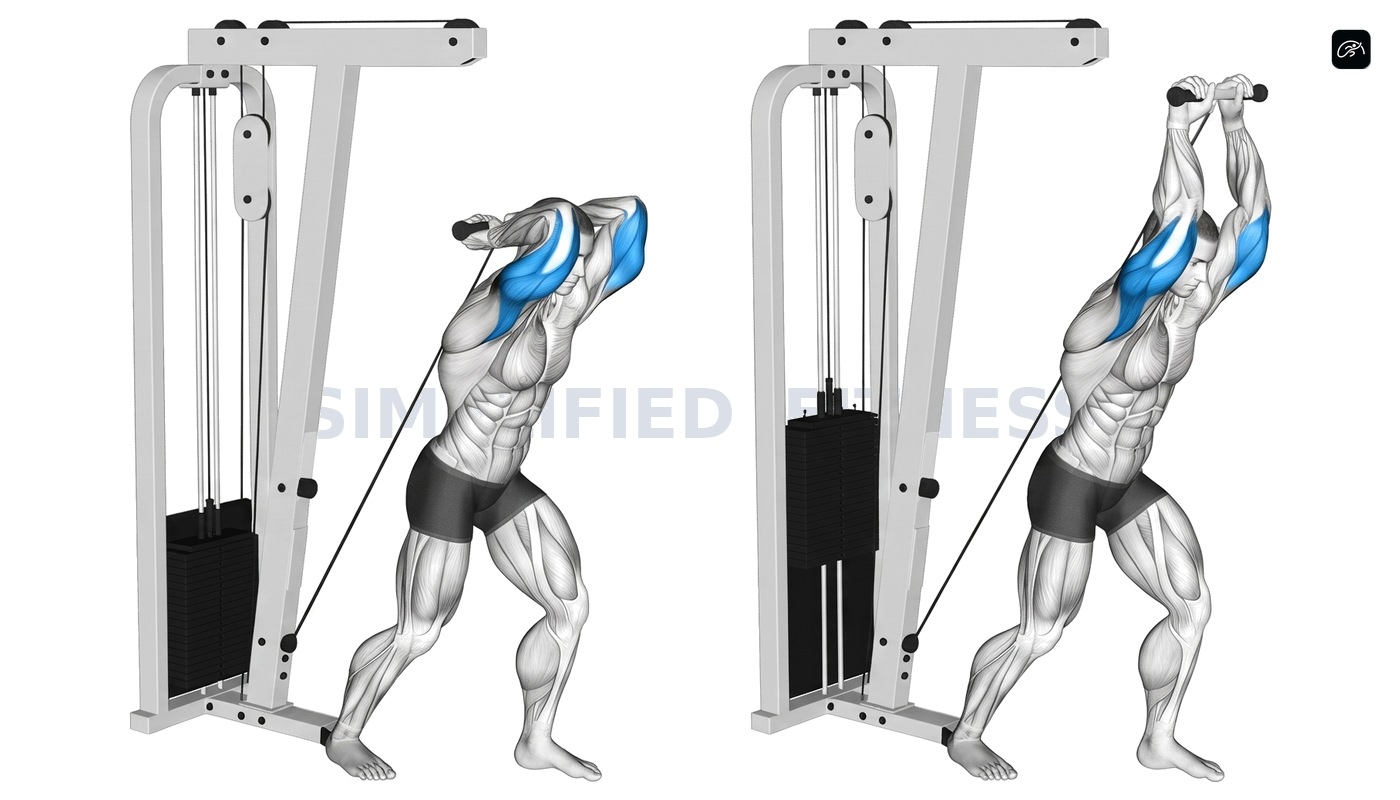
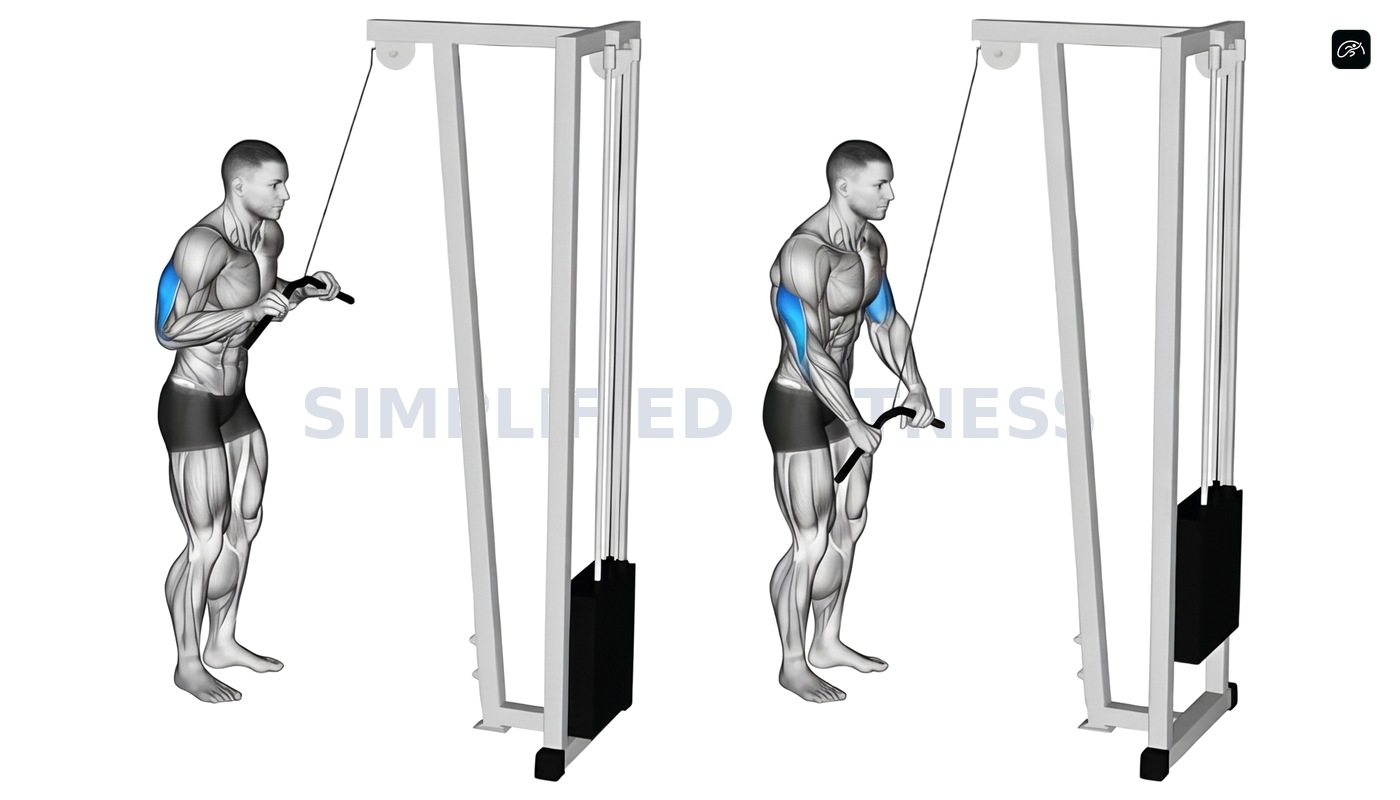
For the head-to-head with a cable setup, see overhead cable extensions vs pushdowns, and for the execution details, overhead cable triceps extensions for the long head. If you want to keep pushdowns, our comparison of straight bar, V-bar and rope pushdowns covers which attachment suits you.
What about skull crushers and dips?
Lying dumbbell extensions are a common middle ground. A 2018 EMG study in 21 resistance-trained men compared overhead and lying dumbbell extensions and found similar activation patterns across the range of motion, so the authors suggested not programming both in the same routine (Alves et al., 2018).
Be careful with how far you take that. EMG tells you how much a muscle is switched on, not how much it grows, and it did not compare these against pushdowns. The growth data we trust here come from the MRI trial above.
Pressing movements also train the triceps. Close-grip work and dips hit all three heads, mostly at shorter lengths. If you want to understand how those fit, see close-grip bench and wrist spacing and dips for the triceps.
How to set up overhead triceps work
Here is a plain version that fits most gym setups, including a crowded commercial gym.
- Choose your tool. A cable with a rope, a dumbbell held in both hands, or a band anchored low all work. Cables keep tension smoother, but the arm position matters more than the equipment.
- Fix the upper arms. Elbows point forward, upper arms close to your ears. If the elbows flare wide, the stretch moves away from the triceps.
- Go deep on the way down. Lower slowly until you feel a strong stretch in the back of the upper arm. Stop before your lower back arches or your ribs flare.
- Extend fully. Straighten the elbows without slamming into lockout.
- Use moderate loads. 8-15 reps with 1-3 reps left in the tank is a sensible range. The trial’s lighter overhead loads show you do not need to chase heavy weights here.
Elbow comfort and when to see someone
Overhead extensions load the elbow in a deep, bent position, and some people feel a pinch or ache at the back or outer side of the elbow. Fast, heavy reps that slam into lockout can make that worse in any triceps exercise.
The trial’s lighter loads are one reason to go moderate. Slow the lowering phase, warm up with a light set, and stop adding weight if the elbow complains. Compare that with pushdowns, which some people find easier on a cranky elbow.
Pain that is sharp, keeps getting worse, wakes you at night, or comes with numbness, swelling or loss of strength is a reason to stop and see a doctor or physiotherapist. We cannot diagnose elbow problems from an article, and I did not find a study comparing elbow injury rates between these exercises, so please treat any safety talk here as general practice, not proven fact.
How to fit this into your week
Because the overhead position looks better for growth, put it first in the session while you are fresh, then add pushdowns only if you want them.
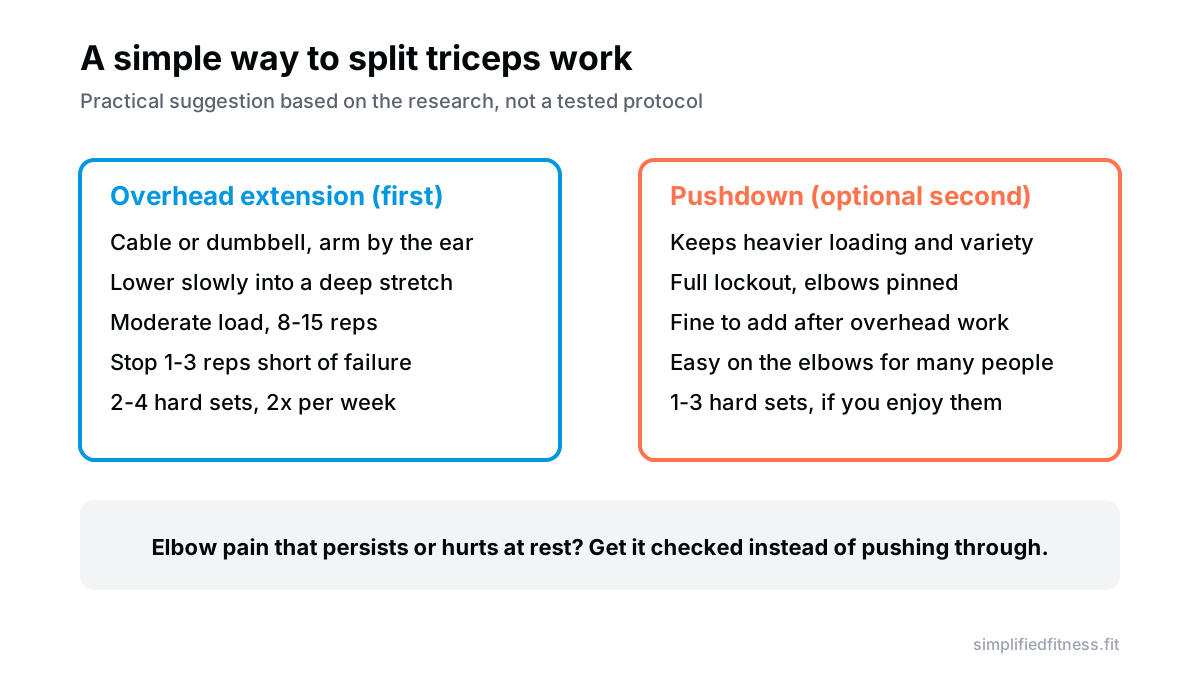
How much total work do you need? There is a graded relationship between weekly sets and muscle growth, with each extra set associated with a small additional gain (Schoenfeld et al., 2017). The meta-regression is not specific to the triceps, and returns do diminish, so there is no magic number. A reasonable starting point is a handful of hard sets a week, split across two sessions, counting the triceps work you already get from pressing. Our training volume calculator helps you add this up, and the push day plan shows where triceps work fits alongside chest and shoulders.
For the bigger picture on why stretched positions seem to work, read long muscle length training for hypertrophy.
The bottom line
Does overhead beat pushdowns for the triceps long head? On the best available evidence, probably yes. Overhead elbow extensions grew the long head and the whole triceps more over 12 weeks, even with lighter loads. The leading explanation is that the long head crosses the shoulder, so raising the arm stretches it more.
The caveats are real: a single small trial, a short duration, and wider research showing that smaller muscle-length differences give similar growth. So make overhead extensions your first triceps exercise, keep pushdowns if you enjoy them, use controlled reps, and judge the change by your own arm size and strength over the next two or three months.
Frequently Asked Questions
Is overhead triceps extension better than pushdowns for muscle growth?
Based on the best current evidence, yes, for the triceps overall and especially the long head. In a 12-week trial in 21 adults, the overhead arm gained about 20% in whole-triceps volume versus about 14% for the neutral arm. It is one study, so use overhead first and keep pushdowns as a second option.
Which exercise is best for the triceps long head?
An elbow extension done with your arm overhead, such as a cable overhead extension or a dumbbell overhead extension. The long head crosses the shoulder joint, and the overhead position lengthens it more than arm-by-side positions. Choose the version you can load smoothly and feel stretching at the bottom.
What are the three heads of the triceps?
The triceps has a long head, a lateral head and a medial head. Only the long head crosses the shoulder joint, which is why shoulder position affects it more than the other two. All three straighten the elbow, so most triceps exercises train all of them to some degree.
Do pushdowns work the long head at all?
Yes, any elbow extension loads the long head. With your arm by your side the long head is simply less stretched than overhead, so the research suggests it grows less. Keep pushdowns if you enjoy them, but do not make them the only triceps exercise.
Why does the overhead position grow more muscle?
The leading explanation is muscle length. Training at longer muscle lengths appears to promote more growth, and the overhead position lengthens the long head. Other mechanisms may also contribute, and researchers are still working out which ones matter.
Can I use less weight overhead and still grow?
Yes. In the trial, loads were 34-39% lower in the overhead arm and it still grew more. That makes overhead work useful if heavy pushdowns bother your elbows. Pick a weight that lets you control a deep stretch and finish 1-3 reps short of failure.
Are skull crushers the same as overhead extensions?
Not quite. In lying extensions the upper arm is usually perpendicular to the body or angled back, so the long head is not stretched as much as with the arm fully overhead. A 2018 EMG study in 21 trained men found similar activation patterns for overhead and lying dumbbell extensions. EMG does not tell us about growth, so if you do both, keep overhead first.
Are overhead triceps extensions bad for your elbows or shoulders?
There is no good evidence that they are harmful for healthy people, but no study I found tested elbow safety head to head. Elbows can feel irritated by heavy, locked-out, fast reps in any triceps exercise. Use controlled reps and moderate loads, and see a doctor or physio if pain is sharp, persistent or worsens at rest.
How many sets of overhead triceps work do I need?
There is no single proven number, but a meta-analysis found a graded relationship between weekly sets and muscle growth. A reasonable start is about 4-8 hard sets of triceps work per week, spread over 2 sessions, after counting the pressing you already do. Increase only if progress stalls.
How should I set up a cable overhead triceps extension?
Set the pulley low or at mid height, face away from the stack, hold the rope behind your head and let the elbows point forward. Lower until you feel a big stretch without your ribs flaring, then extend fully. Keep the upper arms close to your ears and the movement slow on the way down.
Can I do overhead extensions with dumbbells or at home?
Yes. A single dumbbell held with both hands behind the head works, as does a resistance band anchored low. The key variable is the arm position and the stretch, not the equipment. Cables just keep tension more even through the rep.
Is it worth changing my triceps routine if I already do pushdowns?
Probably, and it is a cheap change. Swap pushdowns for overhead extensions as your first triceps exercise and keep pushdowns as a finisher if you like them. Track your arm size and strength over 8-12 weeks, and judge by your own results.
Sources & References
Every claim above is checked against peer-reviewed research (PubMed, U.S. National Library of Medicine) or guidance from established health bodies. How we fact-check.
- Maeo S, et al. Triceps brachii hypertrophy is substantially greater after elbow extension training performed in the overhead versus neutral arm position. Eur J Sport Sci. 2023. PMID: 35819335
- Maeo S, et al. Greater hamstrings muscle hypertrophy but similar damage protection after training at long versus short muscle lengths. Med Sci Sports Exerc. 2021. PMID: 33009197
- Schoenfeld BJ, Grgic J. Effects of range of motion on muscle development during resistance training interventions: a systematic review. SAGE Open Med. 2020. PMID: 32030125
- Varovic D, et al. Does muscle length influence regional hypertrophy? A systematic review and meta-analysis. Int J Sports Med. 2025. PMID: 40570881
- Alves D, et al. Effect of shoulder position on triceps brachii heads activity in dumbbell elbow extension exercises. J Sports Med Phys Fitness. 2018. PMID: 28677940
- Schoenfeld BJ, et al. Dose-response relationship between weekly resistance training volume and increases in muscle mass: a systematic review and meta-analysis. J Sports Sci. 2017. PMID: 27433992

Umair Hazrami · Founder & Head Coach, Simplified Fitness
Umair Hazrami founded Simplified Fitness and the Simplified Lifter channel to cut through fitness noise. With 4+ years of consistent training and 10+ coaching clients, he writes every guide from the peer-reviewed research and links the sources so you can check them. Our editorial standards.
Educational content only, not medical advice. If you have a medical condition, are pregnant, or take medication, talk to a qualified doctor before changing your diet, supplements or training. Full disclaimer.
Keep reading

Hypertrophy
Active vs Passive Insufficiency: How Two-Joint Muscles Change Your Exercise Choice
Active vs passive insufficiency explained for lifters: why hamstrings, triceps, quads and calves grow differently depending on your second joint position.
10 min read

Hypertrophy
Squat Mobility With Long Femurs: Adapting Range of Motion to Your Hips
Squat mobility with long femurs is mostly a lever and hip-socket issue, not a flaw. Learn how to adjust depth, stance and heels without risking your hips.
10 min read
Hypertrophy
Dumbbell Pullovers vs Cable Lat Pull-ins: Training Lats at Long Muscle Lengths
Training lats at long muscle lengths: is the dumbbell pullover a lat or chest exercise, and why a cable lat pull-in may keep tension where you want it.
7 min read
Hypertrophy
Full vs Partial Range of Motion: What the Hypertrophy Research Shows
Full vs partial ROM hypertrophy explained: what two meta-analyses and recent trials found, where lengthened partials fit, and how to set your range of motion.
8 min read