Overhead Cable Triceps Extensions vs Cable Pushdowns: Which Builds More Triceps?
Overhead cable triceps extension vs pushdown: what a 12-week MRI trial found, how the cable angle changes the load, and the exact setup for rope and elbows.

TL;DR. The short answer
- In the one 12-week MRI trial that compared them directly, cable elbow extensions with the arm overhead grew the whole triceps about 20% versus about 14% with the arm by the side, even though the loads were roughly a third lighter.
- The gap was biggest in the long head (+28.5% vs +19.6%), the part of the triceps that crosses the shoulder and is stretched most when your arm is overhead.
- Pushdowns are not useless: they are easy to load, easy on the shoulder, and still grew the triceps. They simply load the muscle least when it is most shortened.
- A good default is to do the overhead rope extension first, then pushdowns for extra volume, and keep the stretch strong but pain-free.
- Elbow pain that lingers, or any numbness or tingling in the hand, is a reason to see a doctor or physio, not to push through.
Part of our complete guide: Muscle Length, Range of Motion and Stretch-Mediated Hypertrophy: What the Research Actually Shows
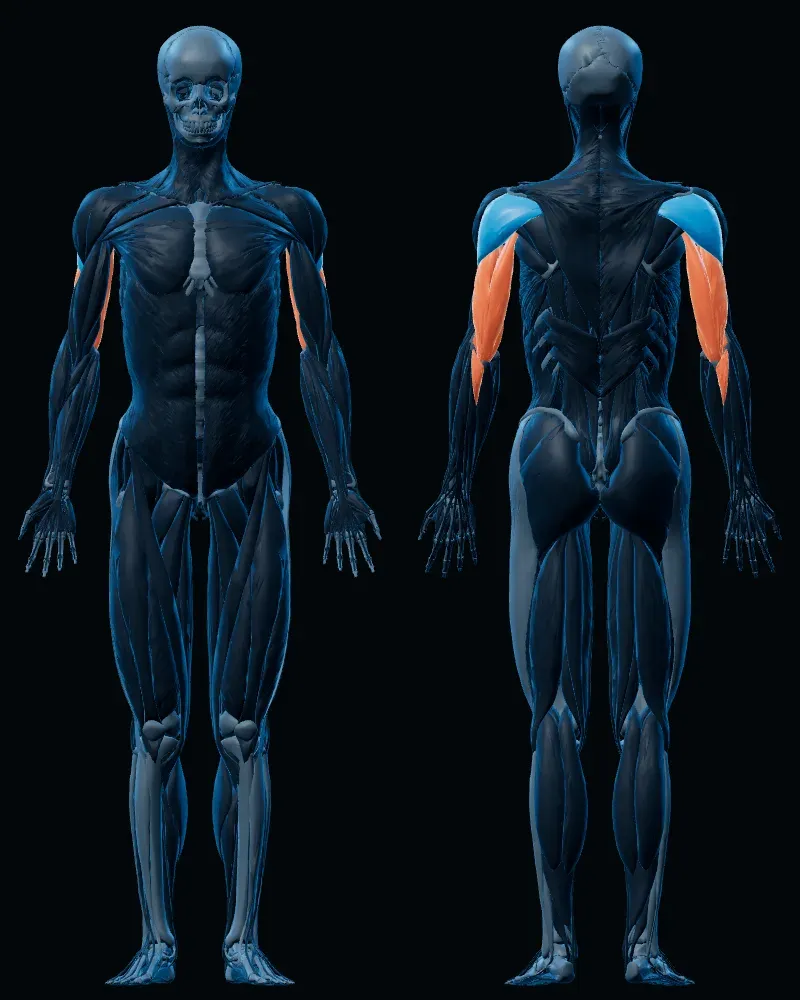
Muscles worked: triceps
Main movers: all three heads of the triceps
Assisting: rear delts
Table of contents
The overhead cable triceps extension vs pushdown question (part of our guide to range of motion and stretch-mediated hypertrophy) has a fairly clear answer: the overhead version probably builds more triceps, especially the long head, and it does it with lighter weights. In a 12-week MRI trial, overhead cable extensions grew the whole triceps by about 20% versus about 14% for the same movement with the arm by the side (Maeo et al., 2023).
That does not make pushdowns a waste of time. It changes the order and the setup. This article focuses on the cable itself: where the line of pull sits, why that changes the load, and how to set up without wrecking your elbows.
Overhead cable triceps extension vs pushdown: what the trial found
Most arm advice is built on gym habit. This one has a proper experiment behind it.
In the trial, 21 adults trained one arm with cable elbow extensions in the overhead position and the other arm in the neutral position (arm by the side). Both arms did 5 sets of 10 reps at 70% of 1RM, twice a week, for 12 weeks, and load went up whenever the previous session was completed without hitting failure. Muscle volume was measured by MRI (Maeo et al., 2023).
Strength rose by a similar amount in both arms. Growth did not.
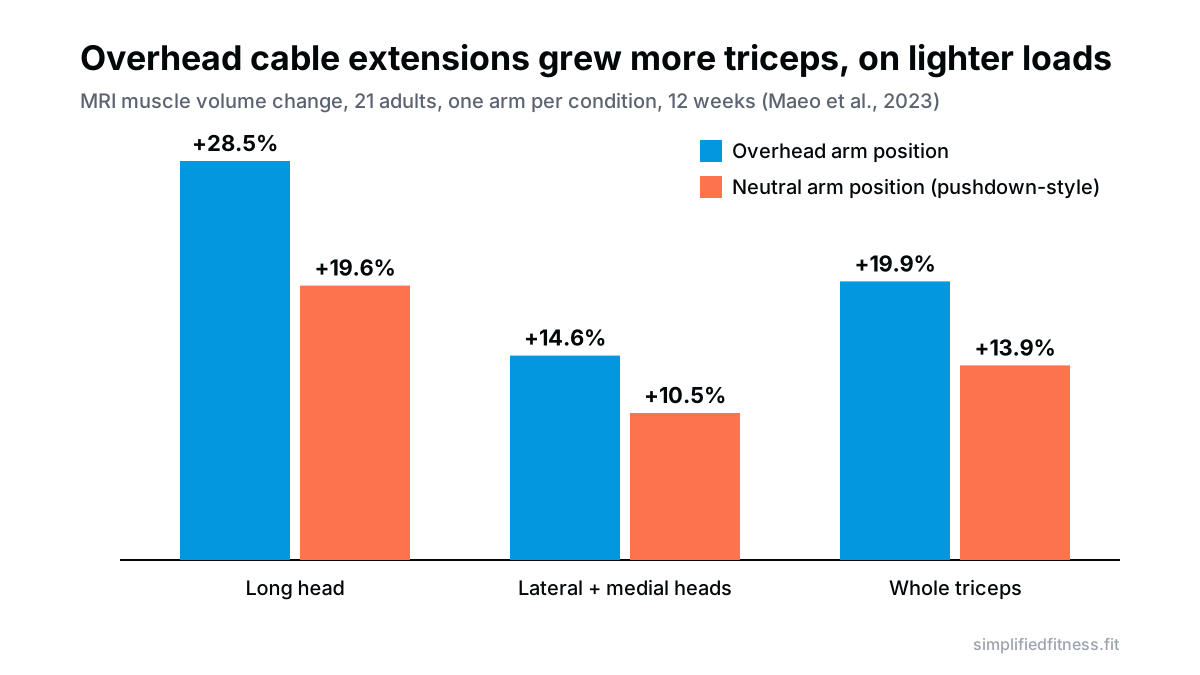
The long head grew 28.5% overhead versus 19.6% neutral. The lateral and medial heads grew 14.6% versus 10.5%. The whole triceps grew 19.9% versus 13.9%. And the absolute weights in the overhead arm were 34-39% lower, so the stronger growth came with less load on the joint (Maeo et al., 2023).
Why the long head cares about arm position
The triceps has three heads. Two (lateral and medial) cross only the elbow. The long head attaches up on the shoulder blade, so it crosses both the shoulder and the elbow. Our triceps heads anatomy guide covers the anatomy in more detail.
Here is the practical bit. Put your arm overhead and bend the elbow, and the long head is stretched at both ends. Keep your arm by your side, as in a pushdown, and it is not stretched at the shoulder end at all. The trial authors built their hypothesis on exactly this point, and the MRI results fit it (Maeo et al., 2023). The deeper comparison of arm positions lives in our article on overhead vs neutral triceps long head training.
Notice that the lateral and medial heads also grew more overhead. That is a hint the overhead position helps more than the long head alone, though the trial cannot tell us why.
How the cable changes the load: torque in plain terms
A cable gives you a constant pull in one direction. What changes through the rep is how far that pull sits from your elbow joint, the moment arm. A long moment arm means more torque on the elbow, which means a harder rep at that point.
Take the pushdown. At the top, your forearm is roughly horizontal and the cable is pulling straight down, so the moment arm is as long as your forearm. As you push down and the forearm becomes vertical, it lines up with the cable. The moment arm shrinks toward zero. Result: the rep feels hardest near the start and nearly weightless at lockout. And because your arm stays by your side, even that hardest point never puts the long head in a deep stretch.
Now the overhead version, facing away from the stack. The cable pulls your hands back toward the pulley behind you. With your upper arm up by your ear and a pulley at roughly low to mid height, that backward pull stays closer to perpendicular to your forearm for more of the rep, so the stretched bottom is loaded and tension fades later than in a pushdown. Move the pulley too far up or down and the load shifts toward one end of the rep, which is why the height is worth experimenting with.
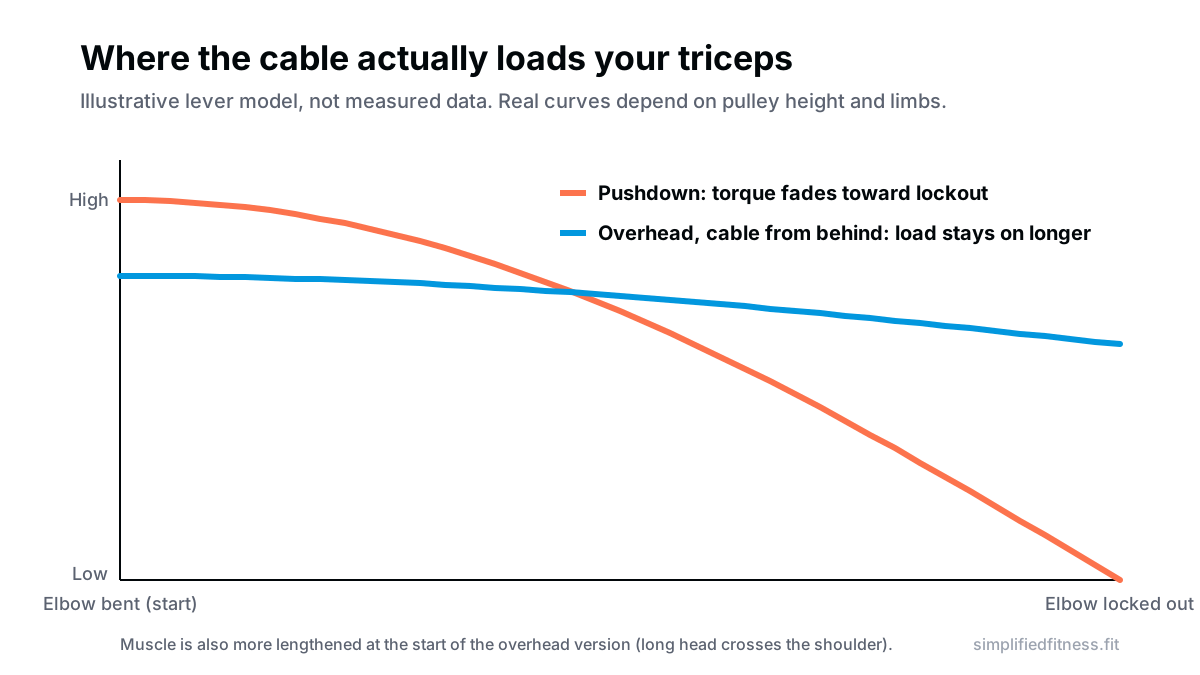
I want to be honest about this figure. It is a simplified lever model, not a measurement. Real torque also depends on your limb lengths, pulley height, rope position and how your body sways. Treat it as the reason to experiment with pulley height, not as a precise curve.
Pushdowns vs overhead extensions at a glance
| Cable pushdown | Overhead cable extension | |
|---|---|---|
| Arm position | Upper arm by your side | Upper arm by your ear |
| Long head stretch | Low | High |
| Where the load is hardest | Early in the rep | Across more of the rep (setup dependent) |
| Typical load | Heavier | Lighter (34-39% less in the trial) |
| Shoulder demand | Low | Higher, needs good overhead mobility |
| Loading and progression | Very easy | Needs more control |
| Best role | Second exercise, extra volume | First exercise for most people |
Best cable triceps setup for overhead extensions
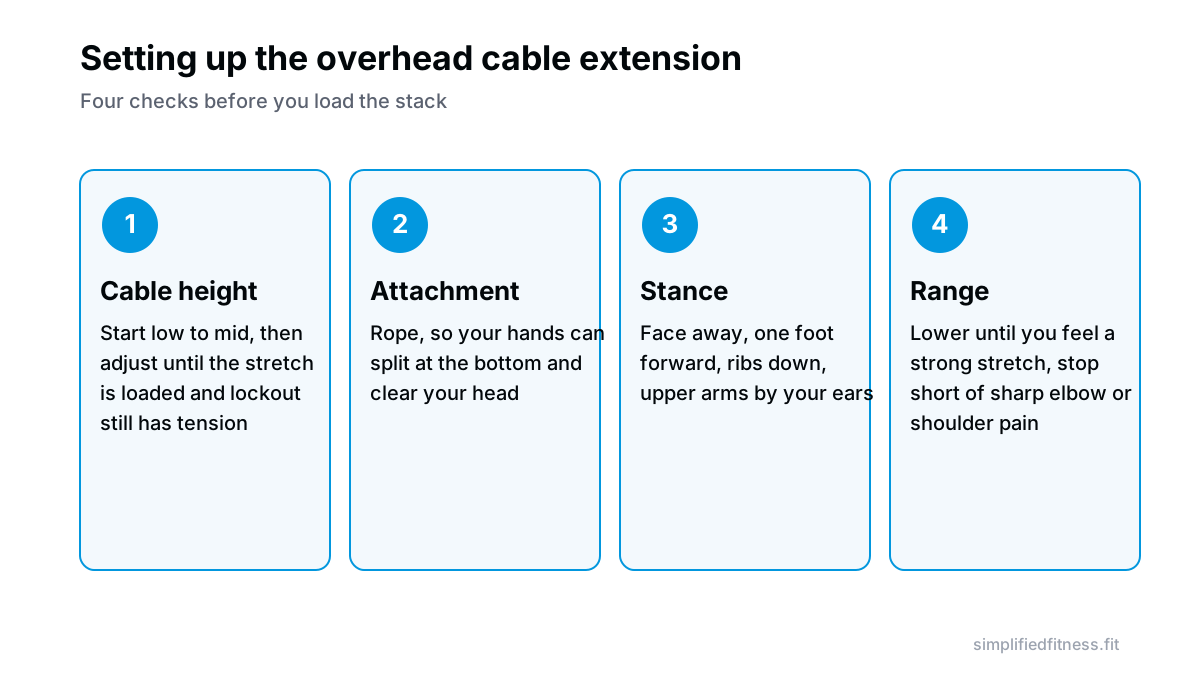
- Cable height. Start low to mid, then adjust. You want a loaded stretch at the bottom and some tension left at lockout. If either end feels dead, move the pulley a notch.
- Rope or bar. The rope wins here because your hands can split and clear your head at the bottom.
- Stance. Face away, one foot forward, ribs down, and glute braced so your lower back does not arch.
- Elbows. Point them forward, not wide. Let them drift only a little.
- Range. Lower until you feel a strong stretch in the back of the arm, then press until the elbow is straight.
For a full rep-by-rep walkthrough of the overhead version, including the cross-body variation, see our overhead cable triceps extension guide.
Handle choice matters less than people think for the triceps itself. In a controlled study of standing cable pushdowns, ball-handle variations changed forearm muscle activity but did not significantly change triceps activity (Rendos et al., 2016). So pick the attachment that is comfortable for your wrists, and do not expect a gadget to unlock extra triceps growth. For the rope-versus-bar details on the pushdown side, see our guide to pushdown attachments, and for pulley heights in general see cable setup mastery.
Do pushdowns still have a place?
Yes. In the trial, the neutral arm position still grew the triceps by about 14% (Maeo et al., 2023). Pushdowns are simple, very easy to load in small steps, and kind to the shoulder.
A sensible structure:
- Overhead rope extension first, 2-3 hard sets, while you are fresh.
- Pushdown second, 1-3 sets, closer to failure, for extra volume without extra shoulder stress.
- If an overhead reach hurts your shoulder, run pushdowns alone until you have had it checked.
If you want to place this inside a full session, our free push day plan already pairs pressing with triceps work, and the training volume calculator can help you count weekly sets.
What about partial reps and the stretched position?
Here the evidence is genuinely mixed, so let me lay it out fairly.
A 2020 systematic review concluded that research on range of motion for the upper limbs was limited and conflicting, which prevented strong practical conclusions (Schoenfeld and Grgic, 2020). A 2023 systematic review of 11 studies reported that partial reps in the middle of the range grew the triceps more than full range (effect size 1.21), and concluded that training at longer muscle lengths, through either full or partial range, seems to favour growth in muscles such as the triceps (Kassiano et al., 2023).
Then in 2025 a trial in 30 resistance-trained people compared lengthened partials with full range for 8 weeks and found similar arm growth, with Bayes factors that moderately supported no difference (Wolf et al., 2025). The authors’ conclusion was that trainees should likely emphasise the stretched position, whether via full range or lengthened partials.
Why the differences? Different studies use different muscles, loads, training status and ways of defining “partial”. So the careful takeaway is simple: do not cut the stretched half of the rep short. If you want to experiment with lengthened partials at the end of a set, our guide to lengthened partials covers how.
Shoulder comfort and elbow tendon flare-ups
Overhead triceps work asks two joints to cooperate. Both need to behave.
Shoulder first. If your arm cannot reach overhead without your ribs flaring, the problem is mobility or position, not triceps strength. Lower the arm angle slightly and shorten the load until the movement feels clean.
Elbows next. A survey of 71 competitive bodybuilders reported that the shoulder and elbow were among the most commonly injured regions, and 45.1% had symptoms while training (Siewe et al., 2014). That is a bodybuilding sample, not a cable study, but it is a useful reminder that elbows are a common weak link in arm training.
To reduce flare-ups:
- Use loads you can control for 8-15 reps, not a heavy 5.
- Slow the lowering phase (2-3 seconds) and avoid bouncing out of the stretch.
- Keep reps smooth, not jerky, especially at the bottom.
- Warm up with one light set first.
- Keep pushing volume up gradually, not in a sudden jump.
A simple weekly plan
You do not need a complicated split.
- Frequency: 2 triceps sessions a week is plenty for most people.
- Per session: 2-3 sets overhead rope extensions, then 1-3 sets pushdowns.
- Effort: finish each set 1-2 reps short of failure on most sets, with the last set closer to failure.
- Progression: add reps first. When you hit the top of your rep range (say 12), add a small amount of weight.
- Budget gym note: no cable stack? An anchored resistance band or one dumbbell held overhead is a workable stand-in, although the load profile will differ from a cable.
The research used 5 sets, twice a week, per arm position, with progressive loading (Maeo et al., 2023). That is a research protocol, not a requirement. If you already bench and dip a lot, your triceps are getting indirect work, so start with fewer direct sets and add only if progress stalls. Hot, humid training halls make long sessions miserable, which is one more reason to keep triceps work short and hard rather than long and sloppy.
One more point for context. A study comparing dumbbell overhead and lying extensions found similar EMG activation patterns across the range for both, and the authors suggested not programming both in the same routine (Alves et al., 2018). EMG is not a growth outcome, so treat this as a practical nudge to avoid doubling up on similar movements, not as proof.
The bottom line
Overhead cable extensions are probably the better first triceps exercise for most lifters, because they load the muscle in a stretched position and, in the best available trial, grew more muscle on lighter weights. Pushdowns are a good second exercise, not a mistake.
Set the pulley low to mid, use a rope, brace your trunk, and own the bottom position. Keep the stretch strong, not painful. And if an elbow or shoulder keeps complaining, get it looked at rather than guessing.
Frequently Asked Questions
Are overhead cable triceps extensions better than pushdowns?
For muscle growth, the best direct evidence says yes, probably. A 12-week trial using MRI found overhead cable extensions produced about 20% whole-triceps growth versus about 14% for the arm-by-the-side version. It was a single study in 21 adults, so treat it as a strong hint, not a final verdict, and start your triceps work with the overhead version.
Do I still need pushdowns if I do overhead extensions?
You do not strictly need them, but they are a useful second exercise. Pushdowns are easy to load, easy on the shoulder and still grew the triceps in the trial's neutral condition. If you add one, do it after the overhead movement so you spend your fresh effort on the stretched version.
What is the best cable triceps setup?
Face away from the stack, use a rope, and start with the pulley at low to mid height so the cable runs back over your shoulder toward the stack. Then adjust the height until the stretch feels loaded, lockout still has some tension, and your shoulder feels comfortable. The rope lets your hands split at the bottom.
Which cable attachment is best for triceps?
The rope is the most practical for overhead work because your hands can separate and clear your head. In one EMG study of standing pushdowns, handle type did not change triceps activity, though it did change forearm muscle activity. Choose the attachment that is comfortable for your wrists and elbows.
Does the overhead position really stretch the long head more?
Yes. The long head attaches at the shoulder blade, so it crosses both the shoulder and the elbow. Raising the arm overhead and bending the elbow lengthens it at both joints, which is the main reason researchers expected, and then observed, more long head growth.
Why do overhead extensions use lighter weights?
In the MRI trial, absolute loads were 34-39% lower in the overhead arm even though strength relative to each position rose similarly. The muscle is working from a lengthened, mechanically harder position and the shoulder has to stabilise. Do not chase your pushdown numbers here, chase clean reps with a deep stretch.
How do I stop my elbows hurting on overhead triceps extensions?
Elbow flare-ups usually come from too much load, too much speed and a jerky bottom position. Use a load you can control for 8-15 reps, slow the lowering phase, and keep your elbows pointing forward rather than flaring wide. If pain persists for more than a couple of weeks or is sharp, see a doctor or physio.
Should I do overhead cable extensions with one arm or two?
Both work. Single-arm lets you set each side up properly and use a stronger stretch, while two-arm with a rope is faster and easier to load. The MRI trial trained one arm in each position, so unilateral work has direct evidence behind it.
How many sets of triceps do I need per week?
There is no single number, and the trial used 10 sets per week for the triceps in the form of 5 sets twice a week. Many lifters grow on a similar amount when sets are hard and close to failure. If you already press a lot, your triceps are getting indirect work too, so start modestly and add sets only if progress stalls.
Do full range of motion or partial reps work better for triceps?
The evidence is mixed. One systematic review reported more triceps growth from partial reps in the middle of the range than from full range, while a trained-lifter trial found lengthened partials and full range grew the arms similarly. The practical takeaway is to emphasise the stretched half of the rep, whether you do full reps or lengthened partials.
Can I do overhead cable extensions at home or in a basic gym?
Yes, if you have a cable stack or even a resistance band anchored low behind you. The principle is the same: arm overhead, elbow bent, resistance pulling forward. A single dumbbell held overhead is a decent fallback, though the load profile differs from a cable.
Is it safe to train triceps if I have shoulder problems?
Overhead positions can aggravate some shoulder conditions, so this depends on your shoulder. If an overhead reach hurts, use a slightly lower arm angle, a lighter load, or stay with pushdowns until you have been assessed. A doctor or physio can tell you what is actually going on, which this article cannot.
Sources & References
Every claim above is checked against peer-reviewed research (PubMed, U.S. National Library of Medicine) or guidance from established health bodies. How we fact-check.
- Maeo S, et al. Triceps brachii hypertrophy is substantially greater after elbow extension training performed in the overhead versus neutral arm position. Eur J Sport Sci. 2023. PMID: 35819335
- Kassiano W, et al. Which ROMs Lead to Rome? A Systematic Review of the Effects of Range of Motion on Muscle Hypertrophy. J Strength Cond Res. 2023. PMID: 36662126
- Schoenfeld BJ, et al. Effects of range of motion on muscle development during resistance training interventions: A systematic review. SAGE Open Med. 2020. PMID: 32030125
- Wolf M, et al. Lengthened partial repetitions elicit similar muscular adaptations as full range of motion repetitions during resistance training in trained individuals. PeerJ. 2025. PMID: 39959841
- Rendos NK, et al. Differences in Muscle Activity During Cable Resistance Training Are Influenced by Variations in Handle Types. J Strength Cond Res. 2016. PMID: 26694502
- Alves D, et al. Effect of shoulder position on triceps brachii heads activity in dumbbell elbow extension exercises. J Sports Med Phys Fitness. 2018. PMID: 28677940
- Siewe J, et al. Injuries and overuse syndromes in competitive and elite bodybuilding. Int J Sports Med. 2014. PMID: 24886919

Umair Hazrami · Founder & Head Coach, Simplified Fitness
Umair Hazrami founded Simplified Fitness and the Simplified Lifter channel to cut through fitness noise. With 4+ years of consistent training and 10+ coaching clients, he writes every guide from the peer-reviewed research and links the sources so you can check them. Our editorial standards.
Educational content only, not medical advice. If you have a medical condition, are pregnant, or take medication, talk to a qualified doctor before changing your diet, supplements or training. Full disclaimer.
Keep reading
Hypertrophy
Active vs Passive Insufficiency: How Two-Joint Muscles Change Your Exercise Choice
Active vs passive insufficiency explained for lifters: why hamstrings, triceps, quads and calves grow differently depending on your second joint position.
10 min read
Hypertrophy
Squat Mobility With Long Femurs: Adapting Range of Motion to Your Hips
Squat mobility with long femurs is mostly a lever and hip-socket issue, not a flaw. Learn how to adjust depth, stance and heels without risking your hips.
10 min read
Hypertrophy
Dumbbell Pullovers vs Cable Lat Pull-ins: Training Lats at Long Muscle Lengths
Training lats at long muscle lengths: is the dumbbell pullover a lat or chest exercise, and why a cable lat pull-in may keep tension where you want it.
7 min read
Hypertrophy
Full vs Partial Range of Motion: What the Hypertrophy Research Shows
Full vs partial ROM hypertrophy explained: what two meta-analyses and recent trials found, where lengthened partials fit, and how to set your range of motion.
8 min read