Shrugs Biomechanics: Barbell vs Dumbbell vs Kelso Shrugs for Trap Thickness
Looking for the best shrugs for upper traps? Compare barbell, dumbbell, angled and Kelso shrugs, what EMG studies show, and why the shoulder roll adds nothing.
TL;DR. The short answer
- For upper traps, the best shrug is the one you can load heavily, lift straight up and down, and hold for a short pause. Barbell and dumbbell shrugs both qualify; no study shows one clearly building more muscle.
- Surface EMG studies show shrugs produce very high upper trap activity (about 102% of a maximal contraction in one study of 12 women with neck pain), and the unilateral shrug topped 10 exercises in 30 healthy adults.
- Doing the shrug with the arms about 30 degrees out to the side raised upper trap activity versus a standard shrug in one 2014 EMG study (37 people). That supports angled dumbbell or cable shrugs, but it is EMG, not muscle growth data.
- Kelso shrugs train scapular retraction for the mid traps and rhomboids. Direct research on the Kelso shrug is thin, so treat it as a light, controlled add-on rather than a main trap builder.
- Rolling the shoulders adds no useful elevation, so it adds no real trap work. Lift straight up, pause 1-2 seconds, lower under control. See a clinician if you get neck or shoulder pain that does not settle.
Part of our complete guide: Complete Shoulder, Delt & Neck Training Guide: 3D Deltoid Anatomy, Rotator Cuff & Traps
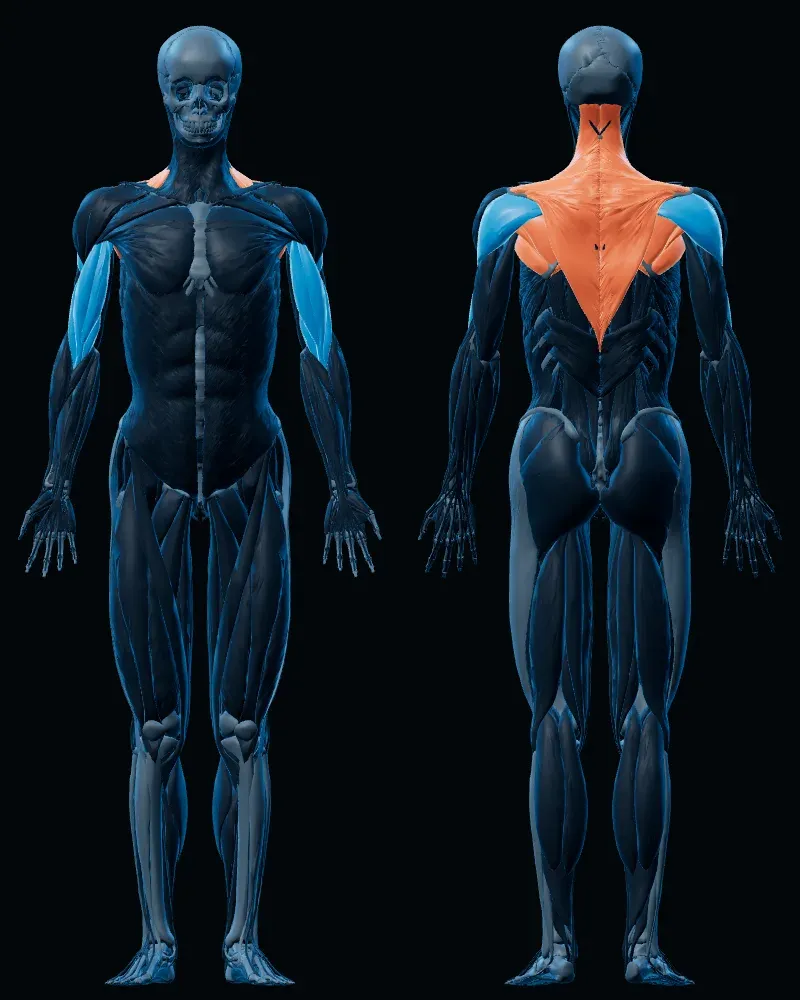
Muscles worked: upper back
Main movers: traps, rhomboids, teres major, infraspinatus and teres minor
Assisting: rear delts, biceps and brachialis
Table of contents
The best shrugs for upper traps are the ones you can load heavily, lift straight up and down, and pause at the top. That can be a barbell, a pair of dumbbells or a cable setup. What matters far more than the tool is whether the reps are clean.
Part of our complete shoulder and delt training guide, this page is the practical exercise guide. For where the traps sit and what each section does, see trapezius anatomy for upper, middle and lower traps. Here we stick to execution: barbell vs dumbbell shrugs, angled cable shrugs, Kelso shrugs, and why the shoulder roll is a waste of effort.
What do shrugs actually train?
A shrug lifts the shoulder blade straight up. The muscle doing that is mostly the upper trapezius, the slope of muscle running from the base of your skull and neck down to the collarbone and shoulder blade. Anatomy reviews describe the trapezius as split into upper, middle and lower parts that each pull the scapula in a different direction (Camargo and Neumann, 2019).
So the job is simple. Shoulders go up toward the ears, with the arms staying long and doing nothing. That is the whole rep.
The research on how hard shrugs work the traps is consistent, although it is almost all EMG (electrical activity), which is not the same as muscle growth. In 30 healthy adults tested across 10 exercises, the unilateral shoulder shrug produced the greatest upper trapezius activity (Ekstrom et al., 2003). In 12 women with chronic neck pain, trapezius activity during shrugs reached about 102% of a maximal voluntary contraction (Andersen et al., 2008).
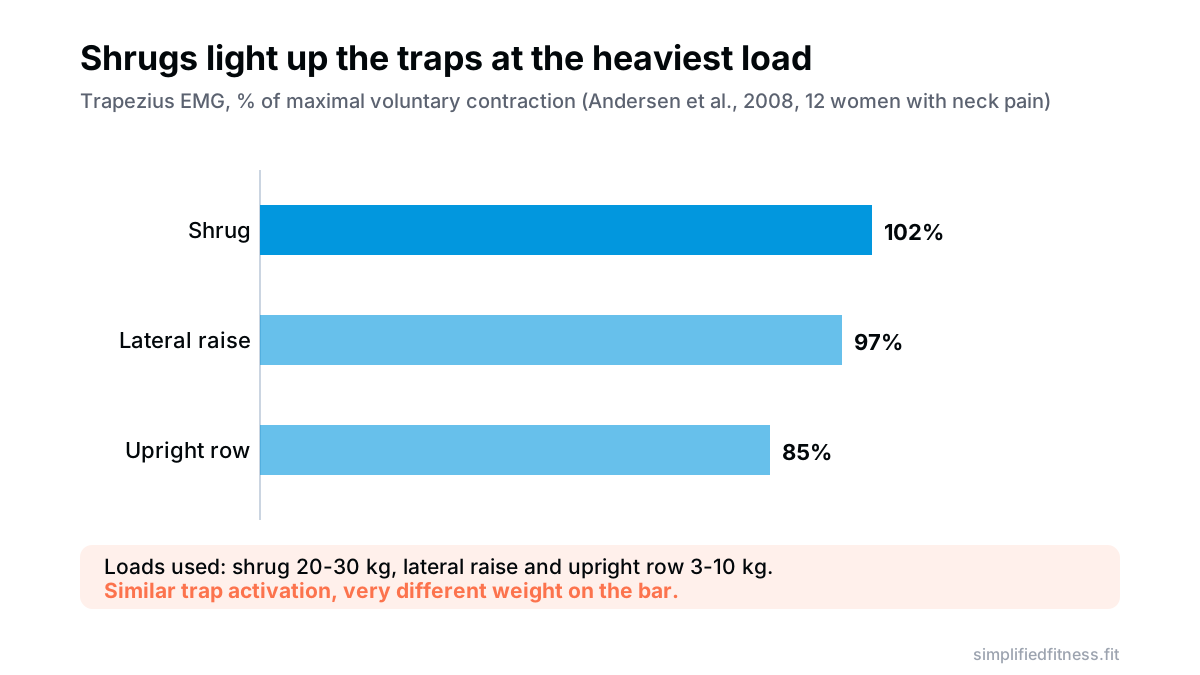
That chart carries a quirky lesson. The trap activation was similar, yet the loads were very different (20-30 kg for shrugs against 3-10 kg for the other two) (Andersen et al., 2008). Shrugs let you load the upper traps heavily with little skill demand, which is a big part of why lifters use them for trap size. The sample was 12 women with neck pain, so do not assume identical numbers in healthy male lifters.
Barbell vs dumbbell shrugs: which is better?
Honest answer: no trial has pitted them against each other for muscle size. So we reason from mechanics and practicality.
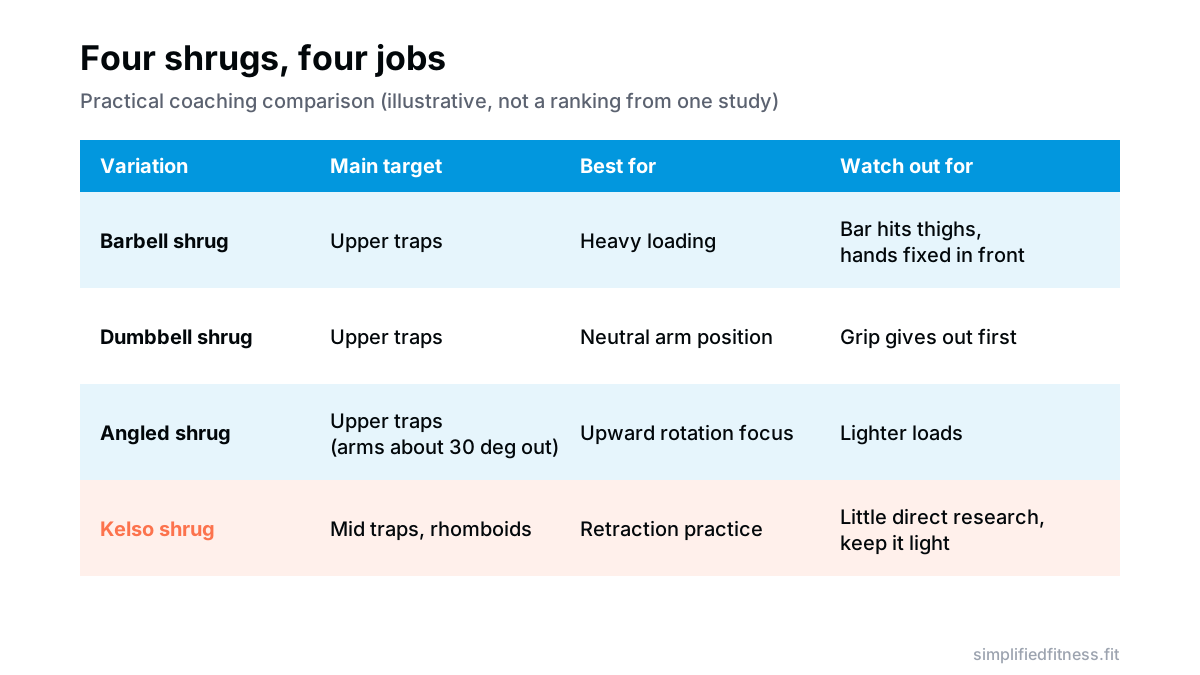
Barbell shrugs let you stack the most weight. The catch is that your hands are fixed in front of the thighs. The bar bumps your legs, your arms internally rotate a little, and many lifters end up pushing their hips back to clear the bar. That is awkward, not dangerous, but it steals focus from the traps.
Dumbbell shrugs let the arms hang by your sides in a neutral position. No thigh clearance problem, and you can vary the arm angle slightly. The downside is that grip fails before the traps do once the dumbbells get heavy.
Do angled or cable shrugs at 30 degrees work better?
This is where the biomechanics gets interesting. The upper trapezius fibers run diagonally, so some coaches argue the pull should follow that diagonal rather than straight up. There is real evidence for the idea, with a big caveat.
In 2014, researchers compared a standard shrug (arms by the sides, 0 degrees of abduction) with an “upward rotation” shrug with the arms about 30 degrees out in the frontal plane. Tested in 23 healthy people and 14 with shoulder instability, upper and lower trapezius activity was significantly higher in the modified shrug in both groups (Pizzari et al., 2014).
A 2016 study of 17 people with scapular downward rotation syndrome also used a 30-degree arm position. Different shrug styles changed scapular upward rotation and how much the upper trap fired versus the levator scapulae (Lee et al., 2016).
Notice what these studies are. Short EMG sessions, small samples, rehab-oriented, and not cable-based. They support angling your arms out slightly. They do not prove a cable shrug builds a bigger yoke than a dumbbell shrug.
Practical takeaway: if you have a cable stack, try holding handles with your arms a bit away from your sides. Do it with a weight you control. If the angled version feels better in your traps and does not bother your shoulder, keep it.
What are Kelso shrugs and do they hit the mid traps?
Kelso shrugs are a retraction movement. You lie chest down on an incline bench (or use a chest-supported setup), let the arms hang, and squeeze the shoulder blades together toward the spine instead of lifting them. Elbows stay straight.
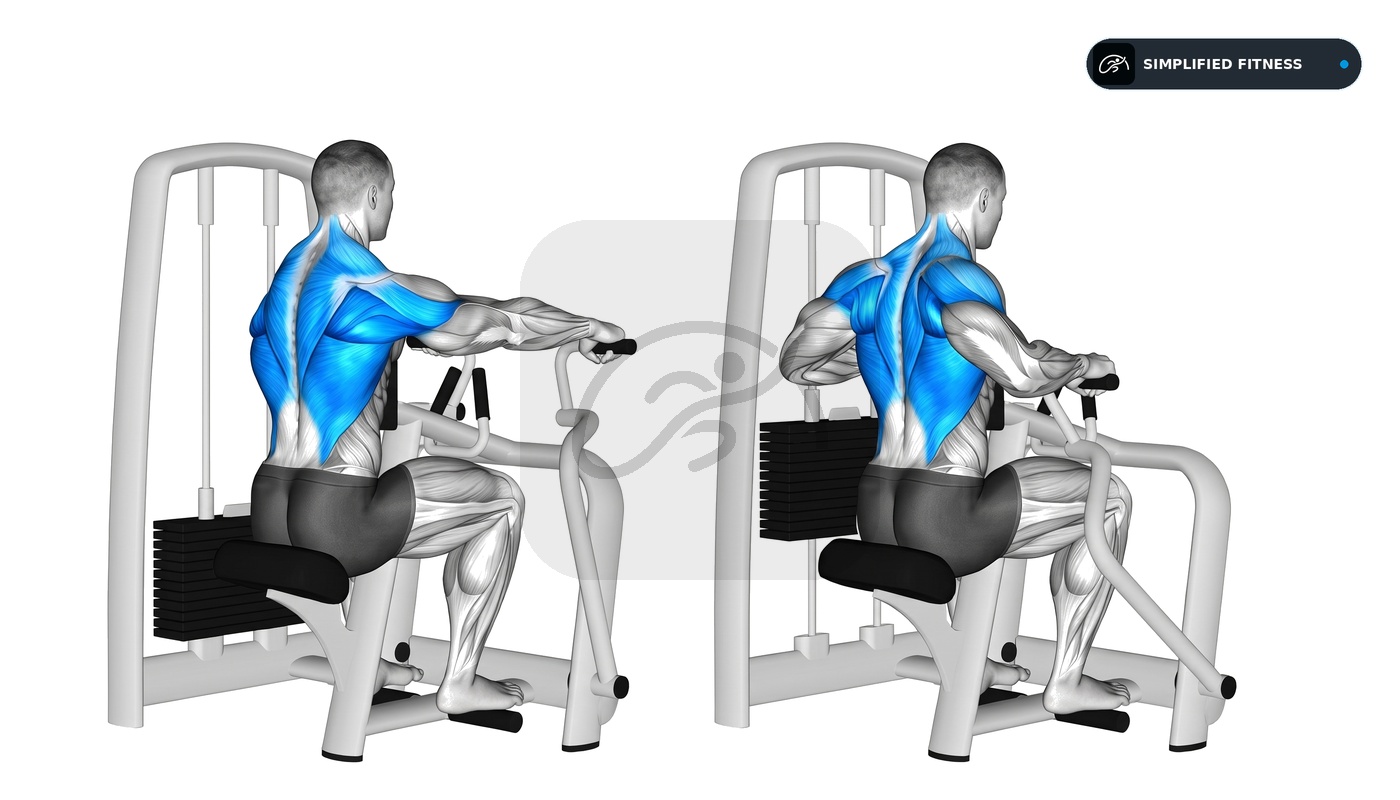
The line of pull makes sense for the middle trapezius, which retracts the scapula. In Ekstrom’s 30-person study, the best mid-trap exercises were horizontal shoulder extension with external rotation and an overhead arm raise in line with the lower trapezius, both lying face down (Ekstrom et al., 2003). Prone horizontal abduction with external rotation also scored well on balance ratios in a 45-person study (Cools et al., 2007).
Here is the honest gap. I could not find a study that tested the Kelso shrug itself. So its mid-trap claim rests on anatomy and on similar prone retraction work. It is a reasonable accessory, not a proven upgrade. For a longer look at the scapular movement itself, see our guide to face pulls and scapular retraction.
Why the shoulder roll adds nothing
You see it everywhere. Lifters shrug up, then roll the shoulders backward in a big circle as though the circle adds something. It does not.
The upper trap’s main action is elevating the shoulder blade. The circle adds no extra elevation, so you get no extra tension on the muscle. What you do get is a loaded circular path through the joint, which is exactly what you do not want with a heavy dumbbell. Note this is a mechanical argument, not something I found a trial on.
The fix costs nothing. Go straight up, stop, go straight down.
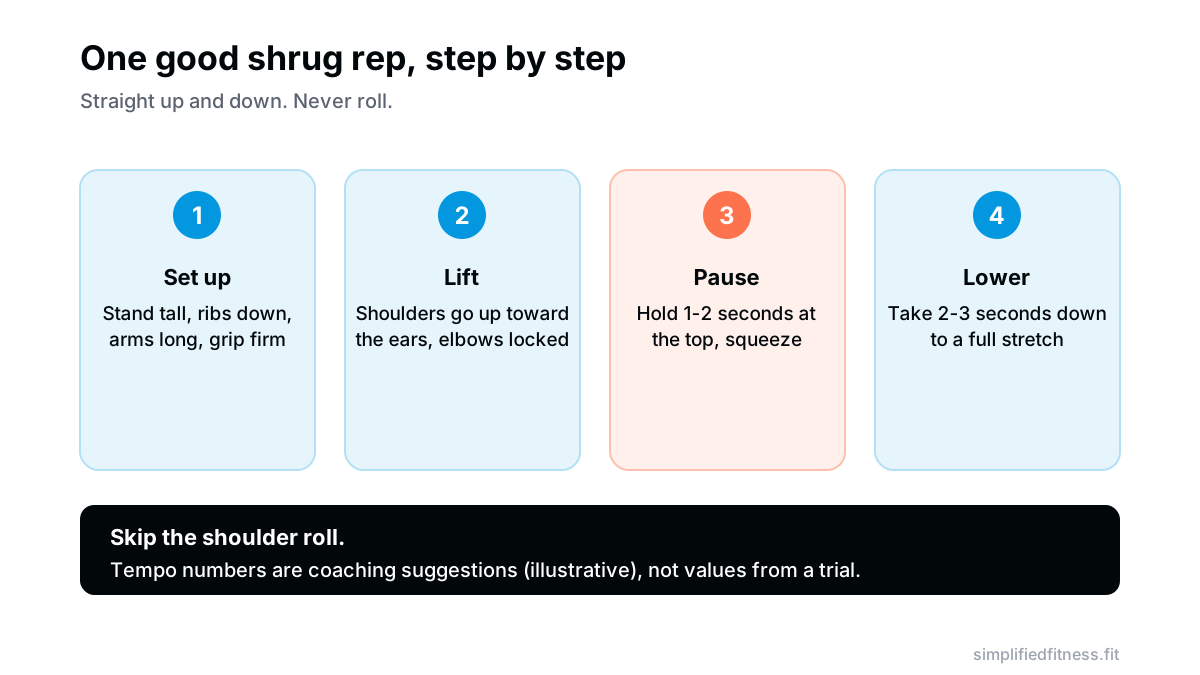
How to shrug properly with a controlled pause
Follow the four steps in Figure 3. A few coaching details help:
- Stand tall with ribs down and head neutral. Jutting the chin forward turns a shrug into a neck-strain exercise.
- Keep the elbows straight and the arms along for the ride.
- Lift as high as you can, then hold for 1-2 seconds. The pause is there to remove momentum, which is the cheapest way to make a light weight honest.
- Lower in 2-3 seconds to a full stretch, shoulders dropped, before the next rep.
Tempo numbers are my suggestions, not trial results. The reason for the pause is practical: if you can only hit the top by bouncing, the weight is too heavy for the muscle you are trying to train. If you want the reasoning for going through the full stretch, our full vs partial range of motion guide covers it.
How heavy, how many reps, how many sets?
The classic idea was that hypertrophy needs 8-12 reps and nothing else. A 2021 review challenged that, arguing muscle growth can be achieved, and in some cases optimized, across a wide spectrum of loading zones (Schoenfeld et al., 2021). That is a review rather than a trap-specific trial, so the practical numbers below are starting points.
- Reps: 8-15 with a clean pause. Heavy enough that the last 1-2 reps feel hard, not ugly.
- Sets: 2-4 hard sets, once or twice a week, after your rows or deadlifts. Use our training volume calculator to see where your weekly shoulder and back work sits.
- Effort: In novice women doing 15-rep-max sets, shrug and other shoulder exercise muscle activity rose from the first to the last rep, with signs of fatigue building inside the set rather than between sets (Jakobsen et al., 2012). The study did not compare training plans, but it fits the usual advice to take sets close to failure rather than adding many easy ones.
For the bigger picture of rep ranges, see our guide to the hypertrophy rep spectrum. If your pull day already includes heavy rows, you can slot shrugs there; our pull day plan shows one way to fit them in.
Shrugs, neck pain and when to be careful
Shrugs are also used in rehab research. In women with chronic neck muscle pain, lateral raises and upright rows reached similar trap activation to shrugs with lighter loads, and the authors suggested these as alternatives during rehabilitation (Andersen et al., 2008). If you are choosing among those options, read our guide to safer upright row modifications.
If you want thicker traps and a stronger neck together, see neck hypertrophy and cervical spine strength training.
When to see a doctor or physiotherapist: sharp or shooting pain, pain that wakes you at night, numbness or tingling down the arm, headaches that start with lifting, or neck pain that does not settle within a couple of weeks. Do not push through those with heavier shrugs.
A simple trap-thickness plan for Indian gyms
Many gyms here have a barbell, a dumbbell rack up to 40-50 kg, and a basic cable stack, so you can run this with almost anything.
- Heavy rows or deadlift variations first, since they work the traps hard anyway.
- Dumbbell or barbell shrugs, 3 sets of 8-15 with a 1-2 second pause.
- Optional: a light Kelso or cable set with arms slightly out, 2 sets of 12-15.
- Eat enough protein (dal, paneer, curd, eggs, soya chunks, chicken) and sleep well; neither shrugs nor any other exercise grows muscle without them.
Frequently Asked Questions
What is the best shrug for upper traps?
There is no single proven winner, but heavy dumbbell or barbell shrugs done straight up and down are the safe default. EMG studies show shrugs of any kind drive the upper traps to very high activation. Pick the version that lets you use a challenging weight with a full range and a pause.
Are barbell or dumbbell shrugs better?
Neither has been shown to build more muscle in a head-to-head trial. Barbells let you go heavier, while dumbbells let your arms hang beside your body so the bar is not blocked by your thighs. Choose based on comfort and how much load you can hold.
Do shrugs actually build big traps?
Shrugs train the upper trapezius directly, and the research shows high activation. Size depends on progressive loading over months, along with deadlifts, rows and carries. Shrugs are a useful finisher, not magic.
What are Kelso shrugs?
A Kelso shrug is a chest-supported, retraction-focused movement where you pull the shoulder blades together rather than lifting them toward your ears. It is meant to target the mid traps and rhomboids more than a standard shrug, though that rests on anatomy rather than direct testing. Start light and focus on a pause at the squeeze.
Do Kelso shrugs work the mid traps?
Mechanically the line of pull fits, since the mid traps retract the scapula. However, I could not find a study that tested the Kelso shrug itself, so the claim rests on anatomy and on research for similar retraction exercises. Use it as a controlled option and keep rows in your program too.
Should I roll my shoulders when I shrug?
No. Rolling adds no extra trap load because the muscle's main action is lifting the shoulder blade, and a loaded circular path may bother the shoulder for no gain. Keep the movement straight up and down with a pause at the top.
How heavy should shrugs be?
Heavy enough that the last couple of reps are hard, but light enough that you can still pause at the top. A 2021 review argues muscle growth can be driven across a wide range of loads when sets are taken close to failure. Many lifters work in the 8-15 rep range for shrugs.
How many reps and sets for shrugs?
Two to four hard sets once or twice a week is a reasonable starting point for most lifters. In one study of novices, muscle activity rose from the first to the last rep within a set, which fits the usual advice to take sets close to failure rather than pad them with easy ones. Add sets slowly if your traps recover well.
Do shrugs hurt your neck or shoulders?
They usually do not when done with sensible loads and no rolling. Heavy shrugs with the chin pushed forward or a jerky bounce may irritate the neck. Stop and see a doctor or physiotherapist if you have sharp pain, numbness or tingling in the arm.
Are cable shrugs better than dumbbell shrugs?
Cables keep tension through the whole rep and let you set an angle, but there is no trial showing they build more muscle. The 30-degree arm position has some EMG support from shrug research that did not use cables. Try it if your gym has a cable stack and you like the feel.
Why do my traps not grow even though I shrug?
Common reasons are using a weight you can bounce, stopping the rep short of the top, and not adding load over time. Grip can also limit you on heavy shrugs. Use straps for the final sets, track your numbers, and aim to beat last week by a rep or a small jump in weight.
Can I train traps with deadlifts and rows instead of shrugs?
Yes, the traps work hard in heavy rows, deadlifts and carries, so many lifters get decent trap size without shrugs. Shrugs just let you target the upper fibers directly with little skill demand. If your program is already full, one or two sets after your pulling work is enough.
Sources & References
Every claim above is checked against peer-reviewed research (PubMed, U.S. National Library of Medicine) or guidance from established health bodies. How we fact-check.
- Ekstrom RA, et al. Surface electromyographic analysis of exercises for the trapezius and serratus anterior muscles. J Orthop Sports Phys Ther. 2003. PMID: 12774999
- Andersen LL, et al. Muscle activation during selected strength exercises in women with chronic neck muscle pain. Phys Ther. 2008. PMID: 18339796
- Pizzari T, et al. Modifying a shrug exercise can facilitate the upward rotator muscles of the scapula. Clin Biomech. 2014. PMID: 24342452
- Lee JH, et al. Various shrug exercises can change scapular kinematics and scapular rotator muscle activities in subjects with scapular downward rotation syndrome. Hum Mov Sci. 2016. PMID: 26625348
- Camargo PR, et al. Kinesiologic considerations for targeting activation of scapulothoracic muscles, part 2: trapezius. Braz J Phys Ther. 2019. PMID: 30797676
- Cools AM, et al. Rehabilitation of scapular muscle balance: which exercises to prescribe? Am J Sports Med. 2007. PMID: 17606671
- Jakobsen MD, et al. Evaluation of muscle activity during a standardized shoulder resistance training bout in novice individuals. J Strength Cond Res. 2012. PMID: 22067242
- Schoenfeld BJ, et al. Loading recommendations for muscle strength, hypertrophy, and local endurance: a re-examination of the repetition continuum. Sports. 2021. PMID: 33671664

Umair Hazrami · Founder & Head Coach, Simplified Fitness
Umair Hazrami founded Simplified Fitness and the Simplified Lifter channel to cut through fitness noise. With 4+ years of consistent training and 10+ coaching clients, he writes every guide from the peer-reviewed research and links the sources so you can check them. Our editorial standards.
Educational content only, not medical advice. If you have a medical condition, are pregnant, or take medication, talk to a qualified doctor before changing your diet, supplements or training. Full disclaimer.
Keep reading
Exercise Technique
3D Shoulder Protocol: Weekly Volume, Frequency (2-3x/Week) and Rep Ranges
How to build 3D shoulders: how many weekly sets, how often to train side and rear delts, and which rep ranges to use, with an 8-week plan and the research.
8 min read

Exercise Technique
Are Front Raises Necessary? Why Bench Pressers Rarely Need Direct Front Delt Work
Are front raises necessary if you bench and overhead press? See what EMG and volume research says, when they can still help, and where to spend those sets.
8 min read
Exercise Technique
Behind-the-Neck Press: Shoulder Mobility, Neck Safety and Muscle Bias
Behind the neck press safety explained: who has the shoulder mobility for it, what EMG studies show for delts, and which swaps work if you do not.
10 min read
Exercise Technique
Cable Lateral Raises: Behind-the-Back vs Cross-Body Setup, Which Is Better?
Cable lateral raise behind the back vs in front: what the research says, which setup suits most lifters, and a step-by-step guide to pulley height and cuffs.
9 min read