Rear Deltoid Training: Reverse Pec Deck vs Cable Face Pulls vs Incline Dumbbell Flyes
Best rear delt exercise? Compare reverse pec deck, cable flies, face pulls and incline flyes, with grip, arm angle and rep range tips backed by EMG research.
TL;DR. The short answer
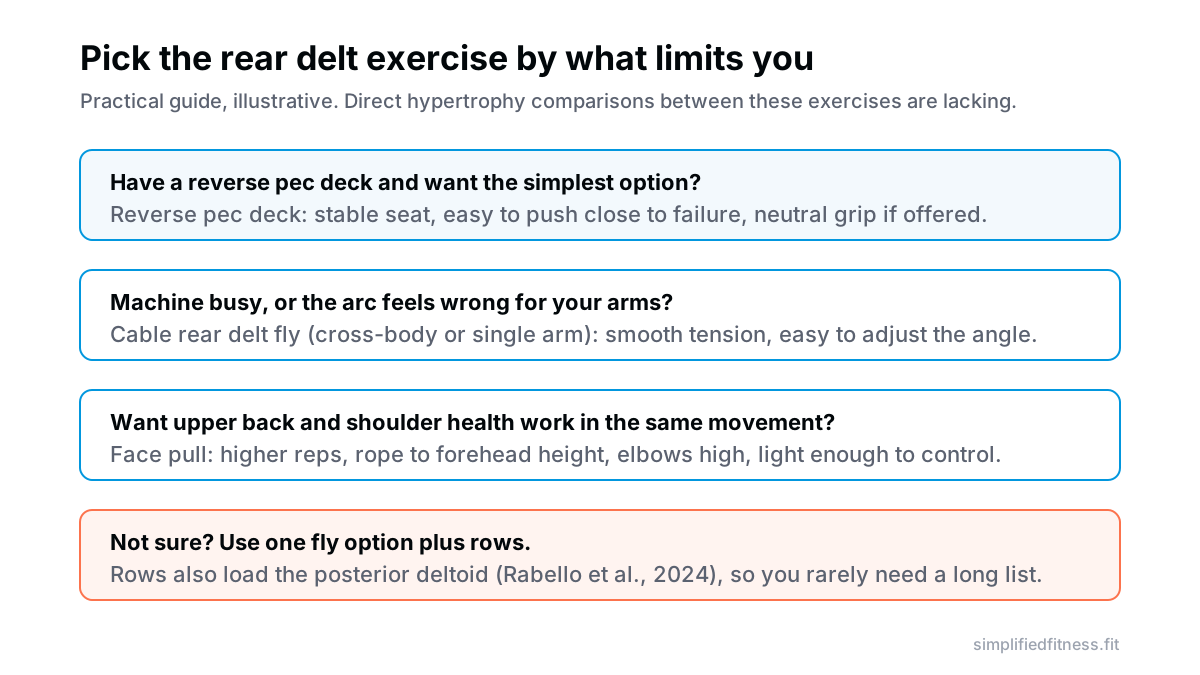
- There is no single best rear delt exercise proven by growth studies. The reverse pec deck, cable rear delt fly and rows all load the posterior deltoid well, so pick the one you can do with control and progress.
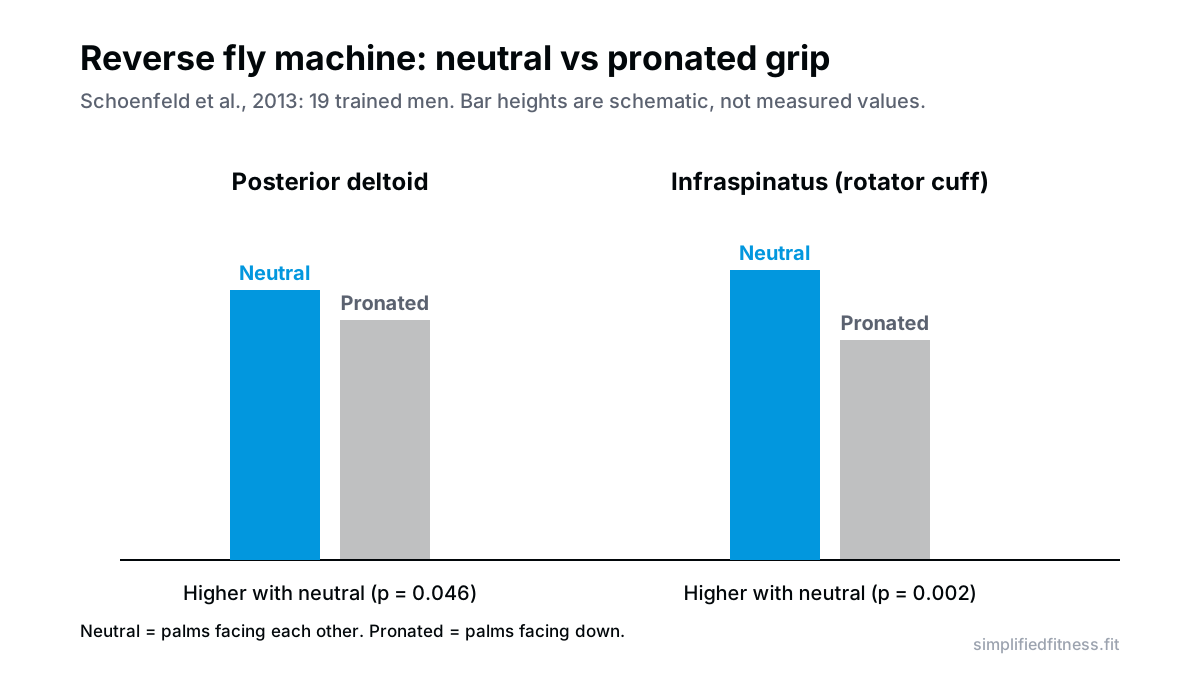
- On the reverse fly machine, a neutral grip (palms facing each other) produced higher posterior deltoid and infraspinatus EMG than a pronated grip in 19 trained men.
- Face pulls are better thought of as a rear delt plus upper back plus shoulder health move, done in higher reps with a lighter load.
- Rows count too. A 2024 systematic review ranked pull-ups and inverted rows highest for posterior deltoid activation among the exercises it compared.
- Use roughly 10-20 reps per set, stop a rep or two short of failure on most sets, and train rear delts two to three times a week if they lag.
Part of our complete guide: Complete Shoulder, Delt & Neck Training Guide: 3D Deltoid Anatomy, Rotator Cuff & Traps
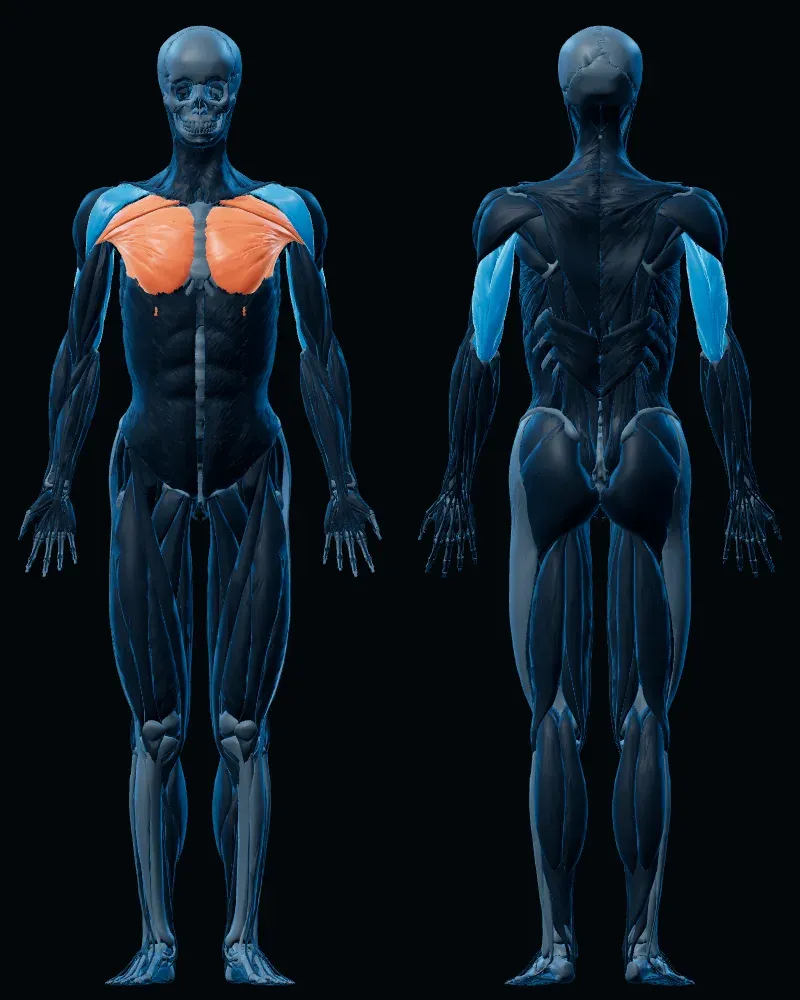
Muscles worked: chest
Main movers: pectoralis major
Assisting: front delts and triceps
Table of contents
The best rear delt exercise is the one you can do with clean form, close to failure, and progress for months. Reverse pec deck, cable rear delt flies and rows all load the posterior deltoid well, and no study has crowned a winner for muscle growth.
That sounds like a cop-out. It is not. It means the details (grip, arm angle, load, rep range) matter more than the machine. This article sits inside our complete shoulder and delt training guide, and it focuses on the back of the shoulder, the head most lifters skip.
What do the rear delts actually do?
The posterior deltoid pulls your upper arm backward and out to the side. In gym terms, it is the muscle that moves when you do a reverse fly. If the anatomy is new to you, start with our breakdown of the three deltoid heads.
Most pressing already hits the front delt, and lateral raises handle the side. The rear head gets little from bench pressing or a standard front overhead press. Rows help, which we will get to.
Reverse pec deck vs cable fly vs face pull: how do they compare?
Here is the honest summary. EMG studies show these exercises all activate the rear delt. What we do not have is a trial that trains one group on pec deck and another on cables for 12 weeks and measures growth. So the comparison below is about practicality, not proven superiority.
| Exercise | Best for | Watch out for |
|---|---|---|
| Reverse pec deck | Stable, easy to push close to failure | Seat height that puts arms too high or low |
| Cable rear delt fly | Smooth tension, easy angle changes | Cable height and body lean changing the line of pull |
| Face pull | Upper back, external rotation, higher reps | Turning it into a trap and rhomboid pull |
| Chest-supported dumbbell fly | Cheap, works anywhere | Little resistance at the bottom of the rep |
| Rows and pull-ups | Heavy loading, big muscle groups | Rear delts may not be the weak link in the movement |
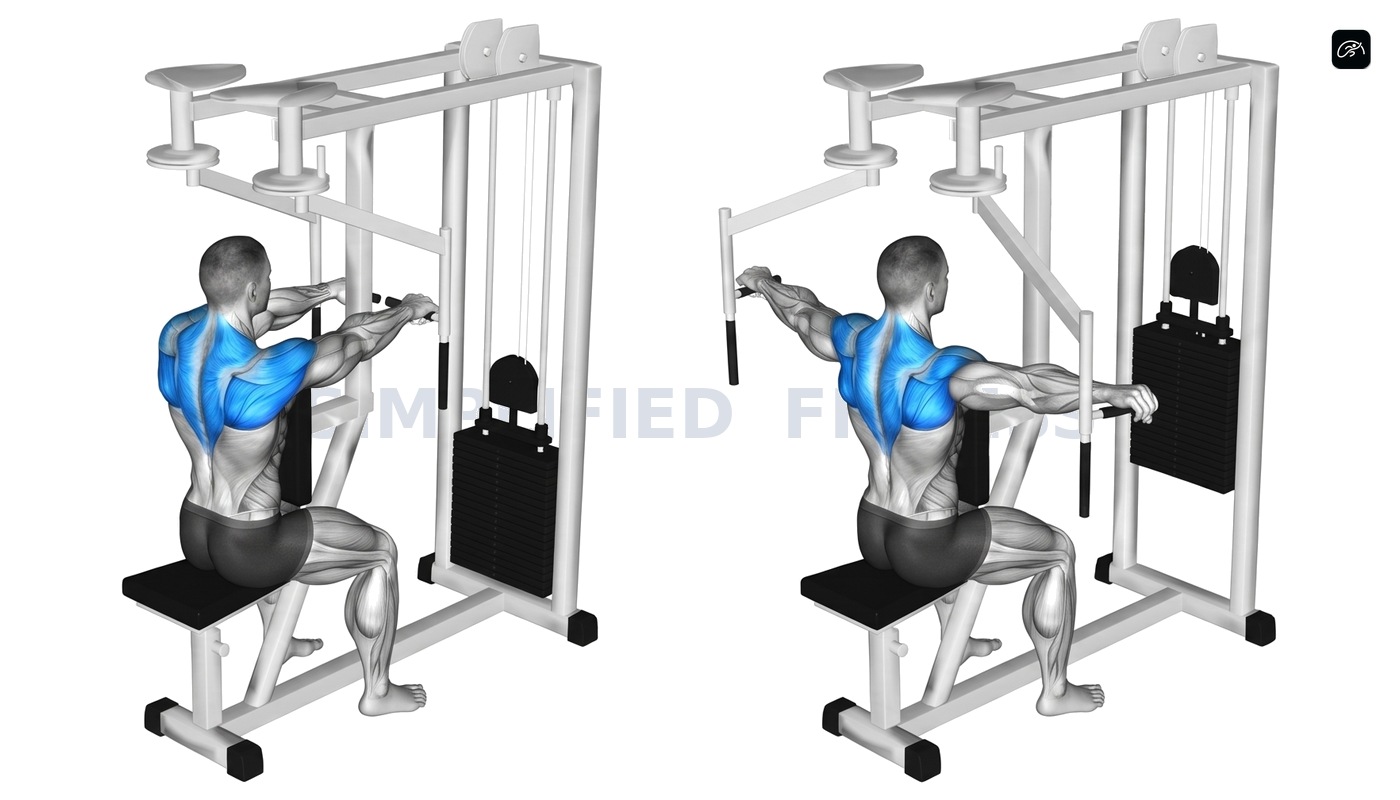
Reverse pec deck
This is the default for most people. The pad fixes your torso, the path is guided, and you can focus on pushing the handles back. You also do not need to balance anything, so it is easy to train hard.
The downside is fit. Machines are built for an average body. If the handles start too far forward or your shoulders roll up, adjust the seat or skip it.
Cable rear delt fly
Set two pulleys at about shoulder height and cross the cables so each hand holds the opposite handle. Step back until there is light tension at the start. Or do it one arm at a time, which makes the path easier to feel.
Cables keep tension on the muscle through the arc, though the exact resistance depends on how you stand and where the pulley sits. Our guide to cable setup, pulley heights and angles covers this in more detail.
Face pulls
Face pulls pull the rope toward your face with the elbows high, then rotate the hands up. That mixes rear delt, mid-back and rotator cuff work. Treat it as a bonus, not your only rear delt exercise. The full technique lives in our face pull form guide.
Incline (chest-supported) dumbbell flyes
Lie chest down on a bench set at about 30-45 degrees and raise light dumbbells out to the sides. It costs nothing if your gym has no machine. Because gravity pulls straight down, the exercise is hardest near the top, when your arms are close to parallel with the floor, and easiest at the bottom where the dumbbells hang.
What does the research say about grip and arm position?
Two details have real data behind them.
Neutral vs pronated grip
Schoenfeld and colleagues (2013) had 19 resistance-trained men do reverse fly machine sets to failure with a neutral and a pronated grip. Mean posterior deltoid EMG was significantly higher with the neutral grip (p = 0.046), and so was infraspinatus activity (p = 0.002). The authors used surface EMG, which measures electrical activity, not muscle growth.
So a neutral grip, palms facing each other, looks like the better first choice. This is one small acute study in young men. It does not prove a neutral grip builds more muscle, but it is a reasonable tiebreaker.
Arm angle
The usual coaching cue is to keep your upper arms at about shoulder height, roughly perpendicular to your torso, rather than drifting up toward your ears or down toward your hips, so the rear delt does the work and the traps do not. This cue is common practice, not a tested rule. The closest data comes from Reinold et al. (2004), who used intramuscular electrodes in 10 healthy people. Prone horizontal abduction at 100 degrees of abduction with full external rotation produced the highest posterior deltoid activity of the seven exercises tested, at 88% of maximal voluntary isometric contraction.
That tells us the position, arms out to the side and thumbs up, loads the rear delt hard. It does not tell us it is best for growth, and the study was not a lifter-style trial.
How do rows and pull-ups fit in?
A 2024 systematic review pulled together 33 EMG studies on the three deltoid heads. For the posterior deltoid, pull-ups gave the greatest group activation, with standard pull-ups and suspension inverted rows the top individual exercises. For the other heads, other exercises led.
Not a reason to ditch reverse flies. Rows are heavy, big-muscle moves, and the rear delts probably get some work. If your back training is solid and your rear delts still lag, add direct sets. Our guide to chest-supported rows for the upper back shows how to row without your rear delts dropping out.
How do I keep the traps and rhomboids from taking over?
Excessive scapular retraction is the classic fault. You lean back, squeeze your shoulder blades together and the movement turns into a mid-back row. The rear delt is along for the ride.
Fix it like this:
- Lower the load. If you can’t pause for one second at the end of the rep, it is too heavy.
- Think about moving your hands apart, not pinching your shoulder blades.
- Keep your shoulders down, not shrugged toward your ears.
- Stop the rep when your arms are about in line with your body, not pulled behind it.
- Keep your chest on the pad or bench.
The most common mistake here is ego loading: stacking the pin way too far down the stack and finishing every rep with a jerk. Rear delts are small and respond poorly to that.
What rep range works best for rear delts?
Roughly 10-20 reps is a practical zone. Rear delt exercises are awkward to load heavily, and light-to-moderate loads are easier to control. The evidence supports this. A 2017 meta-analysis of 21 studies found similar hypertrophy with low-load and high-load training when sets were taken to failure, while heavy loads favored 1RM strength. The 2021 review of the repetition continuum proposes that muscle growth can occur across a wide spectrum of loading zones.
None of that research looked at rear delts specifically, so treat it as a general principle, not a rear delt-specific result.
How many sets and how often to grow rear delts fast?
Faster results come from consistent weekly volume, not from exotic exercises. A meta-regression by Schoenfeld and colleagues (2017) of 15 studies found a graded dose-response between weekly sets and muscle size, with each added set linked to a small gain. That data covers muscles in general, not rear delts. A larger 2026 meta-regression of 67 studies confirmed that growth rises with weekly volume but with diminishing returns, and found frequency mattered little for growth once volume was set.
A practical starting point:
- 6-12 hard weekly sets for rear delts, rows included
- Split across two or three sessions
- One fly option as your main lift, one lighter option (such as face pulls) as a finisher
If your shoulders ache, cut sets before you add them. Our 3D shoulder protocol shows how to fit all three heads into a week. You can also plug your sets into the training volume calculator to see your weekly total.
Is it safe? When to see a doctor
Rear delt training is generally low-risk when the load is light and the range is comfortable. Scapular position matters for shoulder comfort. Escamilla and colleagues (2009) reviewed shoulder rehab exercises and noted that scapular retraction, compared with protraction, widens the subacromial space during elevation. That is one reason controlled retraction is useful, and also why swinging, shrugged reps are a poor idea.
Sharp pain, pain at night, numbness, tingling or sudden weakness are reasons to stop and see a doctor or physiotherapist. Do not push through them.
A simple rear delt template for Indian gym setups
Many Indian commercial gyms have a pec deck that doubles as a reverse fly, plus a cable crossover. That is enough. Here is a sample:
- Pull day: reverse pec deck, 3 sets of 12-15, neutral grip if available
- Push day: cable rear delt fly or chest-supported dumbbell fly, 2-3 sets of 15-20
- Optional finisher: face pulls, 2 sets of 15-20
Eat enough protein through dal, paneer, curd, soya or eggs, sleep properly, and be patient. Small muscles are slow to change visibly. Photograph your side delts and back every four weeks under the same light.
The bottom line
The best rear delt exercise is a controlled one you can progress. Use a neutral grip on the reverse pec deck when possible, keep reps in the 10-20 zone, avoid pinching your shoulder blades, and mix in cables, face pulls and rows. Then count your weekly sets and add only when progress stalls.
Frequently Asked Questions
What is the best rear delt exercise?
No exercise has been proven best for rear delt growth, because head-to-head hypertrophy trials do not exist. Reverse pec deck, cable rear delt flies and rows all produce strong posterior deltoid activation in EMG work. Choose the one you can control best and add reps or load over time.
Is reverse pec deck better than face pulls for rear delts?
The reverse pec deck is usually easier to load and feel in the rear delts, while face pulls spread the work across the upper back and rotator cuff. Neither has been shown in a trial to grow rear delts more. Use the pec deck as your main rear delt movement and face pulls as a lighter add-on.
Should I use a neutral or pronated grip on the reverse pec deck?
Try neutral first. In a 2013 study of 19 resistance-trained men, a neutral grip gave higher mean posterior deltoid and infraspinatus EMG than a pronated grip on the reverse fly machine. If a neutral grip bothers your wrists or shoulders, a pronated grip is a reasonable alternative.
How do I stop my traps taking over on rear delt flies?
Keep the weight light enough that you can pause at the end of each rep, and think about moving your arms apart, not squeezing your shoulder blades together. Heavy loads and big shrugs shift effort to the traps and rhomboids. Drop the load by 20-30% and lead with the elbows.
How many sets of rear delts per week do I need?
Many lifters do well on roughly 6-12 hard sets a week for rear delts, counting rows that reach the rear delts too. A volume meta-analysis found a graded relationship between weekly sets and muscle gain, though it covered whole muscles, not rear delts specifically. Start at the lower end, track your reps, and add a set only if progress stalls.
What rep range is best for rear delts?
Moderate to high reps, around 10-20, tend to work well because rear delt exercises are hard to load heavily with good form. Reviews show muscle growth can happen across a wide range of loads when sets are taken close to failure. Pick a weight that lets you finish the range without swinging.
How often should I train rear delts?
Two to three times per week is a sensible default for a lagging rear delt. A 2026 meta-regression found frequency had little clear effect on muscle growth once weekly volume was accounted for, so splitting sets across sessions is mainly a way to keep each set high quality. Add one fly or face pull to pull days and one to push days.
Do rows and pull-ups train rear delts?
Yes. A 2024 systematic review of 33 EMG studies found pull-ups and inverted rows produced the greatest posterior deltoid activation among the grouped exercises. That does not replace direct work for a stubborn rear delt, but it means your back training already counts. Do not stack extra sets if your shoulders feel beaten up.
Are incline dumbbell rear delt flyes any good?
Chest-supported dumbbell flyes are a solid, cheap option when you have no machine or cables. Gravity pulls straight down, so resistance is hardest when your arms are out to the sides. Start with light dumbbells and keep your chest on the bench so your lower back is not doing the lifting.
Why are my rear delts not growing?
The usual causes are chasing heavy weights with swinging reps, doing too few weekly sets, or letting traps do the work. Rear delts respond to the same basics as any muscle: close-to-failure sets, progressive overload and enough weekly volume. Log your reps for six weeks and fix whichever of those three is weakest.
Can face pulls fix shoulder pain?
Face pulls are a popular shoulder health exercise, but there is no strong evidence that they treat shoulder pain. They train the upper back and external rotators, which can support shoulder function. If you have ongoing pain, night pain, numbness or weakness, see a doctor or physiotherapist before loading it.
How much weight should I use for rear delt flies?
Far less than you think. Rear delts are small, and most people end up using a weight where the last reps are carried by momentum and traps. Choose a load where you hit 12-15 clean reps with a one-second pause at the end of each rep.
Sources & References
Every claim above is checked against peer-reviewed research (PubMed, U.S. National Library of Medicine) or guidance from established health bodies. How we fact-check.
- Schoenfeld BJ, et al. Effect of hand position on EMG activity of the posterior shoulder musculature during a horizontal abduction exercise. J Strength Cond Res. 2013. PMID: 23302754
- Rabello R, et al. Activation of the three deltoid muscle portions during common strengthening exercises: a systematic review. J Bodyw Mov Ther. 2024. PMID: 39593452
- Reinold MM, et al. Electromyographic analysis of the rotator cuff and deltoid musculature during common shoulder external rotation exercises. J Orthop Sports Phys Ther. 2004. PMID: 15296366
- Escamilla RF, et al. Shoulder muscle activity and function in common shoulder rehabilitation exercises. Sports Med. 2009. PMID: 19769415
- Schoenfeld BJ, et al. Loading recommendations for muscle strength, hypertrophy, and local endurance: a re-examination of the repetition continuum. Sports (Basel). 2021. PMID: 33671664
- Schoenfeld BJ, et al. Strength and hypertrophy adaptations between low- vs. high-load resistance training: a systematic review and meta-analysis. J Strength Cond Res. 2017. PMID: 28834797
- Schoenfeld BJ, et al. Dose-response relationship between weekly resistance training volume and increases in muscle mass: a systematic review and meta-analysis. J Sports Sci. 2017. PMID: 27433992
- Pelland JC, et al. The Resistance Training Dose Response: Meta-Regressions Exploring the Effects of Weekly Volume and Frequency on Muscle Hypertrophy and Strength Gains. Sports Med. 2026. PMID: 41343037

Umair Hazrami · Founder & Head Coach, Simplified Fitness
Umair Hazrami founded Simplified Fitness and the Simplified Lifter channel to cut through fitness noise. With 4+ years of consistent training and 10+ coaching clients, he writes every guide from the peer-reviewed research and links the sources so you can check them. Our editorial standards.
Educational content only, not medical advice. If you have a medical condition, are pregnant, or take medication, talk to a qualified doctor before changing your diet, supplements or training. Full disclaimer.
Keep reading
Exercise Technique
3D Shoulder Protocol: Weekly Volume, Frequency (2-3x/Week) and Rep Ranges
How to build 3D shoulders: how many weekly sets, how often to train side and rear delts, and which rep ranges to use, with an 8-week plan and the research.
8 min read

Exercise Technique
Are Front Raises Necessary? Why Bench Pressers Rarely Need Direct Front Delt Work
Are front raises necessary if you bench and overhead press? See what EMG and volume research says, when they can still help, and where to spend those sets.
8 min read

Exercise Technique
Behind-the-Neck Press: Shoulder Mobility, Neck Safety and Muscle Bias
Behind the neck press safety explained: who has the shoulder mobility for it, what EMG studies show for delts, and which swaps work if you do not.
10 min read
Exercise Technique
Cable Lateral Raises: Behind-the-Back vs Cross-Body Setup, Which Is Better?
Cable lateral raise behind the back vs in front: what the research says, which setup suits most lifters, and a step-by-step guide to pulley height and cuffs.
9 min read