Long Muscle Length Training: Why Stretched Positions Build More Muscle
Long muscle length training may build more muscle when the stretch is loaded. See the MRI trials, the exercise swaps, and where the evidence is still thin.

TL;DR. The short answer
- Long muscle length training means loading a muscle hard while it is stretched. In several 12-week MRI trials it grew more muscle than the shorter-length version of the same exercise: hamstrings +14% vs +9%, triceps +19.9% vs +13.9%.
- The likely reasons are that a stretched muscle carries both active force from contraction and passive tension from stretched tissue, though human trials cannot yet isolate which one does the work.
- The strongest evidence is for hamstrings, calves and the triceps long head. Evidence for the chest, back and quads is thinner, and a 2025 meta-analysis found similar regional growth between longer and shorter mean lengths.
- Practical swaps: seated leg curl over lying, standing calf raise over seated, overhead triceps extension over pushdown. Keep the weight you can control at the bottom of the rep.
- Stretch under load does not mean forcing a painful range. If a position hurts a joint or tendon, shorten it and see a physio if the pain persists.
Part of our complete guide: Muscle Length, Range of Motion and Stretch-Mediated Hypertrophy: What the Research Actually Shows
Table of contents
Long muscle length training means putting a muscle under heavy load while it is stretched, and in several MRI trials it has produced more growth than the same exercise done at shorter lengths. The effect looks real for some muscles, like hamstrings, calves and the triceps long head, and uncertain for others.
This is the general principle behind our range of motion and stretch-mediated hypertrophy guide. Here we stay on the practical question: which exercises put you in a lengthened position, why that may matter, and where the evidence is still thin.
What is long muscle length training?
A muscle is “long” when the joints it crosses are positioned so that it is stretched. For your hamstrings that means hips flexed, like sitting upright. For your triceps long head it means the arm overhead. For your calves it means the knee straight.
Long muscle length training is simply choosing exercises and ranges that load the muscle hard in that stretched position, instead of only at the squeezed, shortened top of the rep.
It is not a new type of program. It is an exercise selection filter: of the options that train a muscle, prefer the one that gives it real work when it is stretched.
What do the MRI trials actually show?
Three well-controlled trials from the same Japanese lab give the clearest picture. Each used a within-person design, meaning one limb trained the long-length version and the other limb the shorter-length version. All used 70% of 1RM, 5 sets of 10 reps, twice a week for 12 weeks, with muscle volume measured by MRI.
- Hamstrings. In 20 healthy adults, seated leg curls (hips flexed, hamstrings longer) grew the whole hamstrings 14% versus 9% for prone leg curls. The difference sat in the two-joint hamstring muscles; the single-joint one grew similarly (+10% vs +9%) (Maeo et al., 2021).
- Triceps. In 21 adults, overhead cable extensions grew the whole triceps +19.9% versus +13.9% for the arm-by-side version, and the long head +28.5% versus +19.6%, even though the overhead arm lifted 34-39% less absolute weight (Maeo et al., 2023).
- Calves. In 14 untrained adults, standing calf raises grew the whole triceps surae +5.6% versus +2.1% for seated, and the lateral gastrocnemius +12.4% versus +1.7%. The soleus, which does not cross the knee, grew similarly in both (Kinoshita et al., 2023).
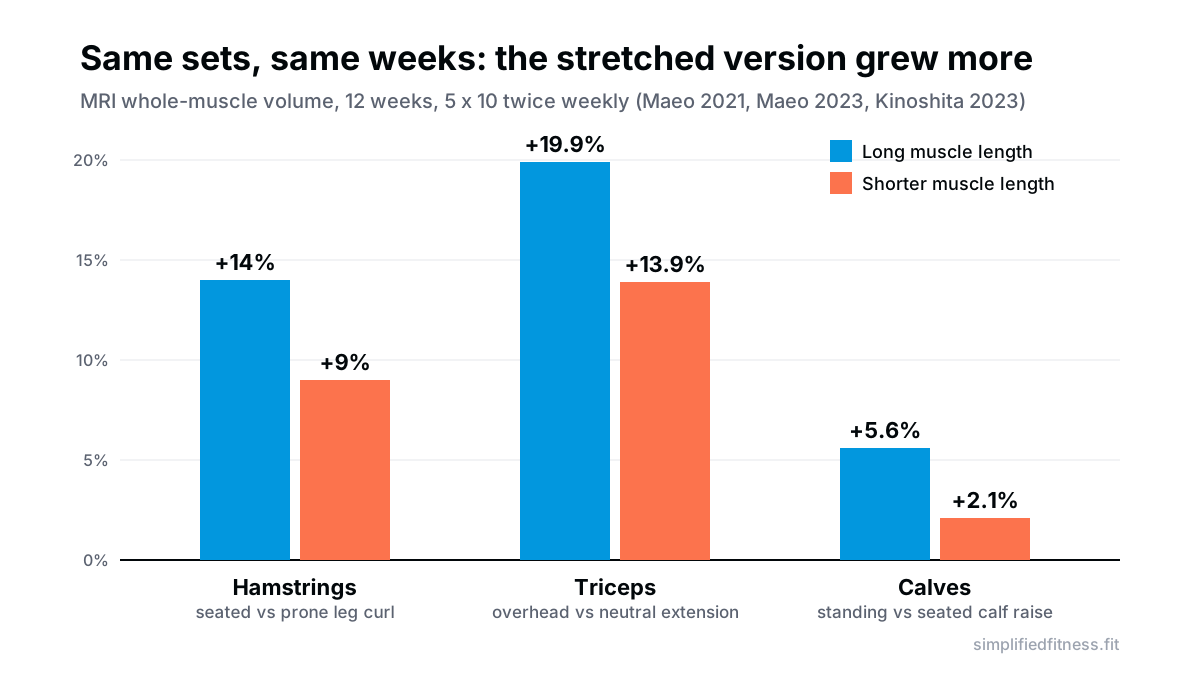
The calf result is a nice built-in control. The soleus did not change length between conditions and did not differ, while the gastrocnemius did change length and did differ.
Why would a deep stretch build more muscle?
Nobody has a clean answer yet, but the leading idea has two parts.
Active force. When you contract, the force comes from the actin and myosin cross-bridges inside the muscle fibres. How much force a muscle can produce depends on its length, which is the length-tension relationship. We cover that physics in the length-tension curve explainer.
Passive tension. When a muscle is stretched, connective tissue and the giant protein titin also resist and carry load, even with no contraction. At long lengths you get contraction force plus stretch-related tension, so the muscle may experience more total mechanical tension per rep.
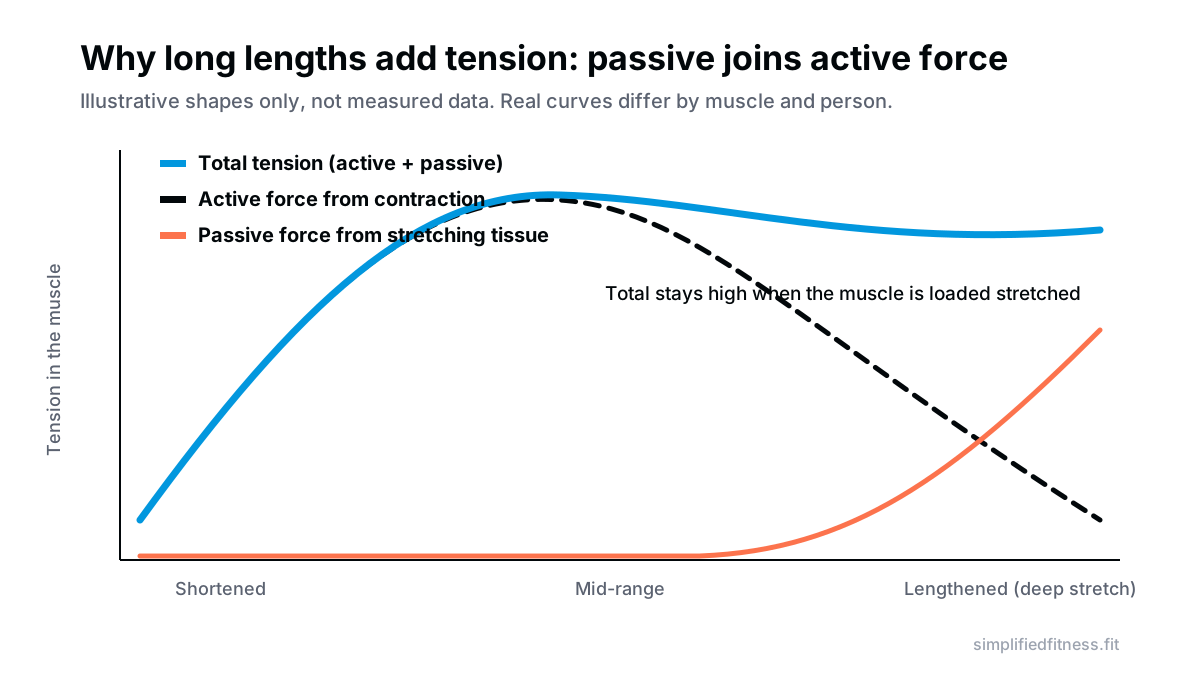
Here is the honest caveat. A 2026 review noted it is difficult to tell whether muscle length itself is the main factor, because length, range of motion and exercise choice are tangled together. It also found that the extra growth tends to show up when there is a relevant external torque in the lengthened position, meaning the exercise actually loads you there (Pedrosa et al., 2026).
In plain gym language: a stretch with no load on it is not the point. A stretch with the weight pulling hardest on you is.
Does it work the same for every muscle?
No, and this is where the claims on social media get ahead of the data.
The strongest human evidence is for muscles where a clear long-versus-short exercise pair exists: hamstrings, triceps long head, gastrocnemius. For the quads, chest, back and biceps, trials are fewer, smaller or give mixed results.
Take the biceps. In a 2026 trial, 21 untrained adults trained one arm with incline dumbbell curls (shoulder extended, biceps longer) and the other with preacher curls for 12 weeks. The biceps brachii grew more with incline (+22.1% vs +18.9%), but the brachialis and brachioradialis grew more with preacher, and total elbow flexor growth did not differ (+17.6% vs +19.2%) (Kobayashi et al., 2026). Small-to-moderate differences between individual muscles, no clear whole-arm winner.
Now the conflicting meta-analysis. A 2025 Bayesian meta-analysis of 12 studies in young adults looked at regional hypertrophy and found trivial differences between proximal, mid-belly and distal sites, concluding that training at longer and shorter mean muscle lengths produces similar hypertrophic effects. The authors warned that the length differences between conditions in the included studies were small (about 21.8% of muscle length on average), so the result should be read with caution (Varovic et al., 2025).
Why do these disagree? Nobody has tested it directly, but one likely reason is that the MRI trials compared large length differences between two quite different exercises. The meta-analysis pooled many studies with smaller differences and looked at regions inside a muscle rather than whole-muscle volume. Both can be true: a big change in length for a muscle that responds to it may matter, and small tweaks may not.
The sensible takeaway is to treat lengthened exercises as a good tiebreaker, not a magic switch.
How does this fit with full range of motion?
Full range already includes the stretched position, which is one reason full reps tend to do well. A 2021 meta-analysis of 16 studies found full range training beat partial range for lower-limb hypertrophy (effect size 0.88), with no clear difference in muscle thickness, pennation angle or fascicle length (Pallares et al., 2021).
What about cutting the top half off the rep and only working the stretch? In a 2025 trial, 30 resistance-trained people trained upper-body muscles with lengthened partials on one side and full range on the other for 8 weeks. Muscle thickness grew similarly in both, and the authors suggest trainees should emphasise the stretched position either way (Wolf et al., 2025). We go deeper on the technique in lengthened partials for hypertrophy, and on the broader comparison in full vs partial range of motion.
Which lengthened position exercises should you use?
Here is a practical shortlist. Rows marked “MRI trial” come from the studies above; the others apply the same logic and have thinner direct evidence.
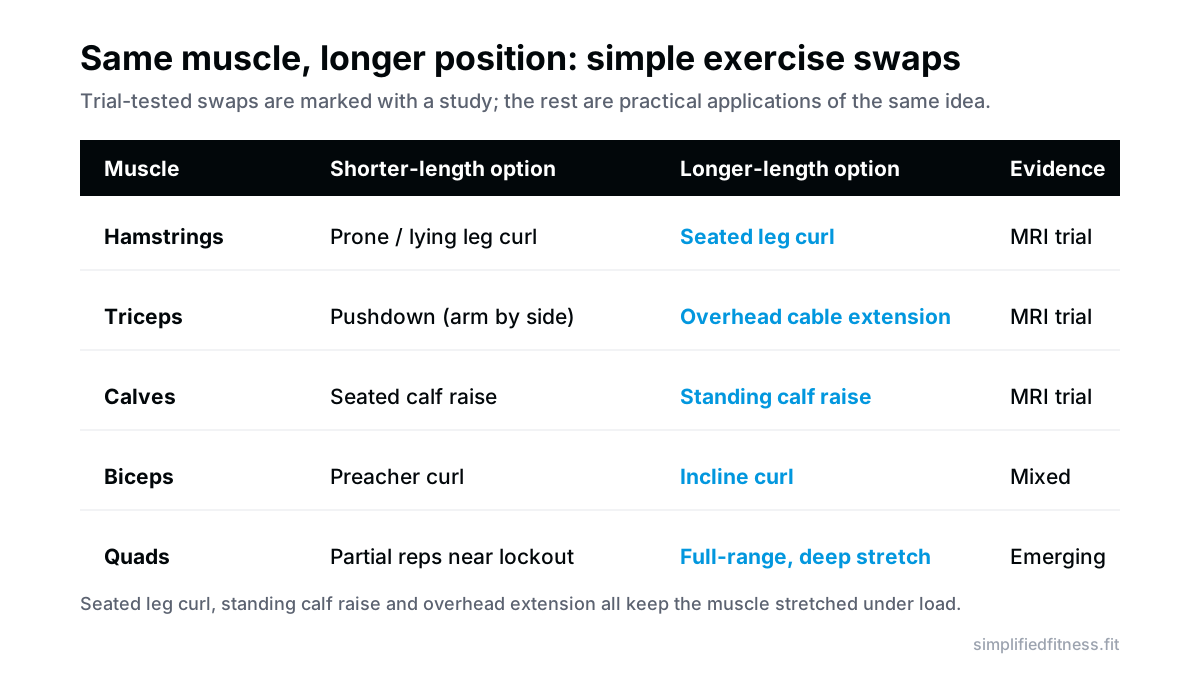
Hamstrings: seated leg curl. Sit upright so the hips are flexed and the hamstrings are stretched at the start of each rep. Our seated vs lying leg curl comparison goes into setup details.
Triceps: overhead extension. Raise the arm overhead and bend the elbow deeply. More in overhead vs neutral triceps.
Calves: standing calf raise. Keep the knee straight and lower the heel as far as you can control. If your gym only has a seated calf machine, standing raises on a stair edge holding a dumbbell keep the knee straight and do the same job. See straight-leg vs bent-knee calf raises.
Biceps: incline curl or a stretched curl. The trial evidence is mixed, so use it as variety, not as a replacement. Compare options in incline vs preacher curls.
Quads, chest, back. Deep squats, deep leg press and controlled dumbbell or cable flyes with a real stretch are reasonable choices. The direct trial evidence is thinner, so hold these more loosely.
How to add it to your training
Keep it boring and consistent.
- Pick one lengthened option per muscle. Do not replace everything at once.
- Control the bottom. Lower for 2-3 seconds, pause lightly if you like, and do not bounce.
- Use weight you can control in the stretch. The overhead triceps trial used lower loads than the neutral version and still grew more, so ego loading is not needed.
- Train it twice a week and progress it. Add reps first, then weight.
- Count sets. Check your weekly volume with the training volume calculator, or build the leg session around our free leg day plan.
None of this replaces the basics. Enough protein and enough hard weekly sets are the foundation, and an exercise swap is a refinement on top. If you eat vegetarian, dal, paneer, curd and soya (plus eggs, if you eat them) can cover your protein. This article is about exercise selection, not a substitute for those basics.
Who should be careful?
Deep stretch under load is demanding on joints and tendons. Be cautious if you have a current injury, a history of hamstring, shoulder or knee problems, or hypermobility. Start with lighter loads and a smaller range, and build up over several weeks.
Stop and get checked by a doctor or physiotherapist if you have sharp pain, pain that lingers for days, numbness or swelling. This article is general education and cannot diagnose anything.
Bottom line
Long muscle length training is a sensible way to choose exercises: when two options train the same muscle, prefer the one that loads the stretch. The best human evidence comes from hamstrings, calves and the triceps long head, in short MRI trials mostly in untrained or lightly trained adults. For other muscles the evidence is mixed or emerging, and a 2025 meta-analysis found similar regional growth between longer and shorter lengths.
So make a small change: one swap per muscle, controlled reps, full range, and enough weekly sets. That is where the gain is likely to come from.
Frequently Asked Questions
What is long muscle length training?
It is training where the muscle is under heavy load while it is in a lengthened, stretched position. Examples are the bottom of a Romanian deadlift for the hamstrings or the deep stretch of an overhead triceps extension. The idea is that this position combines contraction force with stretch-related tension, so choose exercises and ranges that load that part of the movement.
Do lengthened position exercises really build more muscle?
In several 12-week MRI trials, yes, for specific muscles: seated beat prone leg curls for the hamstrings and overhead beat neutral triceps extensions. A 2025 review of regional growth found similar results between longer and shorter mean lengths, so the effect is not universal. Treat it as a useful tilt in exercise selection rather than a rule that overrides everything else.
Why does a deep stretch build more muscle?
The leading explanation is that a stretched muscle has high passive tension from connective tissue and titin on top of the force from contraction, which may raise the growth signal. Human studies show the outcome but cannot prove which mechanism produces it. In practice, load the stretched position and do not bounce out of it.
What is passive tension in hypertrophy?
Passive tension is the force a muscle produces just from being stretched, without any contraction, coming from tissues like fascia and the giant protein titin. Active tension is what the contraction itself generates. A lengthened set adds the two together, which is why the stretched position is of interest to researchers.
Which exercises train muscles at long lengths?
Common ones are the seated leg curl, standing calf raise, overhead cable triceps extension, incline dumbbell curl, Romanian deadlift, deep squat and dumbbell flyes with a controlled stretch. What matters is that the exercise places real external load on the muscle in the stretched position. Pick one lengthened option per muscle and progress it.
Is long muscle length training better for hamstrings?
The evidence is strongest here. In a 12-week trial of 20 adults, seated leg curls grew the whole hamstrings 14% versus 9% for prone curls, with the extra growth in the two-joint hamstring muscles. If your gym has a seated leg curl, make it your main hamstring curl.
Should I train only at long muscle lengths?
No. Full range of motion remains a sound default and long-length work is one tool inside it. Meta-analyses of range of motion favour full range for lower-body size, and reviewers note it is hard to separate muscle length from range itself. Use full reps as the base and emphasise the stretch where you can.
Are lengthened partials the same as long muscle length training?
Lengthened partials are one method of it: you work only the stretched half of the rep. A 2025 trial in trained people found similar upper-body growth with lengthened partials and full range. Our guide on lengthened partials covers the technique in detail, while this article is the general principle.
Does stretching between sets count as long muscle length training?
Not really. Long muscle length training means the stretch happens under load during the rep. Passive stretching between sets is a separate idea with its own limited evidence. Spend the time on controlled reps instead.
Is long muscle length training safe for joints?
For most healthy lifters it is fine when you control the load and the speed in the stretched position. Painful end ranges, a sharp pinch or joint discomfort are signs to reduce depth or load. See a doctor or physiotherapist if pain persists, especially around the shoulder, hip or knee.
Does it work for beginners?
The MRI trials mostly used young adults who were not experienced lifters (the calf and biceps trials explicitly recruited untrained people), so the evidence for beginners is better than for advanced lifters. Beginners also grow well from almost any sensible program. Learn full-range technique first, then choose the lengthened variation of each exercise.
How many sets of lengthened exercises do I need?
The trials used 5 sets of 10 reps at about 70% of 1RM, twice a week, but that was a research protocol rather than a prescription. A reasonable starting point is 2-3 hard sets of a lengthened exercise per muscle, twice weekly, within your existing weekly volume. Add sets slowly if recovery is good.
Do I need to change my whole program?
Usually not. Swap one exercise per muscle for its lengthened version, and keep the rest. You can use the free leg day plan and training volume calculator to keep weekly sets in a sensible range.
Sources & References
Every claim above is checked against peer-reviewed research (PubMed, U.S. National Library of Medicine) or guidance from established health bodies. How we fact-check.
- Maeo S, et al. Greater hamstrings muscle hypertrophy but similar damage protection after training at long versus short muscle lengths. Med Sci Sports Exerc. 2021. PMID: 33009197
- Maeo S, et al. Triceps brachii hypertrophy is substantially greater after elbow extension training performed in the overhead versus neutral arm position. Eur J Sport Sci. 2023. PMID: 35819335
- Kinoshita M, et al. Triceps surae muscle hypertrophy is greater after standing versus seated calf-raise training. Front Physiol. 2023. PMID: 38156065
- Pedrosa GF, et al. The interplay between muscle length, range of motion, and exercise selection: a review. Sports Med Int Open. 2026. PMID: 41777276
- Varovic D, et al. Does muscle length influence regional hypertrophy? A systematic review and meta-analysis. Int J Sports Med. 2025. PMID: 40570881
- Pallares JG, et al. Effects of range of motion on resistance training adaptations: a systematic review and meta-analysis. Scand J Med Sci Sports. 2021. PMID: 34170576
- Wolf M, et al. Lengthened partial repetitions elicit similar muscular adaptations as full range of motion repetitions during resistance training in trained individuals. PeerJ. 2025. PMID: 39959841
- Kobayashi Y, et al. Exercise-specific preferential hypertrophy of individual elbow flexor muscles after incline versus preacher dumbbell curl training. J Sports Sci. 2026. PMID: 42829982

Umair Hazrami · Founder & Head Coach, Simplified Fitness
Umair Hazrami founded Simplified Fitness and the Simplified Lifter channel to cut through fitness noise. With 4+ years of consistent training and 10+ coaching clients, he writes every guide from the peer-reviewed research and links the sources so you can check them. Our editorial standards.
Educational content only, not medical advice. If you have a medical condition, are pregnant, or take medication, talk to a qualified doctor before changing your diet, supplements or training. Full disclaimer.
Keep reading

Hypertrophy
Active vs Passive Insufficiency: How Two-Joint Muscles Change Your Exercise Choice
Active vs passive insufficiency explained for lifters: why hamstrings, triceps, quads and calves grow differently depending on your second joint position.
10 min read

Hypertrophy
Squat Mobility With Long Femurs: Adapting Range of Motion to Your Hips
Squat mobility with long femurs is mostly a lever and hip-socket issue, not a flaw. Learn how to adjust depth, stance and heels without risking your hips.
10 min read
Hypertrophy
Dumbbell Pullovers vs Cable Lat Pull-ins: Training Lats at Long Muscle Lengths
Training lats at long muscle lengths: is the dumbbell pullover a lat or chest exercise, and why a cable lat pull-in may keep tension where you want it.
7 min read

Hypertrophy
Full vs Partial Range of Motion: What the Hypertrophy Research Shows
Full vs partial ROM hypertrophy explained: what two meta-analyses and recent trials found, where lengthened partials fit, and how to set your range of motion.
8 min read