Best Lateral Raise Variation: Dumbbells vs Cables vs Machines for Wider Shoulders
Which is the best lateral raise variation for side delt growth? Dumbbell vs cable vs machine, what a 2025 trial found and how to set up each one safely.
TL;DR. The short answer
- In the only direct trial in trained lifters (24 people, 8 weeks), dumbbell and cable lateral raises grew the lateral deltoid by a similar amount, about 3.3-4.6% in muscle thickness.
- Dumbbells load the delt least at the bottom and most near 90 degrees. Cables and machines can spread tension more evenly, but that has not yet been shown to produce more growth.
- The best lateral raise variation is the one you can do through a controlled, pain-free range, close to failure, and repeat every week.
- Weekly side delt volume matters more than the equipment: more hard sets generally mean more growth, with diminishing returns, so build up gradually.
- Sharp pinching at the top of the shoulder, or pain that lingers after training, is a reason to see a physio or doctor, not to push harder.
Part of our complete guide: Complete Shoulder, Delt & Neck Training Guide: 3D Deltoid Anatomy, Rotator Cuff & Traps
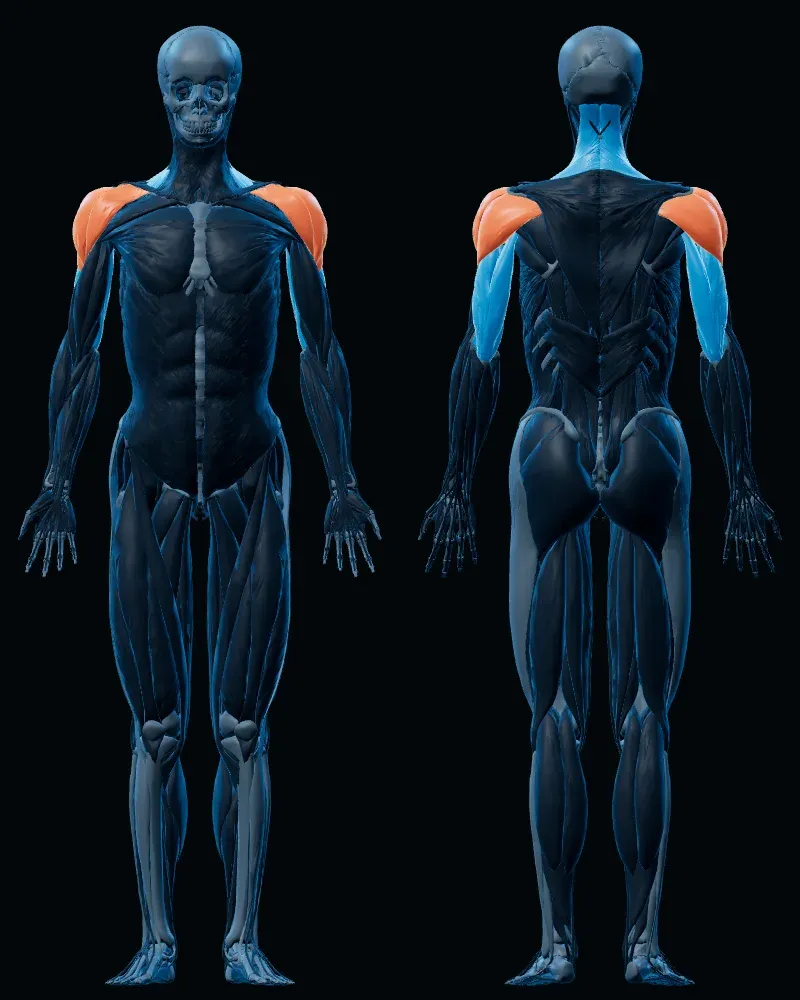
Muscles worked: shoulders
Main movers: all three heads of the deltoid
Assisting: supraspinatus, upper traps and triceps
Table of contents
The best lateral raise variation is, on current evidence, the one that lets you train the side delt hard through a controlled range without joint pain. In the one direct trial comparing dumbbells with cables in trained lifters, muscle growth was similar. Machines make sense too, but nobody has tested them head to head over weeks yet.
That surprises people, because the internet is loud about “constant tension” and “dead zones.” This article sits inside our complete shoulder and delt training guide. Here we look at what the mechanics say, what the research actually found, and how to set up each version so your shoulders stay happy.
Why the side delt matters for shoulder width
The lateral (or “medial”) head of the deltoid sits on the outside of your shoulder. It is the part that sticks out sideways, so it has the biggest say in how wide you look from the front. If you want the anatomy first, see our breakdown of the three deltoid heads.
Its main job is raising the arm out to the side (abduction). That makes the lateral raise the obvious tool. Pressing hits it too, but front delts and triceps do a lot of the work there.
Dumbbell lateral raise: the resistance profile
A dumbbell is gravity, and gravity pulls straight down. With your arm hanging at your side, the weight sits almost in line with your arm, so the turning force on your shoulder is tiny. As your arm rises towards parallel, the weight gets further from the joint horizontally and the demand climbs.
The practical result: standing dumbbell raises feel nearly weightless at the bottom and hardest near the top.
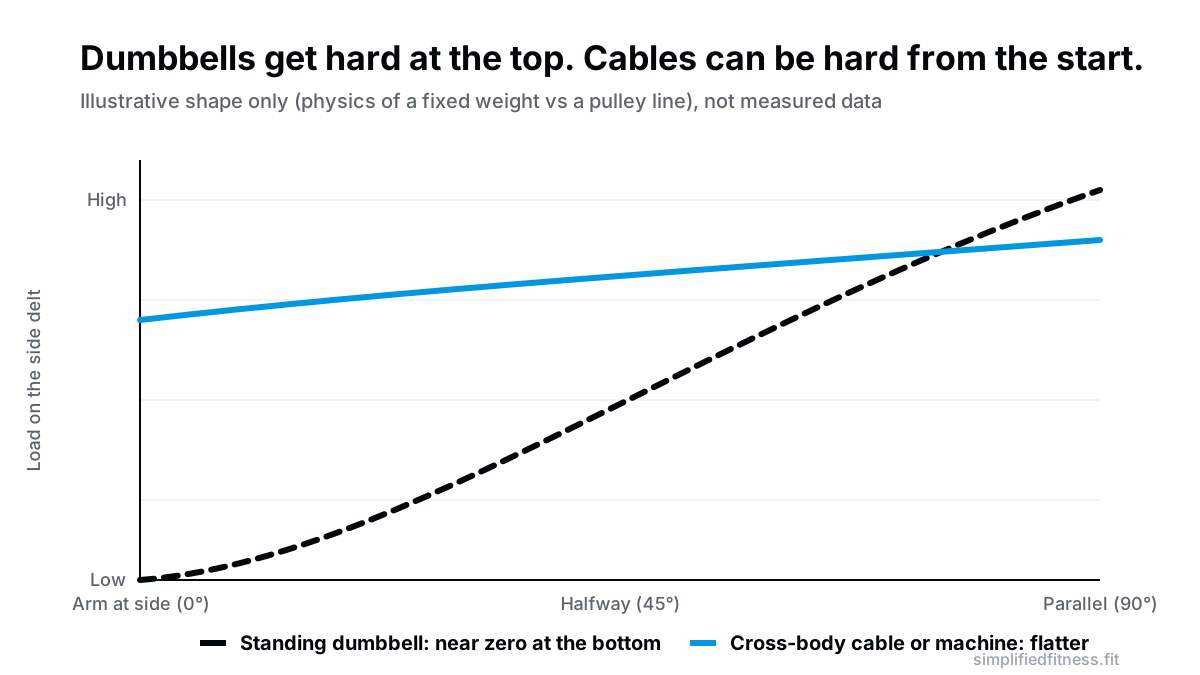
Is that a problem? The bottom of the raise is where the side delt is most lengthened, and a dumbbell asks the least of it there. That is the basis of the “dead zone” argument for cables. The argument is neat, but the evidence is less clean than it sounds, as we will see below.
Cable lateral raises: what they change
A cable pulls along the line of the rope, not straight down. Set a low pulley beside you and the line of pull is mostly horizontal at the bottom, so your delt has to work from the first centimetre. Set it on the far side of your body and the cable crosses your torso, which adds tension right where the dumbbell goes slack. We cover the setups in detail in cable lateral raises: behind the back vs cross-body.
Two practical bonuses:
- Smooth tension. No bouncing out of the bottom with momentum.
- Easy micro-loading with a pin on the stack.
The downside is one arm at a time, a stack that might be busy at 6 pm, and a cable that can pull your torso sideways if you do not brace.
Machine lateral raises: benefits and limits
Machines fix the arm path and remove balance, grip and wrist angle from the equation. That means you can chase the side delt without thinking about technique, and you can add weight in small steps.
The trade-offs are fit and feel. Machines are built for an average body, so the pad may land at the wrong height on you, and the resistance curve depends on the brand’s cam. Machine lateral raise benefits are mostly practical (consistency, safety near failure, progression) and not backed by a long-term head-to-head trial that I could find. Treat any claim that machines “recruit more motor units” as unproven.
The best lateral raise variation: what the research found
Here is the study that matters most. In 2025, researchers took 24 resistance-trained men and women and trained each person’s arms with different equipment: one arm did cable lateral raises, the other did dumbbells, with range of motion standardised between them. Training was two sessions a week of five sets to momentary failure for eight weeks, with muscle thickness measured by ultrasound (Larsen et al., 2025).
Lateral deltoid thickness rose by about 3.3-4.6%. The analysis supported no difference between the cable and dumbbell conditions at both the distal and proximal sites, and the authors concluded both are similarly effective for lateral deltoid hypertrophy in trained lifters.
So where does the idea that cables and machines are superior come from? Mostly from mechanics (the resistance profile above) and from surface EMG, which measures electrical activity, not growth. EMG tells you which muscle is switched on. It does not tell you how much muscle you will gain. Treat “greater activation” claims as a hypothesis.
Range of motion, stretch and “dead zones”
If the bottom of a dumbbell lateral raise is easy, should you care? The range of motion literature is mixed. A systematic review found full range of motion helps lower body hypertrophy, but upper limb evidence was limited and conflicting (Schoenfeld & Grgic, 2020). A later trial in resistance-trained people found lengthened partials and full range of motion produced similar elbow flexor and extensor growth, and the authors suggest emphasising the stretched position, either with full range or lengthened partials (Wolf et al., 2025).
Note those trials were on arms, not the side delt specifically. Still, the cautious takeaway is:
- Do not turn your lateral raises into tiny top-half partials just because the bottom feels light.
- Do not obsess over the “dead zone” either. The dumbbell-vs-cable trial matched the range and found no gap.
Scapular plane, hand position and cuff height
Two common set-up tweaks are worth knowing.
Scapular plane (about 30 degrees forward). Your shoulder blade sits angled on your ribcage, so raising the arm a little in front of straight sideways follows that angle. Many lifters find it more comfortable. I am not aware of a growth trial for this setup, so use it as a comfort tool, not a hypertrophy hack.
Hand and elbow rotation. Here the research looks conflicted. In 10 competitive bodybuilders, medial deltoid EMG was higher with a neutral grip than with external rotation, while internal rotation raised posterior deltoid, upper trap and triceps activity (Coratella et al., 2020). A 2024 systematic review of 33 studies, on the other hand, ranked lateral raises with internal rotation as producing the greatest middle deltoid activation (Rabello et al., 2024).
Why the split? Different methods, different loads, different normalisation. And again, EMG is not a muscle growth measurement. The cautious call: keep a neutral-ish arm, lead with the elbow, and avoid extreme turns that bring in the traps. We dig into the “pour the pitcher” cue in the dumbbell lateral raise hand cue.
How to set up each version
Dumbbells (standing or seated).
- Light weight, slight bend in the elbows, shoulders down.
- Lead with the elbows and raise to roughly shoulder height.
- Lower slowly, especially the first third of the descent.
A small pause near the top helps you keep tension where the dumbbell is hardest. Leaning slightly can shift where the load feels heaviest, and some lifters like that. There is no strong trial showing it grows more.
Low cable, cross-body. Set the handle at the bottom pulley on the opposite side of your working arm, step away so there is tension at the start, and brace your free hand. Raise the elbow out and slightly forward. Our lateral raise physics article on incline and side-lying versions shows another way to fix the dumbbell’s weak start.
Machine. Adjust the seat so your elbow lines up roughly with the shoulder joint, push through the elbows (not the hands), and stop short of shrugging.
| Option | Where it is hard | Best for | Watch for |
|---|---|---|---|
| Standing dumbbell | Top half | Anyone, any gym | Easy start, momentum |
| Seated or leaning dumbbell | Changes with lean | Reducing swinging | Overthinking angle |
| Cross-body cable | More even | Constant feel | One arm at a time, busy stack |
| Machine | Depends on the cam | Hard sets to failure | Fit and seat height |
How many sets of side delt work per week
Equipment is the small lever. Volume is the bigger one.
A meta-analysis of 15 studies found a graded dose-response: each extra weekly set was associated with a roughly 0.37% bigger gain in muscle size (Schoenfeld et al., 2017). A 2026 meta-regression of 67 studies and 2,058 participants found hypertrophy kept rising with weekly set volume, with diminishing returns, while frequency had effects compatible with negligible once volume was counted (Pelland et al., 2026).
Those studies are mostly in young adults and look at whole-muscle groups, not just side delts. So take the principle, not a magic number. A sensible start is about 6-10 hard sets a week for the side delts (overhead presses count partly), added gradually if you recover well. Our 3D shoulder protocol on volume and frequency goes deeper, and the training volume calculator helps you count.
Which one should you use?
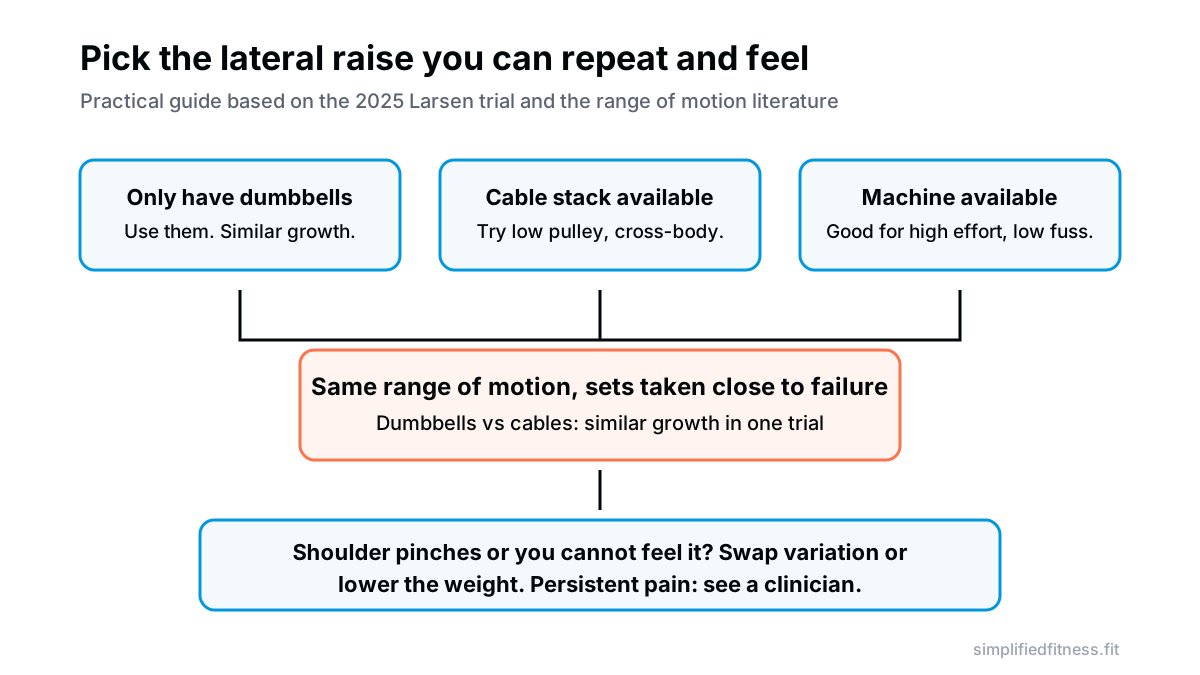
In a typical Indian gym with a limited dumbbell rack and a single cable stack, a simple plan works:
- Use dumbbells on your first side delt exercise of the week.
- Add cable or machine raises as a second exercise, for a different feel and easy progression.
- Keep the rep range where form stays clean, and stop sets close to failure.
The most common mistake here is swapping equipment every week hoping for a magic effect. Pick one setup, log your reps and weight, and push for small improvements.
When pain means stop
Lateral raises should feel like a burn in the side of the shoulder. They should not feel like a pinch at the top of the joint or a deep ache that lasts for days. Try a lighter weight, the scapular plane and a shorter range for a couple of weeks. If pain is sharp, getting worse, causes weakness, or wakes you at night, see a physiotherapist or doctor. This article cannot diagnose a shoulder problem, and our guide to impingement-friendly lifting is a starting point, not a substitute for an assessment.
The bottom line
Dumbbells, cables and machines can all build the side delt. The one direct trial found no difference between dumbbells and cables, so choose the version that keeps your shoulders comfortable and your sets hard. Control the range, train close to failure, build weekly volume slowly, and be patient. Side delt growth is slow, and consistency will beat equipment choice every time.
Frequently Asked Questions
What is the best lateral raise variation for side delt growth?
There is no single winner. A 2025 trial in resistance-trained men and women found dumbbell and cable lateral raises produced similar lateral deltoid growth when range of motion was matched. Pick the version that lets you train close to failure with clean form and without shoulder pain.
Are cable lateral raises better than dumbbell lateral raises?
Not on current evidence. The one direct comparison found similar muscle thickness gains, with Bayesian analysis favouring no difference between the two. Cables may feel better because tension is steadier at the bottom, so use them if that helps you push each set harder.
Do machine lateral raises build side delts as well as dumbbells?
Probably, but direct long-term trials on machines are lacking, so this is an inference rather than a proven fact. A machine lets you add load in small steps and removes balance and grip as limiters. Use it as a main movement or as a finisher after dumbbells.
Why are dumbbell lateral raises hard at the top and easy at the bottom?
A dumbbell pulls straight down, so the turning force on your shoulder grows as your arm rises towards parallel. At your side the weight hangs almost in line with your arm and demands little from the delt. Lighter weight, slower reps and a small pause near the top help you make use of that shape.
Should I raise my arms to the side or slightly forward?
Raising a little in front of the body, in the scapular plane (roughly 30 degrees forward of straight sideways), is a common comfort choice for people whose shoulders pinch. Research on this exact setup for muscle growth is missing, so treat it as a comfort tool. Try it and keep whichever arm path feels smoothest.
How high should I raise the dumbbells in a lateral raise?
Most lifters raise to about shoulder height, roughly parallel to the floor. Going higher shifts work to the upper traps and can irritate some shoulders, while stopping far short leaves part of the movement undone. Stop where you can still feel the side delt and keep your shoulders from shrugging up.
How many sets of lateral raises per week do I need?
Meta-analyses show that more weekly hard sets per muscle tend to produce more growth, with diminishing returns. A practical starting point for the side delts is about 6-10 hard sets a week (including overhead pressing), moving up if progress stalls and recovery is good. Our training volume calculator can help you count sets.
Can I train side delts every day?
You can, but the evidence says total weekly volume matters more than how many days you split it over. A 2026 meta-regression found frequency effects on hypertrophy were compatible with negligible once volume was accounted for. Two or three side delt sessions a week is plenty for most people.
Why do I feel lateral raises in my traps instead of my delts?
The upper traps take over when the weight is too heavy, the shoulders shrug up, or you raise above parallel. Surface EMG work in bodybuilders also showed higher upper trap activity when the arm is rotated inward. Drop the load, keep your shoulders down and think about moving the elbows out, not the hands up.
Is it better to lean during lateral raises?
A small lean can change where the resistance is hardest and some lifters find it more comfortable. There is no strong trial evidence that it builds more muscle, so it is a preference, not a rule. Keep the lean small and consistent so your progress is comparable week to week.
Do I need heavy weights for lateral raises?
No. Side delts respond to sets taken close to failure, and the Larsen trial used sets to momentary failure rather than a specific load. In practice that means moderate to light dumbbells for reps you can control. In Indian gyms with 2 kg jumps on the dumbbell rack, fractional plates or a cable stack make progression easier.
Why does my shoulder pinch when I do lateral raises?
Pinching at the top of the shoulder can come from raising with the thumbs turned down (arm rotated inward), shrugging, going too heavy or a sensitive tendon. Try the scapular plane, a lighter weight and a shorter range for a few weeks. If pain is sharp, lingers after training or wakes you at night, get it assessed by a physio or doctor.
Can I build wide shoulders with just overhead presses?
Presses do train the side delt, and one EMG study found similar side delt activity in a shoulder press and a lateral raise. But presses also load the front delts and triceps heavily, so most lifters still benefit from some direct lateral raise work. The side delt is the muscle that adds width, and isolation sets let you train it hard with little fatigue elsewhere. A press plus two lateral raise exercises per week is a simple structure.
Sources & References
Every claim above is checked against peer-reviewed research (PubMed, U.S. National Library of Medicine) or guidance from established health bodies. How we fact-check.
- Larsen S, et al. Dumbbell versus cable lateral raises for lateral deltoid hypertrophy: an experimental study. Front Physiol. 2025. PMID: 40692697
- Coratella G, et al. An electromyographic analysis of lateral raise variations and frontal raise in competitive bodybuilders. Int J Environ Res Public Health. 2020. PMID: 32824894
- Rabello R, et al. Activation of the three deltoid muscle portions during common strengthening exercises: a systematic review. J Bodyw Mov Ther. 2024. PMID: 39593452
- Schoenfeld BJ, Grgic J. Effects of range of motion on muscle development during resistance training interventions: a systematic review. SAGE Open Med. 2020. PMID: 32030125
- Wolf M, et al. Lengthened partial repetitions elicit similar muscular adaptations as full range of motion repetitions during resistance training in trained individuals. PeerJ. 2025. PMID: 39959841
- Schoenfeld BJ, Ogborn D, Krieger JW. Dose-response relationship between weekly resistance training volume and increases in muscle mass: a systematic review and meta-analysis. J Sports Sci. 2017. PMID: 27433992
- Pelland JC, et al. The resistance training dose response: meta-regressions exploring the effects of weekly volume and frequency on muscle hypertrophy and strength gains. Sports Med. 2026. PMID: 41343037

Umair Hazrami · Founder & Head Coach, Simplified Fitness
Umair Hazrami founded Simplified Fitness and the Simplified Lifter channel to cut through fitness noise. With 4+ years of consistent training and 10+ coaching clients, he writes every guide from the peer-reviewed research and links the sources so you can check them. Our editorial standards.
Educational content only, not medical advice. If you have a medical condition, are pregnant, or take medication, talk to a qualified doctor before changing your diet, supplements or training. Full disclaimer.
Keep reading
Exercise Technique
3D Shoulder Protocol: Weekly Volume, Frequency (2-3x/Week) and Rep Ranges
How to build 3D shoulders: how many weekly sets, how often to train side and rear delts, and which rep ranges to use, with an 8-week plan and the research.
8 min read

Exercise Technique
Are Front Raises Necessary? Why Bench Pressers Rarely Need Direct Front Delt Work
Are front raises necessary if you bench and overhead press? See what EMG and volume research says, when they can still help, and where to spend those sets.
8 min read

Exercise Technique
Behind-the-Neck Press: Shoulder Mobility, Neck Safety and Muscle Bias
Behind the neck press safety explained: who has the shoulder mobility for it, what EMG studies show for delts, and which swaps work if you do not.
10 min read
Exercise Technique
Cable Lateral Raises: Behind-the-Back vs Cross-Body Setup, Which Is Better?
Cable lateral raise behind the back vs in front: what the research says, which setup suits most lifters, and a step-by-step guide to pulley height and cuffs.
9 min read