Functional Anatomy of the Deltoid: Anterior, Lateral, and Posterior Heads
Deltoid muscle anatomy explained for lifters: where the front, side and rear delt heads attach, what each does, and how fiber layout shapes training.

TL;DR. The short answer
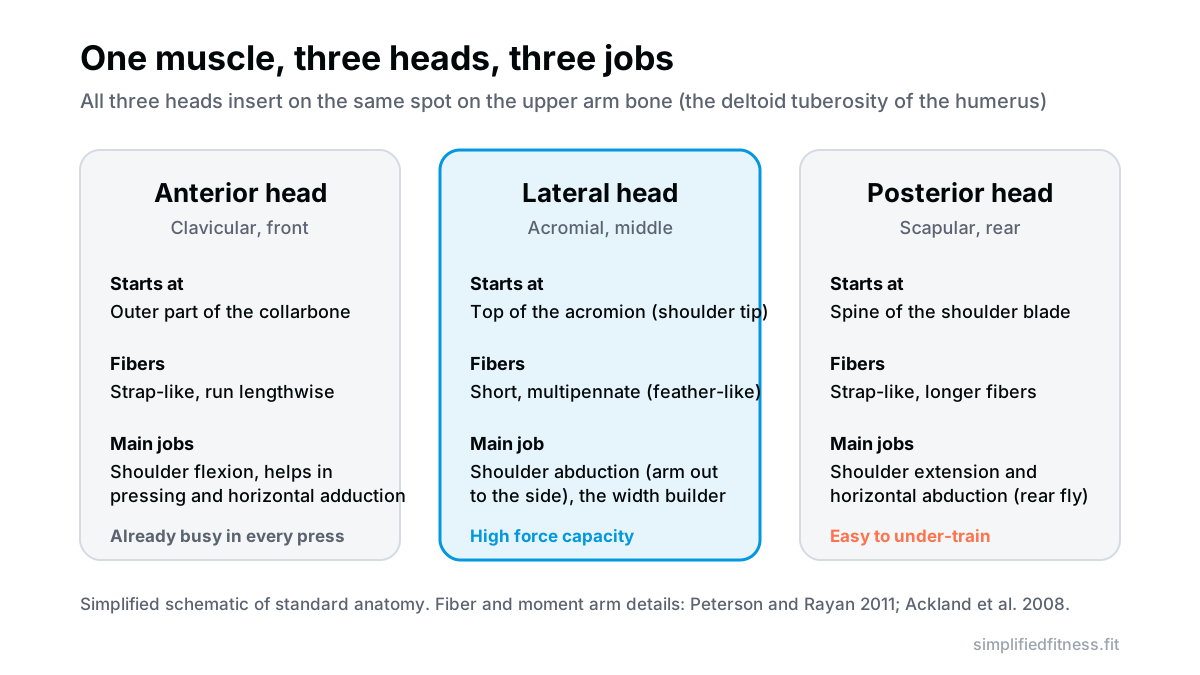
- The deltoid has three heads: anterior (from the collarbone), lateral (from the acromion) and posterior (from the spine of the shoulder blade). All three share one insertion on the humerus.
- The lateral head is multipennate, with short fibers and a large cross-sectional area. That fits its job as the main abductor, lifting the arm out to the side.
- The anterior head flexes the shoulder and the posterior head extends it and pulls the arm back (horizontal abduction). Their fibers are strap-like and run lengthwise.
- Surface EMG reviews rank different exercises best for each head, so a shoulder routine that only presses will usually leave the rear head under-trained.
- No study has directly tested weekly frequency for the lateral head alone, so the idea that it tolerates high frequency is a reasonable inference, not a proven fact.
Part of our complete guide: Complete Shoulder, Delt & Neck Training Guide: 3D Deltoid Anatomy, Rotator Cuff & Traps
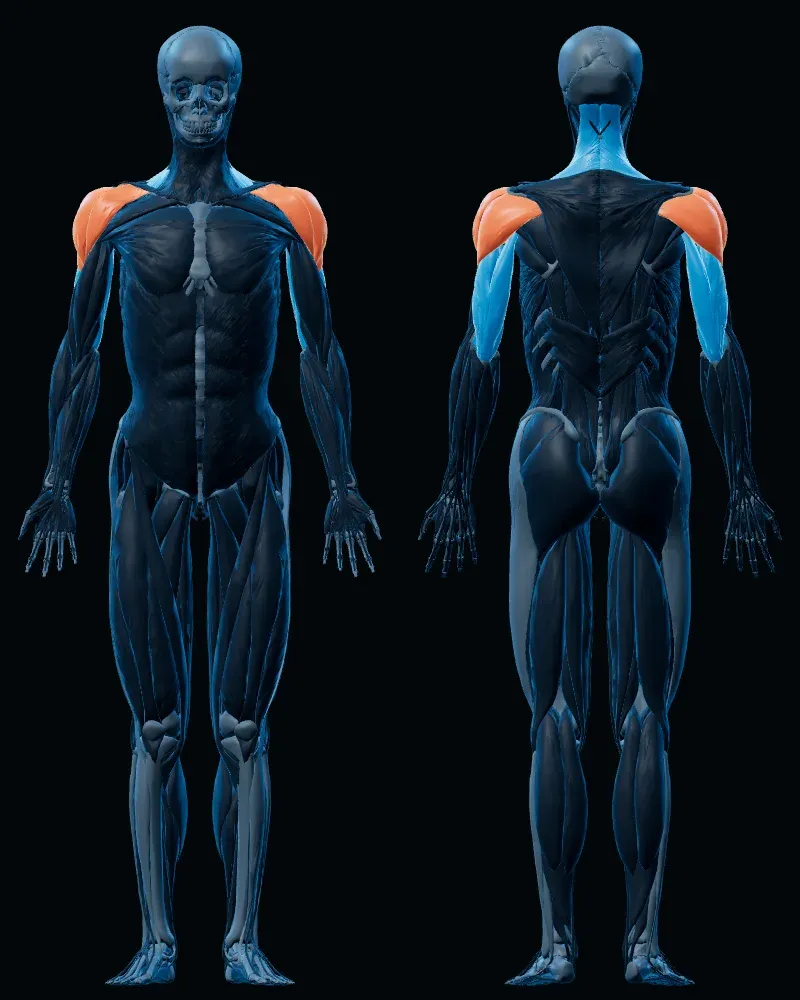
Muscles worked: shoulders
Main movers: all three heads of the deltoid
Assisting: supraspinatus, upper traps and triceps
Table of contents
Deltoid muscle anatomy is simpler than most gym content makes it sound. The deltoid is one muscle with three heads: an anterior (front) head that flexes the shoulder, a lateral (side) head that lifts the arm out to the side, and a posterior (rear) head that pulls the arm back. All three merge into a single tendon on the upper arm.
This is the anatomy reference for our complete shoulder and delt training guide. If you want to know why a lateral raise, a press and a reverse fly each feel different, this is where it starts.
What is the deltoid muscle, and where does it attach?
The deltoid is the rounded cap over your shoulder joint. Its three heads start in different places and come together to insert on the deltoid tuberosity, a rough patch on the outer side of the humerus (upper arm bone), roughly halfway down.
- Anterior (clavicular) head: starts on the outer part of the collarbone.
- Lateral (acromial) head: starts on the acromion, the bony tip of your shoulder.
- Posterior (scapular) head: starts on the spine of the shoulder blade.
That is textbook anatomy, and it is the foundation for everything else. Because the heads start at the front, top and back of the shoulder girdle, they pull the arm in different directions even though they share one insertion.
What does each deltoid head do?
Think in directions. Cadaver work measured the lever length (moment arm) of 18 shoulder muscle sub-regions in eight upper-limb specimens during abduction and flexion. The most effective abductors were the middle and anterior deltoid. In flexion, the anterior deltoid was among the most effective flexors, while the posterior deltoid had one of the largest extensor moment arms (Ackland et al., 2008). Cadavers are not living lifters, but the pattern lines up with what we see in the gym.
| Head | Main actions | Everyday and gym examples |
|---|---|---|
| Anterior | Shoulder flexion, helps horizontal adduction | Front raise, bench press, overhead press |
| Lateral | Shoulder abduction | Dumbbell, cable or machine lateral raise |
| Posterior | Shoulder extension, horizontal abduction | Rear delt fly, reverse pec deck, rows |
A quick caveat. The heads do not work alone. The rotator cuff also contributes a lot to abduction. One review estimated the middle deltoid supplies up to 35-65% of abduction torque, the subscapularis about 30%, the supraspinatus about 25% and the infraspinatus about 10%, and noted the deltoid and cuff trade roles depending on arm angle (Escamilla et al., 2009). Those are model-based estimates. Do not take them as exact percentages for your body.
Why is the lateral deltoid multipennate?
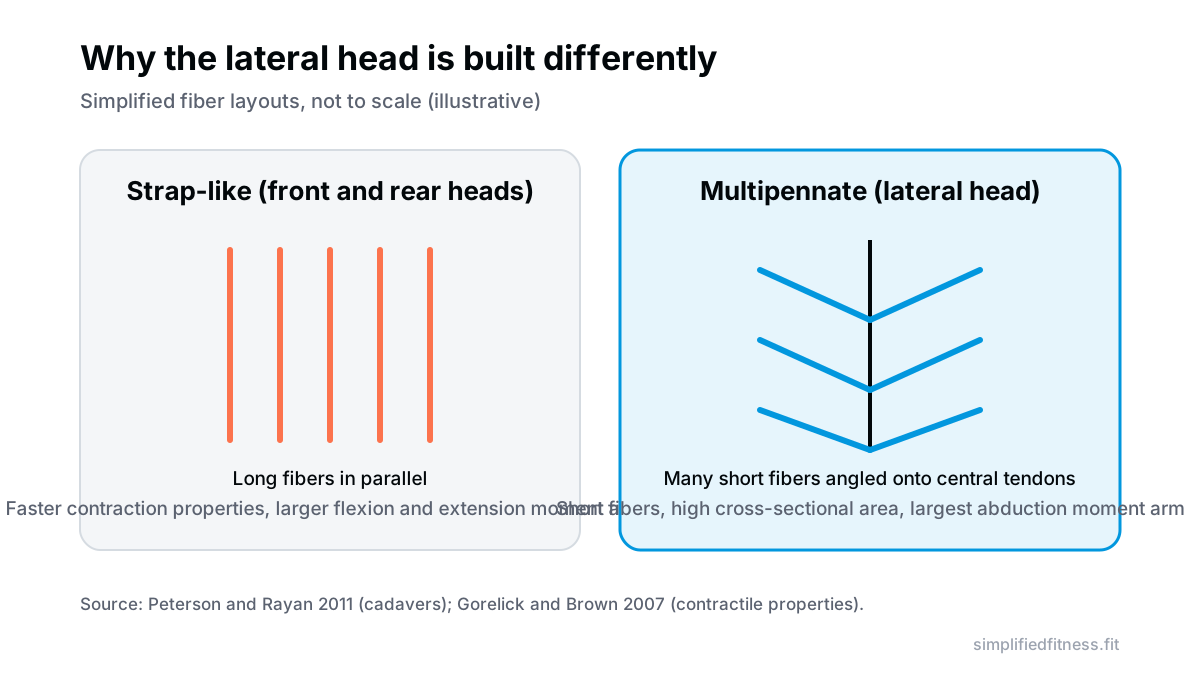
This is the part that makes the side delt special. In a strap-like muscle, fibers run parallel from one end to the other. In a multipennate muscle, many short fibers attach at an angle onto several internal tendons, like feathers on a branched shaft.
A cadaver dissection of 11 shoulder and arm muscles in five cadavers (107 usable muscles) found the middle deltoid had a short fiber length, a complex multipennate structure and a high physiologic cross-sectional area (Peterson and Rayan, 2011). Physiologic cross-sectional area is a good proxy for force capacity, because more fibers in parallel means more force. In plain gym language, you get a lot of force-producing tissue packed into a small space.
Sample size note: this is five cadavers, so the numbers are descriptive. The qualitative picture (short fibers, multipennate, high cross-sectional area) is consistent, but exact values will vary between people.
How does deltoid fiber orientation affect training?
Fiber orientation tells you something about how each head behaves, though not as much as the internet implies.
A mechanomyography study tested seven segments of the deltoid in 18 healthy, athletic students (nine men, nine women, aged 20-24). The medial, strap-like segments of the anterior and posterior heads, with larger moment arms for flexion and extension, had the fastest contractile properties. The multipennate lateral segment, with the largest abduction moment arm, had the slowest (Gorelick and Brown, 2007). The authors read this as properties matched to each segment’s role and architecture.
What can you do with that? Not much, directly. This was a single-twitch stimulation test in young adults, not a training study. It does not tell you to use different rep ranges for different heads. A fair practical reading is that all three heads respond to the same basic recipe (hard sets close to failure, progressive overload), but they need different movements to get loaded properly.
Which exercises hit which head?
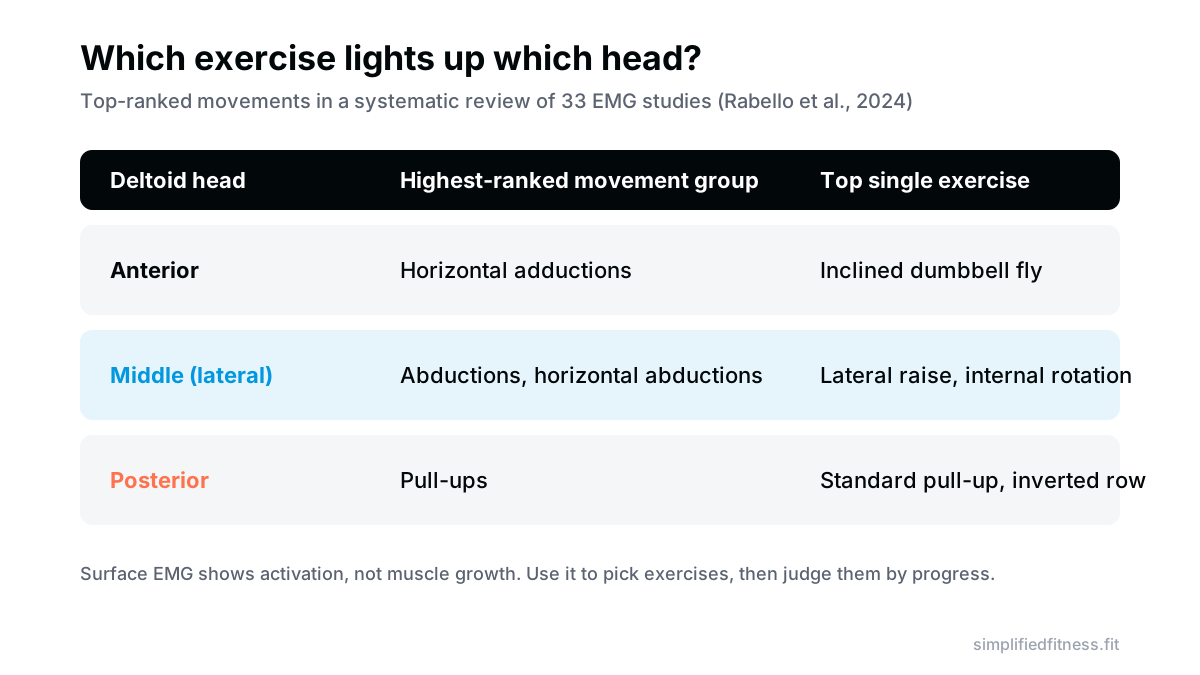
Surface electromyography (EMG) records electrical activity from the muscle surface. A 2024 systematic review pooled 33 EMG studies that looked at the three heads during common loaded exercises (minimum load 60% of one-rep max or body weight) (Rabello et al., 2024). It reported:
- Anterior: horizontal adductions had the highest activation, with the inclined dumbbell fly the top single exercise.
- Middle: abductions and horizontal abductions ranked highest, with lateral raises combined with internal rotation topping the list.
- Posterior: pull-ups ranked highest, with the standard pull-up and the suspended inverted row the top individual exercises.
A smaller lab study in 10 competitive bodybuilders compared lateral raise variations and a frontal raise. The frontal raise gave the greatest anterior deltoid activity. With the humerus rotated internally, posterior deltoid, triceps and upper trapezius activity were higher. Medial deltoid activity was higher with a neutral arm than with the arm rotated outward, and the authors linked external rotation with more anterior deltoid work (Coratella et al., 2020). Only 10 people, short test sets, no hypertrophy outcome. It is a hint for exercise setup, not a mandate.
Two further cautions. First, studies differ in method, load and normalization, which is why rankings can disagree between papers. Second, higher EMG does not mean more growth. It only means that muscle was working hard in that movement.
If you want a hands-on version, a standing dumbbell raise like the one below hits the lateral head directly.
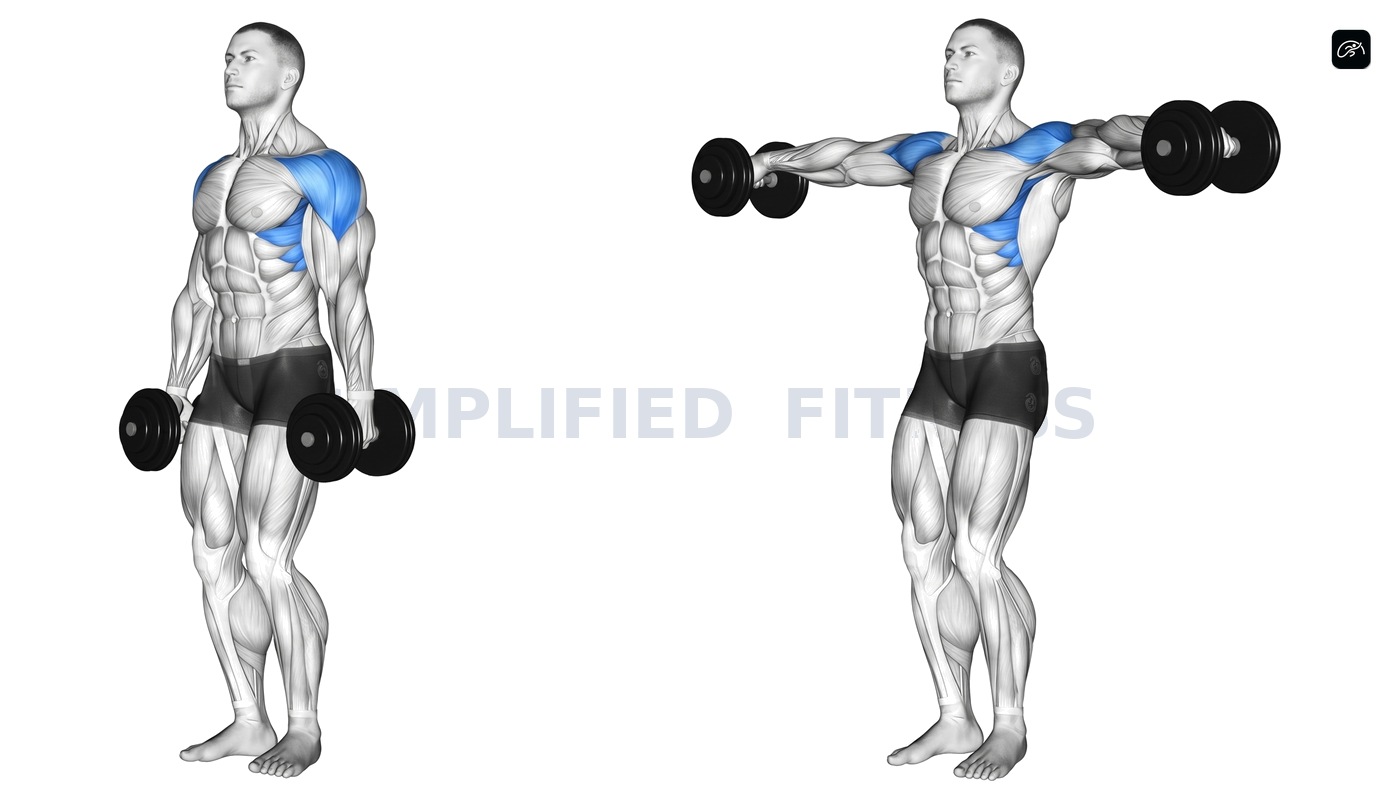
For choosing between dumbbells, cables and machines for that head, see our breakdown of lateral deltoid optimization with dumbbells vs cables vs machines. For the rear head, our rear deltoid training guide covers the reverse pec deck against cables and face pulls.
Why do lateral delts tolerate frequent training?
You will often hear that side delts can be trained four or five days a week. Let me be straight about the evidence: no study has specifically tested lateral deltoid frequency. What we have is a general argument, and it is a reasonable one, but it is an inference.
The reasoning goes like this. The lateral head is a small muscle that is rarely the limiting factor in your big lifts, and a lateral raise with moderate loads is not heavy systemic work. So you may recover from smaller doses of it faster than you would from, say, heavy squats. That is a logic argument, not a measured result.
What do the general frequency studies say? A 2016 meta-analysis of ten studies found that training muscle groups at least twice a week led to larger hypertrophy effect sizes than once a week (0.49 vs 0.30) when volume was equated, while noting that three times per week versus twice remained undetermined (Schoenfeld et al., 2016). A more recent meta-regression of 67 studies and 2,058 participants found weekly set volume had a clear, diminishing-returns relationship with muscle size, while the effect of frequency on hypertrophy was compatible with negligible once the sets were counted (Pelland et al., 2026).
Those two results can look like they conflict. They partly do not: the older work compared frequencies at matched volume in small groups of studies, while the newer model treats weekly sets as a continuous dose. Why they might differ is a matter of method and which studies are included. A cautious takeaway: weekly hard sets matter most, and splitting them across at least 2 days is sensible. For side delts, spreading those sets over 2-3 sessions is easy and low-risk. Most participants in these meta-analyses were young adults, so older lifters may need more recovery time.
You will find a full volume and frequency plan in our 3D shoulder protocol.
How to turn anatomy into a shoulder routine
Here is a simple map. It is a starting point, not a prescription.
- Cover each head at least twice a week. Presses count for the front head. Lateral raises (dumbbell, cable or machine) cover the side head. A reverse pec deck or rear-delt fly covers the rear head.
- Count your front-head sets honestly. If you press on push day and bench on chest day, you probably already get enough. Our take on why front raises are often unnecessary goes through the numbers.
- Add direct side and rear work. These two heads are the usual weak links, because no standard press hits them hard.
- Progress the load or reps. Whatever exercise you pick, adding weight or reps over time is the signal that it is working.
- Use a free plan if you want structure. Our push day plan and pull day plan already include side and rear delt work.
If you are planning around Indian life, nothing about delt anatomy changes with a vegetarian diet. You still need enough protein across the day (dal, paneer, curd, soya, eggs if you eat them) to support whatever volume you train. A quick way to set your number is our protein calculator.
When should you see a doctor about shoulder pain?
This article is about muscle anatomy, not diagnosis. If you have sharp or persistent shoulder pain, pain at night, pain that comes with weakness, numbness, a visible deformity, or an injury after a fall or heavy lift, get it assessed by a doctor or physiotherapist before training through it. For lifting-specific impingement guidance, see our article on subacromial shoulder impingement and lifting solutions.
The bottom line
Three heads, one tendon, three jobs. The front head flexes and pushes, the lateral head abducts and carries most of the width, and the rear head extends and pulls back. The lateral head’s multipennate design packs a lot of force capacity into a small muscle, which makes it an efficient target for raises.
What anatomy cannot tell you is the perfect set and rep scheme. For that, use the evidence on volume and effort, check your progress every month, and adjust. A balanced plan that hits all three heads twice a week beats any single “secret” shoulder exercise. For the full programming picture, return to the complete shoulder and delt training guide.
Frequently Asked Questions
What are the three heads of the deltoid muscle?
The deltoid has an anterior (front) head, a lateral (middle) head and a posterior (rear) head. They start at the collarbone, the acromion and the spine of the shoulder blade respectively, then join into one tendon on the upper arm. Learn which head a given exercise loads, because that decides how you split your weekly shoulder sets.
Where does each deltoid head attach?
The anterior head starts on the outer part of the clavicle, the lateral head on the acromion, and the posterior head on the spine of the scapula. All three insert on the deltoid tuberosity on the outside of the humerus, about midway down the upper arm. Knowing the shared insertion explains why the three heads can all help lift the arm but pull in different directions.
What does the lateral deltoid do?
The lateral head is the main abductor of the shoulder, meaning it lifts the arm out to the side. Cadaver work found its moment arm for abduction is among the largest of the shoulder muscles, so it is well placed for that job. Lateral raises, whether with dumbbells, cables or a machine, train it most directly.
What does the posterior deltoid do?
The posterior head extends the shoulder (arm moves back) and performs horizontal abduction, as in a rear delt fly. Cadaver data show it has one of the largest extensor moment arms at the shoulder. Add a rear-delt movement such as a reverse pec deck, and do not rely on back rows to cover it.
What does the anterior deltoid do?
The anterior head flexes the shoulder (arm moves forward and up) and assists horizontal adduction, which is the pressing and flye pattern. It also has a high flexion moment arm in cadaver testing. Because bench and overhead presses already load it heavily, most lifters do not need much isolation work for it.
Why is the lateral deltoid called multipennate?
Multipennate means its short muscle fibers attach at an angle onto several internal tendon sheets, like feathers on multiple shafts. A cadaver study found the middle deltoid has short fibers, a complex multipennate structure and high physiologic cross-sectional area. In practice this packs a lot of force capacity into a small space, which is part of why a strong side delt widens the shoulder line.
Which deltoid head is the strongest?
The middle (lateral) head appears to have the greatest force capacity because of its high physiologic cross-sectional area. One review estimated it contributes up to 35-65% of abduction torque, with the rotator cuff supplying much of the rest. Treat those numbers as model estimates, not exact values for your shoulder.
Do the deltoid heads have different fiber types?
There are signs of regional differences. A mechanomyography study in 18 healthy young adults found the multipennate lateral segment had the slowest contractile properties while the strap-like front and rear segments were faster. That is a small, indirect measurement, so it does not mean you need different rep ranges for each head.
Can the lateral deltoid be trained often?
Probably, but this is an inference. The lateral head is a relatively small muscle with a short-fiber design, and general meta-analyses show training a muscle at least twice a week is better than once when volume is matched. No trial has isolated the lateral deltoid, so start with 2-3 sessions a week and watch recovery.
Do front raises work the anterior deltoid?
Yes, a study in 10 competitive bodybuilders found the frontal raise gave the highest anterior deltoid activity of the raise variations tested. But the anterior head also works hard in every pressing movement, so many lifters get enough without direct front raises. If your front delts lag, add a small amount and check progress.
Does internal or external rotation change lateral raise muscle use?
It can shift emphasis. In 10 competitive bodybuilders, rotating the humerus inward raised posterior deltoid and upper trap activity, while medial deltoid activity was highest with a neutral arm and the outward-rotated version leaned more on the front delt. These were short EMG tests, not growth studies, so use them as a tweak and not a rule.
Which exercises train the rear deltoid best?
A 2024 systematic review of surface EMG studies ranked pull-ups and inverted rows highest for posterior deltoid activation. Horizontal pulling and fly-type movements also load it, depending on arm position. Pair a heavy pull with a light, controlled rear-delt isolation like the reverse pec deck.
Does EMG activation tell me which exercise builds the most muscle?
No. Surface EMG measures electrical activity during a set, which is useful for choosing exercises but is not a direct measure of growth. Growth depends on total hard sets, effort, progression and recovery over months. Pick an exercise with good activation, then keep the version that you can progress and feel working.
Do I need to learn deltoid anatomy to build bigger shoulders?
No, but a basic map helps you avoid two common gaps: too many presses and too little rear and side work. Knowing which head does what makes it easier to spot a weak link and fix it. Use it to build a sensible split, then let progress decide.
Sources & References
Every claim above is checked against peer-reviewed research (PubMed, U.S. National Library of Medicine) or guidance from established health bodies. How we fact-check.
- Peterson SL, et al. Shoulder and upper arm muscle architecture. J Hand Surg Am. 2011. PMID: 21527142
- Ackland DC, et al. Moment arms of the muscles crossing the anatomical shoulder. J Anat. 2008. PMID: 18691376
- Gorelick ML, et al. Mechanomyographic assessment of contractile properties within seven segments of the human deltoid muscle. Eur J Appl Physiol. 2007. PMID: 17277938
- Rabello R, et al. Activation of the three deltoid muscle portions during common strengthening exercises: a systematic review. J Bodyw Mov Ther. 2024. PMID: 39593452
- Coratella G, et al. An electromyographic analysis of lateral raise variations and frontal raise in competitive bodybuilders. Int J Environ Res Public Health. 2020. PMID: 32824894
- Escamilla RF, et al. Shoulder muscle activity and function in common shoulder rehabilitation exercises. Sports Med. 2009. PMID: 19769415
- Schoenfeld BJ, et al. Effects of resistance training frequency on measures of muscle hypertrophy: a systematic review and meta-analysis. Sports Med. 2016. PMID: 27102172
- Pelland JC, et al. The resistance training dose response: meta-regressions exploring the effects of weekly volume and frequency on muscle hypertrophy and strength gains. Sports Med. 2026. PMID: 41343037

Umair Hazrami · Founder & Head Coach, Simplified Fitness
Umair Hazrami founded Simplified Fitness and the Simplified Lifter channel to cut through fitness noise. With 4+ years of consistent training and 10+ coaching clients, he writes every guide from the peer-reviewed research and links the sources so you can check them. Our editorial standards.
Educational content only, not medical advice. If you have a medical condition, are pregnant, or take medication, talk to a qualified doctor before changing your diet, supplements or training. Full disclaimer.
Keep reading
Exercise Technique
3D Shoulder Protocol: Weekly Volume, Frequency (2-3x/Week) and Rep Ranges
How to build 3D shoulders: how many weekly sets, how often to train side and rear delts, and which rep ranges to use, with an 8-week plan and the research.
8 min read

Exercise Technique
Are Front Raises Necessary? Why Bench Pressers Rarely Need Direct Front Delt Work
Are front raises necessary if you bench and overhead press? See what EMG and volume research says, when they can still help, and where to spend those sets.
8 min read

Exercise Technique
Behind-the-Neck Press: Shoulder Mobility, Neck Safety and Muscle Bias
Behind the neck press safety explained: who has the shoulder mobility for it, what EMG studies show for delts, and which swaps work if you do not.
10 min read

Exercise Technique
Cable Lateral Raises: Behind-the-Back vs Cross-Body Setup, Which Is Better?
Cable lateral raise behind the back vs in front: what the research says, which setup suits most lifters, and a step-by-step guide to pulley height and cuffs.
9 min read