Shoulder and Arm Workout Structuring: Push Day vs a Dedicated Delt and Arm Day
Push day vs shoulder and arm day: what the research says about fatigue, volume and frequency, plus a simple way to choose the split that suits your recovery.

TL;DR. The short answer
- Both layouts work. When weekly hard sets are matched, split and full-body style routines produced similar strength and muscle gains in a 2024 meta-analysis of 14 studies.
- Shoulders on push day is fine if lateral raises come early and you do not stack every delt exercise after heavy chest pressing.
- A dedicated shoulder and arm day helps when delts or arms lag, because the muscles are fresh and you can give them a second weekly slot.
- Training each muscle at least twice a week is the better-supported rule, so a once-a-week shoulder day on its own is the weak option.
- Exercises done first get the best performance, but for muscle size the order of lifts made little difference in a 2021 meta-analysis.
Part of our complete guide: Complete Shoulder, Delt & Neck Training Guide: 3D Deltoid Anatomy, Rotator Cuff & Traps
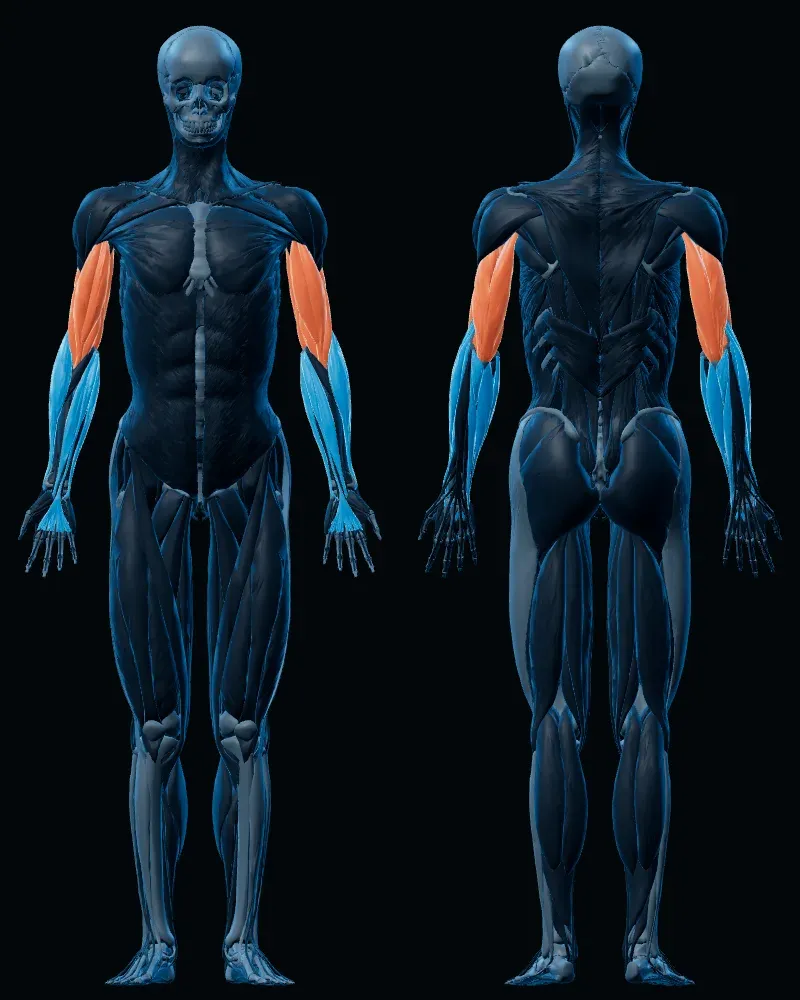
Muscles worked: arms
Main movers: biceps, brachialis and all three heads of the triceps
Assisting: forearm flexors, extensors and brachioradialis
Table of contents
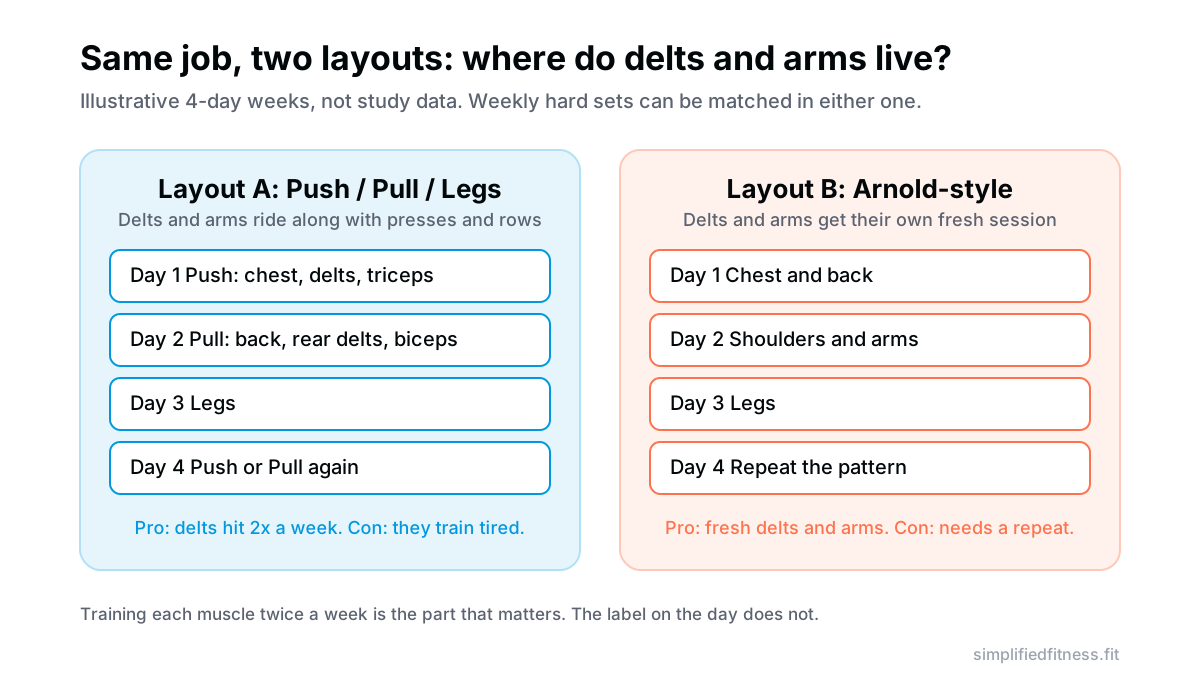
Push day vs shoulder and arm day is mostly a scheduling question, not a growth question. When weekly hard sets are the same, both layouts build muscle about equally, so the better choice is the one that lets your delts and arms train fresh, twice a week, without wrecking the rest of your session.
This article sits inside our complete shoulder and delt training guide. Here we only deal with placement: do shoulders belong on push day, or should they share a day with arms?
Should you train shoulders on push day?
For most people, yes. A push day already includes chest pressing, which loads the front delts and triceps. Adding side delt work and an overhead press fits the same movement family, so you warm up once and finish in one block.
The problem is not the idea. It is the order. Picture a typical push day: heavy incline press, flat press, overhead press, then lateral raises, then triceps. By the time you reach lateral raises, your front delts and triceps are cooked, and the side delts, the muscle that gives you width, get whatever energy is left.
That is the real trade-off. Push day is efficient, but it puts the delts at the back of the fatigue queue.
What does the research say about fatigue and exercise order?
Fatigue carries over between exercises that share muscles. One study of 12 trained men tested all six orders of bench press, shoulder press and triceps extension. Repetition performance in the sequence shoulder press, then triceps extension, then bench press was significantly lower than in two other sequences. The remaining comparisons showed no significant differences, and the authors concluded that priority might be given to exercises done at the start of a session (Miranda et al., 2013).
Keep the limits in mind. That was a small acute study in trained men, so it tells us about reps in one session, not muscle growth over months.
For growth, the picture is calmer. A 2021 meta-analysis of 11 studies found strength gains were largest in the exercises placed first in a session, but there was no significant effect of exercise order on hypertrophy (Nunes et al., 2021). A 6-week trial in 36 young men found multi-joint-first and single-joint-first orders raised biceps thickness similarly (+14.2% vs +13.8%), though only the multi-joint-first group clearly gained mid-thigh thickness (Avelar et al., 2019).
So where does that leave us? Order is a performance tool. Use it to protect the lift you care about most. Do not expect it to make or break your delts.
Does a dedicated shoulder and arm day grow more muscle?
Not by itself. A 2024 meta-analysis of 14 studies (392 participants) compared split and full-body routines. Bench press strength, leg strength, and muscle size in the elbow extensors and flexors were all similar between the two when volume was equated (Ramos-Campo et al., 2024). An 8-week trial in 67 untrained people reached the same conclusion: twice or four times per week gave similar results when weekly sets matched (Evangelista et al., 2021).
Note that the trials are short, some are in beginners, and “split” in these studies is not the same thing as an Arnold split. So read the finding as “layout is not magic”, not “layout never matters”.
What a dedicated day does change is the quality of each set. If your delts, biceps and triceps are fresh, your last lateral raise set is closer to the first. That is a practical benefit, even if the lab results look similar.
Volume and frequency: the two numbers that matter more than the label
If layout is not the driver, what is? Two things, both reasonably well supported.
Weekly volume. A meta-analysis of 15 studies linked more weekly sets to more muscle growth, with each extra set associated with about 0.37% more gain in muscle size (Schoenfeld et al., 2017). In resistance-trained men, a trial found strength gains were similar across low, moderate and high volumes, but the elbow flexors, mid-thigh and lateral thigh grew more with higher volume (Schoenfeld et al., 2019).
Our rule of thumb of roughly 6-10 hard sets per muscle per week is a practical starting range, not a ceiling taken from those papers. The research shows a dose-response trend, so some people will progress with more, as long as they recover.
Frequency. A 2016 meta-analysis found that training a muscle twice a week beat once a week on a volume-equated basis. Whether three times beats two was still unclear (Schoenfeld et al., 2016).
Here is the practical takeaway. A single big shoulder day each week, with no other delt work, is the weakest setup of the lot. Arnold split lifters avoid this because the pattern repeats twice weekly. A PPL lifter avoids it by running push twice.
Push day vs shoulder and arm day: side by side
| Factor | Delts on push day (PPL) | Dedicated shoulder and arm day |
|---|---|---|
| Freshness of delts | Lower, they follow heavy chest work | Higher, nothing heavy before them |
| Freshness of arms | Triceps tired from pressing | Both arms fresh |
| Frequency for delts | Easy to hit twice if push repeats | Needs the pattern repeated (e.g. 6 days) |
| Session length | Push day can run long | Shorter, focused sessions |
| Days per week | Works at 3-5 days | Best at 4-6 days |
| Best for | Time-poor lifters, balanced physiques | Lagging delts or arms, higher tolerance for training days |
How to run each option well
If you keep delts on push day
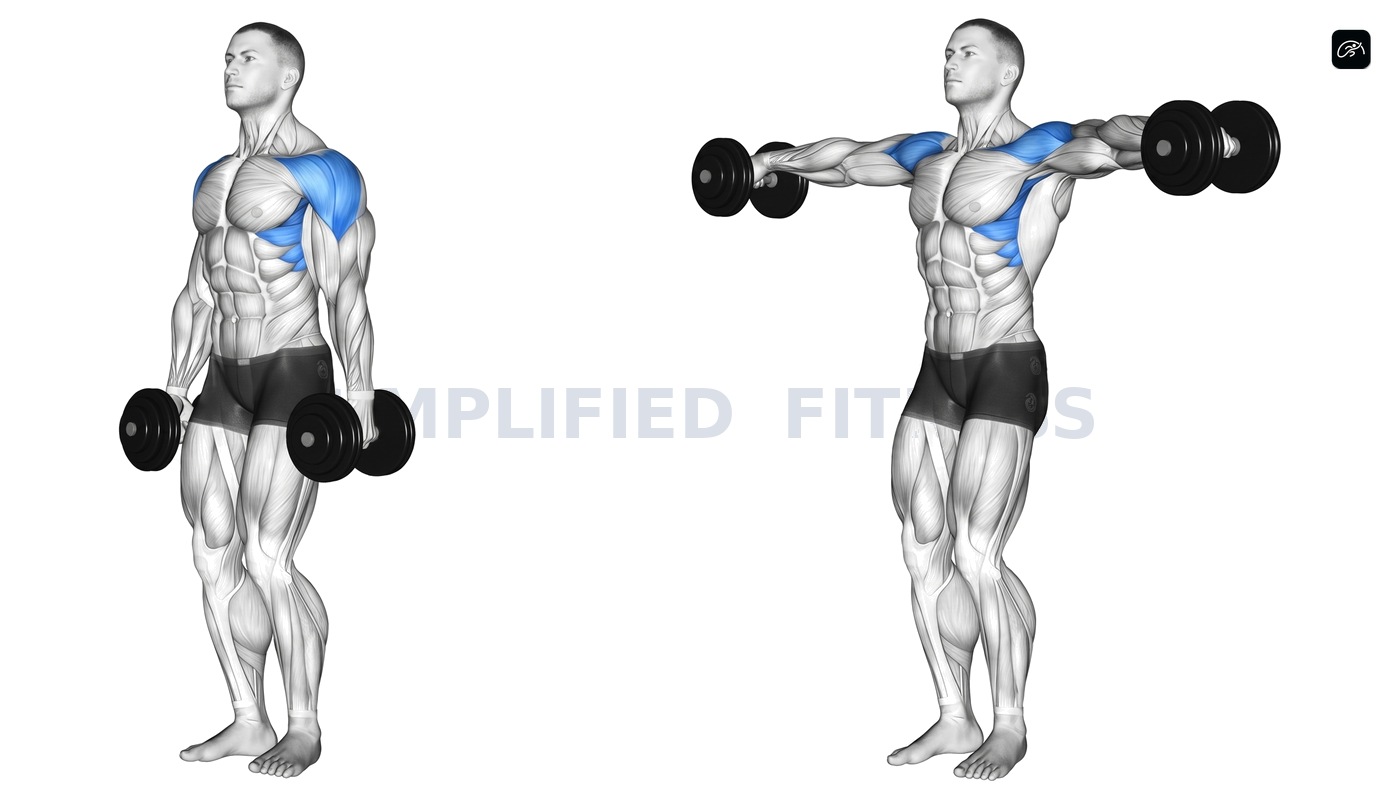
- Do your first heavy press, then lateral raises, then the rest of the pressing.
- Count the indirect work. Chest presses and overhead presses already give your front delts and triceps a lot of stimulus, so you may not need much direct front delt or triceps work.
- Add a second slot for side delts on pull or leg day, 3-4 hard sets, so frequency reaches twice weekly.
- Keep triceps for the end of push day so they do not limit your pressing.
If you use a shoulder and arm day
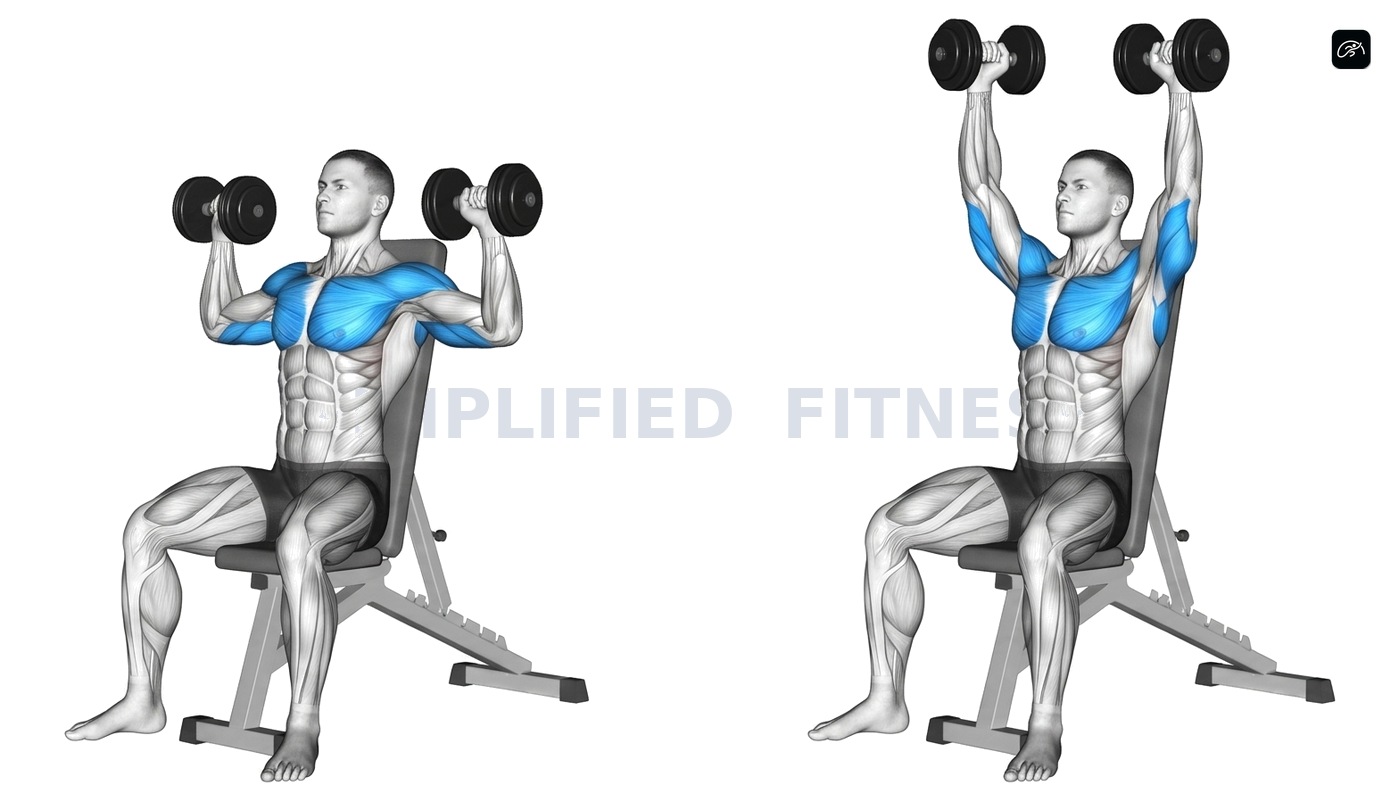
- Start with an overhead press or a heavy lateral raise variation, then move to isolation work.
- Superset or alternate biceps and triceps exercises to save time (we cover this in antagonist arm supersets).
- Keep chest and back days from also including heavy delt isolation, or you double the load on the same tissue.
- Make sure the pattern repeats, or add a lateral raise slot to another day.
When should an intermediate lifter switch?
No study gives a clean switch point, so this is coaching judgement, not a rule from the literature. These are the signs that a change might help:
- Your lateral delts or arms have not grown for 8-12 weeks despite progress in other lifts.
- You can reliably train four or more days per week.
- Push day regularly runs over 80 minutes and quality drops in the final exercises.
- You genuinely enjoy longer arm sessions, which helps consistency.
And these are signs to stay put:
- You can only train three days a week.
- Your elbows or front delts ache and you are already close to your recovery limit.
- Your delts are growing fine.
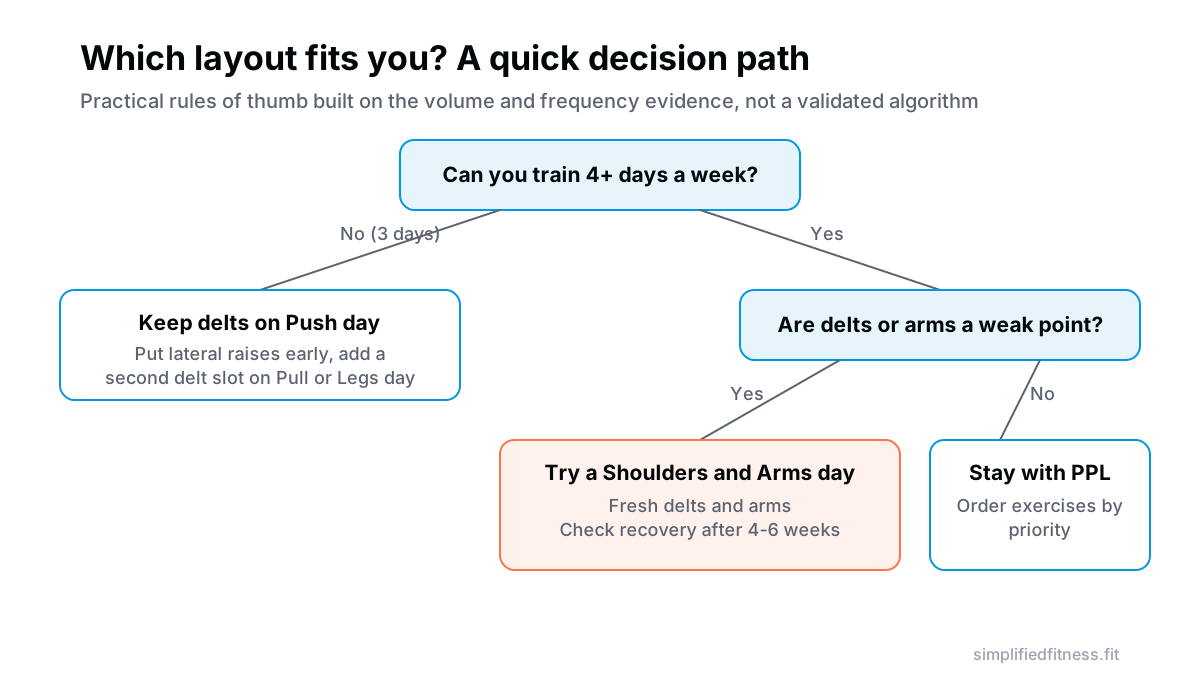
If you switch, run it for four to six weeks. Compare your weekly lateral raise performance, how your joints feel, and whether you still look forward to training.
What about recovery and joint comfort?
Shoulders, elbows and wrists all get used in pressing, so a day that stacks heavy shoulder pressing, heavy triceps and heavy curls can pile stress on the same joints. If your elbows are touchy, a dedicated shoulder and arm day may need lighter loads and more controlled tempo.
Persistent shoulder pain, pain that wakes you at night, numbness or weakness is not a programming problem. See a doctor or physiotherapist. For gym-related shoulder pain, our guide to subacromial impingement and lifting covers common modifications, but it does not replace an assessment.
The simple plan to start with
If you are unsure, begin with push pull legs and keep delts on push day. Put a lateral raise block early, add a few extra sets on pull day, and see how your shoulders respond. Our free push day plan is built that way, and the training volume calculator helps you check your weekly sets.
For a deeper look at splits, read our guides to PPL variations and the Arnold split. For how often to train delts and how many sets to use, see the 3D shoulder protocol. And if overhead pressing is part of your plan, compare options in standing vs seated dumbbell vs machine presses.
Pick the layout you will actually stick to for 6 months. That one wins.
Frequently Asked Questions
Should you train shoulders on push day?
Yes, you can, and it works well for most lifters. Chest presses already hit the front delts and triceps, so a push day is an efficient place to add side delt work. Put lateral raises early in the session if side delts are a priority, so you are not doing them on tired arms.
Is a shoulder and arm day better than push pull legs?
Not automatically. A 2024 meta-analysis found split and full-body routines gave similar results when volume was matched, which suggests the layout matters less than total hard sets and frequency. A shoulder and arm day is mainly a way to give lagging delts and arms fresher sessions.
What is the Arnold split?
It is a six-day pattern of chest and back, shoulders and arms, then legs, repeated twice. Each muscle gets trained about twice a week, which fits the frequency research. The catch is the time cost, so a four-day version is more realistic for most people.
How many sets of shoulders per week do I need?
Many coaches aim for roughly 6-10 hard sets of direct side delt work per week, though research on exact numbers is still developing. A meta-analysis of 15 studies found more weekly sets were linked to more muscle growth overall. Start near the low end, track your progress, and add sets only if you are recovering well.
Do front delts get enough work from bench press?
For most lifters, yes. Pressing movements already load the front delts heavily, which is why many coaches skip direct front raises. Check that your front delts keep growing before adding anything, and if they lag, add an overhead press rather than front raises.
Should I train triceps before or after chest?
After chest is the usual choice. In a study of 12 trained men, the order shoulder press, triceps extension, then bench press produced fewer total reps than two orders that started with triceps extension. Your triceps limit most presses, so keep them fresh for the big lift unless triceps are your priority.
Does exercise order matter for muscle growth?
Order matters for performance in that exercise, but much less for muscle size. A 2021 meta-analysis found strength gains were largest in exercises done first, while hypertrophy was similar whichever order was used. Put your priority exercise first and do not stress over the rest.
Can I train shoulders twice a week on a PPL split?
Yes, and it is usually a good idea. Running push twice a week already gives you two shoulder slots, and you can add a few lateral raise sets on a pull or leg day. The frequency meta-analysis supports hitting a muscle at least twice weekly.
Should I train shoulders and arms on the same day?
It is a popular pairing because the muscles overlap in pressing and pulling, but the evidence does not say it is superior. Do it if it fits your schedule and you recover well. If your elbows or front delts feel beaten up, spread them across different days.
When should an intermediate lifter move to a dedicated shoulder day?
Consider it when your delts or arms have stalled, you can train at least four days a week, and your push day feels too long. Because the research does not favour one layout, the decision comes down to your goals and recovery. Try it for four to six weeks and compare strength, soreness and enjoyment.
How do I fit shoulders into a 3-day split?
Keep delts on push day and add one extra lateral raise slot elsewhere in the week. With only three sessions, twice-weekly delt frequency needs that extra slot. A short finisher of 2-3 sets on another day is enough to get there.
Do I need to train to failure on delt and arm days?
Not on every set. Most lifters do well finishing hard sets with about one to three reps in reserve, and going closer to failure mainly on isolation moves like lateral raises or pushdowns, where it costs less recovery. More sets near failure means more fatigue, so ration it.
How long should a shoulder and arm day last?
Roughly 45-70 minutes is enough for most people. In one trial, trained men gained strength with three short weekly sessions, but muscle size grew more with higher volumes, so there is a trade-off. Stop adding sets once quality drops.
Sources & References
Every claim above is checked against peer-reviewed research (PubMed, U.S. National Library of Medicine) or guidance from established health bodies. How we fact-check.
- Schoenfeld BJ, et al. Effects of Resistance Training Frequency on Measures of Muscle Hypertrophy: A Systematic Review and Meta-Analysis. Sports Med. 2016. PMID: 27102172
- Schoenfeld BJ, et al. Dose-response relationship between weekly resistance training volume and increases in muscle mass: A systematic review and meta-analysis. J Sports Sci. 2017. PMID: 27433992
- Ramos-Campo DJ, et al. Efficacy of Split Versus Full-Body Resistance Training on Strength and Muscle Growth: A Systematic Review With Meta-Analysis. J Strength Cond Res. 2024. PMID: 38595233
- Miranda H, et al. Influence of exercise order on repetition performance among all possible combinations on resistance training. Res Sports Med. 2013. PMID: 24067121
- Nunes JP, et al. What influence does resistance exercise order have on muscular strength gains and muscle hypertrophy? A systematic review and meta-analysis. Eur J Sport Sci. 2021. PMID: 32077380
- Avelar A, et al. Effects of order of resistance training exercises on muscle hypertrophy in young adult men. Appl Physiol Nutr Metab. 2019. PMID: 30248269
- Schoenfeld BJ, et al. Resistance Training Volume Enhances Muscle Hypertrophy but Not Strength in Trained Men. Med Sci Sports Exerc. 2019. PMID: 30153194
- Evangelista AL, et al. Split or full-body workout routine: which is best to increase muscle strength and hypertrophy? Einstein (Sao Paulo). 2021. PMID: 34468591

Umair Hazrami · Founder & Head Coach, Simplified Fitness
Umair Hazrami founded Simplified Fitness and the Simplified Lifter channel to cut through fitness noise. With 4+ years of consistent training and 10+ coaching clients, he writes every guide from the peer-reviewed research and links the sources so you can check them. Our editorial standards.
Educational content only, not medical advice. If you have a medical condition, are pregnant, or take medication, talk to a qualified doctor before changing your diet, supplements or training. Full disclaimer.
Keep reading
Exercise Technique
3D Shoulder Protocol: Weekly Volume, Frequency (2-3x/Week) and Rep Ranges
How to build 3D shoulders: how many weekly sets, how often to train side and rear delts, and which rep ranges to use, with an 8-week plan and the research.
8 min read

Exercise Technique
Are Front Raises Necessary? Why Bench Pressers Rarely Need Direct Front Delt Work
Are front raises necessary if you bench and overhead press? See what EMG and volume research says, when they can still help, and where to spend those sets.
8 min read

Exercise Technique
Behind-the-Neck Press: Shoulder Mobility, Neck Safety and Muscle Bias
Behind the neck press safety explained: who has the shoulder mobility for it, what EMG studies show for delts, and which swaps work if you do not.
10 min read

Exercise Technique
Cable Lateral Raises: Behind-the-Back vs Cross-Body Setup, Which Is Better?
Cable lateral raise behind the back vs in front: what the research says, which setup suits most lifters, and a step-by-step guide to pulley height and cuffs.
9 min read