Why Your Inner Thighs Burn After Deep Squats: Adductor Magnus vs Glute Max
The adductor magnus in a deep squat works as a hip extensor beside your glutes. See what the research shows and how to train depth for bigger thighs.
TL;DR. The short answer
- The adductor magnus is a big hip extensor, not just an inner thigh squeezer. In a 2025 imaging study of 15 young adults, its potential torque for hip extension was over twofold greater than for adduction.
- As the hip folds toward 75 degrees, the adductor magnus moment arm for hip extension increases, while the gluteus maximus moment arm decreases (a 1985 anatomical study). That is a plausible reason deep squats load the inner thigh.
- In a 10-week MRI trial of 17 men, full squats grew the adductors by 6.2% and the glutes by 6.7%, versus 2.7% and 2.2% for half squats.
- Inner thigh soreness after deep squats or leg presses is usually normal muscle soreness. Sharp groin pain, swelling or a pop is not, and needs a doctor or physio.
- Depth is not magic for everyone. In trained lifters, a full-range leg press and a 5-100 degree leg press grew the quads about equally over 8 weeks.
Part of our complete guide: Muscle Length, Range of Motion and Stretch-Mediated Hypertrophy: What the Research Actually Shows
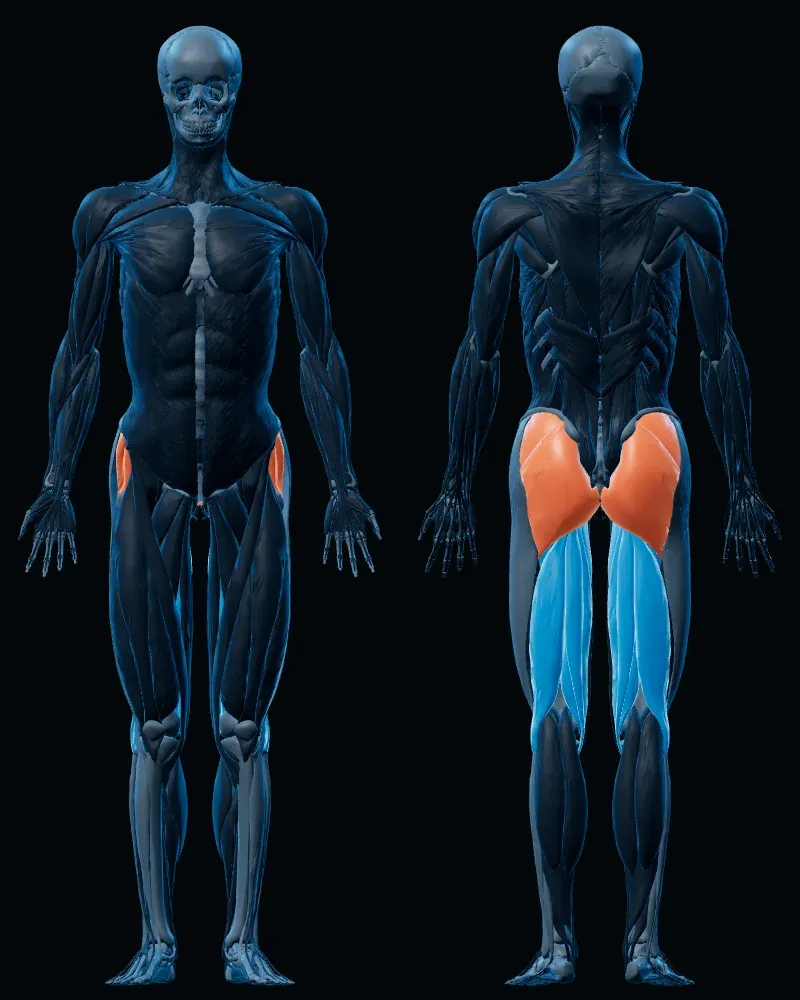
Muscles worked: glutes
Main movers: gluteus maximus, medius and minimus
Assisting: hamstrings and adductor magnus
Table of contents
If your inner thighs are sore after deep squats or leg presses, that is usually the adductor magnus doing real work. In the adductor magnus deep squat position, this big “inner thigh” muscle acts mostly as a hip extender, sharing the job with your glutes.
That changes how you should think about depth. This article sits inside our wider guide to range of motion and stretch-mediated hypertrophy, and it zooms in on one question: what happens at the hip when you go deep, and why the inner thigh joins in.
Why do my inner thighs hurt after squats and leg presses?
Most of the time, it is ordinary muscle soreness. You loaded a large muscle through a long range, probably more than usual, and it is complaining 24 to 72 hours later.
The surprise is which muscle is complaining. We tend to label the adductors “inner thigh squeezers” (the muscles you use in a hip adductor machine). But the adductor magnus is one of the largest muscles in the leg, and it is built more like a hip extensor than a squeezer.
A 2025 study used diffusion tensor imaging to map the muscle’s fibres in 15 young adults. Over 80% of its volume sat in the posterior and anterior-distal portions, and those portions had a longer moment arm for hip extension than for adduction. The whole muscle’s potential torque was over twofold greater for hip extension than for adduction (Takahashi et al., 2025). The scan was done with the hip in a neutral position, and the sample was young adults, so it describes the muscle’s design rather than a squat directly.
So when you stand up out of a deep hole, your glutes and a good chunk of your inner thigh are both pushing your hips forward.
What does hip flexion depth do to the glutes and adductor magnus?
Muscles pull with a lever, called a moment arm. A longer lever means more turning force at the joint for the same muscle force. Where that lever is longest changes with the angle of the hip.
A 1985 anatomical study combined data from ten autopsy specimens and twenty patients examined by CT to measure the hip extensors at angles from 0 to 90 degrees of hip flexion (Nemeth and Ohlsen, 1985). With the hip in its anatomical position, the moment arm was about 79 mm for gluteus maximus, 61 mm for the hamstrings and 15 mm for adductor magnus. As the hip flexed, the gluteus maximus moment arm decreased. The hamstring moment arm rose up to about 35 degrees, then fell. The adductor magnus moment arm rose up to about 75 degrees, then decreased.
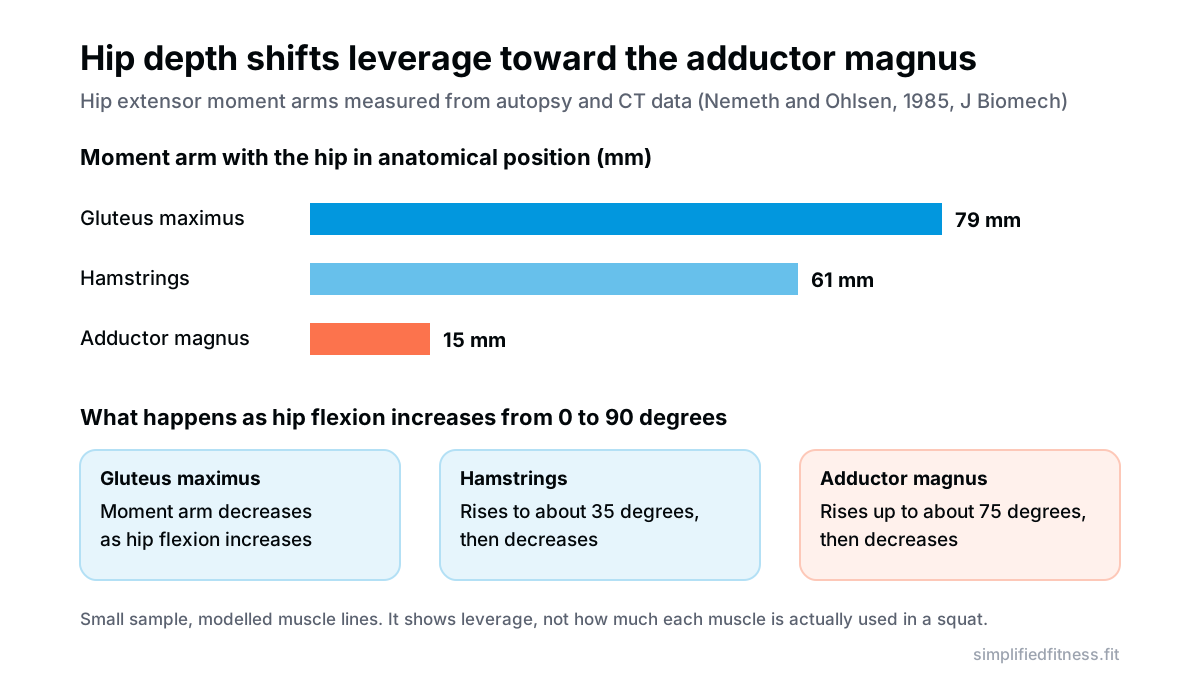
Read that carefully. The glute moment arm is still bigger in absolute terms in this dataset at 0 degrees, and the paper reports trends rather than a hand-over where the adductor magnus becomes “the main” extensor. So the fair reading is: deeper hip flexion shifts some of the load toward the adductor magnus, not that the glutes switch off. It was a small, older, modelled dataset with significant differences between men and women, so treat it as a useful map, not a stopwatch.
The depth of a squat is the hip angle you reach at the bottom. A parallel squat and a squat to the floor differ a lot in hip flexion, and the muscle mix changes with it.
Do deeper squats really work the glutes more?
There is some evidence for it. Ten experienced lifters squatted at partial, parallel and full depth, and researchers measured surface EMG on four muscles. In the lifting phase, the gluteus maximus share of the total activity was 16.9% for partial squats, 28.0% for parallel and 35.4% for full-depth squats, with the parallel figure only borderline significant (p = 0.056). The other three muscles measured (vastus medialis, vastus lateralis and biceps femoris) did not differ across depths (Caterisano et al., 2002).
Three limits matter. It was ten people. Surface EMG measured only superficial muscles, so the adductor magnus was not in the data. And the numbers are relative shares, not absolute effort.
Relative effort tells a similar story from another angle. In ten strength-trained women, greater squat depth and heavier barbell load both raised hip extensor effort, and knee extensor effort rose with depth (Bryanton et al., 2012). The authors’ point is practical: heavier loads are needed to train the hip extensors, while the knee extensors need depth even at low loads.
Do deep squats build bigger inner thighs?
This is the question people actually care about, and one trial speaks to it directly. Seventeen young men were randomly assigned to full squats (8 men) or half squats (9 men) for 10 weeks, twice a week. MRI measured muscle volumes before and after (Kubo et al., 2019).
- Adductors: +6.2% with full squats, +2.7% with half squats.
- Gluteus maximus: +6.7% with full squats, +2.2% with half squats.
- Knee extensors: +4.9% and +4.6%, with no meaningful difference.
The gains in adductor and glute volume were significantly greater in the full squat group. Rectus femoris and hamstring volumes did not change in either group.
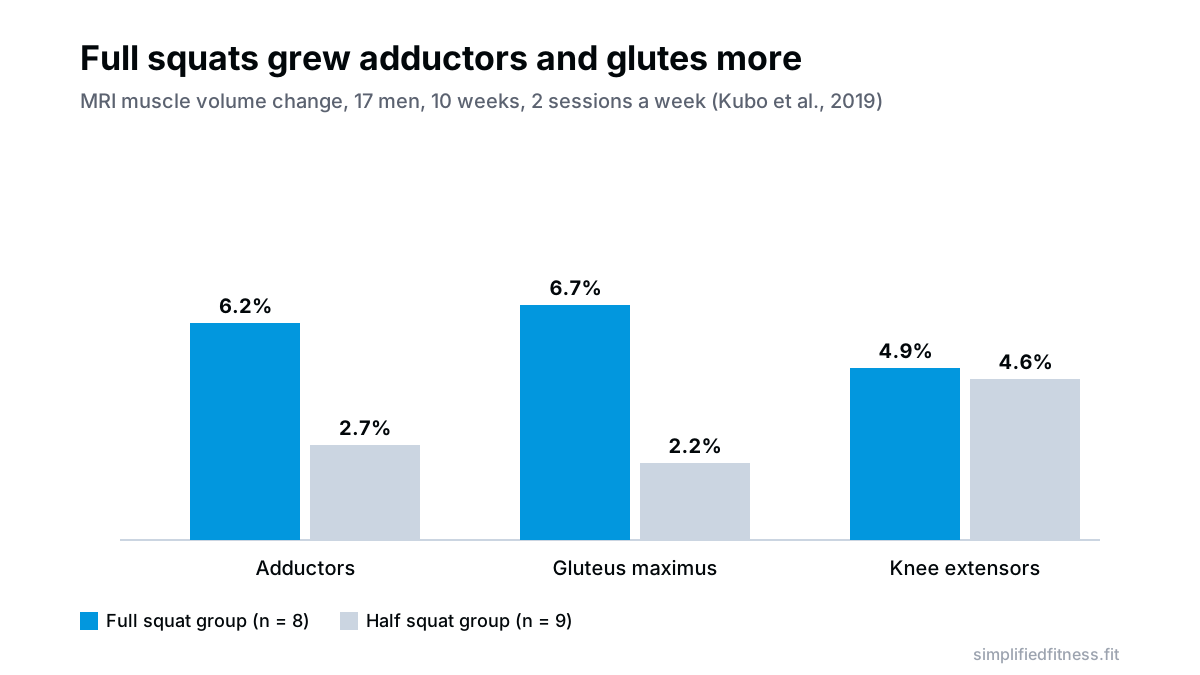
That fits the anatomy: the muscles that grew more with depth were the hip extensors. It also fits the broader review of range of motion, which concluded that full-range training has beneficial effects on lower body hypertrophy versus partial range (Schoenfeld and Grgic, 2020). Only six studies were included in that review, with a mostly male sample, so the claim is a leaning, not a law.
For the full squat-depth debate, including parallel versus deep, see our squat depth science guide.
Does leg press depth work the same way?
Less clear. The leg press is a different hip and knee path, and the data are thinner.
In a 2025 study, 23 resistance-trained people (average training age about 7 years) did unilateral leg presses for 8 weeks, one leg through roughly 5-100 degrees of knee flexion and the other through their maximum individual range, up to about 154 degrees. Quadriceps thickness grew in both legs with no meaningful difference, and the authors reported moderate to extreme evidence for no difference (Larsen et al., 2025).
That tells you the quads do not need extreme depth. It does not tell you about the glutes or adductors, because they were not measured.
The practical point is the hips. On a leg press, if you lower so far that your pelvis rolls off the pad (the “butt wink” on the machine), you stop gaining useful range for the hips and may load your lower back in a rounded position. Our leg press foot placement guide covers how to find the range your hips allow.
Which exercises load the adductor magnus most?
A 2026 modelling study had 15 injury-free people perform eight exercises, and an EMG-assisted model estimated forces in individual adductor muscles (Collings et al., 2026). The headline: the Copenhagen adduction exercise produced the highest forces across most adductors. But for the adductor magnus (ischiocondylar part, the hamstring-like back portion), deadlift, sumo deadlift, step-ups and squats were all in the top tier. The authors summarise it as high adductor magnus forces during hip extension-oriented exercises.
This is the same story from a different angle. The squat is not only a quad exercise, and the back part of the adductor magnus likes hip extension.
| Muscle part or goal | Exercises that scored well in the 2026 model |
|---|---|
| Adductor magnus (back part, hip extension) | Deadlift, sumo deadlift, step-up, squat |
| Adductor longus and brevis | Copenhagen adduction (short and long lever) |
| Whole group, strongest overall | Copenhagen long lever |
The sample was small and the forces were estimated by a model, not measured inside the muscle. Still, it supports a simple plan: squat deep and hinge for the adductor magnus, add direct adduction work if you want the other adductors.
How to use this in your training
Here is the practical version, without pretending the research gives precise numbers it does not.
- Squat as deep as you can control. Pick the depth where your spine stays neutral and the bottom is stable. Film a set from the side.
- Keep your tempo honest. Do not bounce out of the hole. A controlled descent keeps tension on the muscles that lengthen at the bottom.
- Ramp up depth gradually. If you jump from parallel to full depth in one week, expect very sore inner thighs. Add a little range and a little volume at a time.
- Use two exercise types. A deep squat or leg press for the knee and hip extension, plus a hinge (Romanian deadlift style) for the hip extensors in a different position. Our glute hypertrophy guide compares squats and hip thrusts in detail.
- Add direct adductor work if it is a weak point. Our adductor training guide covers the machine and the Copenhagen options.
You can build a week around this with our free leg day plan, and check your weekly set count with the training volume calculator.
Is the soreness normal, or is it an injury?
Soreness after a new stimulus is expected. It tends to be dull, spread across both inner thighs, appear a day or two later and ease after a few days.
An injury looks different. The adductors are a common site of strains, and a deep squat puts them in a stretched position under load.
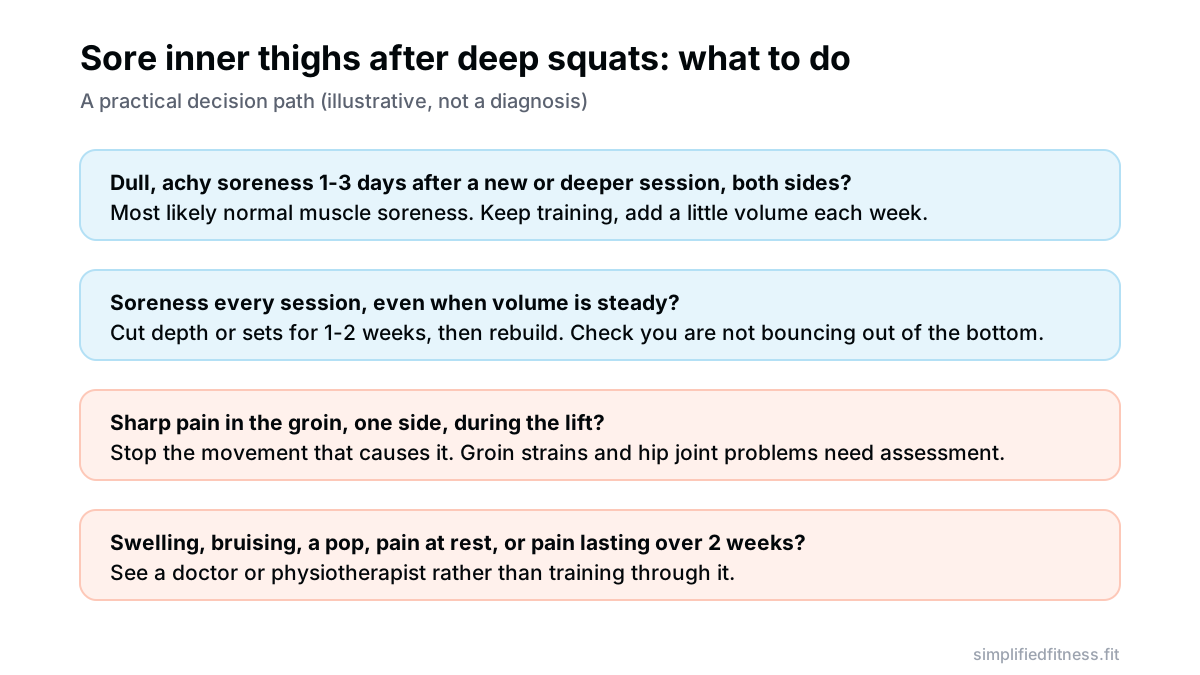
See a doctor or physiotherapist if you have sudden sharp groin pain, a pop, swelling or bruising, pain at rest, or soreness that lasts more than about two weeks. We cannot diagnose anything from an article, and pain that has a specific location and character deserves a proper exam.
What the research does not tell us
Be honest about the gaps.
- The 1985 moment arm data are old, small and modelled, and it did not test a loaded squat.
- The only trial linking depth to adductor and glute volume used 17 young men for 10 weeks.
- You will see claims online that the adductor magnus becomes the main hip extensor past 60 to 90 degrees. The moment arm study does not report that. It reports a rising adductor lever up to about 75 degrees and a falling glute lever.
- There is no trial of leg press depth on adductor size.
- Most subjects were young, healthy men. Results in women, older adults or people with hip pain may differ.
What you can say with reasonable confidence: depth shifts load toward the hip muscles, and in the one trial that checked, full squats grew the adductors and glutes more than half squats.
The bottom line
The adductor magnus is a large hip extender, so deep squats and leg presses load it alongside your glutes. That is why your inner thighs can feel it, and why full-depth squatting grew adductor and glute volume more than half squats in one MRI trial.
You do not need to chase extreme depth for your quads, since trained lifters grew them about the same across leg press ranges. You do want controlled depth if glutes and inner thighs matter to you. Squat as deep as you can own, progress gradually, and get sharp groin pain checked. If you want a structure to follow, start with our leg day plan and revisit the range of motion pillar for the bigger picture.
Frequently Asked Questions
Why do my inner thighs hurt after squats?
Most often it is normal muscle soreness in the adductors, which work hard as hip extensors when you squat deep. Imaging and modelling studies show the adductor magnus has a larger capacity for hip extension than for adduction, so a deep squat is a real workout for it. If the soreness fades in a few days, keep training and build volume gradually.
Is the adductor magnus a hip extensor?
Yes, a large part of it is. A 2025 diffusion tensor imaging study of 15 young adults found the posterior and anterior-distal portions, over 80% of the muscle, had a longer moment arm for hip extension than adduction. The whole muscle's potential torque was over twofold greater for extension than adduction, so treat it as a second glute-like muscle.
Do deep squats work the glutes more than parallel squats?
Possibly, but the evidence is thin. In ten experienced lifters, the glute max share of muscle activity in the lifting phase was 16.9% in partial squats, 28.0% at parallel and 35.4% at full depth, though the parallel result was only borderline significant (surface EMG, small sample). Squat to a depth you can control and own.
Do deep squats build bigger inner thighs?
They appear to. In a 10-week trial with MRI, full squats raised adductor volume 6.2% versus 2.7% for half squats in young men. The sample was small (17 men), so treat it as supportive rather than final, and squat as deep as your hips allow without pain.
Does leg press depth work the glutes and adductors the same way?
Probably in a similar direction, but the evidence is thinner. The leg press study that measured quads found a 5-100 degree knee range and a deeper range grew quads about equally in trained people, and it did not measure the glutes or adductors. If glutes and inner thighs are your goal, use a controlled deep range where your lower back stays flat on the pad.
How deep should I squat for glute and adductor growth?
As deep as you can go with control, a neutral spine and no pain. Full-depth training grew the adductors and glutes more than half squats in one MRI trial, while parallel squats also built the glutes in other work. Test your own depth with a light set, film it, and add load only once the bottom position is stable.
Does stance width change adductor use in squats?
Probably, but direct data on adductor hypertrophy are limited, so this is more theory than proven. A wider stance changes hip angles and may shift some load toward the inner thigh. Use the stance that lets you reach depth comfortably, and read our guide to [stance width and foot placement](/blog/stance-width-foot-placement-squats-leg-press) before changing it.
Can I train my adductors with squats alone?
Squats do train the back part of the adductor magnus: a 2026 modelling study ranked the squat in the top tier for adductor magnus (ischiocondylar) forces. For the other adductors, such as the longus and brevis, other exercises ranked higher. Add an adductor machine if you want direct work, covered in our [adductor training guide](/blog/adductor-magnus-training-inner-thigh-mass-guide).
Is deep squat inner thigh pain a groin strain?
Dull, symmetric soreness that appears a day or two later is usually muscle soreness, while sharp one-sided pain during the lift can be a strain or a hip problem. Strains involve the same adductor group that is loaded in deep positions. Stop the movement that causes sharp pain, and see a doctor or physiotherapist if it persists.
Should I stretch my adductors to squat deeper?
It can help some people, but depth is also set by your hip anatomy, so stretching is not a guarantee. Limited depth can come from joint shape, ankle mobility or technique, not just tight muscle. Try heel-elevated squats and a slightly wider stance first, and read how [anthropometry and femur length](/blog/adapting-range-of-motion-anthropometry-femur-length) shape your range.
How many sets for adductors and glutes from squats?
There is no adductor-specific number from the studies here. The trial that grew these muscles used 10 weeks of squatting twice a week, so two sessions a week is a reasonable starting point. Begin with 3-4 hard sets per session and increase only if soreness and performance allow.
Is a leg press or a squat better for adductor magnus?
We do not have a head-to-head trial for adductor magnus. The squat is the one that a 2026 modelling study found produced high adductor magnus forces, and hip extension-oriented exercises tended to rank high. Use whichever you can perform deep with control and progress consistently.
When should I see a doctor for inner thigh pain?
See a doctor if you have sudden sharp groin pain, swelling, bruising, a pop during a lift, pain at rest or soreness that lasts beyond two weeks. These can signal a strain, tendon problem or hip joint issue that training through will not fix. Until you are assessed, drop the painful movement and keep training what does not hurt.
Sources & References
Every claim above is checked against peer-reviewed research (PubMed, U.S. National Library of Medicine) or guidance from established health bodies. How we fact-check.
- Nemeth G, et al. In vivo moment arm lengths for hip extensor muscles at different angles of hip flexion. J Biomech. 1985. PMID: 3988782
- Takahashi K, et al. Redefining muscular action: human adductor magnus is designed to act primarily for hip extension rather than adduction in living young individuals. J Appl Physiol. 2025. PMID: 40139264
- Kubo K, et al. Effects of squat training with different depths on lower limb muscle volumes. Eur J Appl Physiol. 2019. PMID: 31230110
- Caterisano A, et al. The effect of back squat depth on the EMG activity of 4 superficial hip and thigh muscles. J Strength Cond Res. 2002. PMID: 12173958
- Collings TJ, et al. Hip adductor muscle forces during strength training and rehabilitation exercises. Med Sci Sports Exerc. 2026. PMID: 41931009
- Bryanton MA, et al. Effect of squat depth and barbell load on relative muscular effort in squatting. J Strength Cond Res. 2012. PMID: 22797000
- Larsen S, et al. Knee flexion range of motion does not influence muscle hypertrophy of the quadriceps femoris during leg press training in resistance-trained individuals. J Sports Sci. 2025. PMID: 40113586
- Schoenfeld BJ, et al. Effects of range of motion on muscle development during resistance training interventions: a systematic review. SAGE Open Med. 2020. PMID: 32030125

Umair Hazrami · Founder & Head Coach, Simplified Fitness
Umair Hazrami founded Simplified Fitness and the Simplified Lifter channel to cut through fitness noise. With 4+ years of consistent training and 10+ coaching clients, he writes every guide from the peer-reviewed research and links the sources so you can check them. Our editorial standards.
Educational content only, not medical advice. If you have a medical condition, are pregnant, or take medication, talk to a qualified doctor before changing your diet, supplements or training. Full disclaimer.
Keep reading
Hypertrophy
Active vs Passive Insufficiency: How Two-Joint Muscles Change Your Exercise Choice
Active vs passive insufficiency explained for lifters: why hamstrings, triceps, quads and calves grow differently depending on your second joint position.
10 min read
Hypertrophy
Squat Mobility With Long Femurs: Adapting Range of Motion to Your Hips
Squat mobility with long femurs is mostly a lever and hip-socket issue, not a flaw. Learn how to adjust depth, stance and heels without risking your hips.
10 min read
Hypertrophy
Dumbbell Pullovers vs Cable Lat Pull-ins: Training Lats at Long Muscle Lengths
Training lats at long muscle lengths: is the dumbbell pullover a lat or chest exercise, and why a cable lat pull-in may keep tension where you want it.
7 min read
Hypertrophy
Full vs Partial Range of Motion: What the Hypertrophy Research Shows
Full vs partial ROM hypertrophy explained: what two meta-analyses and recent trials found, where lengthened partials fit, and how to set your range of motion.
8 min read