Overhead Press for Shoulder Size: Standing Barbell vs Seated Dumbbell vs Machine
Is standing overhead press needed for shoulder size? See what EMG and training research says about standing barbell, seated dumbbell and machine presses.

TL;DR. The short answer
- You do not need a standing barbell overhead press to build big shoulders. No trial has shown it beats seated dumbbell or machine pressing for deltoid growth, and the meta-analysis of free weights vs machines found no hypertrophy difference.
- Standing does add work for the abs and obliques (seated pressing cut it by about 58-81% in one dumbbell study), but that effort is not extra deltoid stimulus.
- In one study, seated pressing let lifters press about 10% more with dumbbells and keeps effort on the shoulders, so it is an easy default for hypertrophy.
- Machines are safe to push close to failure, which matters because growth improves as sets finish closer to failure.
- Pain, pinching or clicking at the top of a press is a reason to see a doctor or physio, not to grind through it.
Part of our complete guide: Complete Shoulder, Delt & Neck Training Guide: 3D Deltoid Anatomy, Rotator Cuff & Traps
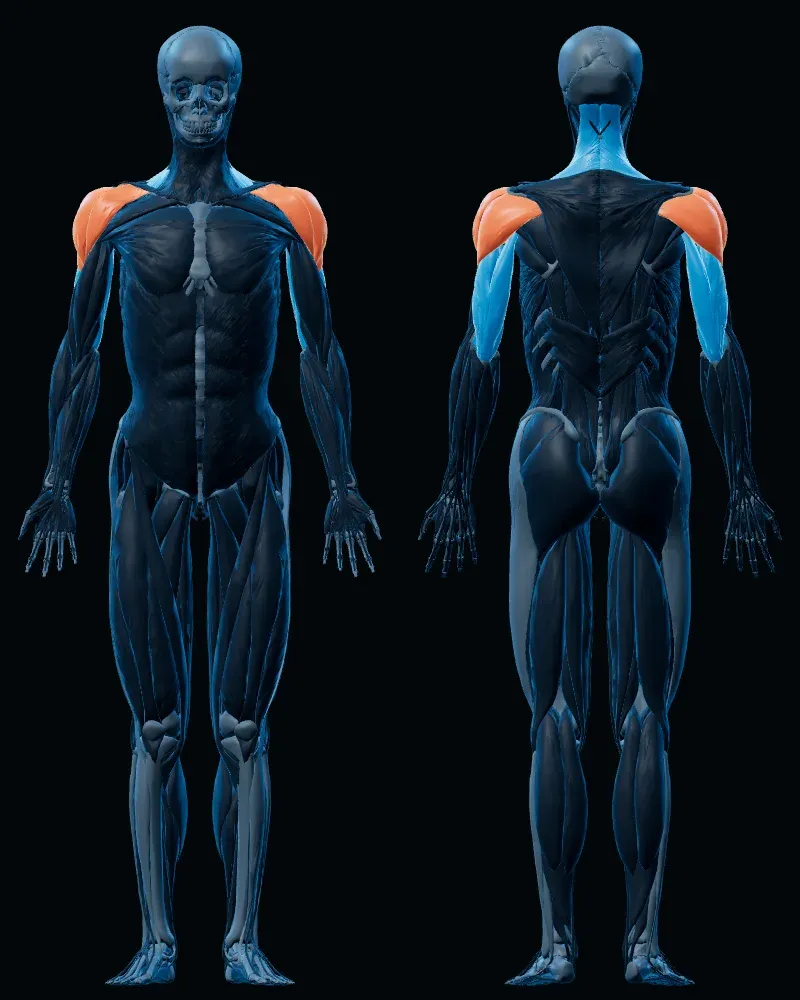
Muscles worked: shoulders
Main movers: all three heads of the deltoid
Assisting: supraspinatus, upper traps and triceps
Table of contents
Is the standing barbell overhead press necessary for big shoulders? No. For hypertrophy, a seated dumbbell press or a machine press can do the same job, and often with less wasted effort. No long-term trial has shown standing barbell pressing grows deltoids better than the alternatives.
That runs against a lot of gym folklore, so here is the honest version. This guide is part of our complete shoulder and delt training guide, and it covers the overhead press standing vs seated dumbbell question in detail, plus where machines fit in.
What does the standing barbell press actually train?
Standing barbell overhead press (OHP) is a full-body lift. You brace your trunk, squeeze your glutes, keep the bar over your midfoot and press. The deltoids and triceps move the bar, but a lot of other muscle is busy keeping you upright.
That is great for strength sport and general capability. For muscle size in the shoulders, it creates a trade-off: the part of you that gets tired first may not be the part you are trying to grow.
Here is what the coaching reality looks like. A set of standing OHP ends when your lower back starts leaning, your ribs flare, or you simply cannot keep the bar path clean. Your delts may still have a couple of good reps left. That is what people mean by non-delt failure.
Overhead press standing vs seated dumbbell: what the studies show
Researchers have measured muscle activity with surface electromyography (EMG) in a few press setups. The data helps, but it has limits, which I will flag as we go.
In 15 healthy men pressing at 80% of their one-rep max, standing and seated presses with dumbbells and barbells were compared (Saeterbakken and Fimland, 2013). With dumbbells, going seated lowered posterior deltoid activity by about 24% and medial deltoid activity by about 15%. With the barbell, posterior deltoid activity was about 25% lower seated. The authors concluded that the setup with the greatest stability demand (standing, dumbbells) produced the highest deltoid activity, though it also had the lowest 1RM.
Does that mean standing is better? Not so fast. EMG tells you how much electrical activity was recorded in a few reps. It does not tell you how much muscle you will gain over 12 weeks. Higher activity at a lighter load is not automatically more growth, and the same study found seated dumbbell 1RM was about 10% higher than standing dumbbells.
The same research group measured the core in a separate study. Seated bilateral dumbbell pressing showed about 81% lower rectus abdominis and about 58% lower external oblique activity than standing, while erector spinae activity was similar (Saeterbakken and Fimland, 2012).
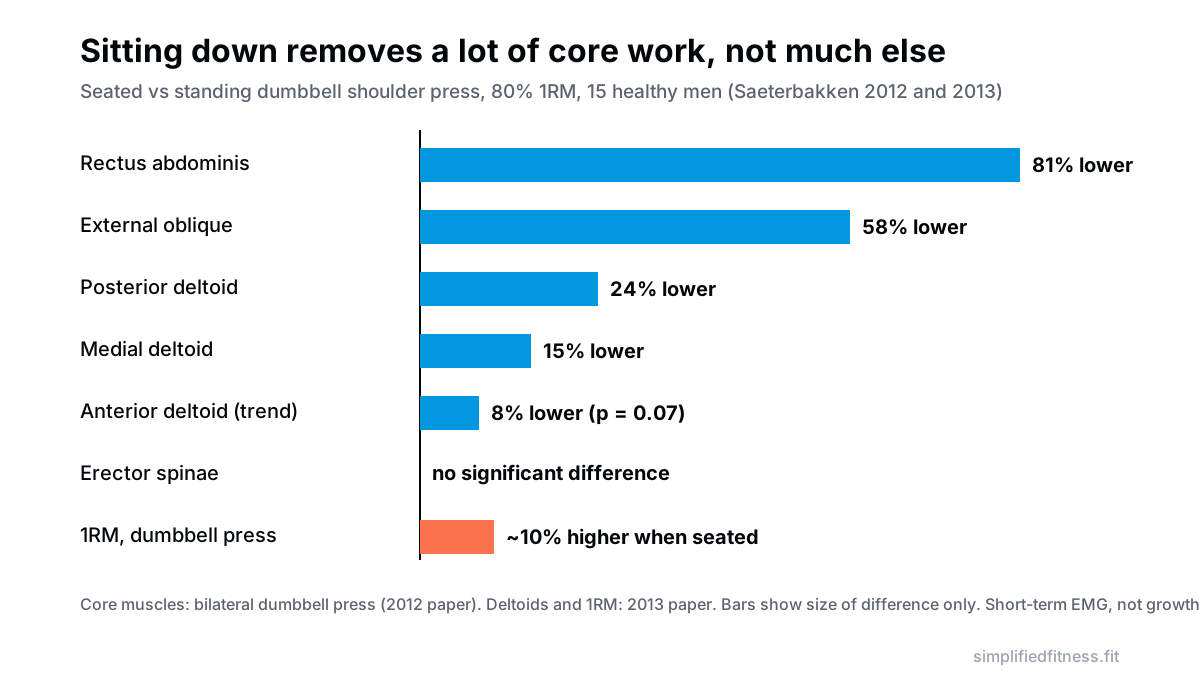
So what is the fair summary? The data point in two directions at once:
- Standing: more total body involvement, slightly higher deltoid EMG, lower load.
- Seated: much less core demand, more load, easier to repeat set after set.
Both are plausible routes to bigger delts. Neither has beaten the other in a head-to-head growth trial that I could find.
Is seated dumbbell press better than barbell?
Dumbbells let each arm move on its own path, so your wrists and shoulders can find a comfortable line. In the same 15-man study, anterior deltoid activity was about 11% lower for a seated barbell press than a dumbbell press, and about 15% lower for a standing barbell press than a standing dumbbell press (Saeterbakken and Fimland, 2013). Triceps activity was about 39% higher with a standing barbell press than standing dumbbells.
That fits what many lifters notice. The barbell press often feels like a triceps and upper-chest-and-trunk exercise, while seated dumbbells feel more shoulder-focused. Still, this is one study of healthy men over a few reps, so hold it loosely.
Dumbbells also solve a practical problem: you can add 1-2 kg a hand when the gym has them, and you can fail safely by dropping them to your thighs. A loaded barbell overhead is less forgiving when you are alone.
Machine shoulder press hypertrophy: does it work?
Yes, with a caveat on how we interpret the evidence.
Let’s start with the best evidence. A 2023 systematic review and meta-analysis pooled 13 studies and 1,016 participants comparing free-weight and machine training for at least 6 weeks (Haugen et al., 2023). Only 5 of those studies measured muscle size, and they showed no difference between the two in hypertrophy (SMD -0.055) or in direct comparisons of dynamic and isometric strength. Strength gains were specific to what people trained on: free-weight training raised free-weight test strength more, while machine training tended to raise machine strength. The authors concluded that the choice comes down to individual preference and goals. Not every included study was a shoulder press, so this tells us about equipment in general, not machine presses specifically.
Now the nuance. In 8 competitive bodybuilders, a behind-the-neck barbell press produced greater anterior and medial deltoid EMG than a behind-the-neck machine press during the lifting phase, and the authors said the barbell excited muscles more than a machine stabilizing the load path (Coratella et al., 2022). That is a small sample, a single session and EMG again.
Two findings, one practical read. Machines may recruit a bit less, but long-term growth did not differ in the pooled data. And machines have a quiet advantage that EMG does not capture: you can safely take them very close to failure, which is where growth tends to improve (more on that below). If your gym has a converging press, our article on the converging machine shoulder press and AC joint comfort goes into how the path changes feel.
Which press hits which delt head?
The overhead press is mainly a front and side delt exercise. In 13 resistance-trained men doing 12 reps at 60% 1RM, the shoulder press produced the highest anterior deltoid activation (33.3% of maximal voluntary contraction), higher than bench press, dumbbell fly and lateral raise (Campos et al., 2020). Medial deltoid activity was similar between shoulder press (27.9%) and lateral raise (30.3%), and both were well above bench press (5%). The lateral raise was highest for the posterior deltoid (24%), with the press at 11.4%.
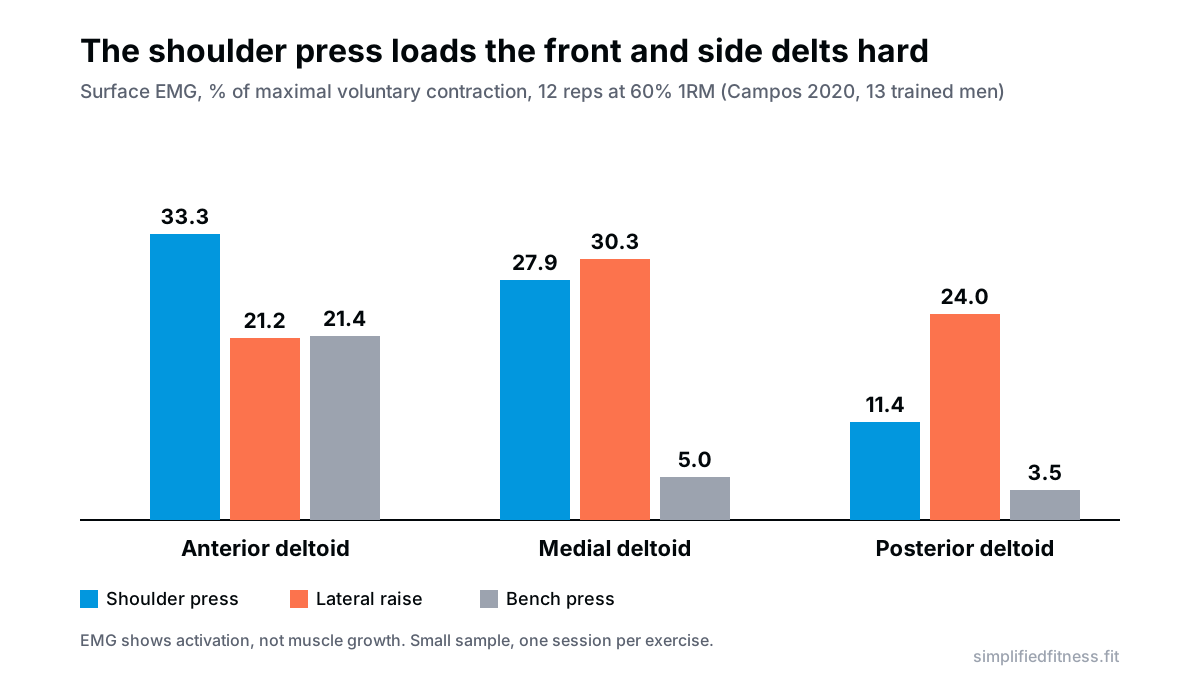
In plain terms, the press takes care of your front delts, so you likely need little or no front-raise volume (see why direct front raises are usually unnecessary). It also trains the side delts well, though most people still benefit from a dedicated lateral movement, which we compare in dumbbells vs cables vs machines for the lateral deltoid.
Women lifters: a study of 12 trained and 12 novice women found anterior deltoid and upper trapezius activity was higher in the dumbbell shoulder press than in incline or flat press, with no difference between novice and trained groups (Luczak et al., 2013). Small sample, but the pattern matched the men.
What matters more than the exact press: effort and volume
If equipment matters little, what does matter? Two things.
Proximity to failure. A 2024 meta-regression estimated how close to failure sets ended and found that muscle growth was greater as sets were terminated closer to failure, while strength gains were similar across a wide range (Robinson et al., 2024). The authors flagged that the analysis was exploratory and that their effort estimates were imperfect, so treat it as a direction, not a precise number. This is exactly where the press choice enters: a lift that is safe and stable enough to push hard is more useful than one you stop early because it feels risky or because your trunk gave out.
Weekly sets. A meta-analysis of 15 studies found a graded dose-response: each additional weekly set was associated with about a 0.37% larger gain in muscle size (Schoenfeld et al., 2017). More is not endlessly better, and recovery limits apply, but it explains why a set that fails at the wrong muscle is a wasted hard set. Our 3D shoulder protocol lays out how to spread that volume across the week.
So which overhead press should you choose?
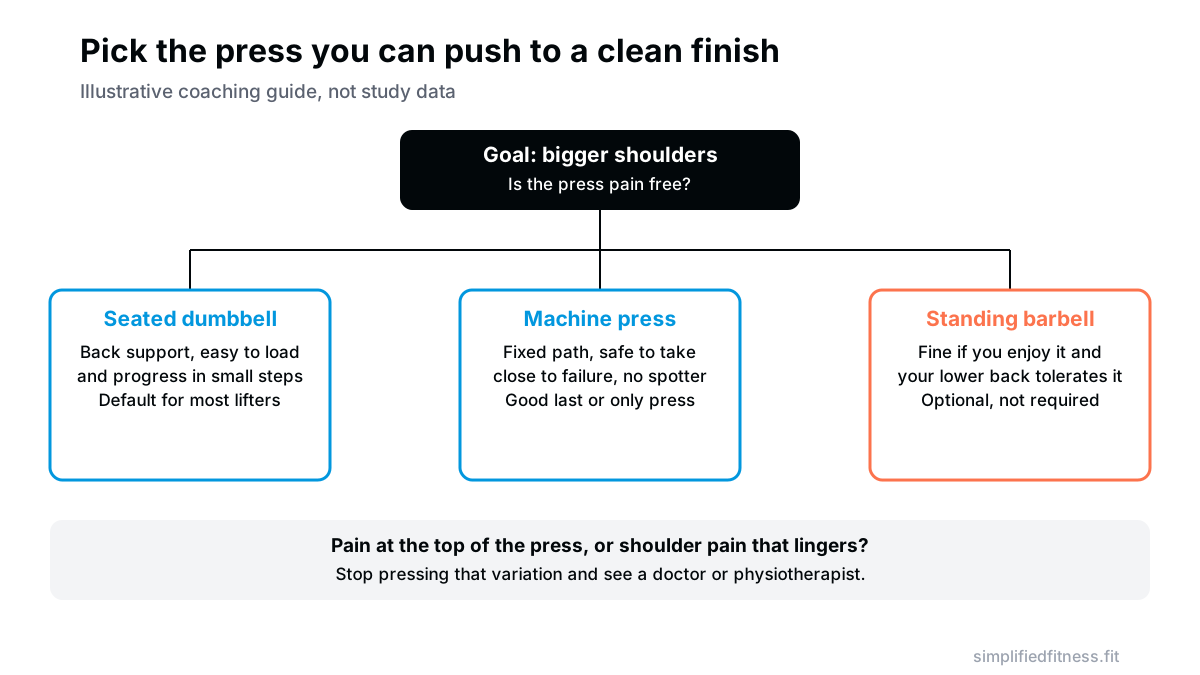
A simple way to think about it:
| Option | Best for | Watch out for |
|---|---|---|
| Seated dumbbell press | Most lifters chasing size | Awkward setup with very heavy bells |
| Machine press | Training near failure safely, low-energy days | Machine fit varies; check that the handles suit your shoulders |
| Standing barbell OHP | Strength goals, athletes, people who enjoy it | Lower back arch, trunk fatigue ending the set early |
Many lifters do well with seated dumbbells as the main press and a machine or cable variation later in the session. If you love the standing barbell press, keep it. It is a good lift. Just do not treat it as a requirement, and do not let guilt about “functional training” push you into a lift that gives you back pain and a half-trained delt.
Want to see how it all fits into a week? Try our free push day plan and use the RIR and RPE calculator to check that your sets end close enough to failure.
When to see a doctor or physio
Overhead pressing should not cause sharp pain, pinching, numbness or clicking with pain. If you get any of these, or ongoing pain at the top of the movement, stop the painful variation and get it assessed by a doctor or physiotherapist. We cover the common causes in our piece on subacromial impingement and lifting solutions, but that is general education, not a diagnosis. Changing the angle or grip, or switching to a neutral-grip dumbbell or machine press, can help some people, but it is no replacement for professional advice if pain persists.
The bottom line
Standing barbell OHP is a legitimate lift, but it is not a hypertrophy requirement. Seated dumbbell and machine presses let you press hard, stay stable and finish sets with tired delts instead of a tired lower back. The research here is mostly short-term EMG plus broader meta-analyses on equipment, so there is no definitive winner. Choose the press you can progress, train close to failure, and hit your weekly volume on.
Frequently Asked Questions
Is standing overhead press necessary for shoulder size?
No. Studies have not shown that the standing barbell press is required for deltoid growth, and a meta-analysis found no hypertrophy difference between free-weight and machine training overall. Any press that lets you add load or reps over time and train near failure can grow your delts. Pick the one your lower back and shoulders tolerate.
Is seated or standing overhead press better for hypertrophy?
Neither has been proven better for hypertrophy in a long-term trial. In EMG work, seated pressing cut abs and obliques activity sharply while leaving the erector spinae similar, so more of the effort stays on the shoulders. Choose seated when you want to focus on delts, and standing when you enjoy it.
Is seated dumbbell shoulder press better than barbell?
For most lifters it is a more practical choice, not a proven superior one. In one study, the dumbbell press showed higher anterior deltoid activity than the barbell press, and seated dumbbells allowed about 10% more load than standing dumbbells. Try both and keep whichever you can progress without back or shoulder discomfort.
Does machine shoulder press build muscle?
Yes, it can. A 2023 meta-analysis of 13 studies (5 of them measured muscle size) found no difference in hypertrophy between free-weight and machine training, and a machine lets you train hard with a fixed path. Use it with full range and sets that end 1-3 reps from failure.
Is the machine shoulder press less effective than barbell for delts?
Not necessarily. In eight bodybuilders, a barbell press showed higher EMG than a machine press in some deltoid heads, but EMG is not growth. Long-term data suggest that equipment choice matters little for muscle size, so progression and effort matter more.
Why do my lower back and abs hurt more on standing overhead press?
Standing pressing makes the trunk work harder to keep the bar over your hips, and abdominal activity was much higher standing than seated in one study. Leaning back to finish reps shifts load to the lumbar spine. Squeeze your glutes, ribs down, and switch to a seated press with back support if the arch keeps creeping in.
How many sets of overhead press do I need per week?
Hypertrophy generally improves as weekly sets per muscle go up, within what you can recover from. A meta-analysis found each extra weekly set was associated with about 0.37% more muscle gain, though results vary by person. Start with roughly 6-10 hard sets for the delts including presses and raises and add slowly.
How close to failure should I take shoulder presses?
A meta-regression found muscle growth was greater as sets ended closer to failure, though the analysis was exploratory. A practical range is about 1-3 reps in reserve on free weights, and closer on a machine. Use our RIR calculator to judge your effort.
Do front delts get enough work from overhead press?
For most lifters, yes. In 13 trained men, the shoulder press gave the highest anterior deltoid activation of four exercises tested, higher than bench press or lateral raise. That is why many lifters need little or no direct front-raise work.
Should I do overhead press and lateral raises?
Usually yes, because they train the middle delt differently. In one study the lateral raise and shoulder press showed similar medial deltoid activation, but the lateral raise hit the posterior deltoid more. Pair a press with a lateral raise variation rather than choosing one.
Is overhead press bad for your shoulders?
Not for most people. Pain depends on mobility, load, technique and individual anatomy, and many lifters press overhead for years without issue. If a press pinches or aches at the top, change the angle or variation and see a doctor or physiotherapist if it persists.
Can I build big shoulders with only machines?
Probably, if you progress the load and train hard. Meta-analysis shows similar hypertrophy for machines and free weights, though strength gains tend to be specific to the equipment you train on. Add a free-weight press now and then if you want to lift free weights.
Sources & References
Every claim above is checked against peer-reviewed research (PubMed, U.S. National Library of Medicine) or guidance from established health bodies. How we fact-check.
- Saeterbakken AH, et al. Effects of body position and loading modality on muscle activity and strength in shoulder presses. J Strength Cond Res. 2013. PMID: 23096062
- Saeterbakken AH, et al. Muscle activity of the core during bilateral, unilateral, seated and standing resistance exercise. Eur J Appl Physiol. 2012. PMID: 21877146
- Coratella G, et al. Front vs back and barbell vs machine overhead press: an electromyographic analysis and implications for resistance training. Front Physiol. 2022. PMID: 35936912
- Campos YAC, et al. Different shoulder exercises affect the activation of deltoid portions in resistance-trained individuals. J Hum Kinet. 2020. PMID: 33312291
- Haugen ME, et al. Effect of free-weight vs. machine-based strength training on maximal strength, hypertrophy and jump performance: a systematic review and meta-analysis. BMC Sports Sci Med Rehabil. 2023. PMID: 37582807
- Robinson ZP, et al. Exploring the dose-response relationship between estimated resistance training proximity to failure, strength gain, and muscle hypertrophy: a series of meta-regressions. Sports Med. 2024. PMID: 38970765
- Schoenfeld BJ, et al. Dose-response relationship between weekly resistance training volume and increases in muscle mass: a systematic review and meta-analysis. J Sports Sci. 2017. PMID: 27433992
- Luczak J, et al. Shoulder muscle activation of novice and resistance trained women during variations of dumbbell press exercises. J Sports Med. 2013. PMID: 26464884

Umair Hazrami · Founder & Head Coach, Simplified Fitness
Umair Hazrami founded Simplified Fitness and the Simplified Lifter channel to cut through fitness noise. With 4+ years of consistent training and 10+ coaching clients, he writes every guide from the peer-reviewed research and links the sources so you can check them. Our editorial standards.
Educational content only, not medical advice. If you have a medical condition, are pregnant, or take medication, talk to a qualified doctor before changing your diet, supplements or training. Full disclaimer.
Keep reading
Exercise Technique
3D Shoulder Protocol: Weekly Volume, Frequency (2-3x/Week) and Rep Ranges
How to build 3D shoulders: how many weekly sets, how often to train side and rear delts, and which rep ranges to use, with an 8-week plan and the research.
8 min read

Exercise Technique
Are Front Raises Necessary? Why Bench Pressers Rarely Need Direct Front Delt Work
Are front raises necessary if you bench and overhead press? See what EMG and volume research says, when they can still help, and where to spend those sets.
8 min read
Exercise Technique
Behind-the-Neck Press: Shoulder Mobility, Neck Safety and Muscle Bias
Behind the neck press safety explained: who has the shoulder mobility for it, what EMG studies show for delts, and which swaps work if you do not.
10 min read
Exercise Technique
Cable Lateral Raises: Behind-the-Back vs Cross-Body Setup, Which Is Better?
Cable lateral raise behind the back vs in front: what the research says, which setup suits most lifters, and a step-by-step guide to pulley height and cuffs.
9 min read