Incline Dumbbell Curls vs Preacher Curls: Lengthened Stretch vs Shortened Resistance
Incline dumbbell curl vs preacher curl: what a 12-week MRI study found for biceps growth, how each loads the stretch, and how to program both.
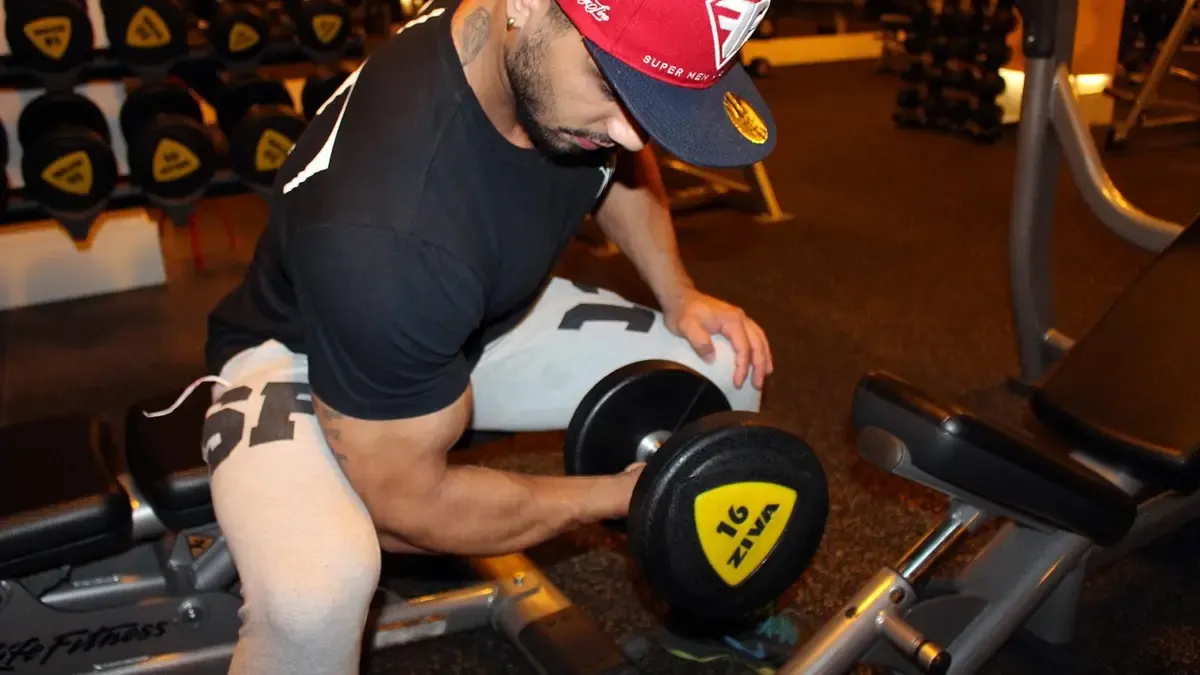
TL;DR. The short answer
- In a 2026 MRI study of 21 untrained adults, incline curls grew the biceps brachii slightly more (+22.1% vs +18.9%), while preacher curls grew the brachialis and brachioradialis slightly more. Total elbow flexor growth did not differ.
- Neither curl is clearly better for overall arm size. The differences were small to moderate, and the data come from beginners training for 12 weeks.
- Incline curls stretch the biceps at both the shoulder and elbow. Preacher curls pin the upper arm forward, so the long head is not stretched at the shoulder but the elbow still loads a deep stretch.
- A practical default is one of each per week, 2-4 hard sets per curl, taken close to failure through a full range of motion.
- Elbow or biceps tendon pain during either curl is a reason to stop and see a doctor or physio, not to push through.
Part of our complete guide: Muscle Length, Range of Motion and Stretch-Mediated Hypertrophy: What the Research Actually Shows
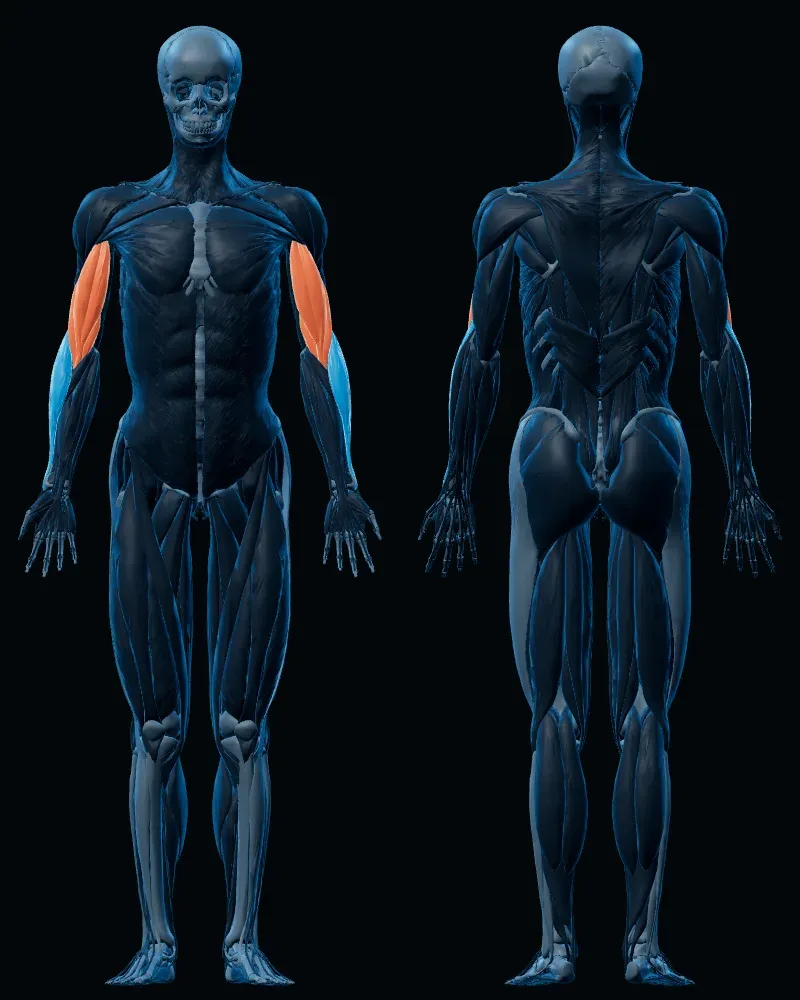
Muscles worked: biceps
Main movers: biceps brachii and brachialis
Assisting: brachioradialis
Table of contents
The incline dumbbell curl vs preacher curl debate has a short answer: neither wins outright. In the one direct MRI comparison, incline curls grew the biceps brachii a little more, preacher curls grew the muscles underneath it a little more, and total elbow flexor growth came out about the same.
That matters because most “best biceps exercise” advice treats them as rivals. They are better seen as two different ways to load a stretch. This article sits inside our wider guide to range of motion and stretch-mediated hypertrophy, so we will focus on the mechanics of these two curls and what the evidence does and does not say.
What is actually different between the two curls?
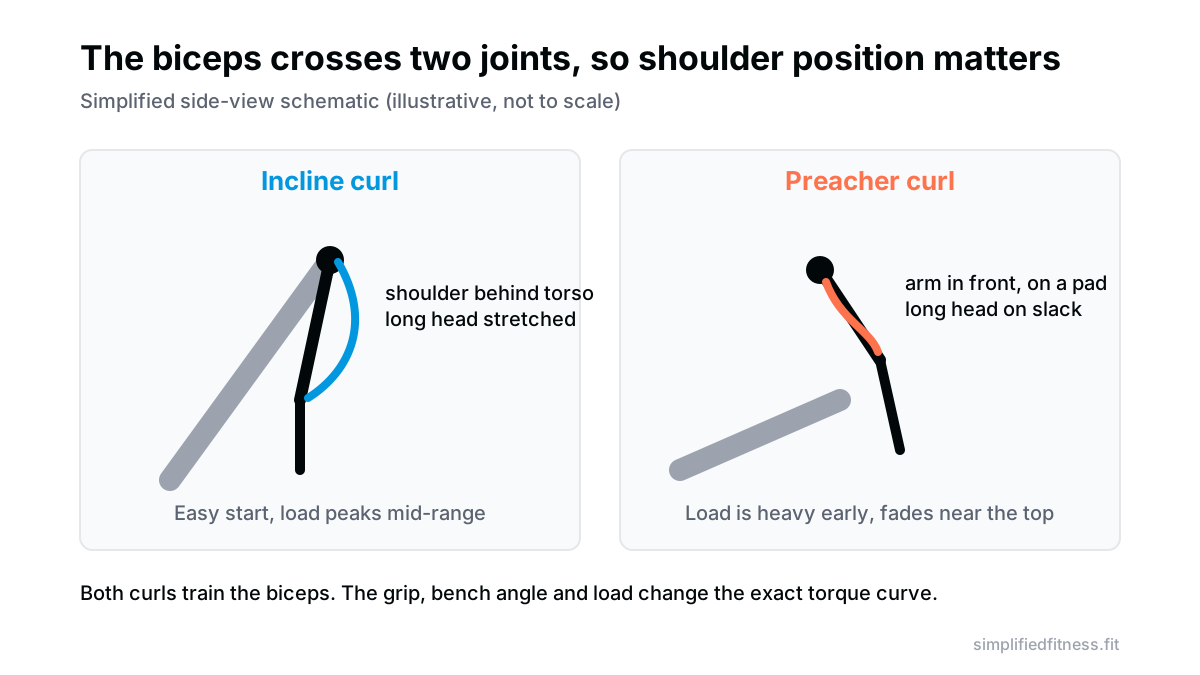
Your biceps brachii crosses two joints. It flexes the elbow and, via the long head, it also crosses the shoulder. That means where your upper arm sits changes how stretched the muscle is before you even start curling.
In an incline curl, you sit back on an angled bench and let the arms hang behind your torso. The shoulder is extended, so the long head is already stretched across the shoulder when the elbow is straight.
In a preacher curl, your upper arm rests on a pad in front of you. The shoulder is flexed, which slackens the long head at the shoulder. The elbow still goes into a deep stretch at the bottom, but the shoulder is not contributing.
The same logic is behind the overhead triceps work. In a 2023 study of 21 adults, overhead cable extensions grew the triceps long head more than neutral-arm extensions (+28.5% vs +19.6%), even with lighter loads (Maeo et al., 2023). The biceps version of that idea is the incline curl. Whether it gives the same payoff is the question the next section answers.
What does the research say about incline vs preacher curls for growth?
Only one study I could find has put the two head to head with MRI. In 2026, Kobayashi and colleagues had 21 untrained adults train one arm with incline dumbbell curls and the other with preacher dumbbell curls for 12 weeks (70% of 1RM, 5 sets of 10 reps, twice a week) (Kobayashi et al., 2026). They measured the volume of the biceps brachii, brachialis and brachioradialis.
The results:
- Biceps brachii: +22.1% after incline vs +18.9% after preacher (Hedges’ g = 0.33).
- Brachialis: +17.1% after incline vs +21.1% after preacher (g = 0.50).
- Brachioradialis: +13.5% after incline vs +17.6% after preacher (g = 0.47).
- Total elbow flexors: +17.6% vs +19.2%, not a significant difference.
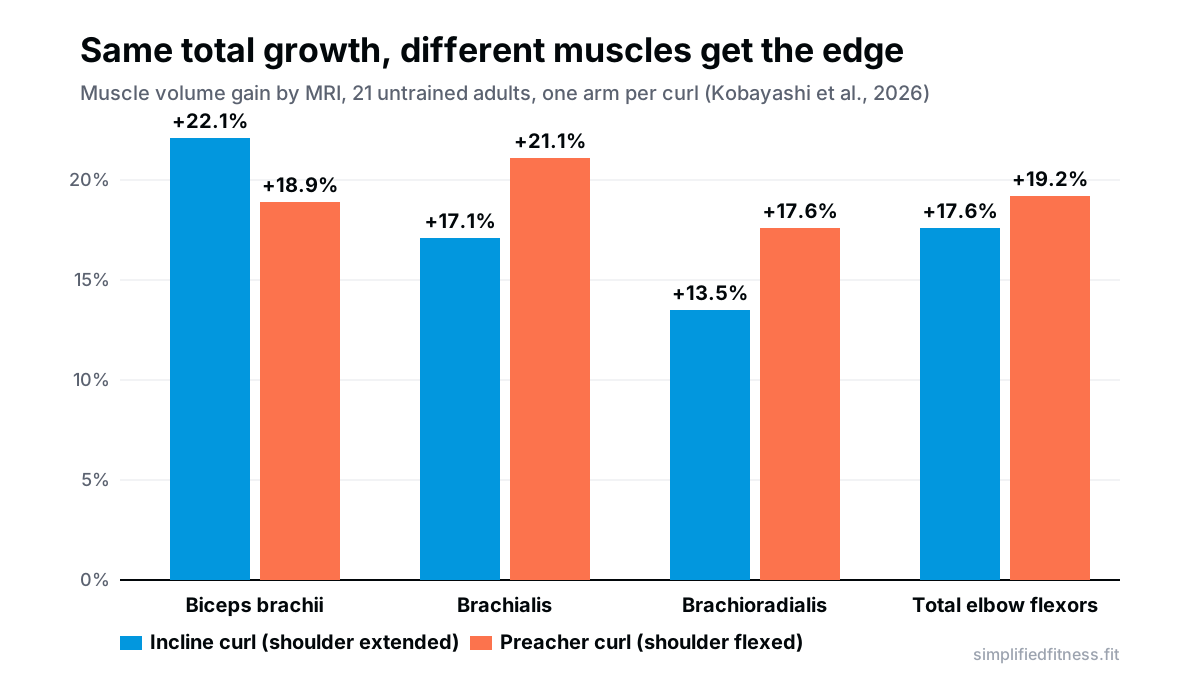
The authors summarised it as small-to-moderate, exercise-specific differences, with limited influence on total elbow flexor growth and on where along the muscle the growth occurred.
Is the biceps lengthened position better for growth?
The idea behind the incline curl is that training at long muscle lengths drives extra growth. The broader literature is promising but not settled.
A 2020 systematic review of range of motion studies found a full range helped lower body hypertrophy, while upper limb research was limited and conflicting, so strong practical conclusions were not possible. It also noted that the response may differ by muscle (Schoenfeld and Grgic, 2020).
More recently, a trial in 30 resistance-trained people trained one arm with lengthened partials and the other with full range for 8 weeks. Elbow flexor and extensor thickness grew similarly, with Bayes factors giving moderate support for no difference (Wolf et al., 2025). The authors suggest emphasising the stretched position, through a full range or lengthened partials, when size is the goal.
Then there is the regional question. A 2025 Bayesian meta-analysis of 12 studies in young adults found trivial differences in regional hypertrophy between training at longer and shorter mean muscle lengths, and the authors warned that the length differences between conditions were relatively small (Varovic et al., 2025).
So what do we do with this? The studies are not contradicting each other as much as asking different questions. The Kobayashi and Maeo trials changed where the muscle sits and found some differences. The meta-analysis pooled mostly small manipulations and found little. A cautious takeaway: loading the stretch is a reasonable way to train, but it is not a magic trick, and you should not drop every other curl variation for it.
Why the preacher curl can still be a great choice
The preacher pad does two useful things. It fixes your upper arm in place, so you cannot swing your torso or drift the elbow. And it moves the hardest part of the load into the stretched half of the rep for most setups.
The resistance curve of a free weight follows simple geometry. A dumbbell feels heaviest when your forearm is closest to horizontal. On an angled preacher pad, that point falls in the lower half of the movement, then the load fades as the hand comes toward the shoulder. On an incline curl, the forearm starts hanging straight down, so the first few degrees feel easier, and the load builds through the middle. Both patterns depend on bench angle and where you place your elbow, so treat them as general principles rather than exact numbers.
One 2009 EMG study compared standing and preacher curls at low loads (25-40% of 1RM) in 20 healthy people. Muscle activity, heart rate and perceived exertion were lower in the preacher version at 40% 1RM by the 20th repetition (Oliveira and Goncalves, 2009). I would not read much into that for growth, since those were light, short-term loads and EMG is not a measure of muscle gain. It simply fits the idea that the pad changes how the movement feels and is executed.
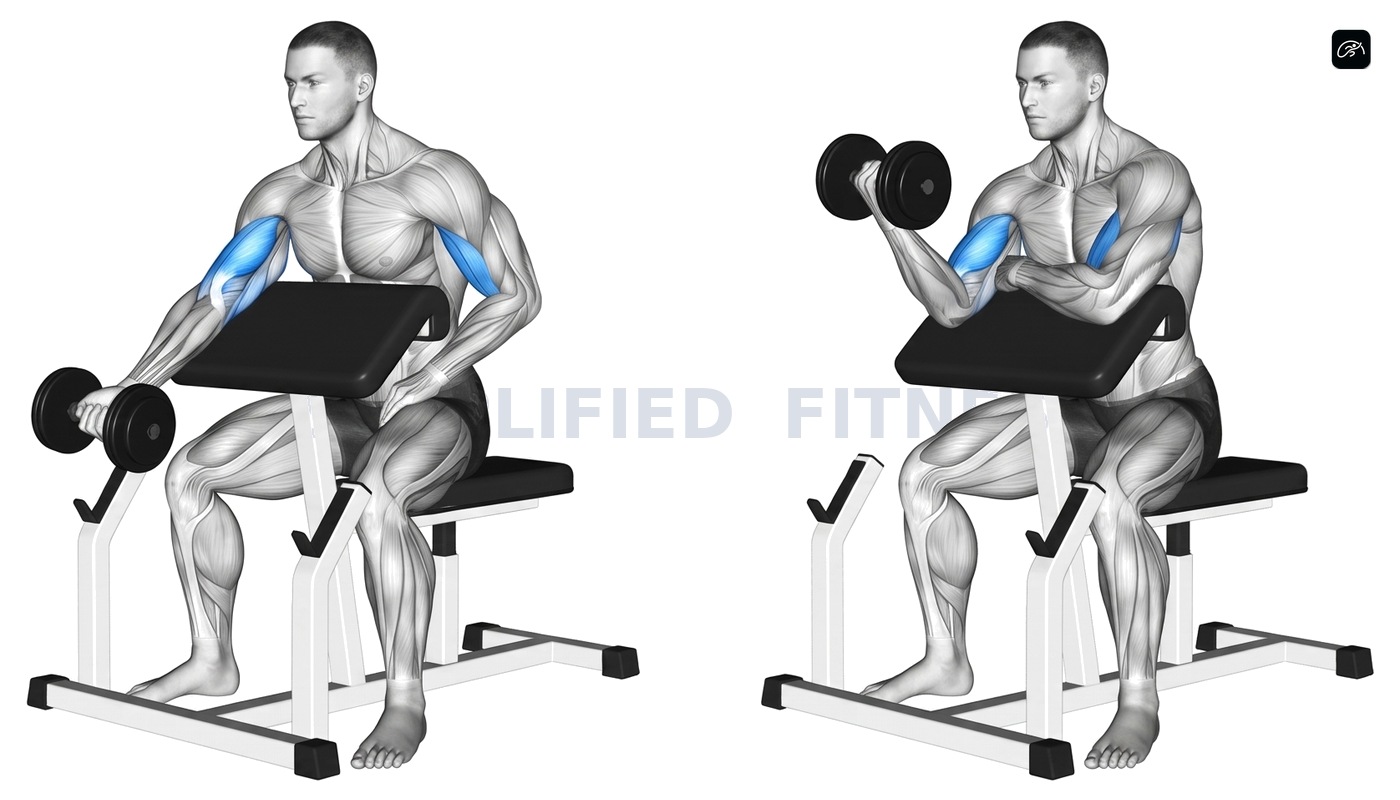
For more on the preacher side, see preacher curls and peak tension for the distal biceps and how it compares to Bayesian cable curls.
How to do incline dumbbell curls properly
Set the bench at roughly 45-60 degrees (a common coaching range, not a research-defined optimum). Sit back with your head and shoulders against the pad and let the dumbbells hang with palms facing forward.
- Keep your elbows just behind your torso. If they drift forward, you lose the stretch you came for.
- Curl without rocking your shoulders off the bench.
- Lower slowly until your elbow is almost straight.
- If your front shoulder feels pinched at the bottom, raise the back pad or reduce the load.
For a closer look, our guide on incline dumbbell curls and shoulder extension covers setup in more detail, and long head vs short head biceps explains why the head-targeting claims are often overstated.
Incline curl vs preacher curl: quick comparison
| Factor | Incline dumbbell curl | Preacher curl |
|---|---|---|
| Shoulder position | Extended, behind torso | Flexed, in front on a pad |
| Biceps stretch | Across shoulder and elbow | At the elbow only |
| 12-week MRI result (untrained) | Biceps brachii +22.1% | Brachialis +21.1%, brachioradialis +17.6% |
| Cheating risk | Low, as long as your back is on the bench | Low, the pad blocks swinging |
| Typical limiter | Front shoulder comfort | Elbow and tendon comfort at the bottom |
| Best for | Loading the biceps stretch | Strict, repeatable elbow flexion |
How to pair them in a week
You do not need to over-plan this. Here is a simple structure that follows the evidence we have without pretending it is more precise than it is.
- Pull day A: incline dumbbell curls, 3 hard sets of 8-12.
- Pull day B: preacher curls, 3 hard sets of 8-12.
- Take sets within 1-3 reps of failure, and add reps before you add weight.
- Count your rows and pulldowns too. They train the biceps, so more curl sets are not always better. Our training volume calculator helps you tally weekly sets, and the pull day plan shows where curls fit.
If you want a third option, see hammer curls for the brachialis and brachioradialis, which train the two muscles that grew more in the preacher arm.
What if you only have one option?
On a basic gym floor in India, a bench and a pair of dumbbells is often all there is. That is enough. Choose the curl that you can load progressively, that does not hurt, and that you will do consistently. A comfortable, progressed curl beats a “perfect” one you avoid.
When to see a doctor
Mild muscle soreness after curls is normal. Sharp pain at the front of the elbow or in the crease, a sudden pop, visible bruising, or a bulge in the upper arm after a heavy rep are not. Persistent pain that lasts more than a week or two, or arm weakness, should be checked by a doctor or sports physiotherapist. I cannot diagnose anything from a description, and you should not train through it.
Bottom line
For the incline dumbbell curl vs preacher curl question, the best current evidence says both build the elbow flexors well, with small differences in which muscle benefits most. If you can only do one, pick the one you can progress comfortably. If you can do both, you get a more complete set of stimuli. For the bigger picture, return to the pillar guide on range of motion and stretch-mediated hypertrophy, or compare functional anatomy of the arm flexors.
Frequently Asked Questions
Are incline curls better than preacher curls for biceps growth?
Only slightly, and only for the biceps brachii itself. In a 2026 MRI trial, incline curls grew the biceps brachii a bit more (+22.1% vs +18.9%, a small effect), but preacher curls grew the brachialis and brachioradialis a bit more and total elbow flexor growth was similar. Use both if you want a rounded arm, and pick the one you can load hard with clean form.
Which curl stretches the biceps more?
The incline curl, because the arm hangs behind the torso and the long head is lengthened across the shoulder as well as the elbow. A preacher curl lengthens the muscle only at the elbow, since the shoulder is held in front of the body. If a deep biceps stretch is your goal, start with incline curls.
What is the biceps lengthened position?
It is the part of a rep where the muscle is stretched the most, with the elbow straight and, for the long head, the shoulder extended behind the body. Research on lengthened training is promising but still developing, and a 2025 meta-analysis found similar regional growth at longer and shorter lengths. Train through a full range and include at least one curl that loads the stretch.
What is the preacher curl resistance curve?
With a dumbbell or barbell, the load feels heaviest where the forearm is closest to horizontal. On a typical angled pad that falls near the stretched half of the rep, then tension fades toward the top. The exact curve changes with pad angle, so a cable or machine preacher can feel different.
Do preacher curls target the short head of the biceps?
That claim is popular but not well supported. The 2026 trial measured whole muscles, not heads, and found the biceps brachii grew in both curls. Do not expect to isolate one head, and choose exercises by stretch, comfort and load.
How many sets of incline and preacher curls should I do?
A reasonable range is 2-4 hard sets of each curl once or twice a week, adjusted to your total arm volume. The 2026 study used 5 sets of 10 twice weekly in beginners, which is a lot for someone who also does rows and pulldowns. Start lower, add sets only if recovery and progress allow.
Should I use a full range of motion on curls?
Mostly yes. A 2025 trial in trained people found lengthened partials and full range gave similar arm growth, so the stretched half appears important, but you do not need to cut the top half off. Own the bottom of the rep and still squeeze at the top.
What bench angle is best for incline curls?
There is no tested best angle, so use one that lets your elbows hang just behind your torso without shoulder pain. Around 45-60 degrees is a common starting point, which is a coaching habit rather than a research finding. If your front shoulder pinches, raise the back pad.
Can I do preacher curls with dumbbells instead of an EZ bar?
Yes, and the 2026 MRI study used dumbbells for both curls. Working one arm at a time lets you fix side-to-side differences and keep the elbow pinned to the pad. Use a grip and weight that keep your upper arm in contact with the pad.
Why do preacher curls hurt my elbow or biceps tendon?
The bottom of a preacher curl puts a high load on the elbow flexors and biceps tendon when the arm is straight, especially if you drop the weight fast. Lower under control and stop a few degrees short of full lockout. Persistent pain, a pop, bruising or weakness needs a doctor or physiotherapist, not more sets.
Do I need both incline and preacher curls?
No single exercise is mandatory. Each curl loads the elbow flexors with a different shoulder position, and the study results suggest slightly different muscle emphasis, so combining them is a sensible way to cover your bases. If you only have time for one, choose the one that is comfortable and that you can progress for months.
How do I do these curls on a budget in an Indian gym?
You only need an adjustable bench and a pair of dumbbells. Prop the bench at 45-60 degrees for incline curls, and for preacher curls use a preacher pad or lean your triceps on the angled bench back. Fixed dumbbells in 1-2 kg steps work fine because small jumps keep progression smooth.
How long until I see results from changing my biceps curls?
Give any change at least 8-12 weeks before judging it. The study above needed 12 weeks of MRI-tracked training to show differences, and small differences like these are hard to see in a mirror. Beginners progress faster than experienced lifters, who may need many months to see small differences. Track your load and reps each week so you can tell progress is real.
Sources & References
Every claim above is checked against peer-reviewed research (PubMed, U.S. National Library of Medicine) or guidance from established health bodies. How we fact-check.
- Kobayashi Y, et al. Exercise-specific preferential hypertrophy of individual elbow flexor muscles after incline versus preacher dumbbell curl training. J Sports Sci. 2026. PMID: 42829982
- Schoenfeld BJ, Grgic J. Effects of range of motion on muscle development during resistance training interventions: A systematic review. SAGE Open Med. 2020. PMID: 32030125
- Wolf M, et al. Lengthened partial repetitions elicit similar muscular adaptations as full range of motion repetitions during resistance training in trained individuals. PeerJ. 2025. PMID: 39959841
- Varovic D, et al. Does muscle length influence regional hypertrophy? A systematic review and meta-analysis. Int J Sports Med. 2025. PMID: 40570881
- Maeo S, et al. Triceps brachii hypertrophy is substantially greater after elbow extension training performed in the overhead versus neutral arm position. Eur J Sport Sci. 2023. PMID: 35819335
- Oliveira AS, Goncalves M. Positioning during resistance elbow flexor exercise affects electromyographic activity, heart rate, and perceived exertion. J Strength Cond Res. 2009. PMID: 19387393

Umair Hazrami · Founder & Head Coach, Simplified Fitness
Umair Hazrami founded Simplified Fitness and the Simplified Lifter channel to cut through fitness noise. With 4+ years of consistent training and 10+ coaching clients, he writes every guide from the peer-reviewed research and links the sources so you can check them. Our editorial standards.
Educational content only, not medical advice. If you have a medical condition, are pregnant, or take medication, talk to a qualified doctor before changing your diet, supplements or training. Full disclaimer.
Keep reading
Hypertrophy
Active vs Passive Insufficiency: How Two-Joint Muscles Change Your Exercise Choice
Active vs passive insufficiency explained for lifters: why hamstrings, triceps, quads and calves grow differently depending on your second joint position.
10 min read
Hypertrophy
Squat Mobility With Long Femurs: Adapting Range of Motion to Your Hips
Squat mobility with long femurs is mostly a lever and hip-socket issue, not a flaw. Learn how to adjust depth, stance and heels without risking your hips.
10 min read
Hypertrophy
Dumbbell Pullovers vs Cable Lat Pull-ins: Training Lats at Long Muscle Lengths
Training lats at long muscle lengths: is the dumbbell pullover a lat or chest exercise, and why a cable lat pull-in may keep tension where you want it.
7 min read
Hypertrophy
Full vs Partial Range of Motion: What the Hypertrophy Research Shows
Full vs partial ROM hypertrophy explained: what two meta-analyses and recent trials found, where lengthened partials fit, and how to set your range of motion.
8 min read