Regional Hypertrophy: Can You Grow Proximal, Middle or Distal Muscle Regions?
Regional hypertrophy is real: muscles grow unevenly along their length. See what MRI and ultrasound studies show, and how to pair exercises sensibly.

TL;DR. The short answer
- Regional hypertrophy is real: imaging studies using MRI and ultrasound show that muscles do not grow evenly along their length after training.
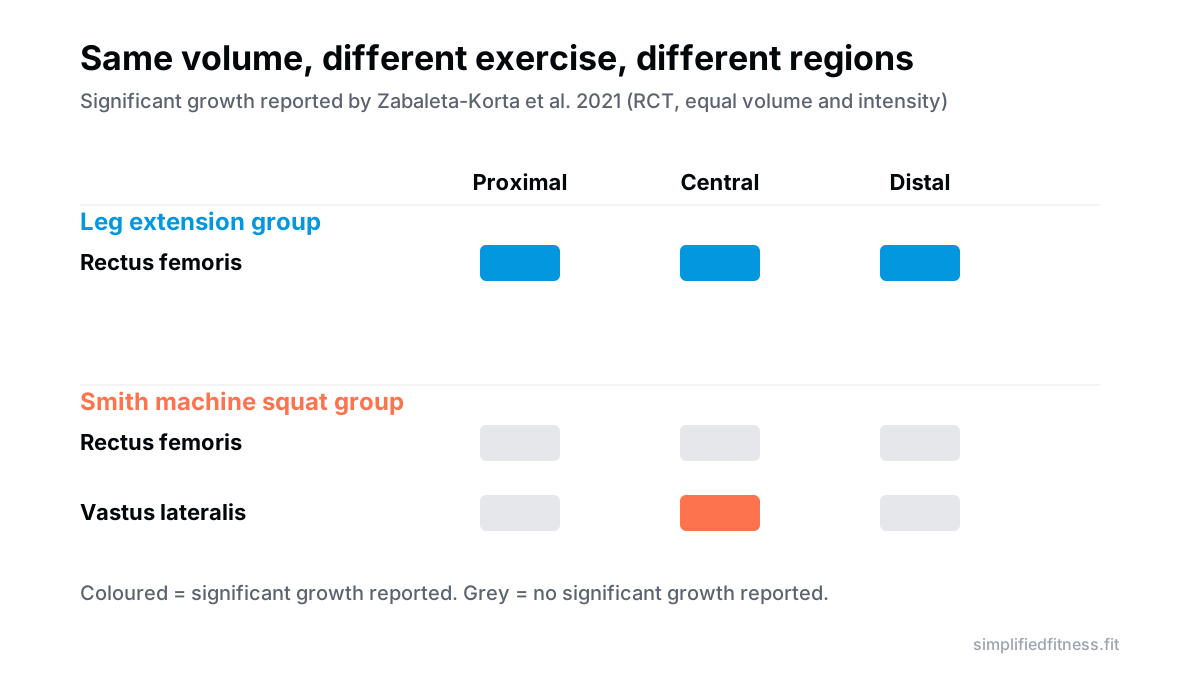
- Exercise choice can shift where a muscle grows. In one trial with equal volume, leg extensions grew all three regions of the rectus femoris, while Smith machine squats grew only the central vastus lateralis.
- You cannot isolate a 'lower biceps' or 'inner chest' in the strict sense. The evidence supports shifting emphasis between regions, not switching one off.
- Results are inconsistent across muscles and studies, and most trials are short and in young men, so use variety as a sensible hedge rather than a precise targeting tool.
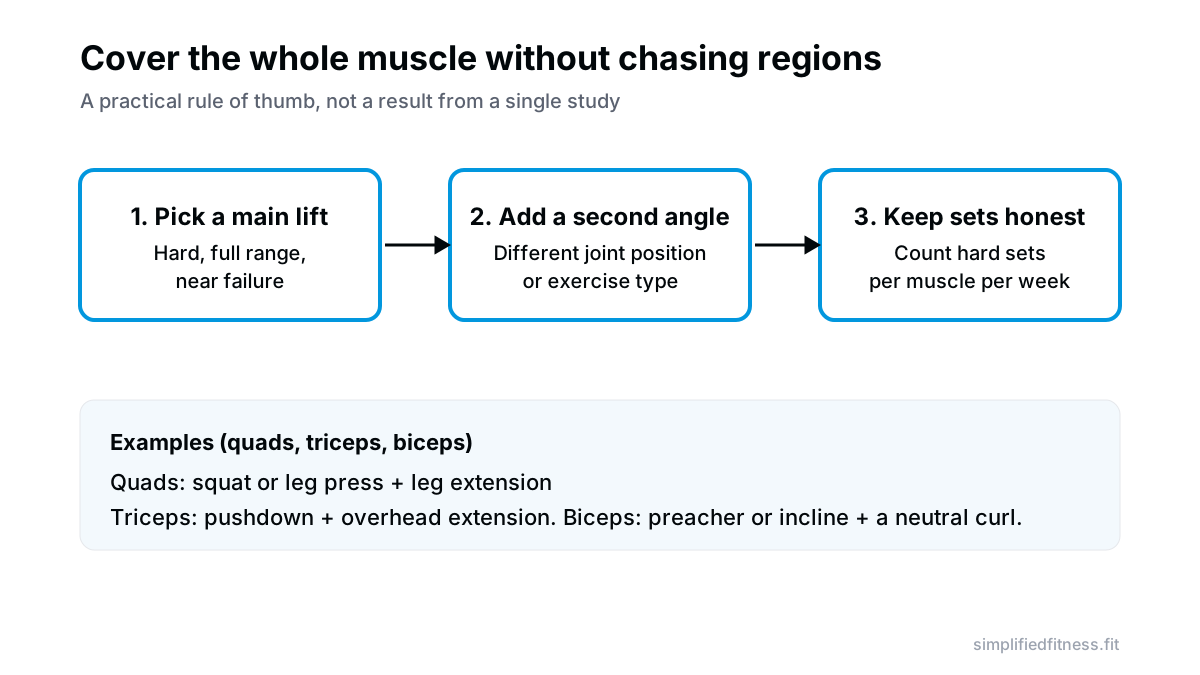
- Practical rule: one hard main lift plus a second exercise that loads the muscle differently, with total weekly hard sets kept in check.
Part of our complete guide: Muscle Length, Range of Motion and Stretch-Mediated Hypertrophy: What the Research Actually Shows
Table of contents
Regional hypertrophy is real, in the sense that muscles do not grow evenly from end to end. Imaging studies keep finding that one site gains more than another. What the research has not shown is that you can switch one region on and leave the rest asleep.
This article sits inside our guide to muscle length, range of motion and stretch-mediated hypertrophy. Here we stay on one question: when you ask “can I grow my lower biceps, inner chest or the bit above my knee?”, what do MRI and ultrasound studies actually say?
What is regional hypertrophy?
Regional hypertrophy means different parts of one muscle grow by different amounts. “Regions” usually means proximal (closer to the trunk), middle, and distal (closer to the elbow or knee). It can also mean one head of a muscle versus another, like the rectus femoris versus the vastus lateralis in the quads.
Researchers can only detect this with direct measurements such as muscle thickness, cross-sectional area or volume taken at several sites. A single measurement misses it. A 2024 methods paper makes the point bluntly: muscle size changes vary across regions within and between muscles, and architecture changes such as fascicle length and pennation angle are also region-specific (Nunes et al., 2024).
So the idea itself is not broscience. The leap people make from it is where things get shaky.
What do MRI and ultrasound studies show?
Let’s start with the structural evidence, muscle by muscle.
Triceps: where the muscle works hardest is where it grows
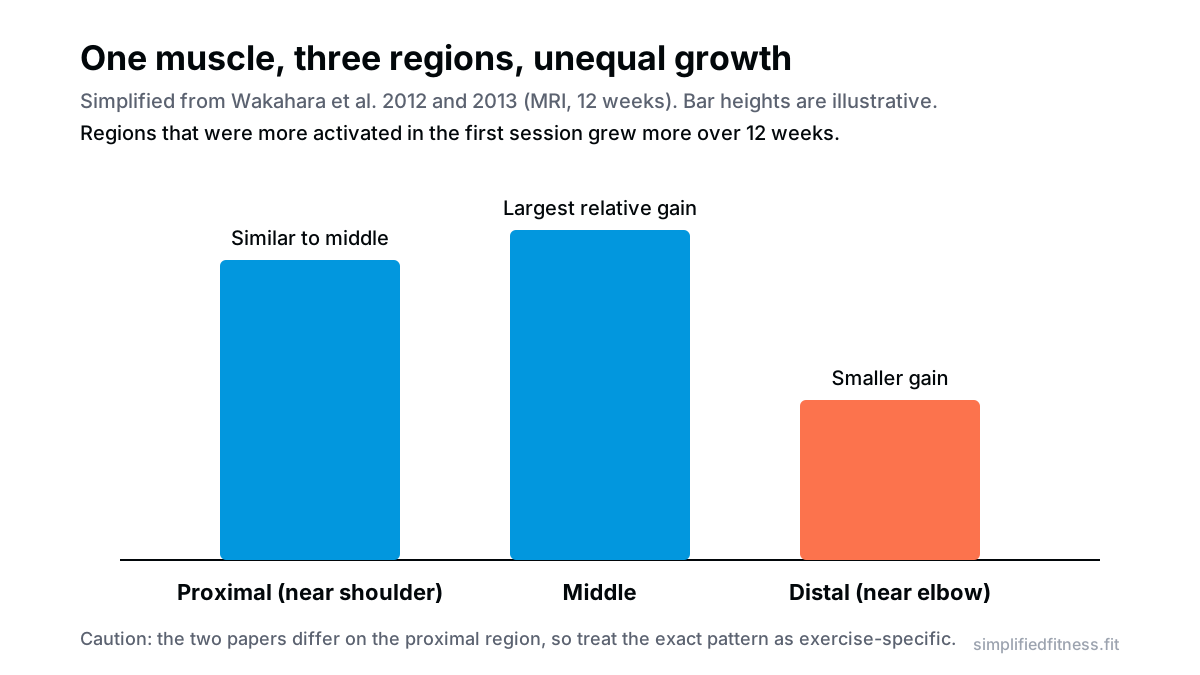
Two MRI studies from the same Japanese group are the clearest pair. In the first, 12 young men trained the elbow extensors with a multijoint exercise for 12 weeks. The middle regions of the triceps brachii were more activated in the first session and also showed bigger relative growth than the most proximal region (Wakahara et al., 2013).
In the earlier study, activation after one session was lower in the distal region than the middle and proximal regions, and the 12-week gain in cross-sectional area was also smaller distally (Wakahara et al., 2012). Both papers conclude that the regional difference in growth tracks the regional difference in activation during training.
Notice that the two studies disagree slightly on the proximal region. That is normal. Different exercises, small samples (12 per group) and slightly different measurement sites will do that.
Quadriceps: exercise choice changed the pattern
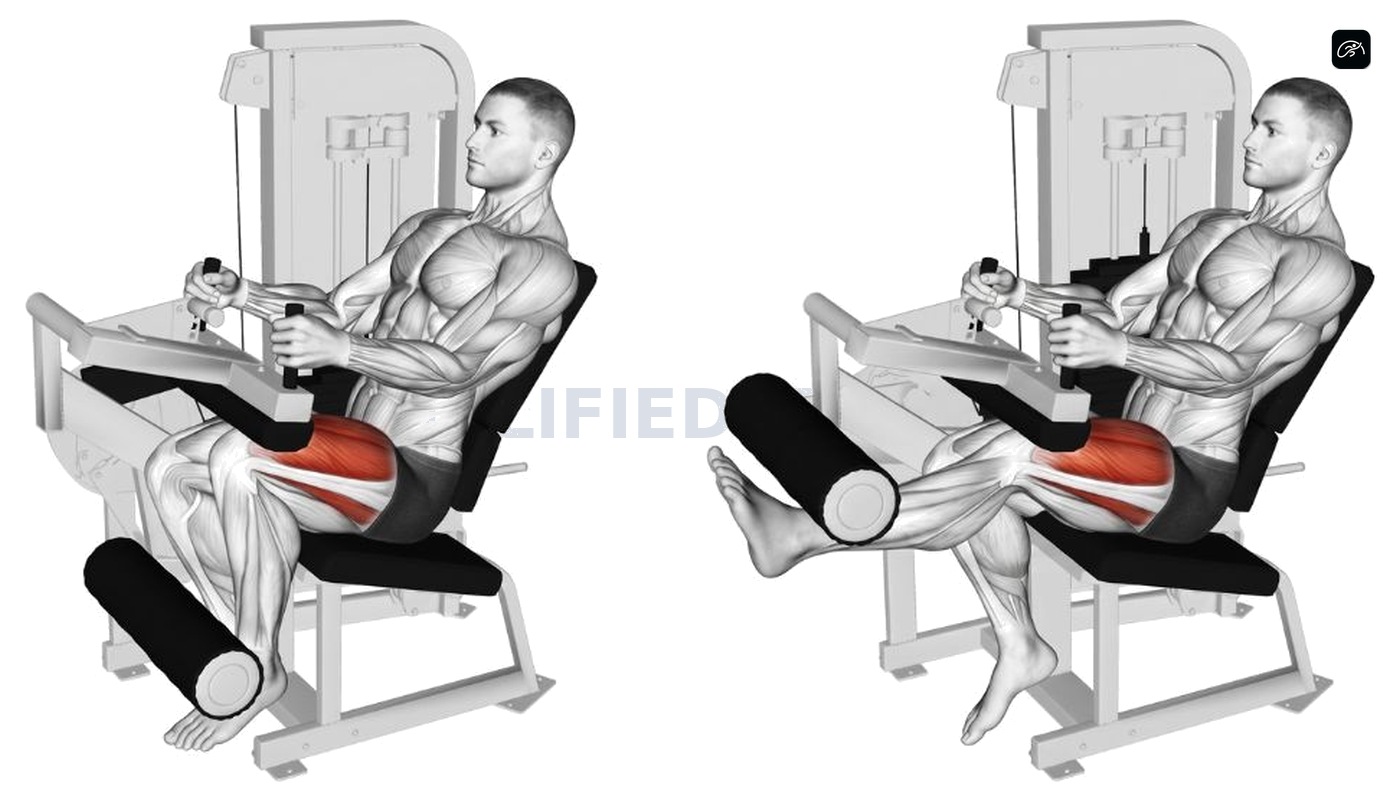
The quads give us the cleanest “same volume, different exercise” test. In a randomized trial, two groups matched for training volume and intensity performed either Smith machine squats or leg extensions. All three regions of the rectus femoris (proximal, central, distal) grew significantly in the leg extension group, while in the squat group only the central region of the vastus lateralis grew significantly (Zabaleta-Korta et al., 2021).
The authors conclude that exercise selection plays a role in regional hypertrophy, with other factors possibly involved too.
A second study used ultrasound in 36 men who were not strength-trained, split into heavy squat, jump squat and control groups. After 8 weeks, heavy squats and jump squats grew the vastus lateralis and intermedius at mid-thigh, but they differed in where else the vasti grew (the abstract is not fully consistent about which grew proximally and which distally). No rectus femoris growth appeared at any site in either squat group (Earp et al., 2015).
Put the two together and you get a consistent message: squat-type training and leg extensions do not grow the quads in the same pattern, and the rectus femoris in particular seems to respond better to an exercise that works the knee extension without much hip involvement. That second part is my interpretation, not a finding either study tested directly.
Biceps: the “lower biceps” claim does not hold up well
Curl variations are where the internet gets most specific. A 2025 within-subject trial put 15 young men through 10 weeks of unilateral curls, one arm with the shoulder flexed (preacher curl), the other with the shoulder extended (Bayesian cable curl), with resistance profiles matched. Muscle thickness rose at the proximal, mid and distal biceps in both conditions, with no significant difference between them (Attarieh et al., 2025). Both conditions grew each region by roughly 6-9%.
So a different shoulder position did not obviously change the regional pattern here. If you want the full exercise comparison, see our breakdown of preacher curls versus Bayesian cable curls.
Why do muscles grow unevenly?
Nobody has a complete answer. The best-supported piece is activation: the triceps MRI work links where a muscle is recruited hardest in a session to where it grows afterwards. A muscle is not a single switch. Parts of it can be loaded harder depending on joint angle, the resistance profile of the exercise and where fatigue builds up.
Other factors are often suggested. These include how muscle fibres are arranged and angled, the fact that large muscles have distinct parts that the nervous system can recruit somewhat separately, and the length the muscle is trained at. These are reasonable hypotheses, but I would not state any of them as proven for a particular exercise.
Muscle length is the one with some systematic evidence. A review of 11 range-of-motion studies found that full range, or partials in the initial (stretched) part of the range, beat partials in the final (shortened) part for growth at distal sites of the rectus femoris, vastus lateralis, biceps brachii and brachialis. Interestingly, partials in the initial range produced more proximal rectus femoris growth than full range (Kassiano et al., 2023). Different regions, different best strategies.
What does the conflicting evidence say?
This is where honesty matters, because the regional story is not clean.
- Leg press range of motion. In 23 resistance-trained people doing the leg press, a fixed knee flexion of about 5-100 degrees and each person’s maximal range gave similar quadriceps growth after 8 weeks, with the evidence favouring no difference at the proximal, central and distal sites (Larsen et al., 2025).
- Long-length isometrics. In 23 resistance-trained people over 6 weeks, isometric knee extensions at long muscle length and full-range isotonic extensions produced similar overall quad growth. The proximal anterior thigh leaned toward isometrics, but the authors say the uncertainty precludes a firm conclusion (Varovic et al., 2025).
- Curls. As above, no regional difference between two shoulder positions.
Why might studies disagree? Short durations (6-10 weeks), small samples, different muscles measured at different sites, mostly young men, and a mix of trained and untrained participants. Untrained people tend to grow quickly from most reasonable programs, which can blur small regional differences. Trained lifters have less room to grow quickly, so effects may need more time to show.
Can you grow the inner chest, lower biceps or lower abs?
Not in the way gym slang implies. Terms like “inner chest” or “lower biceps” describe how a muscle looks, not separately controlled muscles. I did not find an imaging trial settling chest regions, and the biceps trial above found similar growth across the proximal, mid and distal sites regardless of shoulder angle.
What the evidence does allow:
- Different exercises can change which parts of a muscle grow more (quads, triceps).
- Shifting an angle probably changes the emphasis, not the on/off state.
- Some muscles show distal-versus-proximal differences depending on training length.
Think of it as steering, not sniping. For the chest, our guide to incline versus flat bench goes through what the pressing angle research does and does not show.
Compartments, pennation and what they mean for you
Large muscles are not uniform blocks. Fibres run at different angles in different areas, and some muscles are built from several parts. That architecture is one reason the same exercise can load one area differently from another.
For you, the takeaway is practical. Multi-headed muscles like the quads, triceps and hamstrings are where most of the regional and exercise-comparison research has been done so far, and where pairing two exercises has the clearest rationale. For the triceps, we cover this in overhead versus neutral triceps long head training, and for the hamstrings in seated versus lying leg curls.
For muscles that cross two joints, our sibling article on active versus passive insufficiency in biarticular muscles explains why the same muscle behaves so differently depending on the joint positions.
How to pair exercises so the whole muscle gets trained
Here is a simple approach that does not require imaging equipment.
- Pick one main lift per muscle. Something you can load progressively, take close to failure, and move through a good range.
- Add a second exercise with a different joint position. For the quads, that is a leg extension next to a squat or leg press. For the triceps, an overhead extension next to a pushdown. For the biceps, an incline or preacher curl next to a standard one.
- Rotate within reason. Swap an accessory every 6-8 weeks if you are bored or a joint complains, but not every session.
- Count hard sets, not exercises. Total weekly hard sets per muscle matter more than how many exercise names you stack. Use the training volume calculator to sanity-check yours.
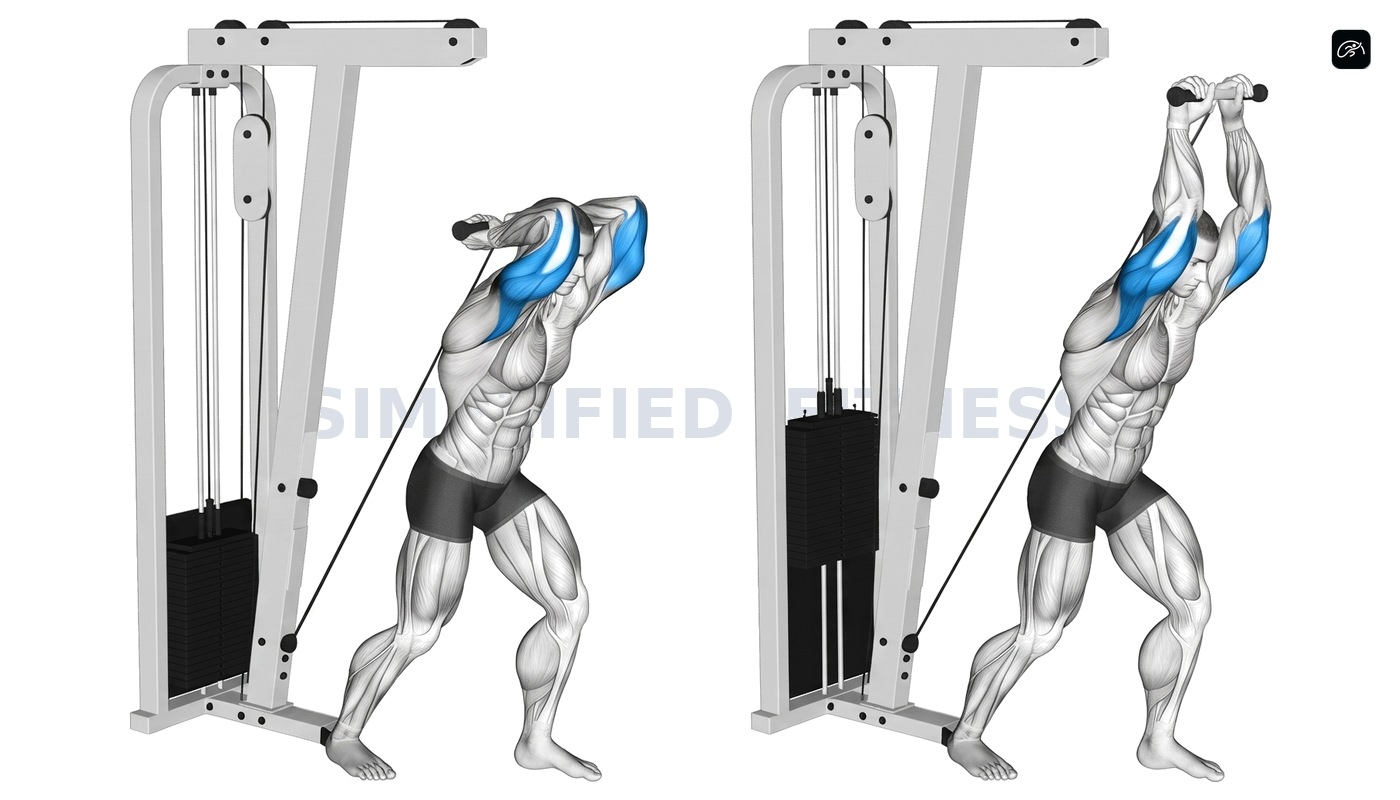
A quick comparison of what the evidence supports
| Muscle | Imaging evidence of uneven growth | Evidence that exercise choice changes the pattern |
|---|---|---|
| Triceps | MRI: regions with higher activation grew more | Limited; mostly one multijoint exercise studied |
| Quadriceps | Ultrasound and RCT data | Stronger: leg extension versus squat differed |
| Biceps | Similar growth across regions | Not seen between preacher and Bayesian curls |
| Quadriceps, trained (leg press) | Growth at all sites in both conditions | Not seen between two ranges of motion |
What about people who are not in the gym every day?
If you train three or four times a week on a budget, in a crowded Indian gym with limited machines, you do not need a full machine floor to apply this. A barbell or dumbbells, one cable or a leg extension machine, and a bench cover most pairings. The principle is two angles per muscle, not a perfect equipment list.
Training hard matters more than the exact exercise. Eating enough protein (dal, paneer, curd, soya, eggs or chicken, whatever fits your diet) and sleeping properly will move the needle more than choosing between two curl variations.
When to see a doctor
Normal soreness is expected. Sharp pain in a stretched position, joint pain that persists for days, swelling, numbness or a pop followed by weakness are not signs of region targeting. They are reasons to stop and get assessed by a doctor or physiotherapist before you keep loading that position.
The bottom line
Muscles grow unevenly, and imaging proves it. The practical lesson is modest: use two sensible exercises per muscle that load it differently, train them hard through a full range, and keep your weekly volume honest. Do not expect to hand-pick the lower biceps or the inner chest.
Most of this research is short, in young men and in a handful of muscles. If a study contradicts a gym belief, trust the pattern across several studies, not one headline. And if you want a ready-made structure, start with our free workout plans and adjust from there.
Frequently Asked Questions
What is regional hypertrophy?
Regional hypertrophy means that different parts of the same muscle grow by different amounts after training. Imaging studies measuring thickness or cross-sectional area at the proximal, middle and distal sites often find uneven gains rather than one uniform increase. In practice it is a reason to use more than one exercise per muscle, not a reason to chase tiny regions.
Can you target the lower or upper part of a muscle?
You can shift emphasis, but you cannot isolate a region completely. Trials show that different exercises produce different regional growth patterns, yet the other regions usually still grow somewhat. Pick exercises that load the muscle in different positions and judge them by how well you can train them hard.
Can you grow your inner chest?
There is no good imaging evidence of a separate inner chest that you can train on its own. Imaging studies on regional growth exist for muscles like the quads and triceps, but I did not find a trial that settles chest regions. A mix of pressing angles and a cable or machine fly is a reasonable way to cover the whole pec.
How do I grow the lower biceps?
There is no proven way to isolate a lower biceps. A 2025 trial compared preacher curls and Bayesian cable curls over 10 weeks and found similar growth at the proximal, mid and distal biceps with no significant difference between them. Choose curl variations you can load progressively and keep close to failure.
Do different exercises grow different parts of the quads?
They can. A randomized trial with equal volume found leg extensions grew the proximal, central and distal rectus femoris, while Smith machine squats grew only the central vastus lateralis significantly. Because the rectus femoris crosses the hip and knee, pairing a squat or leg press with a leg extension is a sensible way to cover the quads.
What does non-uniform muscle growth mean?
Non-uniform muscle growth means a muscle's size increase differs from one site to another along its length or between its parts. MRI studies of the triceps found that regions activated more in a training session grew more over 12 weeks. For you, that means one exercise may leave some regions less trained, so add a second option.
Is regional hypertrophy proven?
Uneven growth along a muscle is well documented with imaging, but our ability to deliberately target a chosen region is less settled. Many studies are short, use small samples and measure only a few sites. Treat region targeting as plausible and exercise-specific rather than guaranteed.
Why do muscles grow unevenly?
A leading explanation is that regions are activated to different degrees by a given exercise, and more activated regions grow more. MRI work on the triceps supports this link between session activation and later growth. Muscle architecture and joint position probably play a role too, though the evidence on those details is limited.
Do I need a different exercise for every part of a muscle?
No. You do not need a separate exercise for every region, and chasing small regions often leads to junk volume. One or two well-chosen exercises per muscle, trained hard through a good range of motion, cover most of what the research can support. Add more only if progress stalls or one angle bothers a joint.
Does training at long muscle lengths change where a muscle grows?
It may. A systematic review found that exercising at longer muscle lengths favoured growth in muscles such as the quadriceps, biceps and triceps, and some distal sites in particular. Evidence is mixed, though, as a 2025 leg press trial in trained lifters found no difference between two ranges of motion. Train through a full, controlled range unless an exercise genuinely hurts in the stretched position.
Are the same results seen in trained lifters?
Mostly the evidence comes from young, often untrained men, and trained-lifter data is thinner. Some trained-lifter trials show similar growth across different ranges, which suggests regional effects may be modest. Treat the headline findings as a guide for variety, not as precise prescriptions.
How many exercises per muscle do I need?
Most lifters do well with two or three exercises per muscle across a week, not a different one for each region. This covers different joint positions and gives you a backup if one movement stalls. Count your total hard sets per muscle per week and check them with our training volume calculator.
Can I fix a lagging region of a muscle?
Sometimes a region looks smaller because of genetics, muscle shape or insertion points that no exercise can change. Imaging studies show regions can respond differently to training, but they do not show that you can reliably rebuild one area. Add an exercise that loads it differently, train it hard for a couple of months, and judge progress with photos and measurements.
Sources & References
Every claim above is checked against peer-reviewed research (PubMed, U.S. National Library of Medicine) or guidance from established health bodies. How we fact-check.
- Zabaleta-Korta A, et al. The role of exercise selection in regional Muscle Hypertrophy: A randomized controlled trial. J Sports Sci. 2021. PMID: 34743671
- Earp JE, et al. Inhomogeneous Quadriceps Femoris Hypertrophy in Response to Strength and Power Training. Med Sci Sports Exerc. 2015. PMID: 25811947
- Wakahara T, et al. Nonuniform muscle hypertrophy: its relation to muscle activation in training session. Med Sci Sports Exerc. 2013. PMID: 23657165
- Wakahara T, et al. Association between regional differences in muscle activation in one session of resistance exercise and in muscle hypertrophy after resistance training. Eur J Appl Physiol. 2012. PMID: 21858666
- Attarieh P, et al. Comparison Between Shoulder Flexed and Extended Positions in Elbow Flexion Resistance Training on Regional Hypertrophy and Maximum Strength: Preacher versus Bayesian Cable Curls. Eur J Sport Sci. 2025. PMID: 40082069
- Nunes JP, et al. Determining Changes in Muscle Size and Architecture After Exercise Training: One Site Does Not Fit all. J Strength Cond Res. 2024. PMID: 38513182
- Kassiano W, et al. Which ROMs Lead to Rome? A Systematic Review of the Effects of Range of Motion on Muscle Hypertrophy. J Strength Cond Res. 2023. PMID: 36662126
- Larsen S, et al. Knee flexion range of motion does not influence muscle hypertrophy of the quadriceps femoris during leg press training in resistance-trained individuals. J Sports Sci. 2025. PMID: 40113586
- Varovic D, et al. The effects of long muscle length isometric versus full range of motion isotonic training on regional quadriceps femoris hypertrophy in resistance-trained individuals. Appl Physiol Nutr Metab. 2025. PMID: 40911904

Umair Hazrami · Founder & Head Coach, Simplified Fitness
Umair Hazrami founded Simplified Fitness and the Simplified Lifter channel to cut through fitness noise. With 4+ years of consistent training and 10+ coaching clients, he writes every guide from the peer-reviewed research and links the sources so you can check them. Our editorial standards.
Educational content only, not medical advice. If you have a medical condition, are pregnant, or take medication, talk to a qualified doctor before changing your diet, supplements or training. Full disclaimer.
Keep reading
Hypertrophy
Active vs Passive Insufficiency: How Two-Joint Muscles Change Your Exercise Choice
Active vs passive insufficiency explained for lifters: why hamstrings, triceps, quads and calves grow differently depending on your second joint position.
10 min read
Hypertrophy
Squat Mobility With Long Femurs: Adapting Range of Motion to Your Hips
Squat mobility with long femurs is mostly a lever and hip-socket issue, not a flaw. Learn how to adjust depth, stance and heels without risking your hips.
10 min read
Hypertrophy
Dumbbell Pullovers vs Cable Lat Pull-ins: Training Lats at Long Muscle Lengths
Training lats at long muscle lengths: is the dumbbell pullover a lat or chest exercise, and why a cable lat pull-in may keep tension where you want it.
7 min read
Hypertrophy
Full vs Partial Range of Motion: What the Hypertrophy Research Shows
Full vs partial ROM hypertrophy explained: what two meta-analyses and recent trials found, where lengthened partials fit, and how to set your range of motion.
8 min read