Trapezius Anatomy: Upper, Middle and Lower Traps and How to Train Each
Trapezius anatomy explained for lifters: what upper, middle and lower traps do, why shrugs mainly hit the upper fibres, and which exercises cover the rest.
TL;DR. The short answer
- The trapezius is one diamond-shaped muscle with three jobs: upper fibres lift the shoulder blade, middle fibres pull it toward the spine, lower fibres pull it down and help it rotate upward.
- Shrugs train the upper traps well (a unilateral shrug gave the highest upper trap EMG in one 30-person study), but the middle and lower regions peaked in other exercises.
- Middle traps respond to rows and horizontal pulls with the elbow out. Lower traps respond best to prone Y-style raises and overhead arm paths.
- Upper traps already get work from carries, heavy pulls and many pressing sessions, so most plans gain more from adding middle and lower trap work than from extra shrugs.
- Shoulder pain, neck pain or numbness down the arm is a reason to see a doctor or physiotherapist, not to add more trap exercises.
Part of our complete guide: Complete Shoulder, Delt & Neck Training Guide: 3D Deltoid Anatomy, Rotator Cuff & Traps
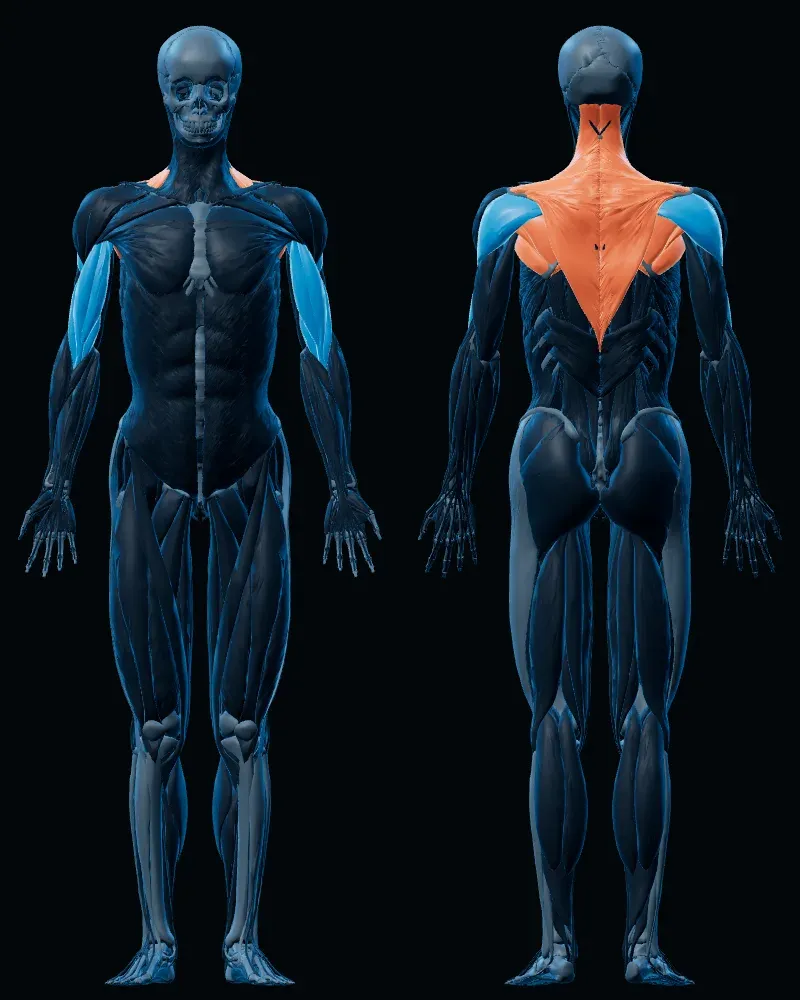
Muscles worked: upper back
Main movers: traps, rhomboids, teres major, infraspinatus and teres minor
Assisting: rear delts, biceps and brachialis
Table of contents
Trapezius anatomy is the reason a shrug-only routine leaves your upper back looking half finished. The trapezius is one big diamond-shaped muscle, but its upper, middle and lower fibres run in different directions and do different jobs, so each needs different exercises.
Quick version: shrugs for the upper traps, rows with the elbow out for the middle, prone Y raises for the lower. This guide sits inside our complete shoulder and delt training guide, and it gives you the full-diamond view.
What does the trapezius do? Trapezius anatomy in plain terms
The trapezius starts along the base of your skull and the spine, from the neck down to the lower part of the thoracic spine. It fans out to attach on the collarbone, the acromion (the bony tip of the shoulder) and the spine of the shoulder blade. Because it spans so much territory, the fibres pull in three different directions.
Think of it as three muscles sharing one name.
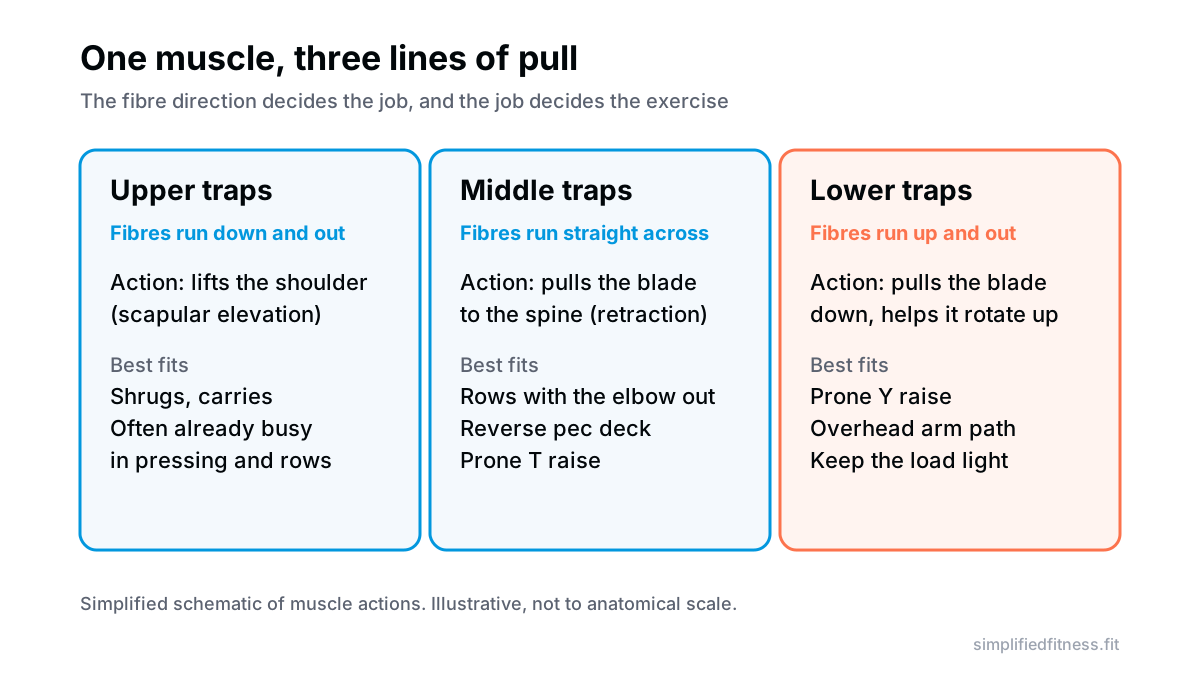
- Upper traps: fibres run down and outward. They elevate the shoulder blade (the shrug motion) and also help with neck extension and side bending.
- Middle traps: fibres run straight across. They retract the blade toward the spine.
- Lower traps: fibres run up and outward from the lower thoracic spine to the base of the shoulder blade spine. They depress the blade and, together with the upper traps and serratus anterior, help rotate it upward when you reach overhead.
That last point matters. When you raise your arm overhead, your shoulder blade has to rotate upward. The upper trapezius, lower trapezius and serratus anterior are the main muscles doing it, and Ekstrom’s team describes the trapezius and serratus as the only upward rotators of the scapula (Ekstrom et al., 2003). If one region is weak, the others compensate.
Why shrugs only build the upper traps
A shrug moves the shoulder blade straight up. That is the upper fibres’ line of pull, so shrugs are a good upper trap exercise. In a 2003 surface EMG study of 30 healthy people, the unilateral shoulder shrug produced the greatest upper trapezius activity of the 10 exercises tested (Ekstrom et al., 2003).
But the same study found that the middle and lower regions peaked elsewhere. Middle trap activity was highest in shoulder horizontal extension with external rotation and in the prone overhead raise in line with the lower fibres. Lower trap activity was highest in the prone overhead arm raise.
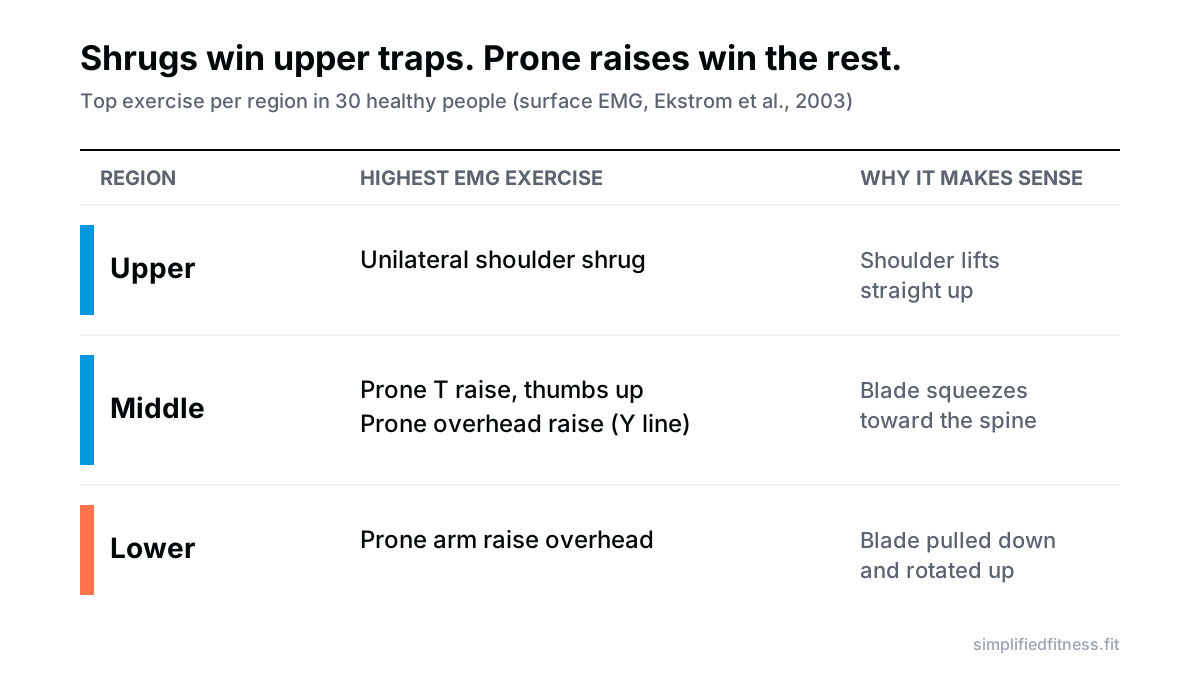
One caution on how to read this. EMG tells you how active a muscle is during a movement, not how much it will grow over months. It is a useful guide to exercise selection, and a poor predictor of hypertrophy on its own. I could not find a trial that compares trap growth between these exercises in trained lifters, so treat the exercise lists here as sensible, not proven.
For a deep dive on shrug technique, bar choice and the Kelso variation, see our guide to shrug biomechanics with barbells, dumbbells and cables.
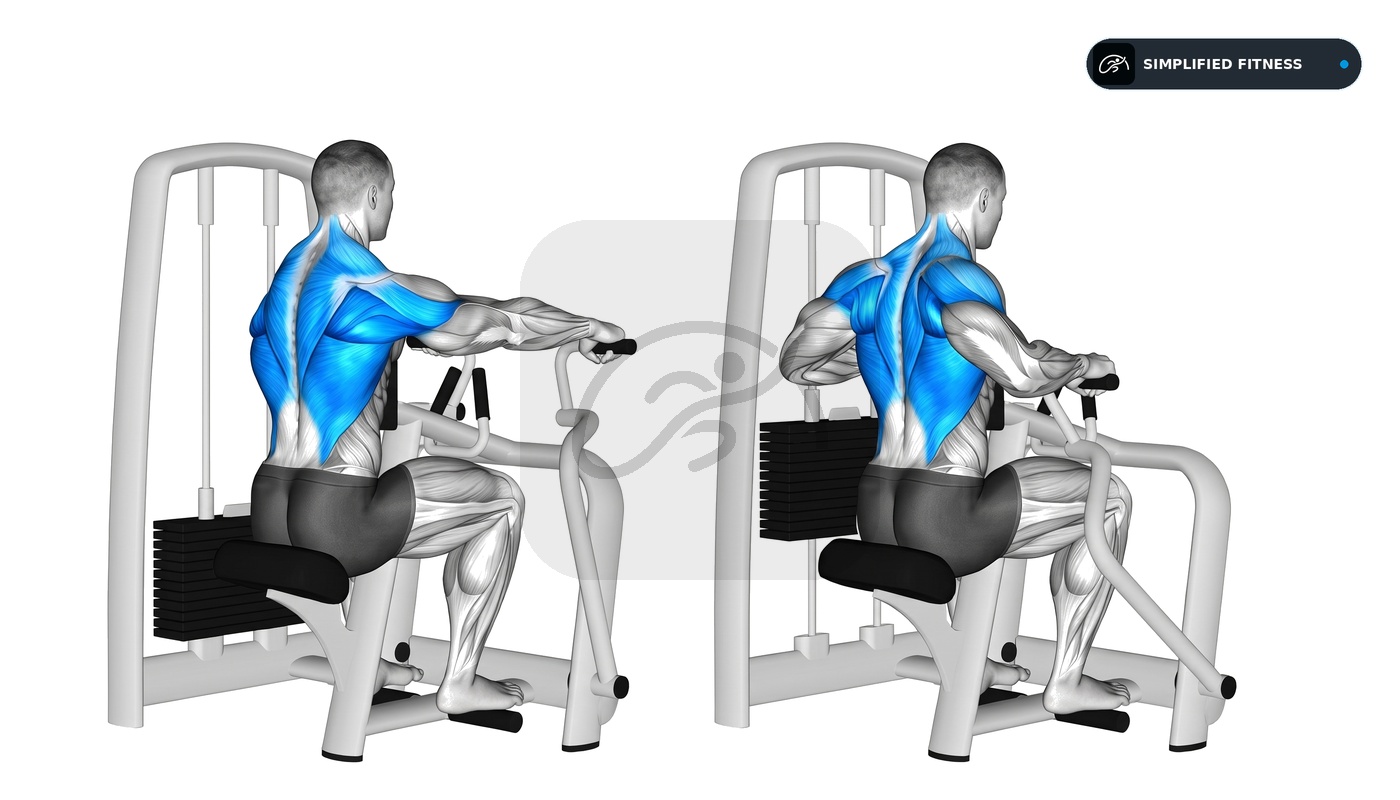
How do you train the middle traps?
The middle fibres pull the shoulder blade toward your spine, so you want movements that end with a real squeeze between the blades. Horizontal pulls with the elbow flared out are a good fit, since a tucked elbow tends to bring the lats in more. That is coaching logic rather than a tested result.
Good middle trap options:
- Rows with the elbow around shoulder height, either chest-supported or cable
- Reverse pec deck flys
- Prone T raises (arms out to the sides, thumbs up)
- Prone horizontal abduction with external rotation
The last one showed up in both lab studies above. It was among the top middle trap exercises in Ekstrom’s work and one of four exercises that Cools et al. found had favourable upper-to-middle and upper-to-lower trap ratios in 45 healthy people (Cools et al., 2007).
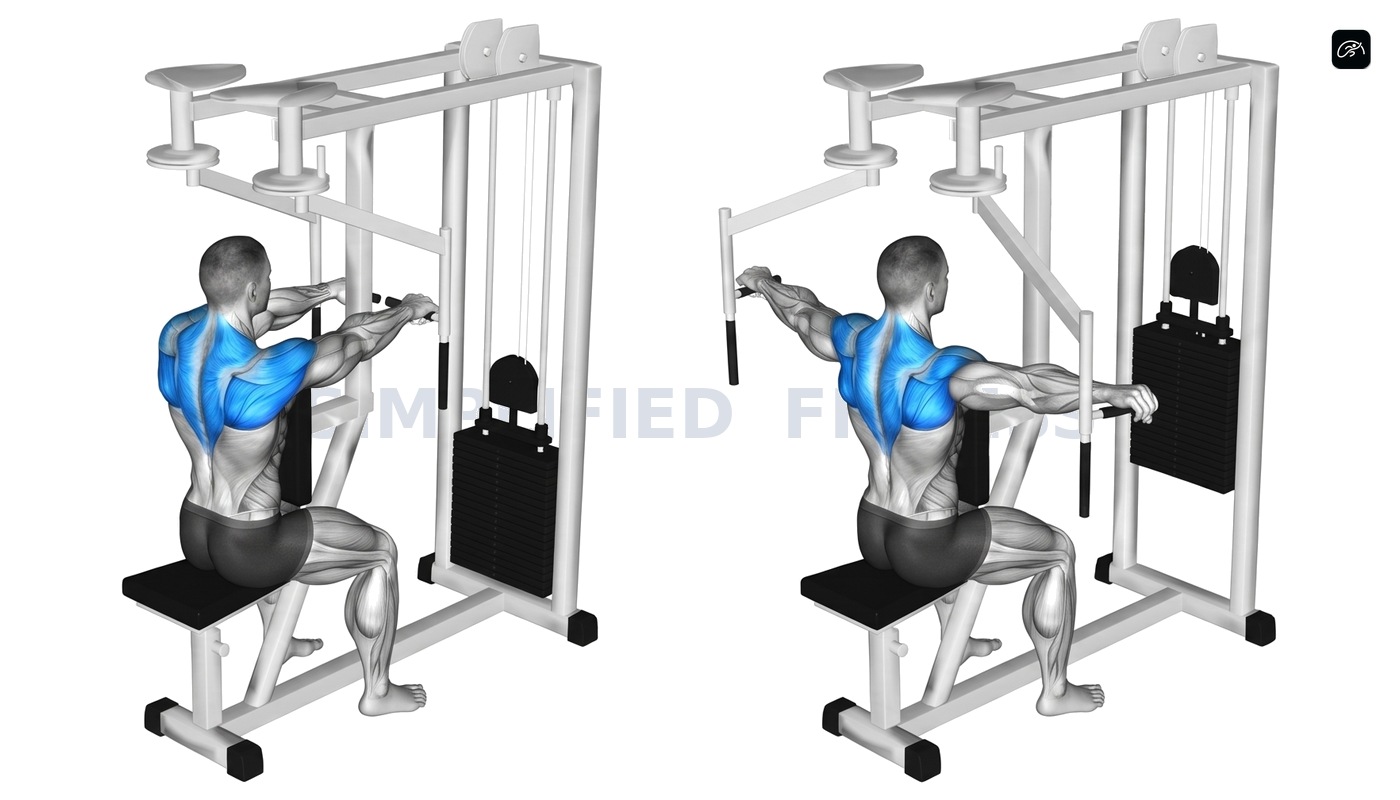
Rows also work the upper back as a whole. In an inverted row study of 26 healthy participants, researchers recorded activity in the upper, middle and lower trapezius along with other scapular muscles, which is a reminder that a row is not an isolation exercise (Youdas et al., 2020). If you want the full row story, our chest-supported rows guide covers it.
How do you train the lower traps?
Lower traps are the hard one. They are small, they fatigue quickly, and most lifters never feel them. Overhead arm paths are the key, because that is where the lower fibres help the blade rotate upward and stay down.
The prone arm raise overhead (a Y raise) produced the highest lower trap EMG in Ekstrom’s study (Ekstrom et al., 2003). Lie face down on a bench or the floor, arms in a Y, thumbs up, and lift the arms without shrugging.
Common mistakes:
- Going too heavy. Your upper traps and lower back take over. Use light dumbbells or none at all.
- Shrugging up into the ears. Think “shoulder blades slide down my back” before you lift.
- Rushing. Hold the top for a second.
A cable or band version works too if you cannot lie prone comfortably. Start with 2-3 sets of 10-15 slow reps.
Retraction and shrug variations: the shoulder position matters
Arm position changes which muscles share the load. In a 2016 study of 26 people with surface and fine-wire electrodes, shrugs with the arms at the side, shrugs overhead and retractions overhead all produced similarly high upper trap activity (Castelein et al., 2016). The overhead retraction was the best of the three for the middle trapezius, lower trapezius and rhomboid major.
Practical reading: if you want to bring in the mid and lower fibres, pulling the shoulder blades back with the arms raised looks like a better choice than another shrug. The study measured muscle activity in a single lab session, so it says little about long-term growth.
Upper vs mid vs lower traps exercises: a quick comparison
| Region | Main action | Strong options | Typical rep range |
|---|---|---|---|
| Upper | Elevation | Shrugs, farmer carries | 8-15 |
| Middle | Retraction | Elbow-out rows, reverse pec deck, T raise | 10-15 |
| Lower | Depression, upward rotation | Prone Y raise, overhead retraction | 10-15, light |
The rep ranges are a coaching starting point, not a rule from the studies above.
Upper traps tight, lower traps weak: what the research says about balance
Many lifters hear that their upper traps are “overactive” and the lower traps “lazy”. There is some research behind this, though it is narrower than gym talk suggests.
Cools et al. compared 39 overhead athletes with chronic impingement symptoms against 30 non-injured athletes. The injured group showed higher upper trap activity during isokinetic abduction and external rotation, with lower activity in the lower trapezius during abduction and in the middle trapezius during external rotation (Cools et al., 2007).
Now the other side. Kara and colleagues compared 22 patients with subacromial impingement against 22 healthy people during six scapular retraction exercises. They found no significant difference in trapezius activation or ratios between the groups, and concluded that retraction exercises at different shoulder angles could be safely offered to these patients (Kara et al., 2019).
Why might they differ? The tasks were different (resisted overhead-athlete movements versus standing retraction), and the populations were different too. So the cautious takeaway: balance work for the mid and lower traps is a reasonable idea, but we should not claim that one tight upper trap explains your shoulder pain. For pain, see a clinician. Our guide to shoulder impingement and lifting solutions goes deeper.
A simple weekly layout for complete traps
You do not need a separate trap day. A pull day built like this covers all three regions (our pull day plan is a starting template):
- A row variation with the elbow out (middle, plus upper)
- A pulldown or pull-up variation (lats, with trap involvement)
- Reverse pec deck or face pulls (middle traps, rear delts, see our face pull form guide)
- Shrugs or carries, 2-3 sets (upper)
- Prone Y raises, 2-3 light sets (lower)
If you are vegetarian and training on a budget, nothing here needs special equipment. Dumbbells, a bench and a resistance band cover every movement above, and protein from dal, paneer, curd and soya supports recovery as it would for any other muscle.
Progress by adding reps or small amounts of load, and stop sets with a rep or two in reserve. Expect the shape to change over months rather than weeks.
When to see a doctor
Trap soreness after a hard session is normal. Pain that is sharp, follows a fall or impact, wakes you at night, or comes with tingling, numbness or weakness in the arm is not. Neck pain with headaches, dizziness or chest symptoms also needs medical advice. This article is education, not diagnosis, and a physiotherapist or doctor can assess what is going on.
The upper traps get the attention, but the middle and lower fibres complete the shape and the function. Train all three, and keep the lower traps light and clean.
Frequently Asked Questions
What does the trapezius muscle do?
The trapezius moves and steadies the shoulder blade. Its upper fibres elevate it, the middle fibres retract it, and the lower fibres depress it and help it rotate upward during overhead reaching. Knowing which fibres you are loading lets you pick exercises on purpose instead of by habit.
Do shrugs work the whole trapezius?
No, shrugs mostly hit the upper traps. In an EMG study of 30 healthy people the unilateral shoulder shrug produced the highest upper trap activity, while the middle and lower regions peaked in other exercises like prone raises. Pair shrugs with rows and prone raises if you want the full diamond.
What are the best middle trap exercises?
Rows with the elbow flared out, reverse pec deck flys and prone horizontal abduction with external rotation all load the middle fibres well. Those movements pull the shoulder blade straight toward the spine, which is the middle trap's line of pull. Start with 2-3 hard sets and a slow squeeze at the end of each rep.
What are the best lower trap exercises?
The prone arm raise overhead (a Y raise) produced the highest lower trap EMG in a 2003 study of 30 healthy people. Prone extension and side-lying external rotation also showed favourable lower-to-upper trap ratios in a later study. Use light loads, since the lower traps are small and form breaks down fast.
How do I build huge traps?
Train the upper traps with shrugs and carries, then add rows and prone raises so the middle and lower fibres fill in the rest of the diamond. Hypertrophy is driven mainly by hard sets taken close to failure, progressive loading and enough protein and sleep. Expect the shape to develop over months, not weeks.
How often should I train traps?
Most lifters get enough trapezius work from rows, pulldowns and carries on back day, plus 1-2 dedicated trap exercises. There is no trap-specific frequency trial that I would lean on, so treat 2 sessions a week as a sensible starting point and adjust to your recovery. If your neck feels tight and sore, cut back instead of adding more.
Why are my upper traps always tight and my lower traps weak?
Research on overhead athletes with shoulder impingement symptoms found higher upper trap activity and lower activity in the lower and middle traps compared with uninjured athletes. That study was in injured athletes, so it does not prove the same pattern in every lifter. Shift volume toward prone raises and rows, and see a physiotherapist if tightness comes with pain.
Do rows work the traps?
Yes, rows load the middle trapezius, and often the lower and upper fibres too. An inverted row study in 26 healthy people recorded activity across upper, middle and lower trapezius at once. That study did not compare elbow positions, but in coaching practice a wider elbow tends to put more emphasis on the upper back.
Are face pulls good for the traps?
They can be, mainly for the middle trapezius and rear delts, but the exact balance depends on your angle and arm height. Retraction with the arms overhead activated the middle and lower traps and rhomboids more than a regular shrug did in one EMG study. Keep the load light and the pull smooth.
Can trap exercises fix rounded shoulders or bad posture?
Not on their own. Evidence for strengthening alone changing resting posture is limited, though balanced upper back work is still a good idea for shoulder function. Combine rows and prone raises with some variety in your daily positions.
When should I see a doctor about neck or trap pain?
See a doctor if pain is severe, follows an injury, wakes you at night, or comes with numbness, tingling or weakness in the arm. Those signs point to something other than a tight muscle. Do not train through them while you wait for an assessment.
Sources & References
Every claim above is checked against peer-reviewed research (PubMed, U.S. National Library of Medicine) or guidance from established health bodies. How we fact-check.
- Ekstrom RA, et al. Surface electromyographic analysis of exercises for the trapezius and serratus anterior muscles. J Orthop Sports Phys Ther. 2003. PMID: 12774999
- Cools AM, et al. Rehabilitation of scapular muscle balance: which exercises to prescribe? Am J Sports Med. 2007. PMID: 17606671
- Castelein B, et al. Modifying the shoulder joint position during shrugging and retraction exercises alters the activation of the medial scapular muscles. Man Ther. 2016. PMID: 26409441
- Kara D, et al. Trapezius muscle activation levels and ratios during scapular retraction exercises: a comparative study between patients with subacromial impingement syndrome and healthy controls. Clin Biomech. 2019. PMID: 31103961
- Youdas JW, et al. Scapular muscle balance and spinal stabilizer recruitment during an inverted row. Physiother Theory Pract. 2020. PMID: 29944029
- Cools AM, et al. Trapezius activity and intramuscular balance during isokinetic exercise in overhead athletes with impingement symptoms. Scand J Med Sci Sports. 2007. PMID: 16774650

Umair Hazrami · Founder & Head Coach, Simplified Fitness
Umair Hazrami founded Simplified Fitness and the Simplified Lifter channel to cut through fitness noise. With 4+ years of consistent training and 10+ coaching clients, he writes every guide from the peer-reviewed research and links the sources so you can check them. Our editorial standards.
Educational content only, not medical advice. If you have a medical condition, are pregnant, or take medication, talk to a qualified doctor before changing your diet, supplements or training. Full disclaimer.
Keep reading
Exercise Technique
3D Shoulder Protocol: Weekly Volume, Frequency (2-3x/Week) and Rep Ranges
How to build 3D shoulders: how many weekly sets, how often to train side and rear delts, and which rep ranges to use, with an 8-week plan and the research.
8 min read

Exercise Technique
Are Front Raises Necessary? Why Bench Pressers Rarely Need Direct Front Delt Work
Are front raises necessary if you bench and overhead press? See what EMG and volume research says, when they can still help, and where to spend those sets.
8 min read
Exercise Technique
Behind-the-Neck Press: Shoulder Mobility, Neck Safety and Muscle Bias
Behind the neck press safety explained: who has the shoulder mobility for it, what EMG studies show for delts, and which swaps work if you do not.
10 min read
Exercise Technique
Cable Lateral Raises: Behind-the-Back vs Cross-Body Setup, Which Is Better?
Cable lateral raise behind the back vs in front: what the research says, which setup suits most lifters, and a step-by-step guide to pulley height and cuffs.
9 min read