Neck Hypertrophy and Cervical Spine Strength: Flexion, Extension and Lateral Training
Neck training for hypertrophy works, but only if you train the neck directly. Learn the safe exercises, rep ranges and what research says about concussion risk.
TL;DR. The short answer
- Neck training for hypertrophy needs direct work. In an MRI study, 12 weeks of squats, deadlifts and rows did not grow neck muscle, while adding a head extension exercise did.
- Train extension, flexion and side bending to each side with 15-25 reps, 2 days a week, starting far lighter than feels necessary and adding load slowly.
- A stronger neck can reduce how far the head moves in lab impact tests, but proof that it prevents real-world concussions is weak and mixed, so treat it as one piece of a safety plan.
- Skip jerky reps, heavy loading and extreme neck bending. Smooth reps, light weight and bracing the trunk matter more than the harness.
- See a doctor before starting if you have neck pain, numbness, tingling, dizziness or a past neck injury.
Part of our complete guide: Complete Shoulder, Delt & Neck Training Guide: 3D Deltoid Anatomy, Rotator Cuff & Traps
Table of contents
Neck training for hypertrophy works, but your neck will not grow from squats and rows alone. It needs direct work in a few directions, with light loads, slow reps and patience.
That is the core idea. This guide sits inside our complete shoulder and delt training guide, because the neck shares the upper traps and a lot of the same real estate. Here we cover the anatomy, the exercises, rep ranges, a simple weekly plan, and an honest look at the concussion claims, which are weaker than the internet makes them sound.
How do the neck muscles actually work?
Your neck is a stack of seven cervical vertebrae, held up by a surprisingly busy crew of muscles. You do not need all the Latin, but four names are worth knowing.
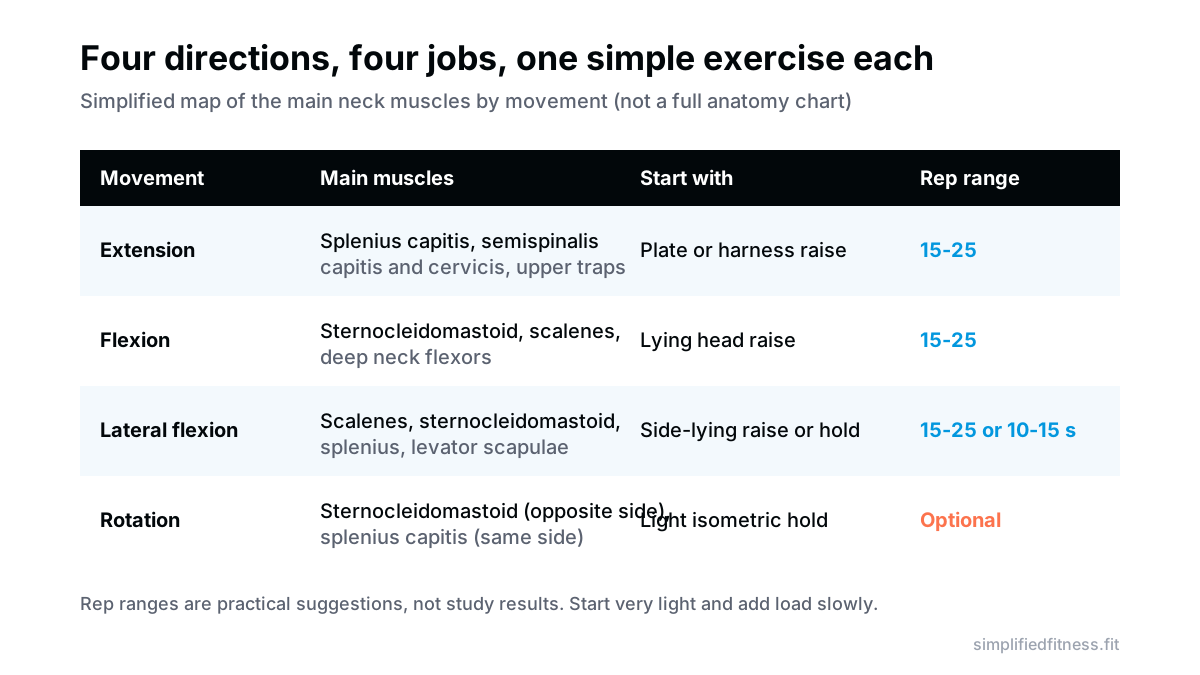
- Splenius capitis and the semispinalis muscles sit at the back and extend the head (look up, pull it back).
- Sternocleidomastoid is the thick strap running from behind the ear down to the breastbone and collarbone. It flexes and rotates the head.
- Scalenes run along the side of the neck and help with side bending.
- Deep neck flexors sit close to the spine and stabilise it.
An MRI study found that head extension training grew the splenius capitis and semispinalis capitis and cervicis, which the authors concluded are mainly responsible for head extension (Conley et al., 1997). That is why the back of the neck is where most visible “thickness” comes from.
Do you need direct neck training to grow your neck?
Yes, based on the best study we have on this.
In that 1997 trial, 22 active college students were split into three groups for 12 weeks. One group did big lifts (squat, deadlift, push press, bent row, mid-thigh pull) plus a head extension exercise of 3 sets of 10. A second did the big lifts only. The third did nothing. Only the group with the head extension work grew neck muscle on MRI, with total cross-sectional area rising from 19.5 to 22.0 cm2. The big-lifts-only group stayed flat, even though their quadriceps grew about 7% (Conley et al., 1997).
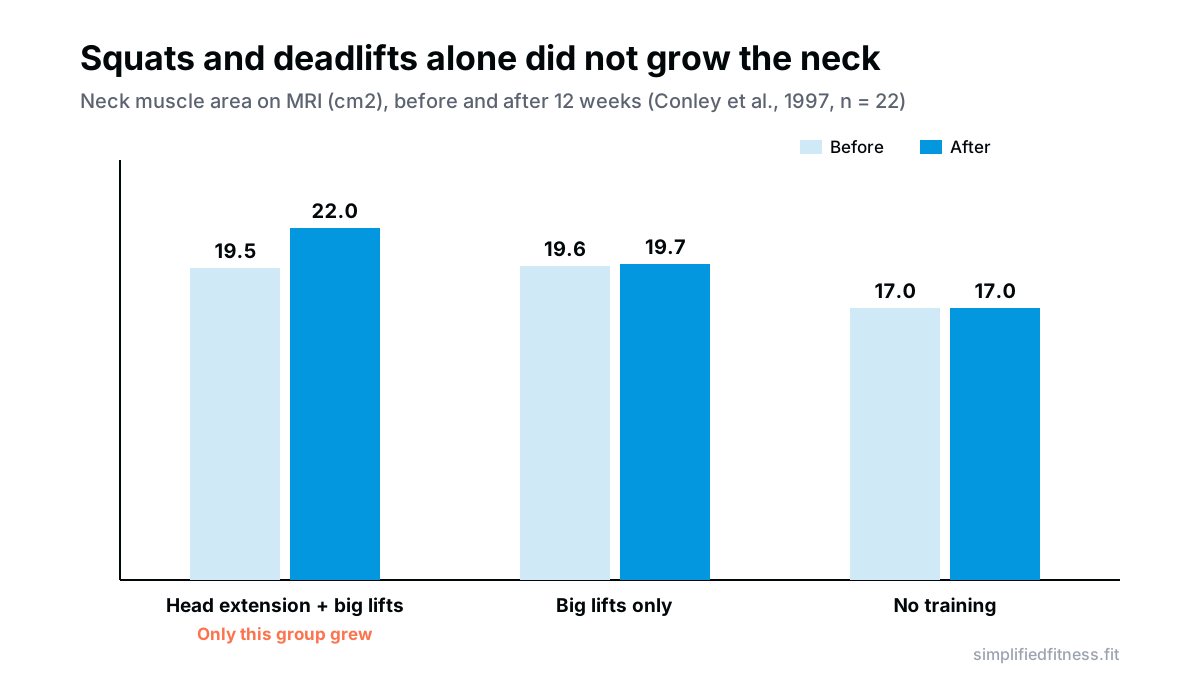
A caveat: this was a small study in young, active students, it only trained extension, and the neck group used sets of 10 at their 10-rep max. The lighter 15-25 rep approach below is a conservative choice for the neck, backed by broader loading research rather than a neck-specific trial. Still, it matches what most lifters notice. Shrugs and deadlifts build the traps, not the deeper neck muscles. If you want the trap side of the story, read our guide on trapezius anatomy and the upper, middle and lower trap exercises.
Which neck exercises are best?
Keep it boring. Three or four movements cover everything.
1. Neck extension (back of the neck). Lie face down on a bench with your head hanging off the end, or sit in a harness with a light plate. Lower the head slowly, then raise it to a neutral line with your spine. No yanking.
2. Neck flexion (front of the neck). Lie on your back on a bench, head off the edge, and lift your chin toward your chest. Start with bodyweight. Later, place a small towel-wrapped plate on your forehead.
3. Lateral flexion (sides). Lie on your side with your head off the bench and lift toward the ceiling. Or do an isometric hold against your own hand.
4. Isometric holds (optional). Push your palm against your head and resist for 10-15 seconds in each direction.
The isometric option has real support. In a pilot randomised trial of 28 under-18 rugby players, an 8-week programme of 15-second maximal self-resisted holds in four directions, 3 times a week, increased total neck strength compared with controls (effect size 1.2) (Attwood et al., 2022). That needs no equipment at all. It was a small pilot with male teenagers, so take the size of the effect with a pinch of salt.
What rep range and weekly volume should you use?
The neck muscles hold your head up all day, and the cervical spine is not a place to take chances. Light to moderate loads and 15-25 reps are a sensible, conservative choice.
There is scientific cover for that. A 2021 review of loading research argues that muscle growth can happen across a wide spectrum of loads, not only in a narrow “8-12 rep” zone (Schoenfeld et al., 2021). Heavy neck work is not necessary for growth, and for a body part this delicate, it is not smart.
A starting plan:
- Frequency: 2 days a week, with a rest day between.
- Sets: 2-3 per direction (extension, flexion, each side).
- Reps: 15-25, slow, about 2 seconds up and 2-3 seconds down.
- Effort: finish with 1-3 reps left. Our RIR and RPE calculator helps you judge this.
- Progression: add reps until you hit 25, then add the smallest plate you have.
For how weekly sets add up across your whole body, see our guide on training volume for hypertrophy and our breakdown of load, rep ranges, RIR and rest intervals. Neck work can sit at the end of a pull day or push day, and you can slot it into our free training plans.
Is a neck harness workout safe?
It can be, but “safe” depends on how you use it. We could not find research on injury rates from harness neck training specifically, so the following is conservative coaching practice rather than a study result.
- Use a harness that fits snugly and does not slip.
- Begin with 2-5 kg or even less.
- Keep the movement within a comfortable range. No forced end-range stretching under load.
- Brace your trunk. Your upper back should stay still while only the neck moves.
- Stop if you feel sharp pain, pins and needles, or lightheadedness.
Avoid bouncing, drop sets and max effort singles. They carry cost without a benefit. If you already have a neck disc problem, nerve symptoms or a history of whiplash, check with a doctor or physiotherapist before loading the neck.
Does neck training protect against concussion?
This is where you will see the boldest claims, so let us separate what is shown from what is hoped for.
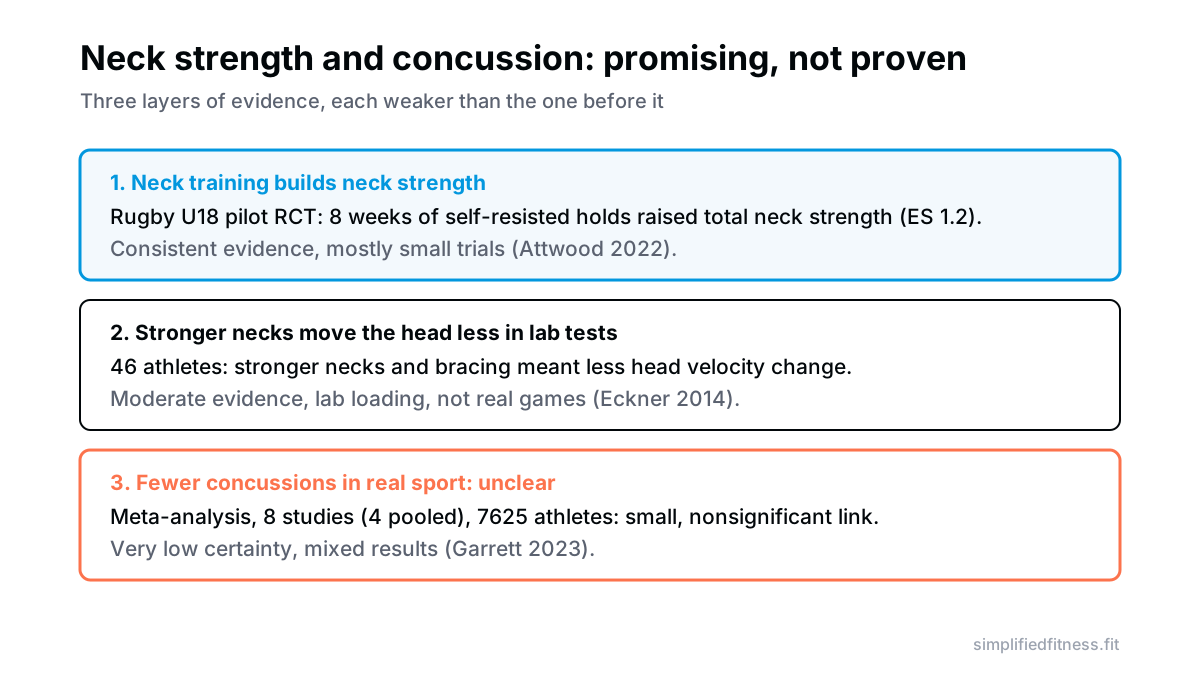
Step 1: can you build neck strength? Yes. Beyond the rugby pilot above, a 16-week programme in 25 children (average age about 10) using bands, bodyweight and manual resistance increased neck extension and flexion strength, and reduced head pitch after a chest perturbation. It was a single-group study with no control group, and the authors say more research is needed on concussion rates (Le Flao et al., 2021).
Step 2: do stronger necks move the head less? In a lab study of 46 male and female contact-sport athletes aged 8 to 30, greater neck strength and bracing before impact were each linked with lower head velocity change after a controlled impulse, with moderately strong correlations (r = 0.417 to 0.657) (Eckner et al., 2014). That is a lab test, not a match.
Step 3: fewer real concussions? Here the evidence is mixed. A 2016 review noted limited evidence for head stabilisation, but did report a retrospective rugby analysis where isometric training reduced match-related cervical spine injuries and a prospective study where greater neck strength lowered concussion risk in high school athletes (Hrysomallis, 2016). Then a 2023 meta-analysis of 8 studies and 7,625 participants pooled 4 of those studies and found a small, nonsignificant link between greater neck strength and fewer concussions, with very low certainty and large differences between studies (Garrett et al., 2023).
Another trial adds caution. In 33 male soccer players, 6 weeks of neck flexor and extensor training did not significantly reduce head acceleration during headers, and strength itself did not change significantly over time between groups (Becker et al., 2019). It was short and small, which may explain it.
What to do with this: if you play rugby, football or a combat sport, add neck work as one layer, next to good tackling or striking technique, rules, rest after suspected head injury and proper medical care. If you hit your head and feel confused, dizzy, nauseous or have a worsening headache, see a doctor. Do not assume a thick neck makes you safe.
Can neck training improve posture or neck pain?
Possibly in some ways, though the evidence is more indirect. Strong neck and upper back muscles can help you hold a neutral position longer during desk work. That is a plausible benefit, not a proven cure for forward head posture.
If you already have neck pain, do not self-prescribe a heavy plan. Get the cause checked first. Once cleared, light work for the neck, upper back and shoulder blades is the usual path. Pair neck work with rows and rear delt work from our complete shoulder guide, and if you sit all day, see our desk worker workout plan.
Will a thick neck affect health or sleep?
Muscle in the neck is healthy. A larger neck circumference, though, is also a known marker used when screening for sleep apnea, and it is not well established whether a muscular neck is exempt. If you are a big lifter who snores loudly, stops breathing at night or feels exhausted after a full night, read our piece on sleep apnea in muscular lifters and neck circumference and speak to a doctor.
A simple 8-week neck plan
Weeks 1-2: 2 sessions a week. Bodyweight extension, flexion and side-lying raises, 2 sets of 15 each.
Weeks 3-4: 2-3 sets of 15-20. Add isometric holds of 10-15 seconds if you like.
Weeks 5-6: 3 sets of 20-25. Introduce a very light plate (about 2.5 kg) on extension only.
Weeks 7-8: keep 3 sets, add the smallest plate increase once you hit 25 clean reps.
A hot Indian summer matters here too. Skip neck work if you feel dehydrated and dizzy, because lightheadedness and neck loading are a bad mix. Eat enough protein from dal, paneer, eggs or soya across the day, because small muscles still need building material.
The bottom line
A bigger, stronger neck is a realistic goal. Train it directly, twice a week, in extension, flexion and side bending, using light weight and slow reps. Expect slow progress, measure monthly, and stop at any pain, tingling or dizziness.
As for concussion, treat it as a plausible bonus, not a guarantee. The strength gains are well supported. The injury prevention story is still being worked out.
Frequently Asked Questions
Can you build a thick neck?
Yes, though it takes direct training. In a 12-week MRI study, only the group that added a head extension exercise grew their neck muscles, while the group that only did big lifts did not. Train extension, flexion and side bending twice a week with light loads and add weight slowly.
How do you build a thick neck fast?
There is no safe shortcut, because the neck is a delicate region where speed raises injury risk. Hypertrophy research suggests muscle can grow across a wide range of loads, so moderate loads for 15-25 smooth reps are enough. Progress by adding reps first, then a small amount of weight, over months rather than weeks.
How often should I train my neck?
Two sessions a week is a sensible starting point. Studies in youth rugby and soccer players used 2-3 short sessions a week and saw strength gains. Keep it to 2-3 sets per direction and leave at least one day between sessions.
What are the best neck exercises?
A plate or harness neck extension, lying head raises for flexion and a side-lying raise cover the main directions. These work the splenius, semispinalis, sternocleidomastoid and scalenes. Start with bodyweight or a very light plate and master the slow tempo first.
How many reps should I do for neck training?
Aim for 15-25 controlled reps. Lighter loads are a conservative choice for the neck, and a review of loading research argues hypertrophy is possible across a wide range of loading zones, not only heavy sets. Stop each set with a rep or two in reserve.
Are neck harness workouts safe?
They can be, if you use a well-fitted harness, a light load, a slow tempo and a stable trunk. There is limited research on harness-specific injury rates, so caution is wise. Never swing the weight, and stop if you feel pain, tingling or dizziness.
Do squats and deadlifts grow your neck?
Not much on their own. In a 1997 MRI trial, lifters doing squats, deadlifts, push press and rows gained no neck muscle size, even though their thigh muscles grew. Add a direct neck exercise if you want visible change.
Does a stronger neck prevent concussions?
It might lower how much the head moves on impact, but there is no strong proof it prevents concussions. A 2023 meta-analysis of 8 studies, pooling 4 of them, found a small, nonsignificant link with very low certainty. Treat neck training as a supporting measure alongside technique, rules and protective practices.
How long does it take to see a bigger neck?
Strength usually improves within 8 weeks, but visible size takes longer. The main MRI study on neck muscle size ran 12 weeks and saw measurable growth in the muscles trained. Take a tape measure at the same point monthly and be patient.
Can neck training fix forward head posture?
Neck and upper back strength may help your posture endurance, but evidence for fixing posture itself is limited. Stronger deep neck flexors and mid-back muscles may help you hold a neutral position longer. Pair neck work with rows and face pulls, and take movement breaks from the desk.
Can I train my neck at home without equipment?
Yes. A pilot trial in teenage rugby players used 15-second maximal self-resisted holds in four directions and improved neck strength. Press your hand against your head, push back without moving, and build up slowly.
Is neck training bad for you?
Done carefully, it is generally considered low risk in healthy people, though high-quality injury data is limited. Risk rises with heavy loads, fast reps and ignoring pain. If you have a neck or spine condition, get cleared by a doctor or physiotherapist first.
Does a thicker neck affect sleep apnea?
Neck circumference is used as a screening marker for sleep apnea. Whether a neck that is big from muscle carries the same risk as one that is big from fat is not well established. Either way, if you snore loudly, stop breathing at night or feel tired all day, talk to a doctor.
Sources & References
Every claim above is checked against peer-reviewed research (PubMed, U.S. National Library of Medicine) or guidance from established health bodies. How we fact-check.
- Conley MS, et al. Specificity of resistance training responses in neck muscle size and strength. Eur J Appl Physiol Occup Physiol. 1997. PMID: 9189733
- Attwood MJ, et al. Eight weeks of self-resisted neck strength training improves neck strength in age-grade rugby union players: a pilot randomized controlled trial. Sports Health. 2022. PMID: 34558993
- Eckner JT, et al. Effect of neck muscle strength and anticipatory cervical muscle activation on the kinematic response of the head to impulsive loads. Am J Sports Med. 2014. PMID: 24488820
- Garrett JM, et al. The relationship between neck strength and sports-related concussion in team sports: a systematic review with meta-analysis. J Orthop Sports Phys Ther. 2023. PMID: 37428807
- Becker S, et al. Effects of a 6-week strength training of the neck flexors and extensors on the head acceleration during headers in soccer. J Sports Sci Med. 2019. PMID: 31827358
- Le Flao E, et al. An accessible, 16-week neck strength training program improves head kinematics following chest perturbation in young soccer athletes. J Sport Rehabil. 2021. PMID: 34330102
- Hrysomallis C. Neck muscular strength, training, performance and sport injury risk: a review. Sports Med. 2016. PMID: 26861960
- Schoenfeld BJ, et al. Loading recommendations for muscle strength, hypertrophy, and local endurance: a re-examination of the repetition continuum. Sports (Basel). 2021. PMID: 33671664

Umair Hazrami · Founder & Head Coach, Simplified Fitness
Umair Hazrami founded Simplified Fitness and the Simplified Lifter channel to cut through fitness noise. With 4+ years of consistent training and 10+ coaching clients, he writes every guide from the peer-reviewed research and links the sources so you can check them. Our editorial standards.
Educational content only, not medical advice. If you have a medical condition, are pregnant, or take medication, talk to a qualified doctor before changing your diet, supplements or training. Full disclaimer.
Keep reading

Exercise Technique
3D Shoulder Protocol: Weekly Volume, Frequency (2-3x/Week) and Rep Ranges
How to build 3D shoulders: how many weekly sets, how often to train side and rear delts, and which rep ranges to use, with an 8-week plan and the research.
8 min read

Exercise Technique
Are Front Raises Necessary? Why Bench Pressers Rarely Need Direct Front Delt Work
Are front raises necessary if you bench and overhead press? See what EMG and volume research says, when they can still help, and where to spend those sets.
8 min read

Exercise Technique
Behind-the-Neck Press: Shoulder Mobility, Neck Safety and Muscle Bias
Behind the neck press safety explained: who has the shoulder mobility for it, what EMG studies show for delts, and which swaps work if you do not.
10 min read

Exercise Technique
Cable Lateral Raises: Behind-the-Back vs Cross-Body Setup, Which Is Better?
Cable lateral raise behind the back vs in front: what the research says, which setup suits most lifters, and a step-by-step guide to pulley height and cuffs.
9 min read