Stretch-Mediated Hypertrophy: Longitudinal Sarcomerogenesis vs Parallel Addition
Stretch mediated hypertrophy science explained: titin, passive tension and sarcomeres in series vs parallel, plus what human studies really show about it.
TL;DR. The short answer
- Stretch mediated hypertrophy means extra muscle growth after training with load at long muscle lengths. Human trials support the growth effect in several muscles, but the exact mechanism is still unproven.
- Muscles can grow thicker (sarcomeres added in parallel) or longer (sarcomeres added in series). Animal studies show both, and human scans can only estimate series growth indirectly through fascicle length.
- Titin, the elastic protein inside every sarcomere, is the leading candidate for sensing stretch. Evidence for this comes mostly from mice and rats, plus one mathematical model.
- A 2025 review concluded that high muscle force at long fibre lengths, active or passive, is the key trigger for adding sarcomeres in series, and that eccentric training does not seem to be a key promoter.
- Practically: pick exercises that load the muscle hard while it is stretched, use a controlled range, and treat 'sarcomerogenesis' as a plausible bonus rather than a guarantee.
Part of our complete guide: Muscle Length, Range of Motion and Stretch-Mediated Hypertrophy: What the Research Actually Shows
Table of contents
Stretch mediated hypertrophy science boils down to this: when you load a muscle hard while it is stretched, it tends to grow more than when you load it in a shortened position. Several human trials support that. The cellular story behind it (titin sensing tension, sarcomeres being added end to end) is plausible but not proven in lifters.
This article is the ultrastructure explainer inside our range of motion and stretch-mediated hypertrophy guide. If you want the practical side, the sibling pieces on long muscle length training and lengthened partials cover exercise choice. Here we stay inside the sarcomere.
What is stretch mediated hypertrophy, exactly?
The phrase gets used for three different things, and mixing them up is where most of the confusion starts.
- A training observation. Loaded work at long muscle lengths seems to build more muscle in several muscles.
- A structural claim. Muscles may add sarcomeres in series, making fascicles longer.
- A molecular claim. A stretch sensor (often titin) switches on growth signals.
Number 1 has the best human support. Numbers 2 and 3 are mostly inferred from animals, models and indirect ultrasound measures. Keep them separate in your head and the rest of this article gets easier.
Parallel vs series hypertrophy: what is the difference?
A muscle fibre is a long chain of tiny repeating units called sarcomeres. Think of a train. Adding carriages grows the train longer. Adding more tracks side by side makes the whole thing wider.
- In series (longitudinal): more sarcomeres end to end. Fascicles get longer.
- In parallel (radial): more contractile material side by side. Fibres get thicker, and cross-sectional area goes up.
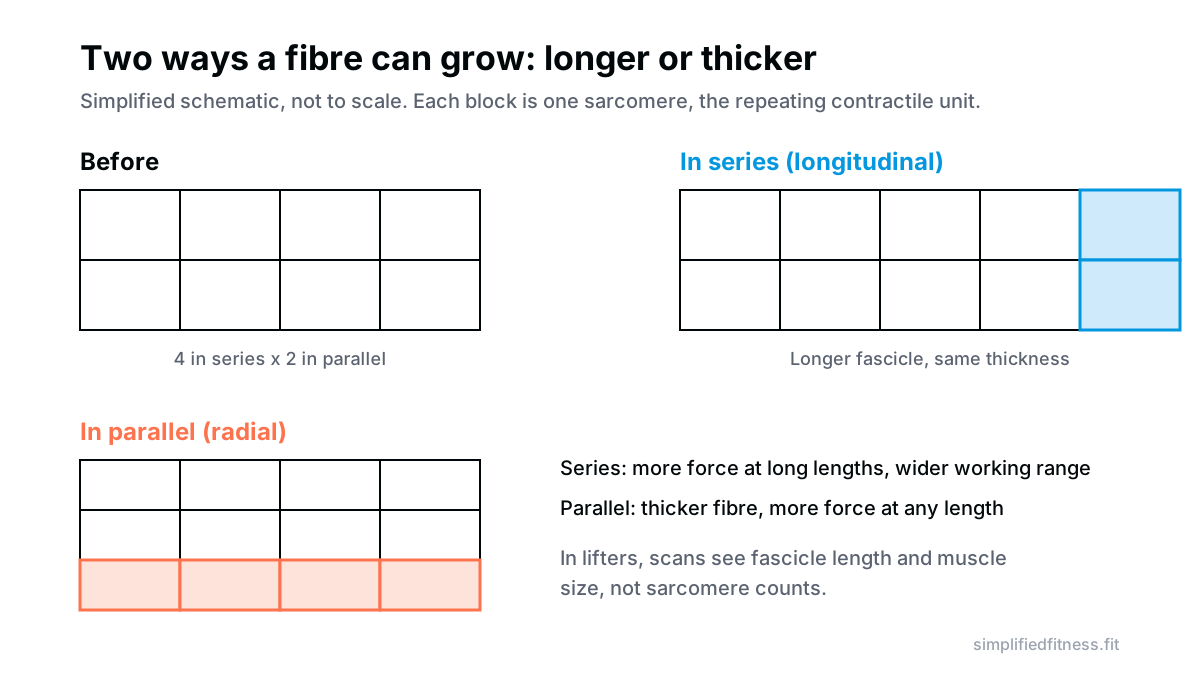
Both happen in animals. In mice, one stretch model produced a 48% rise in diaphragm mass in six days, due to sarcomeres added both in series and in parallel (van der Pijl et al., 2018). That is an extreme, passive-stretch rodent model, so do not map the number onto your biceps.
Why does series growth matter at all? A review of serial sarcomere addition notes it affects muscle function, and that fascicle shortening with ageing may reflect fewer serial sarcomeres (Hinks et al., 2023). It is also a hypothesised protection against injury, though that part is still debated.
Passive vs active tension: what the sarcomere feels at long lengths
Tension inside a muscle has two sources.
Active tension comes from actin and myosin cross-bridges pulling. It is highest near the middle of the sarcomere’s working range and drops when the sarcomere is stretched so far that the filaments barely overlap. We cover that curve in the length-tension curve article.
Passive tension comes from elastic structures, mainly titin and connective tissue. It is near zero at short lengths and climbs steeply as the muscle is stretched.
So at a long length, the cross-bridges are producing less force, but titin and the surrounding tissue are carrying more. In a loaded lengthened lift, you get a mix of both, and the fibre is under strain at a long length. That combination is what the research keeps pointing to.
A 2025 historical and meta-analytic review concluded that high active or passive muscle forces applied at long fibre lengths appear to be the key stimuli for sarcomerogenesis, and that a bigger range of movement on its own was not the specific driver (Blazevich et al., 2025). Notice the wording: “appear to be”. It is a best reading of the data, not a settled fact.
How titin might turn stretch into growth
Titin is the largest protein in the body. It spans half a sarcomere like a molecular spring, and it holds the thick filament centred. When the sarcomere is stretched, titin is strained. That makes it an obvious candidate for sensing stretch.
What do we actually know?
- Mice, stiffness: in the diaphragm model, mice with less stiff titin had a hypertrophy response about 20% smaller, while mice with stiffer titin had one about 18% bigger. The authors conclude titin acts as a mechanosensor regulating muscle trophicity (van der Pijl et al., 2018).
- Rodents, signalling: a 2026 follow-up in rats and mice found that stretch switched on titin-associated proteins called MARPs. Knocking MARPs out in mice produced more longitudinal hypertrophy with mTOR pathway activation, and blocking mTORC1 with rapamycin suppressed that growth. In other words, MARPs seem to act as a brake (van der Pijl et al., 2026).
- Modelling: a mathematical model of the titin kinase domain predicts it opens under force as a mechanosensitive switch, producing a greater signal after high-load resistance exercise than after an equally energetic endurance effort (Ibata and Terentjev, 2021). It is a model, not a measurement in people.
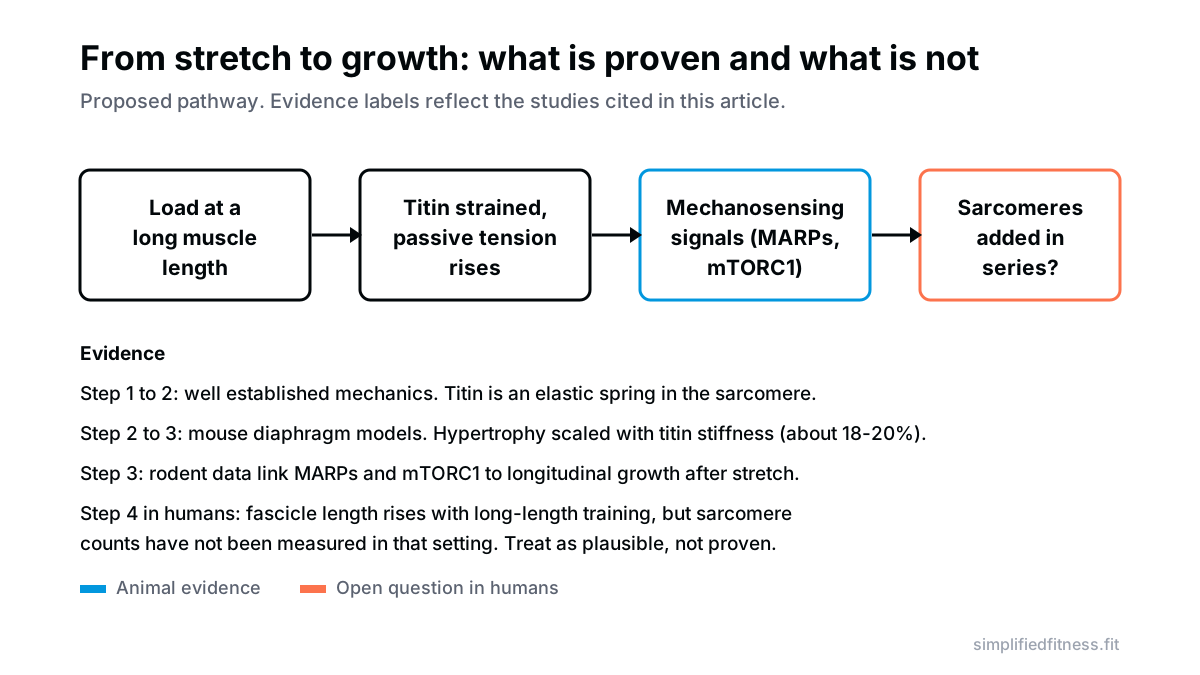
You may have seen the claim that “titin kinase activates and directly triggers sarcomere addition” stated as fact online. The honest version is narrower. Titin is a leading candidate stretch sensor, and rodent work links it to stretch-driven growth. Direct proof of the whole chain in resistance-trained humans does not exist yet.
Do lifters actually add sarcomeres in series?
Here is where the story gets less tidy.
What supports it. Fascicle length tends to rise after training at long lengths. In a trial of 33 young adults assigned to calf eccentric training at long or short muscle lengths (27 completed), fascicle length rose about 8.5% in the long-length group but not in the short-length group, and this was independent of changes in passive muscle-tendon properties (Bizet et al., 2025). The authors suggest it may reflect added sarcomeres in series or longer sarcomeres.
What complicates it. In a 3-week Nordic hamstring study of 10 recreationally active people, fascicle length in the distal biceps femoris long head rose 21%, but sarcomere length rose 17% and the estimated number of sarcomeres in series did not change (Pincheira et al., 2022). So longer fascicles were explained by longer sarcomeres, at least over 3 weeks.
The animal data on eccentrics. Animal studies show serial sarcomere changes exceeding 20% over several weeks with different activities, but the meta-analysis found no effect of eccentric resistance training specifically in animal models (a 1% difference, Cohen’s d 0.19, 95% CI -0.29 to 0.67) (Blazevich et al., 2025).
The overall human picture. A 2026 systematic review of eight studies (120 participants) found that both muscle size and fascicle length may increase more after long-length training, but noted that evidence is largely mixed, that no study has estimated serial sarcomere number, and that nearly all used linear extrapolation to estimate fascicle length, which has questionable validity (Wolf et al., 2026).
Why might these studies disagree? Different muscles, different durations (3 to 12 weeks is short for architectural change), different measurement methods, and untrained or recreationally active participants, who may respond differently to a novel stimulus than experienced lifters.
What the growth data show (the part you can use)
Whatever the mechanism, the size outcomes are more consistent than the architecture outcomes.
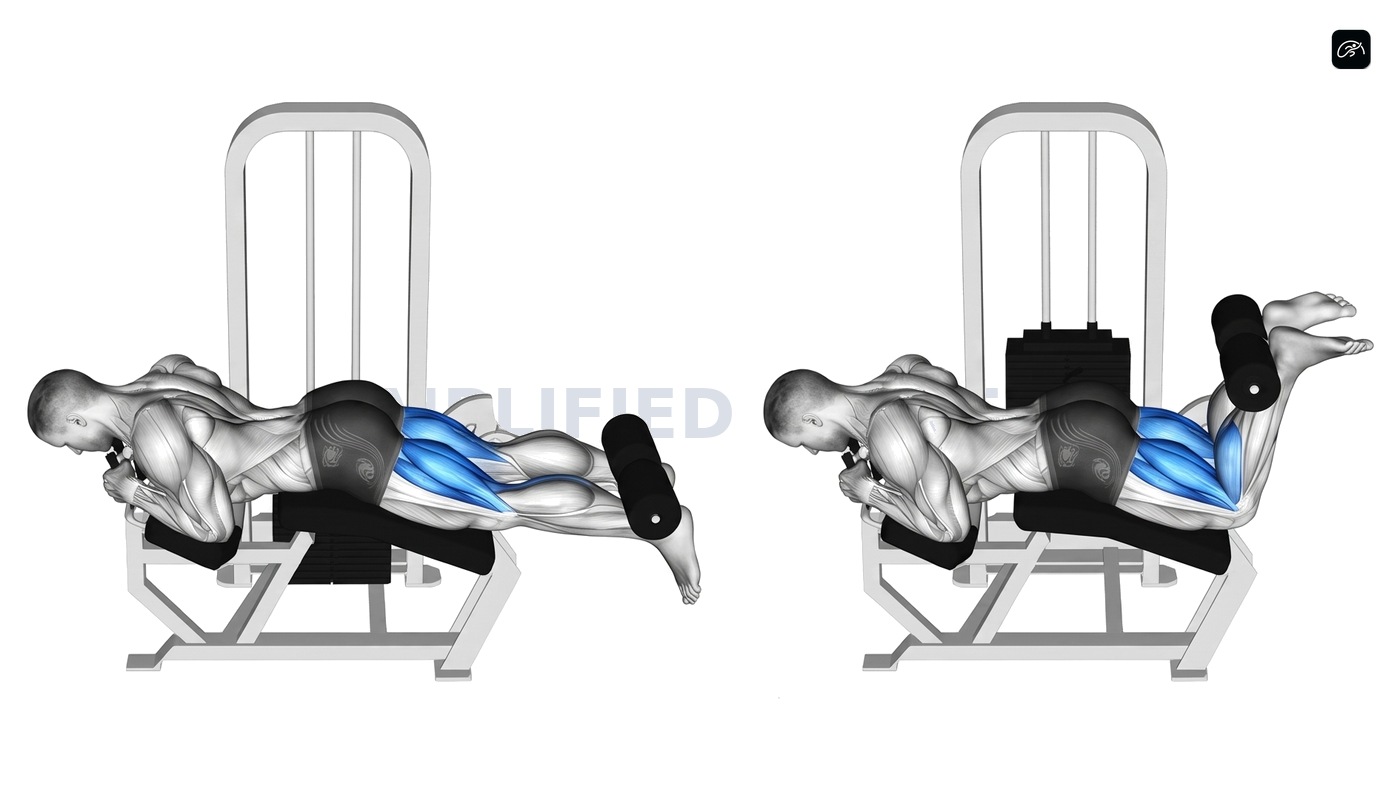
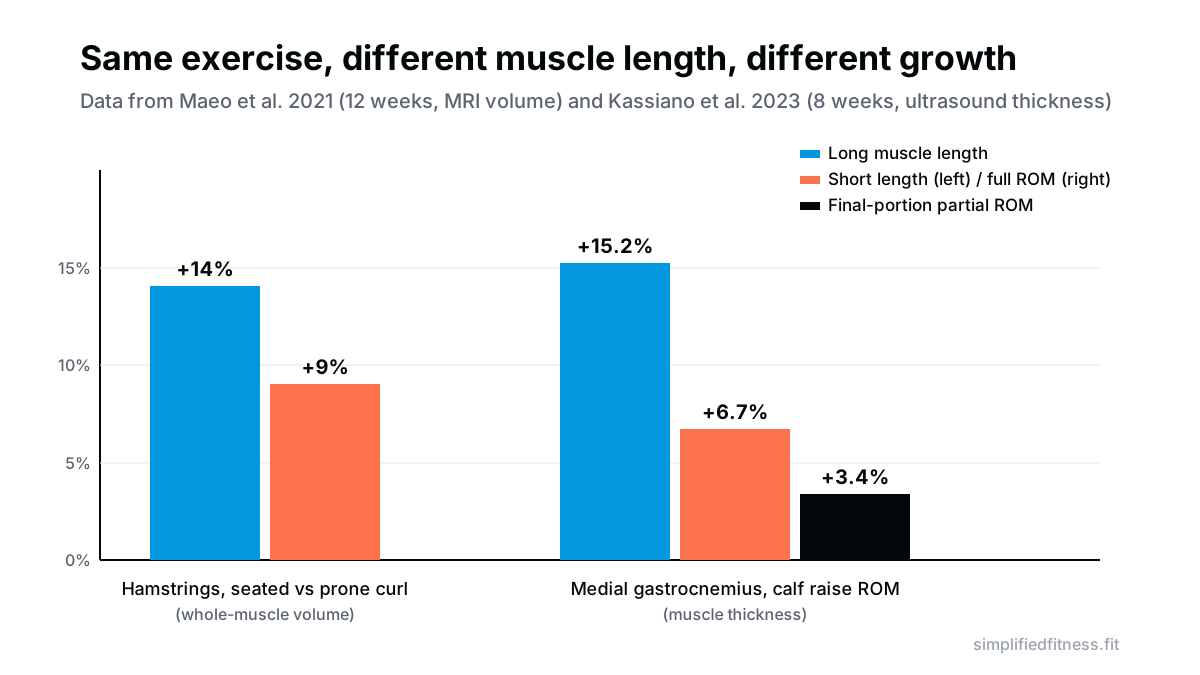
In a 12-week within-person trial of 20 healthy adults, one leg trained with seated leg curls (hamstrings long) and the other with prone curls (hamstrings shorter). MRI muscle volume rose more with the seated version for the whole hamstrings (+14% vs +9%) (Maeo et al., 2021). The advantage showed up in the biarticular hamstring muscles but not the monoarticular one.
In an 8-week trial of 42 young women, calf raises done only in the stretched half of the range grew the medial gastrocnemius by +15.2%, compared with +6.7% for full range and +3.4% for the shortened half (Kassiano et al., 2023).
A systematic review of 11 range-of-motion studies reached a similar conclusion, saying that training at longer muscle lengths, through partial or full range, tends to give optimal growth in muscles such as the quadriceps, biceps brachii and triceps brachii (Kassiano et al., 2023). An earlier review found full range of motion favoured lower-body growth, while upper-body evidence was limited and conflicting (Schoenfeld and Grgic, 2020). For a head-to-head on those findings, see our full vs partial range of motion meta-analysis breakdown.
Notice that these studies fit either story. Greater growth at long lengths does not prove series addition. It may simply reflect more mechanical tension per rep, regional effects or both.
Is it passive stretching, or loaded training? A common mix-up
Stretch mediated hypertrophy is not “stretch harder and you will grow”. The human data cited here come from loaded exercise. The rodent stretch models are very different from a hamstring stretch in the gym or on a yoga mat.
Whether stretching between sets adds anything on top is a separate question, which we look at in intra-set stretching.
How to apply this without overthinking it
Here is the practical translation, and it is more modest than the internet makes it sound.
- Choose the loaded stretch. For hamstrings, a seated leg curl beats a lying one on the evidence above. For triceps, an overhead variation puts the long head under more stretch (overhead vs neutral triceps work). For calves, own the bottom of the raise.
- Control the bottom. The most common mistake here is bouncing out of the stretch with momentum. If you cannot pause for a second at the bottom, the weight is too heavy.
- Do not abandon range. Long-length partials look good in trials for specific muscles, but full range remains a solid default, especially for the lower body.
- Build up gradually. Deep loaded stretches are new for tendons and muscles. Add load across a few weeks.
- Count your volume. Hard sets still matter. Our training volume calculator helps you check you are not under- or overdoing it.
What we still do not know
Honest list, because this topic attracts overconfidence.
- Whether humans add sarcomeres in series from lifting, and how much.
- Whether active or passive tension is the bigger trigger.
- Whether results in trained lifters match those in recreational or untrained people.
- How long it takes for architecture to change, given most studies run 3 to 12 weeks.
- Whether the effect differs between sexes, ages and muscles. Muscle-specific responses to range of motion have been proposed but need more study.
If you have persistent joint or muscle pain when training in deep stretched positions, or any unusual swelling or weakness, speak to a doctor or physiotherapist rather than pushing through.
Frequently Asked Questions
What is stretch mediated hypertrophy?
It is muscle growth that appears to be enhanced when you apply mechanical load while the muscle is held at a long, stretched length. In trials, training at long muscle lengths has produced more growth than training at short lengths in several muscles. The exact cellular mechanism is still being worked out, so use it as a reason to choose lengthened exercises, not as a promise.
What is sarcomerogenesis?
Sarcomerogenesis is the creation of new sarcomeres, the repeating contractile units inside muscle fibres. They can be added end to end (in series), which lengthens the fibre, or side by side (in parallel), which thickens it. Animal studies show clear series addition under some conditions, while in humans it has not been directly counted after lifting.
What is the difference between series and parallel hypertrophy?
Series hypertrophy adds sarcomeres along the length of the fibre, so fascicles get longer. Parallel hypertrophy adds contractile material side by side, so the fibre gets thicker. Most normal lifting growth is thought to include a parallel component, which is why muscle cross-sectional area and thickness are the usual measures.
What does titin do in a muscle?
Titin is a giant elastic protein that links the thick filament to the Z-disc and produces passive tension when a sarcomere is stretched. Because it is strained when the muscle is long, it is a candidate sensor for stretch signals. In mice, hypertrophy after passive stretch scaled with how stiff titin was, but that has not been shown in lifters.
Is passive tension or active tension more important for growth?
Nobody knows yet. A 2025 review concluded that high active or passive forces at long fibre lengths seem to be the key triggers for series sarcomere addition. Heavy lengthened lifts give you both at once, so you do not need to separate them in training.
Does eccentric training add sarcomeres in series?
The evidence is weak. A 2025 meta-analysis of animal studies found no meaningful effect of eccentric resistance training on serial sarcomere number, and a 3-week human study found longer fascicles came from longer sarcomeres, not more of them. Eccentrics are still a good training tool; just do not credit them with a mechanism that has not been shown.
Do human studies prove that lifters add sarcomeres in series?
No. A 2026 systematic review of eight studies found fascicle length and muscle size may rise more with long-length training, but noted that no study had estimated serial sarcomere number and most used extrapolated ultrasound. Treat longer fascicles as consistent with series growth, not proof of it.
Do I need to stretch passively to trigger stretch mediated hypertrophy?
You do not have to. Evidence in lifters comes from loaded exercise at long lengths, not from stretching alone. Passive stretching has its own research, which we cover in a separate article on intra-set stretching.
Which exercises load a muscle at long lengths?
Seated leg curls for hamstrings, overhead triceps extensions, incline curls, deep squats and calf raises with a full bottom stretch are common examples. Pick the version where the muscle is hard to contract and loaded while elongated. Control the bottom position instead of bouncing out of it.
Can partial reps at the stretched position build muscle?
They can. An 8-week trial in 42 young women found calf raises done only in the stretched half grew the medial gastrocnemius more than full-range or shortened-half raises. It was one muscle in one group of women, so treat it as promising, not universal. Our guide to lengthened partials shows how to use them safely.
Does training at long muscle lengths cause more muscle damage?
Not necessarily. In a 12-week study of seated versus prone leg curls, hamstring damage protection after training was similar between the two. Soreness still depends on how new and how hard the stimulus is, so ramp up gradually.
Should I worry about injury when training in a deep stretch?
Loaded stretch is not inherently dangerous, but it demands control. Start lighter, own the bottom position and stop if you feel sharp pain. If a joint or muscle pain persists, see a doctor or physiotherapist.
Sources & References
Every claim above is checked against peer-reviewed research (PubMed, U.S. National Library of Medicine) or guidance from established health bodies. How we fact-check.
- Blazevich AJ, et al. Triggering sarcomerogenesis: Examining key stimuli and the role attributed to eccentric training-Historical, systematic, and meta-analytic review. J Sport Health Sci. 2025. PMID: 40623648
- Wolf M, et al. Does longer-muscle length resistance training cause greater longitudinal growth in humans? A systematic review. Sports Med Health Sci. 2026. PMID: 41646176
- Maeo S, et al. Greater Hamstrings Muscle Hypertrophy but Similar Damage Protection after Training at Long versus Short Muscle Lengths. Med Sci Sports Exerc. 2021. PMID: 33009197
- Kassiano W, et al. Greater Gastrocnemius Muscle Hypertrophy After Partial Range of Motion Training Performed at Long Muscle Lengths. J Strength Cond Res. 2023. PMID: 37015016
- Kassiano W, et al. Which ROMs Lead to Rome? A Systematic Review of the Effects of Range of Motion on Muscle Hypertrophy. J Strength Cond Res. 2023. PMID: 36662126
- Schoenfeld BJ, et al. Effects of range of motion on muscle development during resistance training interventions: A systematic review. SAGE Open Med. 2020. PMID: 32030125
- van der Pijl R, et al. Titin-based mechanosensing modulates muscle hypertrophy. J Cachexia Sarcopenia Muscle. 2018. PMID: 29978560
- van der Pijl R, et al. The titin N2A-MARP signalosome constrains muscle longitudinal hypertrophy in response to stretch. Elife. 2026. PMID: 42530086
- Ibata N, et al. Why exercise builds muscles: titin mechanosensing controls skeletal muscle growth under load. Biophys J. 2021. PMID: 34389312
- Pincheira PA, et al. Biceps femoris long head sarcomere and fascicle length adaptations after 3 weeks of eccentric exercise training. J Sport Health Sci. 2022. PMID: 34509714
- Bizet B, et al. Eight weeks of eccentric training at long-muscle length increases fascicle length independently of adaptations in passive mechanical properties. J Appl Physiol. 2025. PMID: 40048648
- Hinks A, et al. The importance of serial sarcomere addition for muscle function and the impact of aging. J Appl Physiol. 2023. PMID: 37410905

Umair Hazrami · Founder & Head Coach, Simplified Fitness
Umair Hazrami founded Simplified Fitness and the Simplified Lifter channel to cut through fitness noise. With 4+ years of consistent training and 10+ coaching clients, he writes every guide from the peer-reviewed research and links the sources so you can check them. Our editorial standards.
Educational content only, not medical advice. If you have a medical condition, are pregnant, or take medication, talk to a qualified doctor before changing your diet, supplements or training. Full disclaimer.
Keep reading

Hypertrophy
Active vs Passive Insufficiency: How Two-Joint Muscles Change Your Exercise Choice
Active vs passive insufficiency explained for lifters: why hamstrings, triceps, quads and calves grow differently depending on your second joint position.
10 min read

Hypertrophy
Squat Mobility With Long Femurs: Adapting Range of Motion to Your Hips
Squat mobility with long femurs is mostly a lever and hip-socket issue, not a flaw. Learn how to adjust depth, stance and heels without risking your hips.
10 min read
Hypertrophy
Dumbbell Pullovers vs Cable Lat Pull-ins: Training Lats at Long Muscle Lengths
Training lats at long muscle lengths: is the dumbbell pullover a lat or chest exercise, and why a cable lat pull-in may keep tension where you want it.
7 min read

Hypertrophy
Full vs Partial Range of Motion: What the Hypertrophy Research Shows
Full vs partial ROM hypertrophy explained: what two meta-analyses and recent trials found, where lengthened partials fit, and how to set your range of motion.
8 min read