Intra-Set Passive Stretching: Does Stretching Between Sets Increase Muscle Growth?
Does stretching between sets increase muscle growth? Read what the human trials found, the volume cost on heavy lifts, and a safe way to test it yourself.
TL;DR. The short answer
- Stretching between sets has not been shown to reliably increase muscle growth. Human trials are few, small and mostly 5-8 weeks long, with some showing a benefit at certain muscle sites and others showing none.
- In one 8-week trial of 29 untrained adults, adding a 30-second stretch between sets grew the vastus lateralis by 17.0% versus 7.3% with normal rest, but the authors said the data were not enough to call it superior.
- In trained lifters, stretching between sets lowered total training volume over 8 weeks and cut the load lifted in a single cable fly session, which is why heavy compound lifts, where every rep counts, are a poor place to try it.
- If you test it, use isolation moves, a 30-45 second comfortable stretch, and track your reps. Drop it the moment it costs you performance or causes pain.
Part of our complete guide: Muscle Length, Range of Motion and Stretch-Mediated Hypertrophy: What the Research Actually Shows
Table of contents
Does stretching between sets increase muscle growth? Possibly a little, in some muscles, but nobody has shown it reliably. The human trials are small, short, and they disagree with each other. On heavy lifts the stretching also seems to cost you training volume.
Here is the idea, the studies, and a sensible way to test it without wrecking your workout. This is one narrow corner of range of motion and stretch-mediated hypertrophy, so if you want the bigger picture on training muscles at long lengths, start there.
What is intra-set (inter-set) passive stretching?
You finish a set of cable flys. Instead of standing around checking your phone, you hold the chest in a stretched position for 30-45 seconds. Then you start the next set.
That is it. No extra sets, no extra time. The pitch is “free” stimulus hiding in your rest period. Strictly, this is inter-set stretching (between sets), which is the term the research uses. People online often call it intra-set stretching, and some also mean a stretch held mid-set. This article covers the between-set version, because that is what has been tested.
The reasoning, laid out in a 2022 review by Schoenfeld and colleagues, is that stretch can switch on anabolic signaling through both active force (lengthening contractions under load) and passive force (the muscle being stretched) (Schoenfeld et al., 2022). The same paper is careful to say that longitudinal research on stretching between sets is limited, and that some of it suggests a benefit.
Notice the word “suggests”. It matters for everything below.
Why would stretching between sets work?
Two ideas get repeated online. Both are plausible. Neither is proven in lifters.
Idea 1: passive tension at long muscle lengths. Muscles that are stretched while loaded or stretched hard seem to be a stronger growth signal. A 2025 review of sarcomerogenesis (adding sarcomeres in series) concluded that high active or passive forces at long fiber lengths appear to be the key triggers (Blazevich et al., 2025). But its strongest evidence came from animal studies, and the authors said too few human studies exist to draw conclusions. For the full mechanism debate see our guide to stretch-mediated hypertrophy and sarcomerogenesis.
Idea 2: restricted blood flow (the ischemia theory). Holding a stretch might keep the muscle under metabolic stress during rest. I looked for direct human evidence behind this specific claim and did not find any among the studies reviewed here, so treat it as speculation.
What do the human trials actually show?
A 2020 review of human stretch training found that of 10 studies, only 3 saw positive effects on muscle structure, and those used an assisting apparatus or an external load. Of 5 studies that added stretching to resistance training, 2 applied it between sets and showed enhanced growth. The authors concluded that low-intensity passive stretch does not appear to help, while loaded stretch or stretch between contractions may, with limited evidence (Nunes et al., 2020).
Now the individual trials, in the order they help us understand the picture.
The favourable one: untrained adults, 8 weeks
Evangelista and colleagues split 29 sedentary adults into traditional training (17 people) or the same training plus a maximum-amplitude, 30-second passive stretch between sets (12 people). Both groups did 6 exercises, 4 sets of 8-12RM, with 90 seconds of rest, twice a week for 8 weeks (Evangelista et al., 2019).
Strength was similar. Muscle thickness grew in every site for both groups. But at the vastus lateralis (outer quad), stretching groups gained 17.0% versus 7.3%, and the sum of the four sites rose 10.5% versus 6.7%.
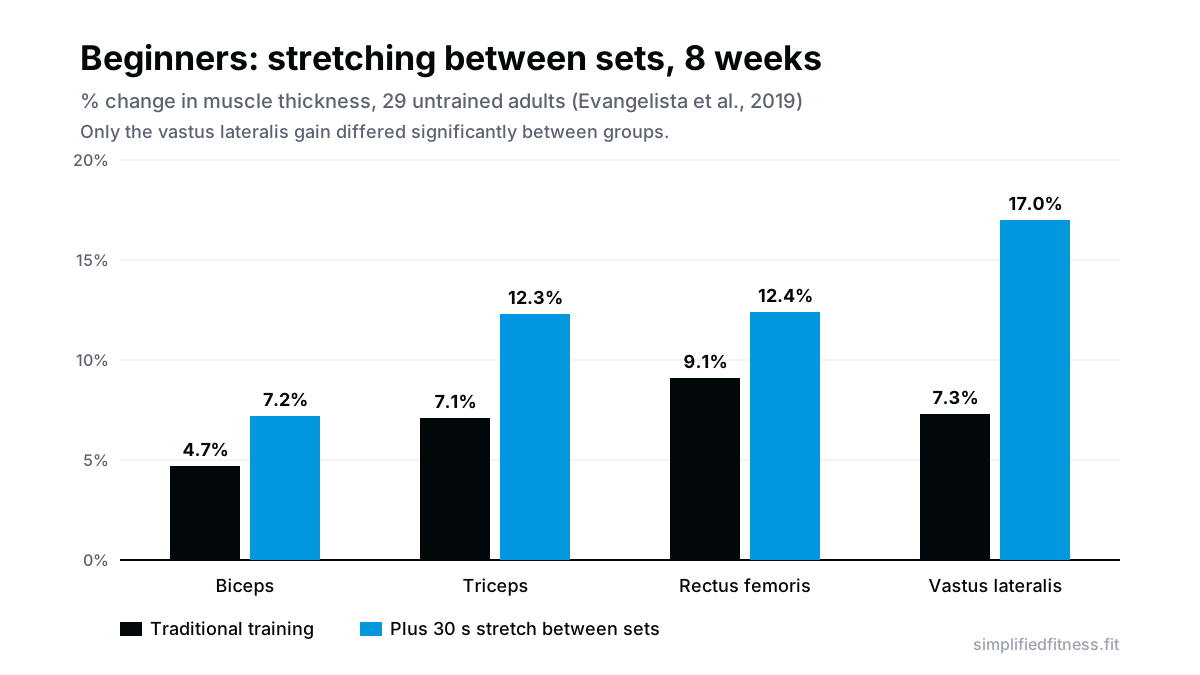
Read the authors’ own conclusion, though. They said the data were not enough to conclude that stretching between sets beats traditional training, only that adding it did not compromise adaptations in the first 8 weeks in untrained people. Twelve people in one group is a thin base for big claims.
The neutral ones: trained lifters and a one-leg design
In a 5-week trial, 16 untrained men trained flywheel squats twice a week, with one leg randomly assigned to inter-set stretching and the other leg as control. Flexibility improved more on the stretching side, isometric knee extension strength rose more, but quadriceps thickness did not differ significantly (7.3% vs 8.0%) (Nakamura et al., 2021).
An 8-week trial in 22 recreationally trained men and women compared the two approaches directly. Stretching lowered total training volume. Strength gains were similar. No significant between-group differences appeared for any strength or muscle outcome (Businari et al., 2024). Triceps thickness rose in the stretching group, but the groups did not differ.
The acute cost
In one crossover study, 17 trained men did 7 sets of seated cable fly at 10RM. Between sets they either stretched the chest for 45 seconds or rested passively. Stretching produced lower total load lifted, less muscle swelling and lower blood lactate than passive rest (de Camargo et al., 2022). The authors suggested using it on lower intensity days to reduce session stress.
Why do the studies disagree?
Several things differ, and any of them could explain the mixed results.
- Who was tested. Beginners grow from almost anything, so a trial that finds a difference in beginners may not carry over to people with years of training.
- Which muscles. Gains varied by site. The Evangelista result was strongest at one quad site and flat at others.
- Stretch dose and intensity. 30 seconds at maximum amplitude is not 45 seconds at “comfortable”.
- Total volume. If stretching leaves you fatigued, you might lift less, which can cancel a small bonus.
- Sample size and duration. All of these trials are small and 5-8 weeks long. Differences of a few percent in muscle thickness can come from measurement noise alone.
This is early-stage science. Not a verdict.
What do the bigger reviews say about stretching and growth?
Zooming out helps, because inter-set stretching is a subset of the wider static stretching literature.
A 2024 meta-analysis of 25 studies concluded that the chronic effect of static stretching on hypertrophy is unclear, with a trivial point estimate (SMD 0.118). Trained individuals showed larger effects than recreationally trained or sedentary people, and longer total stretching time was linked to bigger gains. The authors said stretching may not be very effective unless training duration is high (Arntz et al., 2024).
A separate 2024 meta-analysis of 42 randomized trials with 1,318 participants found a small but significant hypertrophy effect (d = 0.20), larger with longer stretch durations and intervention periods (Warneke et al., 2024).
Two meta-analyses, two readings of roughly the same message: modest at best, dose matters, certainty is low. And these cover stretching in general, not specifically between sets.
Does stretching between sets hurt your next set?
It can. The two studies that measured workload in trained lifters both found a cost: lower total training volume over 8 weeks in one, and less total load lifted in a single cable fly session in the other.
That matters because rest itself is a lever. In a trial of 21 trained men, 3-minute rests produced greater quadriceps thickness and strength gains than 1-minute rests over 8 weeks (Schoenfeld et al., 2016). Stretching does not shorten your rest, but if it leaves your muscle more tired when set two starts, you pay for it in reps. Our guides on 2-3 minute rests versus short rests and the penalties of short rest explain why reps matter so much.
Picture a lifter who stretches hard through the rest period and then gets 7 reps on set two instead of 10. Same time, less work.
Where does it make sense to try it?
Think of where the fatigue cost is smallest and the stretch is easy to hold.
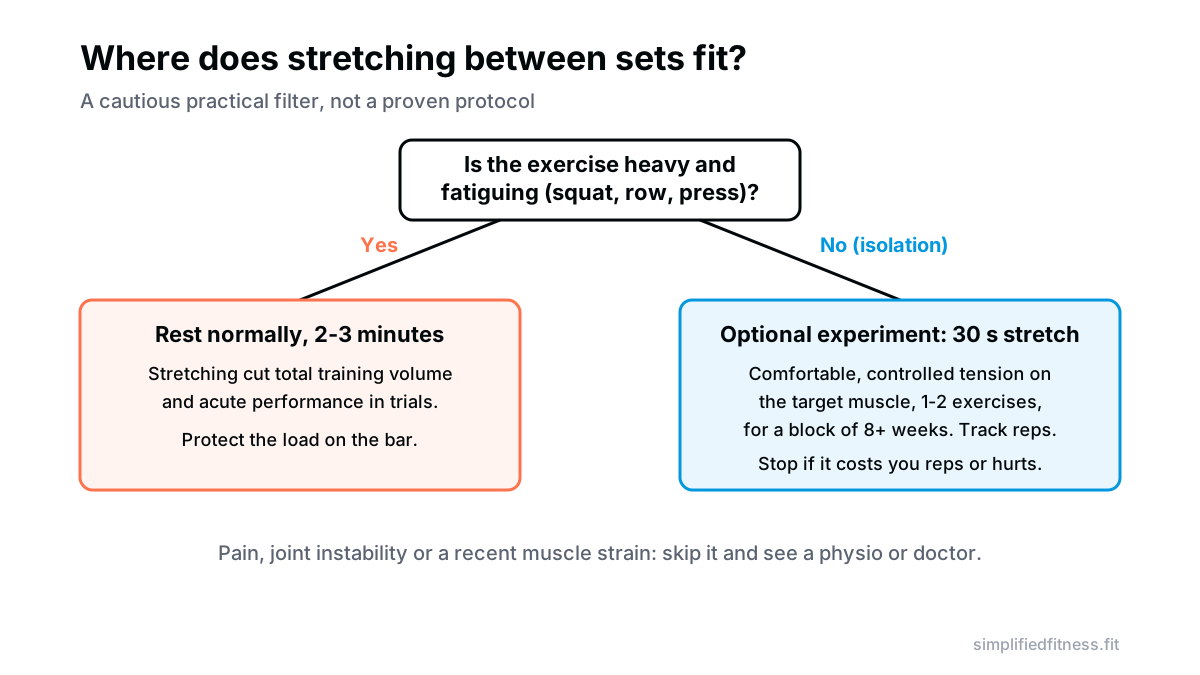
Good candidates, where the stretch is easy to hold and fatigue costs little:
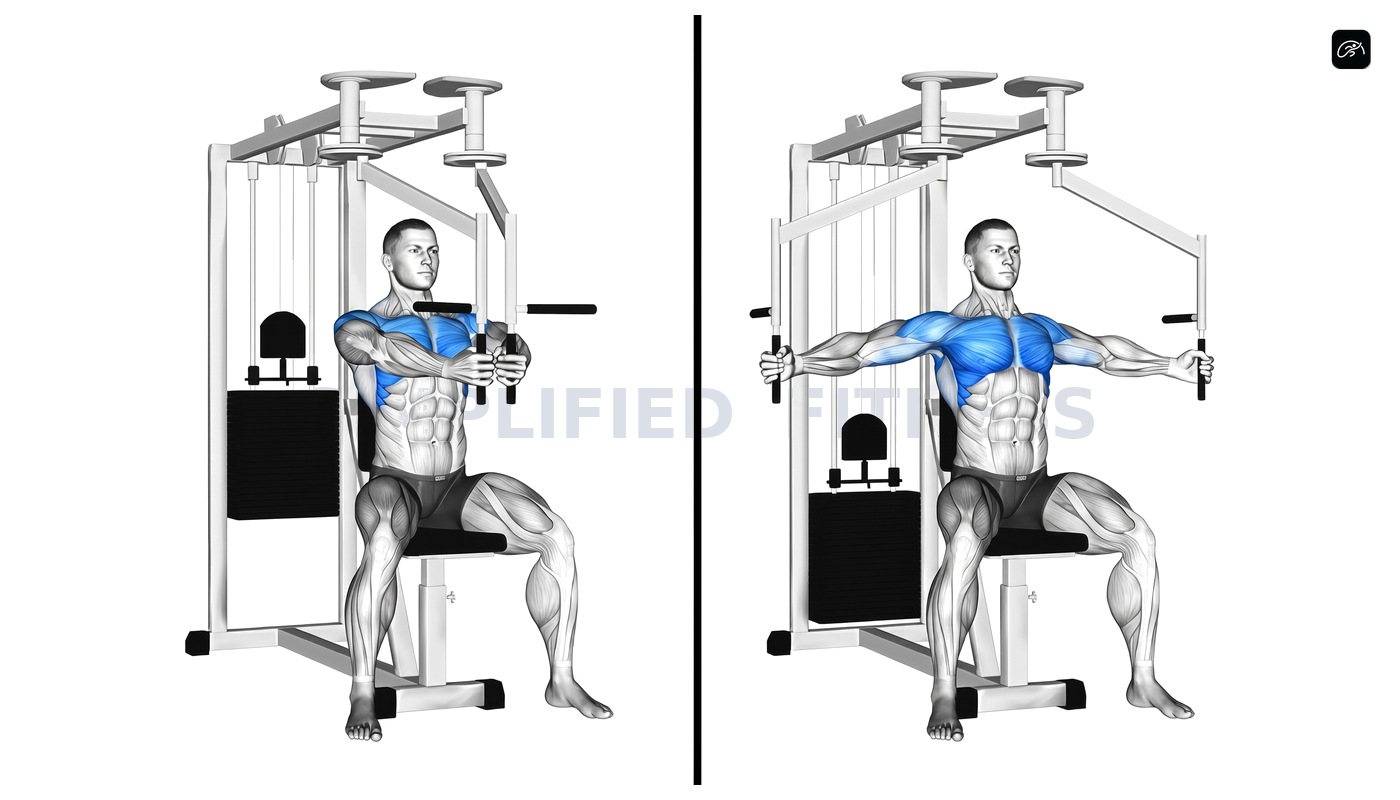
- Cable or pec dec flys for the chest.
- Leg extensions for the quads.
- Calf raises. A calf stretch is simple to hold, and our calf hypertrophy guide covers the exercises themselves. I could not confirm a calf-specific inter-set trial for this article, so I would not promise a calf-specific result.
How to test inter-set stretching safely
If you want to try it, run it as a clean experiment rather than an all-in lifestyle.
- Pick one or two isolation exercises. Leave your main compounds alone.
- Stretch for 30-45 seconds. That is the range the trials used. Use a firm, tolerable stretch. No bouncing, no pain.
- Keep your normal rest. Do not shorten your recovery. Stretch inside it.
- Log your reps. Write down reps and load on set 2 and set 3. If they fall compared with your usual numbers, drop it.
- Give it 8 weeks. Most of the trials ran 5-8 weeks. Two weeks tells you nothing, and even after 8 weeks you will not be able to measure small growth differences by eye, so judge it mainly on whether your performance holds up.
- Compare with a baseline. Use the same weekly set count, which you can check with our training volume calculator.
Watch the clock. If you start holding the stretch past your usual rest, the session quietly gets longer, which removes the main selling point.
What should you do instead if you want more stretch stimulus?
Before you add a new trick, check the basics that have stronger support. Train through a full, controlled range. Use exercises that load the muscle at long lengths. Our guides to long muscle length training and lengthened partials cover those methods, and they use the set itself as the stimulus rather than the rest gap.
Also compare it to the post-workout stretching people do for soreness. That is a different goal with a different answer, covered in stretching after workouts and soreness.
If you need a structured plan to run these ideas in, the free push pull legs plans are a good base.
When to skip it or see a doctor
Skip the experiment if you are recovering from a muscle strain or tear, have a hypermobile or unstable joint, or feel pain rather than a stretch. A pop, sharp pain, numbness or joint pain that lingers after training is a reason to stop and see a doctor or physiotherapist. A stretch in a fatigued muscle should feel like tension, not injury.
The bottom line
Stretching between sets is an interesting idea with a thin evidence base. A few small trials show a benefit at some sites, others show nothing, and trained lifters tend to lose training volume when they do it. None of it is strong enough to rewrite your program.
If your sets, your load progression and your rest are already solid, you can run a careful 8-week test on isolation exercises. If they are not, fix those first. That is where the real growth is.
Frequently Asked Questions
Does stretching between sets increase muscle growth?
It might, but the evidence is too thin to promise it. One 8-week trial in untrained adults found larger thickness gains at some sites, while two other trials found no clear difference between groups. Treat it as an experiment for isolation exercises, not a proven growth tool.
What is inter-set stretching?
It means holding a static stretch of the muscle you just trained during the rest period, instead of resting passively. The idea is to add tension at long muscle lengths without adding extra sets. In trials it is usually 30-45 seconds per rest interval.
How long should I stretch between sets?
The trials reviewed here used 30 to 45 seconds per rest period. Nobody knows the best dose yet, so staying inside that window is the safest guess. Use a stretch that feels strong but tolerable, and make sure you still get enough rest to repeat your reps.
Does stretching between sets hurt strength?
Over 5-8 weeks, trials found strength gains were similar with or without it, and one found slightly larger isometric strength gains with stretching. The acute picture is different: in trained men, stretching between cable fly sets reduced total load lifted that session. So the cost shows up in your workout volume, not your long-term strength.
Is stretching between sets better than resting?
Not clearly. A trained-lifter trial found lower total training volume with stretching and no between-group differences in muscle outcomes. Longer rests of about 3 minutes have their own evidence for better growth than 1 minute, so a proper rest may beat a rushed stretch.
Which exercises work best for inter-set stretching?
Single-joint exercises where the stretch position is easy to hold, such as cable flys, leg extensions or calf raises. The trials did include presses, rows and even flywheel squats, but the volume cost shows up most where load matters most, so keep heavy compounds on normal rest. Avoid it on lifts where fatigue or a loose joint would affect your safety.
Can stretching between sets build sarcomeres?
Adding sarcomeres in series is mostly shown in animal studies. A 2025 review concluded that high active or passive forces at long fiber lengths seem to be the key triggers, but too few human studies exist. So the mechanism is plausible, not confirmed in lifters.
Is it safe to stretch a muscle that is pumped and fatigued?
For most healthy people a controlled, comfortable stretch is low risk, but there is little safety data on forcing intense stretches mid-workout. Stay at a firm but not painful intensity and never bounce. If you feel sharp pain, a pop or lasting joint discomfort, stop and see a doctor or physiotherapist.
Does stretching between sets work better for trained lifters or beginners?
The data point in different directions. A 2024 meta-analysis of static stretching found larger effects in trained people than in sedentary ones, yet the beginner trial here showed the largest percentage gains. Because the studies differ in method, no group can be named as the clear winner.
Does stretching between sets save time?
It does not shorten your workout, because you stretch during rest you would take anyway. The pitch is added stimulus without added time. The catch is that, in trials, it may reduce how much work you can do in later sets.
Is stretching between sets the same as stretch-mediated hypertrophy?
It is one way to apply the idea, not the whole thing. Stretch-mediated hypertrophy covers training at long muscle lengths, such as deep ROM and loaded stretches. Inter-set stretching adds passive tension in the rest gaps, which is a newer and far less tested idea.
Should I stretch between sets for calf growth?
Calves are a reasonable place to experiment, since a calf stretch is easy to hold. I could not confirm a calf-specific inter-set trial on PubMed for this article, so there is no solid proof either way. If you try it, compare it against your normal rest for 8 weeks.
Is a 3-minute rest better than stretching between sets?
For compound lifts, probably yes. In trained men, 3-minute rests produced larger quadriceps thickness gains than 1-minute rests over 8 weeks. Stretching during the rest can leave the muscle less recovered for the next set, and full recovery protects your reps.
Sources & References
Every claim above is checked against peer-reviewed research (PubMed, U.S. National Library of Medicine) or guidance from established health bodies. How we fact-check.
- Schoenfeld BJ, et al. Inter-set stretch: A potential time-efficient strategy for enhancing skeletal muscle adaptations. Front Sports Act Living. 2022. PMID: 36457663
- Evangelista AL, et al. Interset Stretching vs. Traditional Strength Training: Effects on Muscle Strength and Size in Untrained Individuals. J Strength Cond Res. 2019. PMID: 30688865
- Businari GB, et al. Chronic Effects of Inter-Set Static Stretching on Morphofunctional Outcomes in Recreationally Resistance-Trained Male and Female. Res Q Exerc Sport. 2024. PMID: 36638500
- Nakamura M, et al. Effects of Adding Inter-Set Static Stretching to Flywheel Resistance Training on Flexibility, Muscular Strength, and Regional Hypertrophy in Young Men. Int J Environ Res Public Health. 2021. PMID: 33916599
- de Camargo JBB, et al. Acute Effects of Inter-set Stretching on Performance and Metabolic Parameters of Resistance-trained Men. Int J Exerc Sci. 2022. PMID: 36895845
- Nunes JP, et al. Does stretch training induce muscle hypertrophy in humans? A review of the literature. Clin Physiol Funct Imaging. 2020. PMID: 31984621
- Arntz F, et al. Chronic Effects of Static Stretching Exercises on Skeletal Muscle Hypertrophy in Healthy Individuals: A Systematic Review and Multilevel Meta-Analysis. Sports Med Open. 2024. PMID: 39340744
- Warneke K, et al. Effects of Chronic Static Stretching on Maximal Strength and Muscle Hypertrophy: A Systematic Review and Meta-Analysis with Meta-Regression. Sports Med Open. 2024. PMID: 38637473
- Blazevich AJ, et al. Triggering sarcomerogenesis: Examining key stimuli and the role attributed to eccentric training. J Sport Health Sci. 2025. PMID: 40623648
- Schoenfeld BJ, et al. Longer Interset Rest Periods Enhance Muscle Strength and Hypertrophy in Resistance-Trained Men. J Strength Cond Res. 2016. PMID: 26605807

Umair Hazrami · Founder & Head Coach, Simplified Fitness
Umair Hazrami founded Simplified Fitness and the Simplified Lifter channel to cut through fitness noise. With 4+ years of consistent training and 10+ coaching clients, he writes every guide from the peer-reviewed research and links the sources so you can check them. Our editorial standards.
Educational content only, not medical advice. If you have a medical condition, are pregnant, or take medication, talk to a qualified doctor before changing your diet, supplements or training. Full disclaimer.
Keep reading
Hypertrophy
Active vs Passive Insufficiency: How Two-Joint Muscles Change Your Exercise Choice
Active vs passive insufficiency explained for lifters: why hamstrings, triceps, quads and calves grow differently depending on your second joint position.
10 min read
Hypertrophy
Squat Mobility With Long Femurs: Adapting Range of Motion to Your Hips
Squat mobility with long femurs is mostly a lever and hip-socket issue, not a flaw. Learn how to adjust depth, stance and heels without risking your hips.
10 min read
Hypertrophy
Dumbbell Pullovers vs Cable Lat Pull-ins: Training Lats at Long Muscle Lengths
Training lats at long muscle lengths: is the dumbbell pullover a lat or chest exercise, and why a cable lat pull-in may keep tension where you want it.
7 min read
Hypertrophy
Full vs Partial Range of Motion: What the Hypertrophy Research Shows
Full vs partial ROM hypertrophy explained: what two meta-analyses and recent trials found, where lengthened partials fit, and how to set your range of motion.
8 min read