Lu Raises and Full ROM Overhead Raises: Trapezius and Deltoid Hand-Off Above 90°
Lu raises shoulder hypertrophy explained: what the deltoid does past 90°, how traps and serratus take over, and whether overhead raises beat standard ones.

TL;DR. The short answer
- Lu raises (lateral raises continued overhead) have not been tested in any hypertrophy trial, so claims that they build more delt muscle than a standard lateral raise are unproven.
- The lateral deltoid keeps working past 90°, but the scapula has to rotate upward, and the upper and lower trapezius and serratus anterior do a growing share of that job.
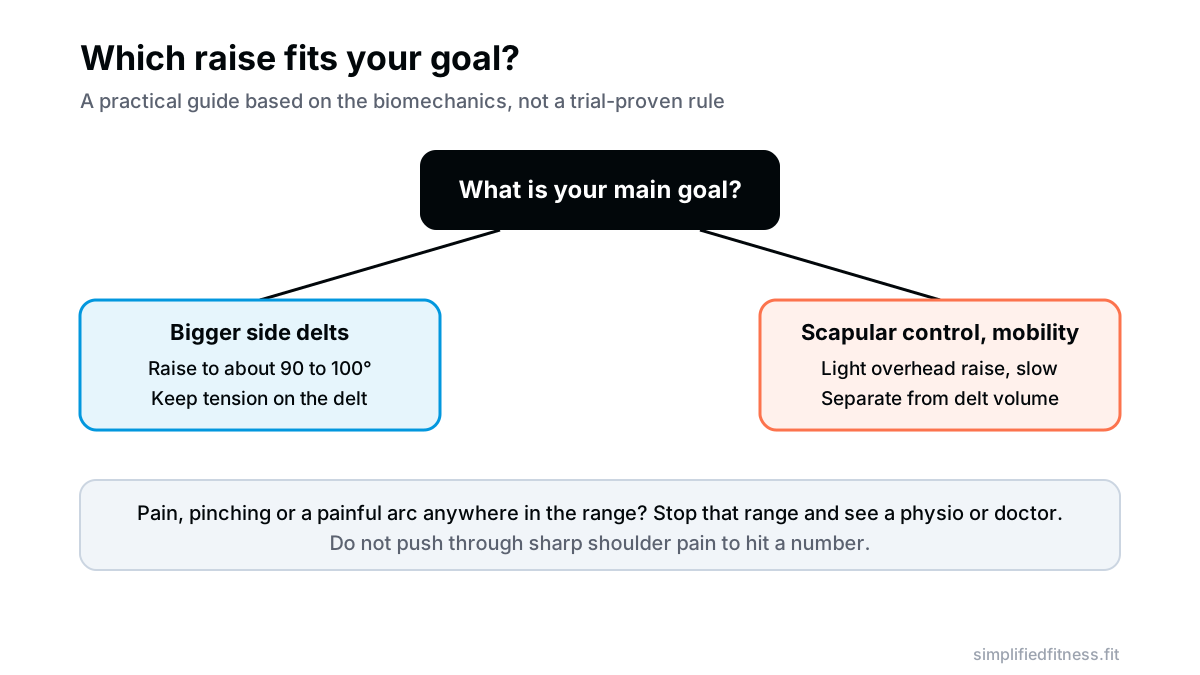
- If side delt size is the only goal, raising to roughly 90-100° keeps the tension on the deltoid and is the simpler choice.
- Light, slow overhead raises can still earn a spot for scapular control and overhead mobility, treated as a separate drill rather than delt volume.
- Pinching, a painful arc or pain at the top of the range means stop that range and get it assessed.
Part of our complete guide: Complete Shoulder, Delt & Neck Training Guide: 3D Deltoid Anatomy, Rotator Cuff & Traps
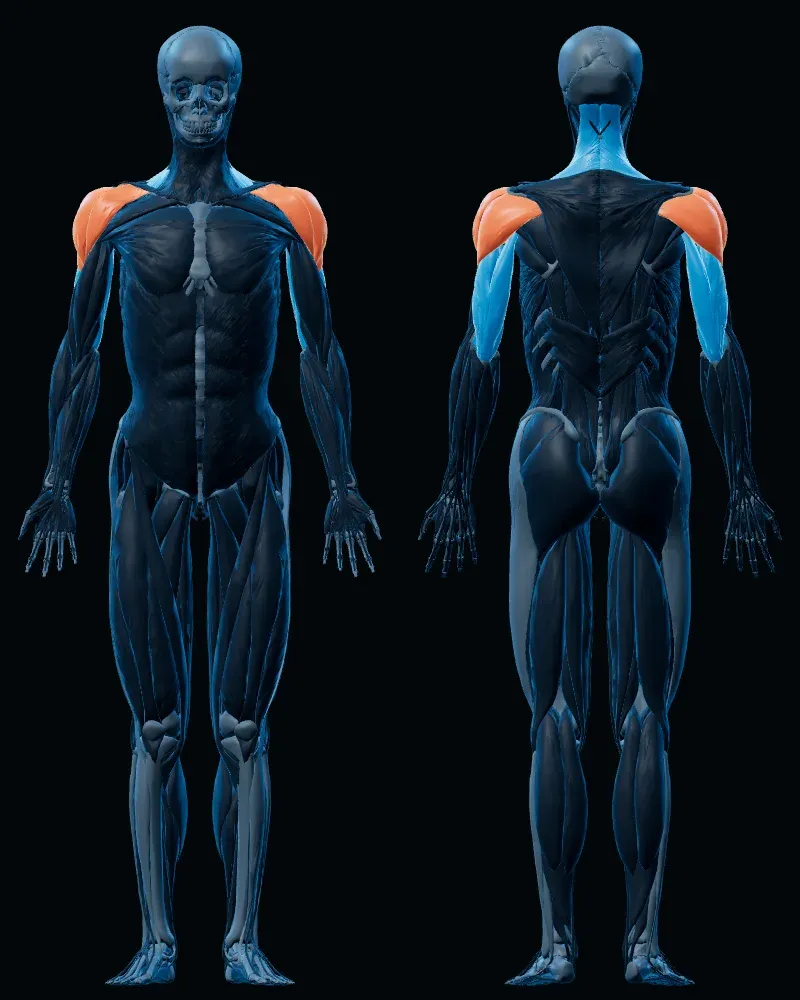
Muscles worked: shoulders
Main movers: all three heads of the deltoid
Assisting: supraspinatus, upper traps and triceps
Table of contents
Do Lu raises build more shoulder muscle than a normal lateral raise? Probably not. No hypertrophy trial has tested them, and the extra range above shoulder height shifts work toward the scapular muscles, away from the lateral deltoid you are trying to grow.
That does not make them useless. If you have seen Chinese weightlifters sweeping dumbbells all the way overhead and wondered whether to copy it, this article covers what the muscles do, what the research can and cannot say, and where the exercise fits. It sits inside our complete shoulder and delt training guide.
What is a Lu raise?
It is a lateral raise that does not stop at shoulder height. You keep lifting the arms out to the sides and up until the dumbbells meet or nearly meet overhead, then lower with control. The name comes from Lu Xiaojun, the Olympic weightlifter whose shoulder routines were widely shared online. Social media popularity is not evidence, so we will check the biomechanics instead.
Think of it as a lateral raise plus a scapular drill glued onto the end. Those are two different jobs.
How does the shoulder blade handle the overhead part?
Raising your arm is not just the upper arm bone moving. The shoulder blade has to rotate upward at the same time, a pairing called scapulohumeral rhythm. In 18 healthy young volunteers raising an arm in the scapular plane, average maximum arm elevation was about 130° with about 32° of scapular upward rotation (Yoshizaki et al., 2009). A fluoroscopy study of 10 healthy men found the scapula rotated more upward during active than passive elevation, with the clearest difference between 45° and 90° (Lee et al., 2020).
These are small samples of young, healthy people. They show the pairing exists, not that every lifter moves the same way.
Does the lateral deltoid stop working above 90 degrees?
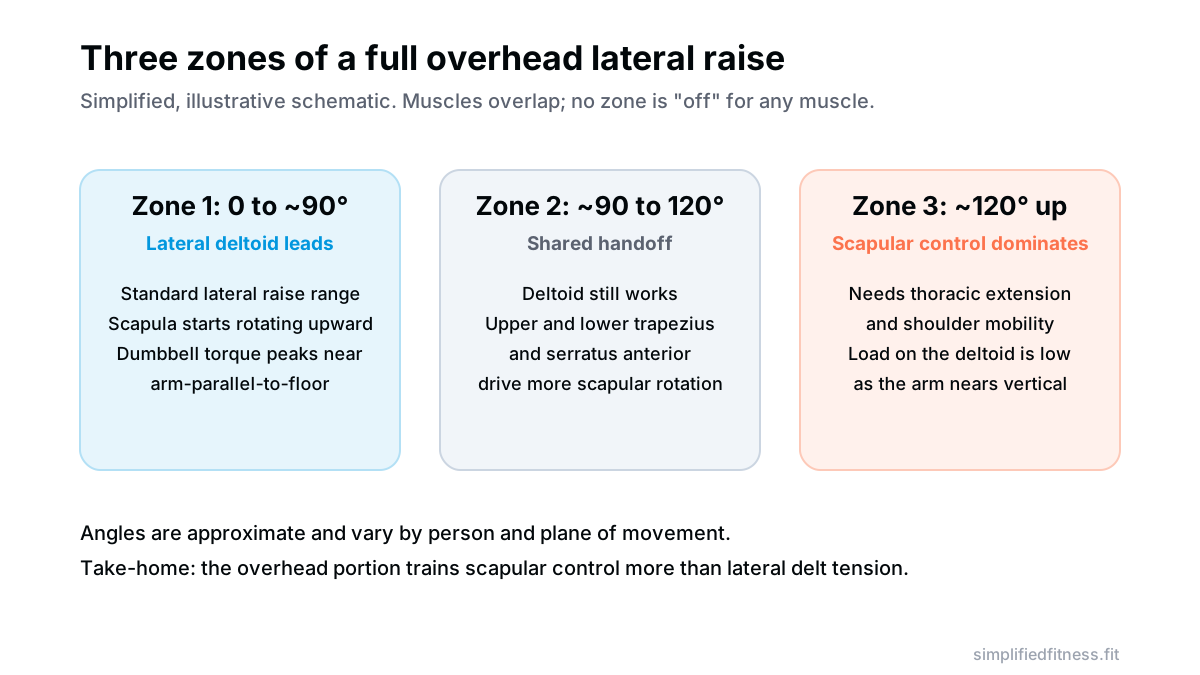
No, and this is where the popular version of the story gets too neat. You will see “the delt hands off to the traps at 90°” repeated online. The real picture is a gradual shift.
In a study that recorded EMG every 15° up to 120° of abduction, middle deltoid, serratus anterior and all three parts of the trapezius were recorded at every step (Contemori et al., 2019). The abstract does not describe a clean switch at 90°. What it shows is how sensitive the pattern is to technique: abducting with the scapula protracted or elevated raised upper trapezius and middle deltoid activity and lowered middle and lower trapezius and, with elevation, serratus activity.
So the practical read is this. Above shoulder height the trapezius and serratus carry a larger share of the scapular rotation, and the deltoid’s mechanical situation changes as the arm nears vertical. Our deltoid anatomy article covers how the three heads differ, and the trapezius anatomy guide covers the three trap regions.
Trapezius vs deltoid: what changes when you go overhead?
Three scapular muscles matter here. The upper trapezius elevates and helps rotate the blade upward. The lower trapezius pulls it down and in, helping rotate it. The serratus anterior wraps around the ribcage and drives upward rotation and keeps the blade against the chest wall (more in our serratus anterior guide).
Some specifics from small lab studies:
- Bending the elbow during shoulder flexion increased scapular upward rotation, mainly through more serratus activation and less upper trap, in 22 healthy people (Rabin et al., 2022).
- Humerus rotation changes the picture during a normal lateral raise. In 10 competitive bodybuilders, a neutral upper-arm position gave greater middle deltoid activity than an externally rotated one, while internal rotation raised upper trapezius activity (Coratella et al., 2020).
The takeaway: small changes in arm position and shoulder-blade control change which muscle is working. In the gym, this looks like shrugging the dumbbells up at the top, which tells you the upper traps have taken over.
Does a bigger range of motion build more muscle?
Sometimes, but not reliably for the upper body. A 2021 meta-analysis of 16 studies found full range of motion beat partial range for strength (ES 0.56) and lower-limb hypertrophy (ES 0.88), while differences in muscle thickness, pennation angle and fascicle length were not significant (Pallarés et al., 2021). A 2020 review of six studies concluded that full ROM favoured lower-body growth, while upper-limb research was limited and conflicting (Schoenfeld and Grgic, 2020).
Then an 8-week trial in 30 resistance-trained people found lengthened partials and full ROM produced similar elbow flexor and extensor growth (Wolf et al., 2025). Why do they differ? Different muscles, different movements and small samples. The cautious takeaway: “full ROM” matters most when the extra range loads the target muscle. In a lateral raise, the top overhead range arguably does not load the lateral deltoid much, so more range is not obviously more stimulus. That reasoning is mine, not a trial result.

The tool matters less than people think. An 8-week trial in 24 trained lifters, with range of motion matched, found dumbbell and cable lateral raises both raised lateral deltoid thickness by about 3.3-4.6% with no meaningful difference (Larsen et al., 2025). We compare them in dumbbells vs cables vs machines.
Should you cap lateral raises at 90-100 degrees?
If your goal is side delt size, yes, that is a sensible default. You keep the tension where the lateral deltoid is doing most of the work, you avoid the trap-dominated top range, and you can train close to failure without losing form.
If your goal is shoulder control, mobility or overhead lifting, the full-range version has a place. Not as a delt builder. As a drill.
How to do a Lu raise properly
- Start much lighter than your lateral raise, such as 2-4 kg dumbbells. Heavy loads become shrugs.
- Stand tall, ribs down, with a soft elbow bend.
- Raise out to the sides, leading with the elbows, keeping the shoulders away from the ears.
- Continue past shoulder height only as far as you can without pinching or leaning back.
- Lower in about 2 seconds. Stop short of the very top if the shoulder blade stops moving smoothly.
Keep your standard 90-100° raises for the delt work. Our cross-body vs behind-the-back cable raises article covers another way to keep tension on the delt, and you can count weekly sets with the training volume calculator or slot them into a push day.
Common mistakes with overhead raises
Most lifters get three things wrong. First, they use their normal lateral raise dumbbell: a weight that works for a 90° raise becomes a shrug the moment it passes the ears. Second, they lean back to get the weights up, which swaps shoulder work for lower-back work. Third, they count the overhead sets as delt volume and then wonder why side delts are not growing.
A simple self-check helps. Film a set from the front. If your shoulders climb toward your ears before your arms reach shoulder height, the load is too heavy or the upper traps are taking over early. Drop the weight and slow the lift down.
Where this fits in a week of shoulder training
Keep the hard work simple: a couple of lateral raise sets to near failure on two days a week, plus your pressing. If you want the overhead drill, put it at the start as a warm-up or at the end as a light finisher. That way it never eats into the effort you need for the sets that actually grow the lateral deltoid. If you train at home with only a pair of light dumbbells, that is enough for this drill. Adjust sets by how your shoulders feel across the week, not by a fixed rule.
Who should be careful?
Overhead elevation is where shoulder problems tend to show up. In 52 construction workers with routine overhead exposure, those with impingement symptoms showed decreased scapular upward rotation, changes in scapular tipping, and decreased serratus anterior activity compared with those without symptoms (Ludewig et al., 2000). This study measured people, not exercises, so it cannot say that Lu raises cause or fix anything.
The bottom line
Lu raises are a lateral raise with a scapular drill attached. The lateral deltoid drives the first part, and the traps and serratus take a bigger share higher up, though the hand-off is gradual. For side delt growth, a 90-100° raise taken close to failure is the simple, evidence-consistent choice. For mobility and control, light overhead raises are reasonable, but they are unproven for muscle growth, so treat them as a bonus.
Frequently Asked Questions
What is a Lu raise?
A Lu raise is a dumbbell lateral raise that keeps going past shoulder height until the arms are overhead, named after Chinese Olympic weightlifter Lu Xiaojun, whose shoulder work went viral. It is a full-range version of the lateral raise rather than a separate muscle-building system. Treat it as a controlled, light shoulder drill and start much lighter than your normal lateral raise.
Do Lu raises build bigger shoulders?
There is no trial showing that Lu raises grow the deltoid more than standard lateral raises. The lateral deltoid does most of the work early in the lift, while scapular muscles share more of the load as the arm goes overhead. If side delt size is your goal, spend most of your effort on a 90-100° lateral raise taken close to failure.
Does the lateral deltoid work above 90 degrees?
Yes, it keeps contributing, but it is no longer the only story. EMG work that tracked abduction up to 120° recorded middle deltoid, trapezius and serratus activity together at every angle, and nothing in it describes a clean switch at 90°. Think of the upper range as shared work between the deltoid and the scapular muscles.
Which muscles rotate the scapula upward during a lateral raise?
The upper trapezius, lower trapezius and serratus anterior are the main scapular upward rotators. Their job is to turn the shoulder blade so the arm can elevate without jamming into the bone above it. Strengthening them with controlled overhead work is reasonable, though no study says it grows the delts.
Are Lu raises good for shoulder mobility?
They may help you practise reaching overhead with good scapular motion, but no trial has tested them for mobility gains. The movement asks for scapular upward rotation and thoracic extension, which is the same pattern an overhead lift needs. Use light weights and slow reps, and stop if you feel pinching.
How heavy should Lu raises be?
Much lighter than your normal lateral raise, often only a few kilograms. The top of the range is a mobility and control task, so heavy loads tend to turn it into a shrug. Choose a weight you can lift and lower in about 2 seconds each way without leaning.
Are Lu raises safe for shoulder impingement?
Not automatically. People with impingement symptoms show altered scapular motion and reduced serratus anterior activity during overhead elevation, and a painful arc is a sign to stop. If overhead raising hurts, see a physiotherapist or doctor before continuing.
Should I use full range of motion on lateral raises?
Full range generally helps, but evidence for upper-body exercises is limited and mixed. A meta-analysis favoured full ROM for strength and lower-limb growth, while upper-limb data is thin. For lateral raises, a range that keeps tension on the deltoid, about 90-100°, is a sensible default.
Do lateral raises need to go above shoulder height?
Not for delt growth. Past roughly shoulder height the arm moves closer to vertical, so the load on the deltoid drops and the trapezius gets more involved. You can stop at about 90-100° and still train the lateral deltoid hard.
Can Lu raises replace overhead presses?
No. A press loads the delts and triceps with much heavier weights, while Lu raises are a light control drill. They can complement pressing, not replace it. Keep your overhead press and use raises for the extra shoulder work.
Why do my traps take over on lateral raises?
Raising the shoulder blades as the arm lifts shifts work to the upper trapezius. Research on shoulder abduction found that adding scapular elevation raised upper trapezius and middle deltoid activity and lowered serratus and lower trapezius activity. Keep the shoulders down, lighten the load and lead with the elbows.
How often should I do overhead lateral raises?
As a light drill, a couple of sets two or three times a week is plenty, but this is a practical suggestion rather than a tested dose. Count your delt volume separately, using the training volume calculator if you want a number. Back off if your shoulders feel irritated.
Sources & References
Every claim above is checked against peer-reviewed research (PubMed, U.S. National Library of Medicine) or guidance from established health bodies. How we fact-check.
- Contemori S, et al. Effects of scapular retraction/protraction position and scapular elevation on shoulder girdle muscle activity during glenohumeral abduction. Hum Mov Sci. 2019. PMID: 30660072
- Yoshizaki K, et al. Analysis of the scapulohumeral rhythm and electromyography of the shoulder muscles during elevation and lowering: comparison of dominant and nondominant shoulders. J Shoulder Elbow Surg. 2009. PMID: 19427233
- Lee B, et al. Three-dimensional in vivo scapular kinematics and scapulohumeral rhythm: a comparison between active and passive motion. J Shoulder Elbow Surg. 2020. PMID: 31401125
- Ludewig PM, et al. Alterations in shoulder kinematics and associated muscle activity in people with symptoms of shoulder impingement. Phys Ther. 2000. PMID: 10696154
- Rabin A, et al. Bending the elbow during shoulder flexion facilitates greater scapular upward rotation and a more favorable scapular muscle activation pattern. J Sport Rehabil. 2022. PMID: 34689121
- Pallares JG, et al. Effects of range of motion on resistance training adaptations: a systematic review and meta-analysis. Scand J Med Sci Sports. 2021. PMID: 34170576
- Schoenfeld BJ, et al. Effects of range of motion on muscle development during resistance training interventions: a systematic review. SAGE Open Med. 2020. PMID: 32030125
- Wolf M, et al. Lengthened partial repetitions elicit similar muscular adaptations as full range of motion repetitions during resistance training in trained individuals. PeerJ. 2025. PMID: 39959841
- Coratella G, et al. An electromyographic analysis of lateral raise variations and frontal raise in competitive bodybuilders. Int J Environ Res Public Health. 2020. PMID: 32824894
- Larsen S, et al. Dumbbell versus cable lateral raises for lateral deltoid hypertrophy: an experimental study. Front Physiol. 2025. PMID: 40692697

Umair Hazrami · Founder & Head Coach, Simplified Fitness
Umair Hazrami founded Simplified Fitness and the Simplified Lifter channel to cut through fitness noise. With 4+ years of consistent training and 10+ coaching clients, he writes every guide from the peer-reviewed research and links the sources so you can check them. Our editorial standards.
Educational content only, not medical advice. If you have a medical condition, are pregnant, or take medication, talk to a qualified doctor before changing your diet, supplements or training. Full disclaimer.
Keep reading
Exercise Technique
3D Shoulder Protocol: Weekly Volume, Frequency (2-3x/Week) and Rep Ranges
How to build 3D shoulders: how many weekly sets, how often to train side and rear delts, and which rep ranges to use, with an 8-week plan and the research.
8 min read

Exercise Technique
Are Front Raises Necessary? Why Bench Pressers Rarely Need Direct Front Delt Work
Are front raises necessary if you bench and overhead press? See what EMG and volume research says, when they can still help, and where to spend those sets.
8 min read

Exercise Technique
Behind-the-Neck Press: Shoulder Mobility, Neck Safety and Muscle Bias
Behind the neck press safety explained: who has the shoulder mobility for it, what EMG studies show for delts, and which swaps work if you do not.
10 min read
Exercise Technique
Cable Lateral Raises: Behind-the-Back vs Cross-Body Setup, Which Is Better?
Cable lateral raise behind the back vs in front: what the research says, which setup suits most lifters, and a step-by-step guide to pulley height and cuffs.
9 min read