The Sliding Filament Theory and Length-Tension Curve: Cross-Bridge Overlap Physics
The length tension curve in resistance training explains why deep positions feel weak. See how sarcomere overlap works and how to match exercises to it.
TL;DR. The short answer
- A muscle makes the most active force at a middle length where actin and myosin overlap well, and less at very short or very long lengths. This is the length-tension relationship.
- At long lengths, fewer cross-bridges can attach, but passive tension from the protein titin and connective tissue adds force, so a stretched muscle still bears load.
- A position can feel weak because of filament overlap, joint moment arm, the resistance profile of the exercise, or all three. The curve alone does not decide how hard a rep feels.
- Basic physiology is solid. The jump from curve shape to 'best exercise for growth' is not proven, but several trials suggest training at longer muscle lengths grows muscle at least as well.
- Practical use: pick exercises that load the muscle hard in its stretched half, and do not skip the strong middle of the range.
Part of our complete guide: Muscle Length, Range of Motion and Stretch-Mediated Hypertrophy: What the Research Actually Shows
Table of contents
The length tension curve in resistance training describes one simple fact: a muscle can produce the most active force at a middle length, and less when it is very short or very stretched. The reason is the overlap between actin and myosin filaments inside each sarcomere, which sets how many cross-bridges can pull at once.
That is the physics. What it means for your program is more nuanced, and that is what this article covers. It sits inside our wider guide to range of motion and stretch-mediated hypertrophy, but here we stay at the cellular level and then climb back up to the gym floor.
How does the sliding filament theory work?
A muscle fibre is a stack of tiny repeating units called sarcomeres. Inside each one, thin actin filaments and thick myosin filaments sit side by side. Myosin heads reach out, grab actin, pull, let go, and grab again. That is a cross-bridge cycle.
When the muscle shortens, the filaments slide past each other. They do not shrink. The sarcomere shortens because the overlap changes.
More cross-bridges attached means more force. So the question becomes: at which sarcomere lengths can the most heads reach actin? That is the length-tension relationship.
What is the length-tension curve, and what shapes it?
Picture an upside-down U with a flat top.
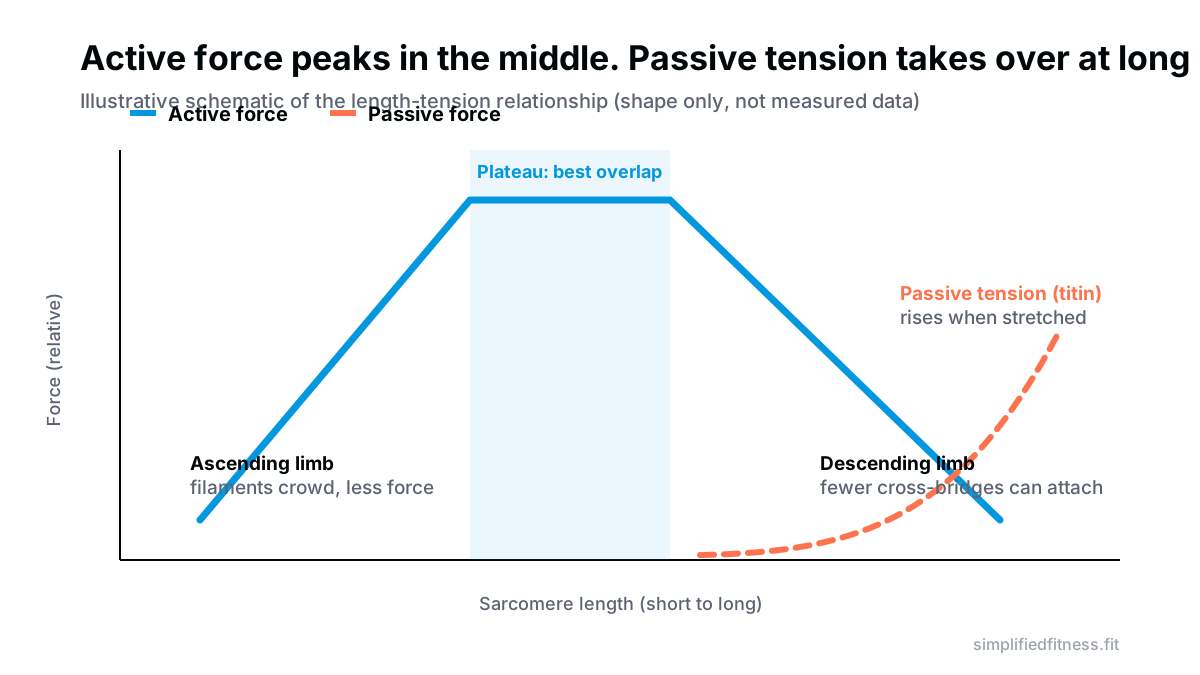
- Ascending limb (short lengths): active force falls as the sarcomere gets very short. The textbook explanation is that filaments crowd and interfere with each other. In frog fibres, tension measured at sarcomere lengths between about 2.2 and 1.3 micrometres fell off at the short end (Moss, 1979). That paper also tested whether calcium release explains the drop and concluded its results did not support calcium as a major cause below about 2.0 micrometres. So the mechanism is still more than a one-line story.
- Plateau (middle lengths): the best overlap of actin and myosin. This is where the 2.0-2.2 micrometre figure usually comes from.
- Descending limb (long lengths): as sarcomeres stretch past the optimum, overlap shrinks and fewer heads can reach actin. In skinned frog fibres tension always fell when sarcomere length went above about 2.2 micrometres (Julian & Moss, 1980).
What does titin do when a muscle is stretched?
Active force is only half the picture. Titin is a spring-like protein that spans the sarcomere, and a review describes its accepted roles as passive force production and stabilising sarcomeres (Herzog, 2018). The same review notes that other proposed roles, such as helping with residual force enhancement, are still controversial.
So on the descending limb, active force from cross-bridges drops while passive tension from titin and connective tissue climbs (the orange line in Figure 1). Total resistance in a deep stretch is a blend of both. A loaded stretch is not “dead”. It is just a different mechanical situation.
Why do shortened positions feel weak?
Here is where gym talk gets sloppy. “The squeeze at the top of a lateral raise feels weak, so the muscle must be on the ascending limb.” Maybe. But there are at least three separate things going on.
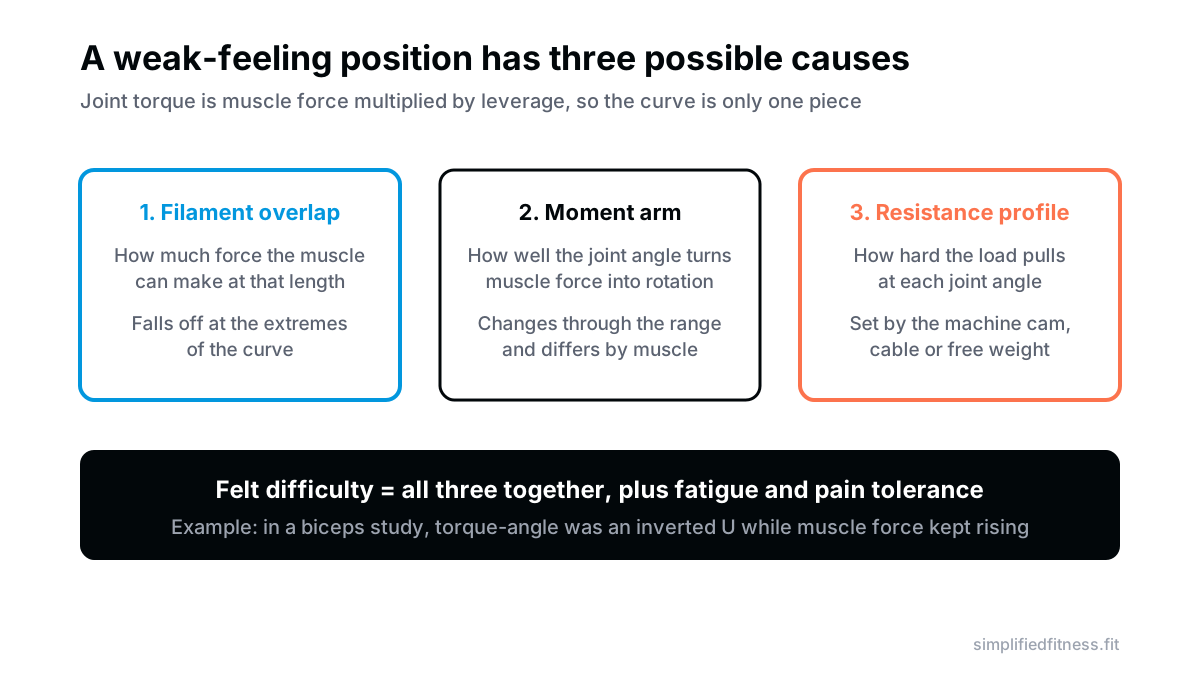
- Filament overlap: the curve itself.
- Moment arm: joint torque is muscle force times moment arm. A position with a poor moment arm feels weak even if the muscle can still produce good force.
- Resistance profile: the load itself pulls harder at some joint angles than others. Our guide to matching resistance profiles to human strength curves covers machine cams and cables in detail.
A human biceps study shows why you cannot read the curve off how a lift feels. In eight subjects, elbow torque followed a classic inverted U across joint angles, but the biceps force-length relationship itself increased steadily across the tested range (Leedham & Dowling, 1995). Torque and muscle force are not the same thing.
The hamstrings are another example. A narrative review concluded that in daily tasks like walking the hamstrings appear to operate on the ascending limb of their force-length relation, and that knee flexion exercises performed with hip angles of 45-90 degrees promote more optimal force generation (Kellis & Blazevich, 2022). That is a modelling-heavy review with caveats about its measurement tools, so treat it as a lead rather than a rule.
Does the curve predict muscle growth?
This is where most articles overreach. Curve physics tells you about force at a given length. It does not directly tell you which range grows the most muscle.
What the training studies show is a mixed but interesting picture:
- A meta-analysis of 16 studies found full range of motion beat partial range for strength (effect size 0.56) and lower-limb hypertrophy (0.88), while muscle thickness, pennation angle and fascicle length showed no significant difference (Pallarés et al., 2021).
- In 30 resistance-trained people, 8 weeks of lengthened partials grew the elbow flexors and extensors about as much as full range, with moderate evidence for no difference (Wolf et al., 2025). The authors suggest emphasising the stretched position, whether through full range or partials.
- In 42 young women doing calf raises, training only the stretched half grew the medial gastrocnemius by 15.2%, versus 6.7% for full range and 3.4% for the shortened half (Kassiano et al., 2023).
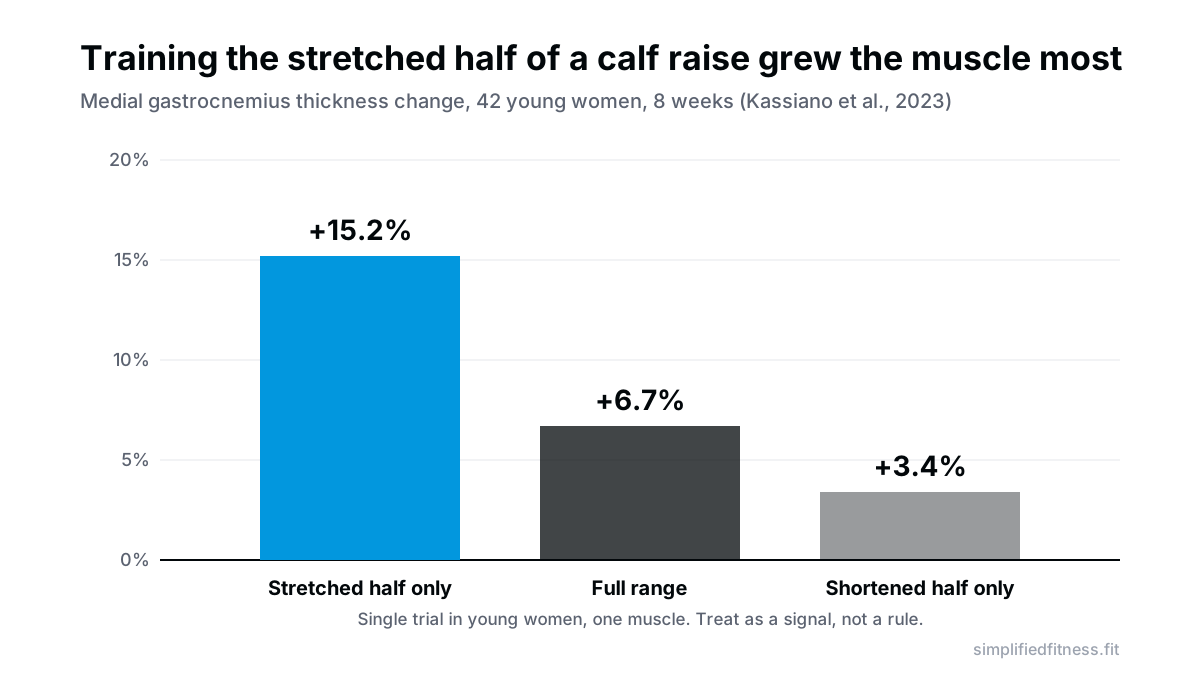
Why might these differ? Different muscles, different joints, different exercises, trained versus untrained participants, and short 8-week durations. Note the calf trial used young women, and the partials trial used resistance-trained participants. Neither tells you what happens over years.
One more caution. These results do not prove the curve is the cause. Longer muscle lengths also mean more passive tension and more stretch under load, and sarcomere addition in series is a separate idea. A 2025 review concluded that high forces at long fibre lengths seem to be the key trigger for adding sarcomeres in animals, and that too few human studies exist to say whether eccentric exercise does it in people (Blazevich et al., 2025). For the detail, see our articles on stretch-mediated hypertrophy and sarcomerogenesis and long muscle length training.
How should you use this when picking exercises?
Cautious, practical takeaways:
| Position in the rep | What the physics says | What to do |
|---|---|---|
| Stretched, loaded | Less active force, more passive tension | Include it and control it. Do not bounce out of the bottom. |
| Middle | Best overlap, strongest | Keep full range so you get this too |
| Very shortened | Lower force, different feel | Fine as a finisher, not the whole set |
A few specifics:
- Prefer exercises that load the stretched position. Overhead triceps work, incline curls, deep leg presses and Romanian-style hip hinges all put a heavy load on a lengthened muscle.
- Keep full range for most lifts. The evidence is clearest for the lower body, per a systematic review of six studies concluding full range is better for lower-body hypertrophy and that upper-body evidence is limited and conflicting (Schoenfeld & Grgic, 2020).
- Use lengthened partials as an add-on. Our lengthened partials guide explains how to add them safely at the end of a set.
- Check biarticular muscles. Muscles crossing two joints can be placed long or short by the other joint. See active vs passive insufficiency for how to use that.
- Calves deserve their own thought. Straight-knee and bent-knee versions change which calf muscle is stretched, covered in straight-leg vs bent-knee calf raises.
What about the Indian gym context?
Most commercial gyms in India have a decent mix of plate-loaded machines, cable stacks and dumbbells. That is enough. A seated leg curl, a cable overhead triceps extension and an incline dumbbell curl give you stretched-position work without fancy equipment. If you train at home with just dumbbells and a bench, an incline curl and an overhead dumbbell extension cover the same idea.
None of this replaces getting the basics right: enough weekly hard sets, progressive overload and enough protein from dal, paneer, curd, soya, eggs or whatever fits your diet. A large meta-analysis found that, on average, gains in lean mass stopped improving beyond about 1.6 g of protein per kg of body weight daily (Morton et al., 2018). If you have kidney disease, check your protein target with a doctor. If you want to gauge your volume, our training volume calculator helps, and the leg day plan shows stretched-position leg exercises in a full session.
What should you take away?
- The length-tension curve is solid physiology: active force depends on sarcomere length because filament overlap decides how many cross-bridges can attach.
- At long lengths, passive structures like titin add tension, so a loaded stretch still counts.
- A weak-feeling position has several possible causes, so do not blame the curve alone.
- The step from physics to “best for growth” is not proven, but trials so far suggest stretched-position training holds up well, at least in the muscles studied.
- Choose exercises that load the stretched half, keep most lifts full range, and let everything else (volume, effort, protein, sleep) do its job.
If you have joint pain, a previous tendon injury, or any condition that limits your range of motion, speak to a doctor or physiotherapist before you push loaded stretches.
Frequently Asked Questions
What is the length-tension curve in simple terms?
It is the relationship between how long a muscle's sarcomeres are and how much active force they can produce. Force is highest at a middle length with good actin-myosin overlap and drops at very short and very long lengths. In the gym, it is one reason the very top and very bottom of some lifts feel different from the middle.
What is the sliding filament theory?
It says muscles shorten when thin actin filaments slide past thick myosin filaments, pulled by myosin heads attaching and detaching as cross-bridges. The filaments themselves do not change length. Force depends on how many cross-bridges can attach at once, which is why sarcomere length matters.
Why does a muscle make less force when it is very short?
The textbook explanation is that filaments crowd and overlap in ways that interfere with cross-bridge formation. Studies on frog muscle fibres confirm that tension falls at short sarcomere lengths, though the exact causes are still debated in the literature. Practically, expect less force and a different feel in a hard squeeze at the very end of a rep.
Why does a muscle make less active force when it is stretched a lot?
As sarcomeres lengthen past the optimum, the thin and thick filaments overlap less, so fewer myosin heads can reach actin. Frog fibre work shows tension declining above roughly 2.2 micrometres of sarcomere length. Passive structures like titin start bearing load in this zone, so a deep stretch under load is not 'weak', just a different mix of forces.
What is the optimal sarcomere length in humans?
The classic 2.0-2.2 micrometre figure comes from frog fibres, and human values differ because filament lengths differ across species. Human gracilis sarcomeres have been measured at 3.24-3.63 micrometres on the descending limb during surgery. For lifting, the exact number does not matter, since you cannot measure your own sarcomere length in the gym.
Does the length-tension curve explain why lengthened partials work?
It might partly, but it is not the only explanation. Trials in trained people found lengthened partials produced similar growth to full range for upper body, and longer muscle lengths seem to matter. The curve is a plausible piece, with mechanical tension at long length, not a proven cause.
Is a muscle weakest at the bottom or the top of a rep?
It depends on the muscle, the joint and the exercise. Joint torque equals muscle force times moment arm, and in a biceps study torque followed an inverted U while the muscle's own force kept rising across the tested range. Judge each lift by feel and load, not by the curve alone.
What is titin and why does it matter for lifting?
Titin is a spring-like protein spanning the sarcomere that produces passive force when the muscle is stretched. Reviews describe its role in passive force and sarcomere stability, with some roles still debated. It helps explain why a loaded stretch carries tension even when active cross-bridge force is lower.
Should I train only in the stretched position?
No. Reviews show full range of motion builds lower-body muscle better than partial range, and for the upper body evidence is mixed. Emphasise the stretched position, but keep a full range for most lifts. Use lengthened partials as an add-on at the end of sets, not a replacement.
Do machines and cables change where an exercise feels hard?
Yes. Cams and cables change the resistance at each joint angle, so you can match the hardest part of the lift to a position where the muscle can produce strong force or deliver stretch. Free weights follow gravity and the lever arm instead. See our guide to resistance profiles for the details.
Does sarcomere physics matter for beginners?
Not much. A beginner gets most results from consistent training, enough protein, progressive overload and a full, controlled range. Treat curve physics as a refinement for exercise selection after the basics are in place.
Can stretching under load make you add sarcomeres?
Animal studies suggest high forces at long fibre lengths are the key trigger for adding sarcomeres in series. A 2025 review found too few human studies to conclude anything about eccentric training, so the idea is plausible but unproven in people. The practical advice is the same, load the stretched position well and stay patient.
Sources & References
Every claim above is checked against peer-reviewed research (PubMed, U.S. National Library of Medicine) or guidance from established health bodies. How we fact-check.
- Moss RL. Sarcomere length-tension relations of frog skinned muscle fibres during calcium activation at short lengths. J Physiol. 1979. PMID: 314975
- Julian FJ, et al. Sarcomere length-tension relations of frog skinned muscle fibres at lengths above the optimum. J Physiol. 1980. PMID: 6969305
- Persad LS, et al. In vivo human gracilis whole-muscle passive stress-sarcomere strain relationship. J Exp Biol. 2021. PMID: 34355750
- Herzog W. The multiple roles of titin in muscle contraction and force production. Biophys Rev. 2018. PMID: 29353351
- Leedham JS, et al. Force-length, torque-angle and EMG-joint angle relationships of the human in vivo biceps brachii. Eur J Appl Physiol Occup Physiol. 1995. PMID: 7671877
- Kellis E, et al. Hamstrings force-length relationships and their implications for angle-specific joint torques: a narrative review. BMC Sports Sci Med Rehabil. 2022. PMID: 36064431
- Wolf M, et al. Lengthened partial repetitions elicit similar muscular adaptations as full range of motion repetitions during resistance training in trained individuals. PeerJ. 2025. PMID: 39959841
- Kassiano W, et al. Greater gastrocnemius muscle hypertrophy after partial range of motion training performed at long muscle lengths. J Strength Cond Res. 2023. PMID: 37015016
- Pallares JG, et al. Effects of range of motion on resistance training adaptations: a systematic review and meta-analysis. Scand J Med Sci Sports. 2021. PMID: 34170576
- Blazevich AJ, et al. Triggering sarcomerogenesis: examining key stimuli and the role attributed to eccentric training. J Sport Health Sci. 2025. PMID: 40623648
- Schoenfeld BJ, Grgic J. Effects of range of motion on muscle development during resistance training interventions: a systematic review. SAGE Open Med. 2020. PMID: 32030125
- Morton RW, et al. A systematic review, meta-analysis and meta-regression of the effect of protein supplementation on resistance training-induced gains in muscle mass and strength in healthy adults. Br J Sports Med. 2018. PMID: 28698222

Umair Hazrami · Founder & Head Coach, Simplified Fitness
Umair Hazrami founded Simplified Fitness and the Simplified Lifter channel to cut through fitness noise. With 4+ years of consistent training and 10+ coaching clients, he writes every guide from the peer-reviewed research and links the sources so you can check them. Our editorial standards.
Educational content only, not medical advice. If you have a medical condition, are pregnant, or take medication, talk to a qualified doctor before changing your diet, supplements or training. Full disclaimer.
Keep reading

Hypertrophy
Active vs Passive Insufficiency: How Two-Joint Muscles Change Your Exercise Choice
Active vs passive insufficiency explained for lifters: why hamstrings, triceps, quads and calves grow differently depending on your second joint position.
10 min read

Hypertrophy
Squat Mobility With Long Femurs: Adapting Range of Motion to Your Hips
Squat mobility with long femurs is mostly a lever and hip-socket issue, not a flaw. Learn how to adjust depth, stance and heels without risking your hips.
10 min read
Hypertrophy
Dumbbell Pullovers vs Cable Lat Pull-ins: Training Lats at Long Muscle Lengths
Training lats at long muscle lengths: is the dumbbell pullover a lat or chest exercise, and why a cable lat pull-in may keep tension where you want it.
7 min read
Hypertrophy
Full vs Partial Range of Motion: What the Hypertrophy Research Shows
Full vs partial ROM hypertrophy explained: what two meta-analyses and recent trials found, where lengthened partials fit, and how to set your range of motion.
8 min read