Is Shortened Overload Useless? What Peak Contraction Training Still Does
Is shortened overload useless? Not quite. See what the research says about pec deck and leg extension squeezes, and how to pair them with lengthened work.
TL;DR. The short answer
- Shortened overload is not useless. Exercises that peak at the squeeze, like the pec deck, still produce real muscle growth, but several head-to-head trials favour training at longer muscle lengths when everything else is matched.
- A 2025 meta-analysis of 12 studies in young adults found trivial differences in regional hypertrophy between longer and shorter mean muscle lengths, so the stretch advantage is smaller and more muscle-specific than social media suggests.
- The best-supported use of peak contraction work is as a supplement: put most of your hard sets in lengthened positions, then add squeeze-focused isolation for variety, extra low-fatigue volume and a better feel for the target muscle.
- Claims that squeeze exercises toughen tendons or give a unique stimulus that stretched work cannot are untested in the studies reviewed here, so pick these lifts for the volume they add, not for those promises.
Part of our complete guide: Muscle Length, Range of Motion and Stretch-Mediated Hypertrophy: What the Research Actually Shows
Table of contents
Is shortened overload useless? No. Exercises that load the muscle hardest at the squeeze still build muscle, but when researchers match everything else, training at longer muscle lengths often wins. The sensible answer is not “delete the pec deck.” It is “build the session around stretched work, then use squeeze exercises where they earn their place.”
This sits inside the bigger picture of range of motion and stretch-mediated hypertrophy. Here we look at the other side of the argument: the internet’s stretch-only trend, what it gets right, and where it overreaches.
What “shortened overload” actually means
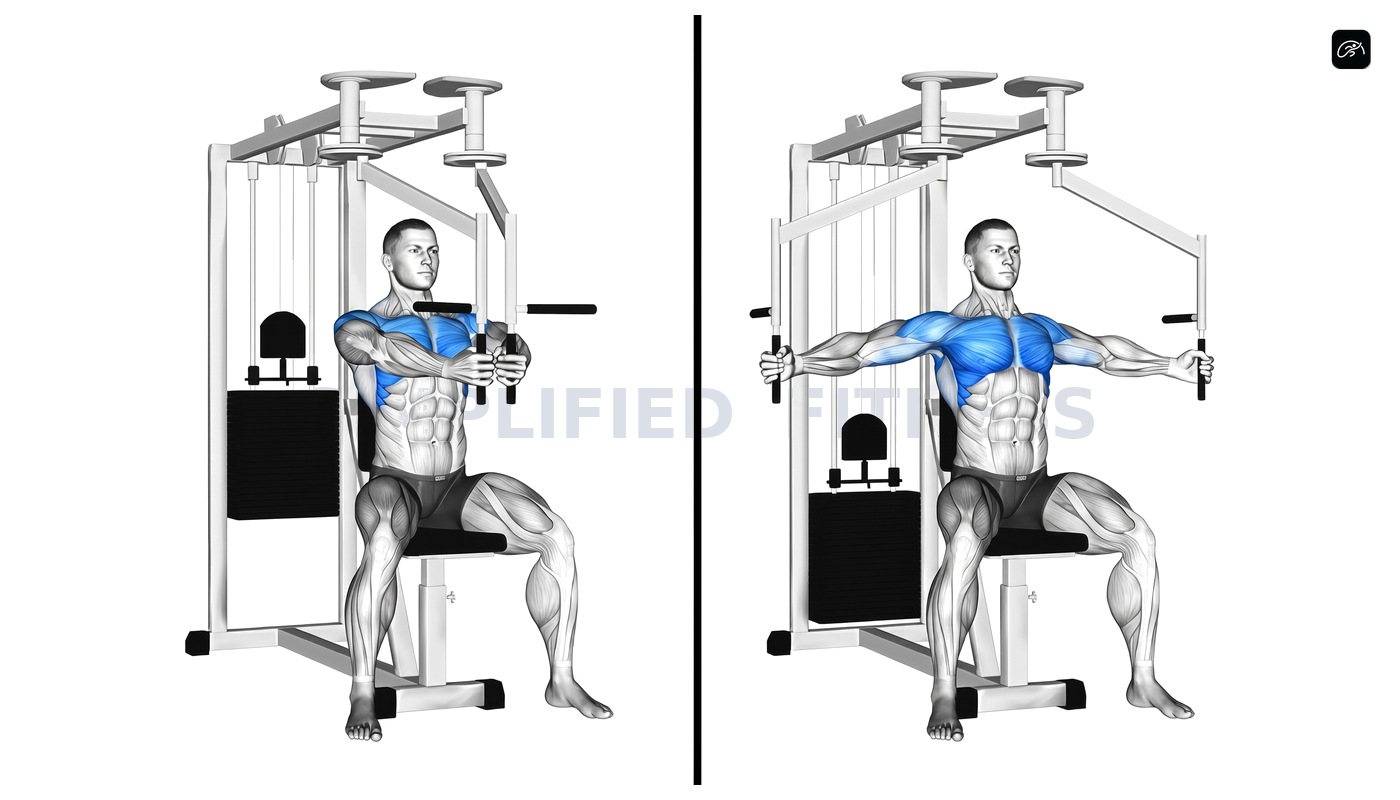
Every exercise has a resistance curve. On a preacher curl the hardest part is near the bottom, with the biceps stretched. On a pec deck fly the hardest part is near the end, when your arms come together and the chest is shortened.
- Lengthened overload: peak tension while the muscle is stretched (incline curls, overhead triceps work, deep leg press).
- Shortened overload: peak tension while the muscle is contracted (pec deck at the squeeze, top range of a leg extension, leg curl at full flexion).
Almost no exercise is purely one or the other. Cable setups, cam machines and joint angles shift where the hardest point sits, which is why it helps to check where a movement actually feels hardest before judging it.
Why the stretch-only trend took off
The trend has a real basis. Several controlled trials have found more growth from the longer-length version of an exercise.
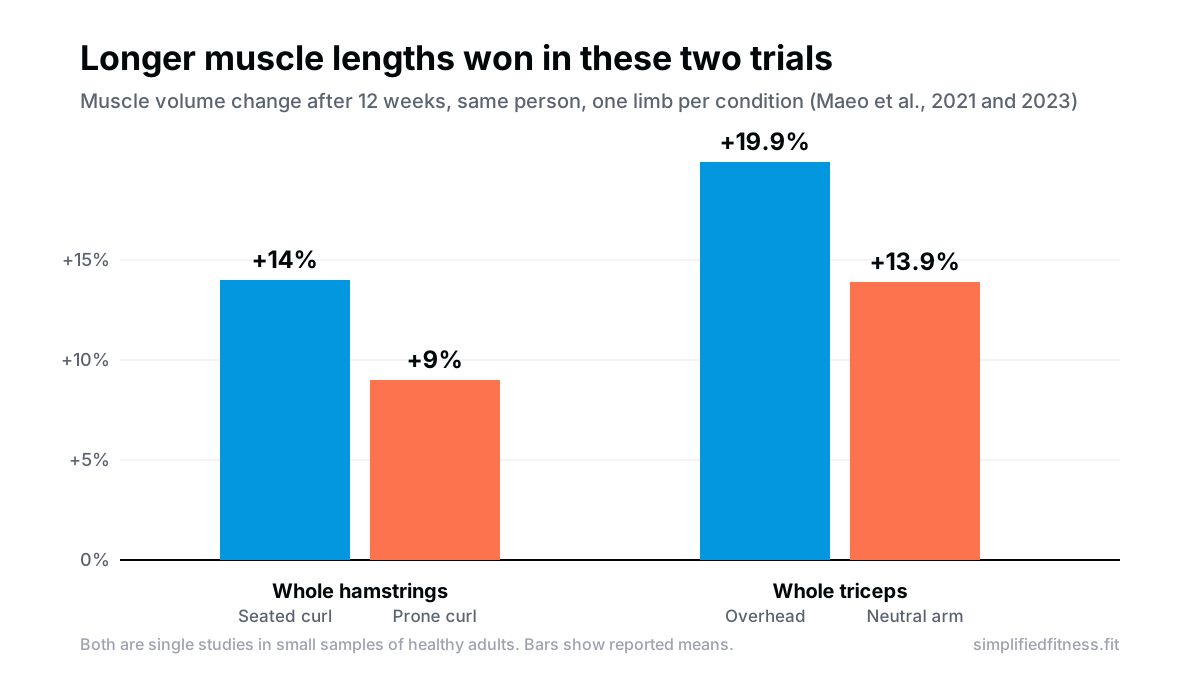
In a 12-week MRI study, seated leg curls (hamstrings stretched at the hip) grew the whole hamstrings by about 14%, versus about 9% for prone leg curls (Maeo et al., 2021). In another, 21 adults trained the triceps overhead on one arm and with a neutral arm on the other. Whole triceps volume rose 19.9% overhead versus 13.9% neutral, even though the overhead arm used 34-39% lighter loads (Maeo et al., 2023).
A 2023 systematic review of range-of-motion studies reached a similar direction. Training at longer lengths, through full or lengthened-partial reps, tended to give optimal growth in muscles such as the quadriceps, biceps and triceps, with some muscle-specific exceptions (Kassiano et al., 2023). If you want the full case for the stretch, read long muscle length training for hypertrophy and our guide to lengthened partials.
So is shortened overload useless?
This is where the trend overreaches. “Often better” is not “useless.”
Three pieces of evidence argue for nuance.
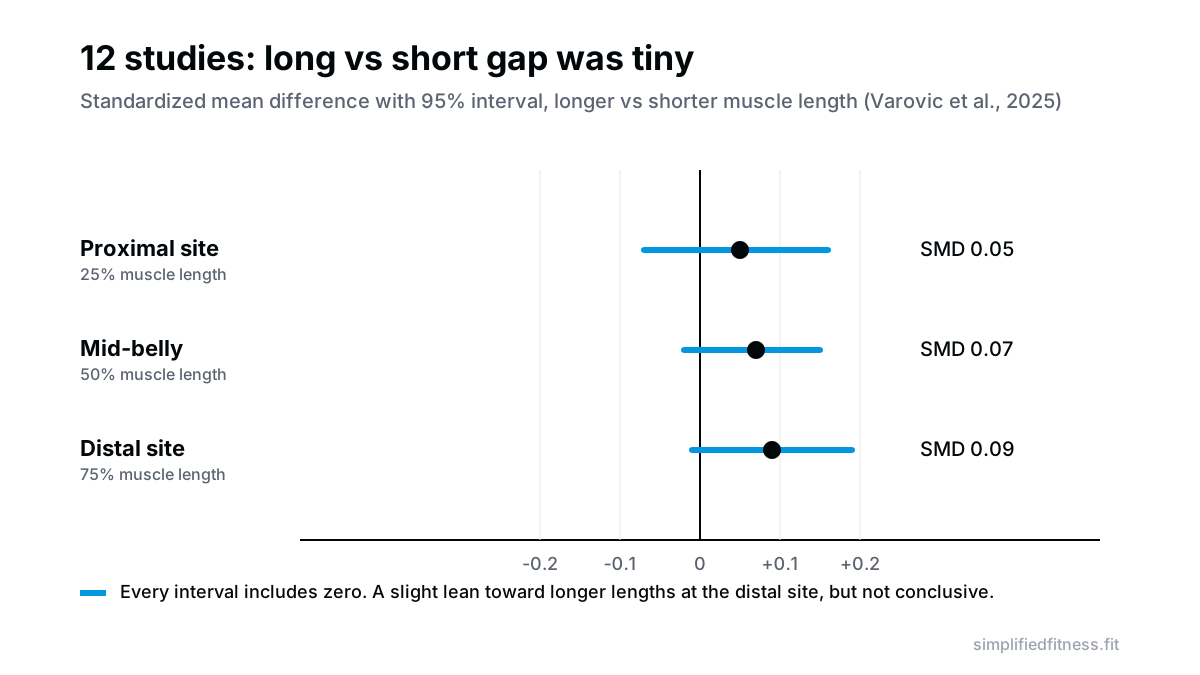
1. The meta-analysis is less dramatic than the headlines. A 2025 Bayesian meta-analysis of 12 studies in young adults compared regional hypertrophy at different mean muscle lengths. The differences were trivial at the proximal, mid-belly and distal sites (SMDs of 0.05, 0.07 and 0.09, all with intervals crossing zero), with a slight trend toward longer lengths at the distal end. The authors concluded that longer and shorter mean lengths produce similar hypertrophic effects, while warning that the length difference between conditions in the studies was small (about 22%) (Varovic et al., 2025).
2. Range-of-motion reviews are mixed outside a few muscles. A 2020 systematic review of six studies found full range of motion helped lower-body hypertrophy compared with partial, but upper-body evidence was limited and conflicting, and responses may be muscle-specific (Schoenfeld and Grgic, 2020). The 2023 review also found a few cases where a partial range in the middle or initial part beat full range, for example the triceps with mid-range partials (Kassiano et al., 2023). The stretch is not a universal switch.
3. Squeeze-style machines still grow muscle. In a 12-week trial of 15 untrained young men, the pec deck alone raised pectoralis major thickness by roughly 17% (clavicular) and 21% (sternocostal), with one set per session working as well as three (Pinto et al., 2025). These were beginners, so progress in advanced lifters would likely be slower. But it shows a classic peak contraction exercise is far from dead weight.
Where the evidence is weakest on stretch-only claims
A few details from the studies are worth knowing before you rewrite your whole program.
Region-specific results are small and patchy. In a 9-week trial of 38 recreationally trained women, preacher curls (peak tension stretched) increased muscle thickness at the distal 70% site of the upper arm, while incline curls did not significantly grow any measured region. But the study found no statistically significant differences between regions or between groups, so the authors’ conclusion about regional growth is more suggestive than settled (Zabaleta-Korta et al., 2023). More on that in our piece on incline versus preacher curls and on regional hypertrophy.
Most studies are short. Trials like these usually run 6-12 weeks, often in beginners or recreationally trained people. We do not know what happens over years in advanced lifters, where variety may matter more.
Measurement is limited. Many studies use ultrasound thickness at a few sites. That is useful, but it is not the whole muscle.
What peak contraction exercises can offer
If the stretch is not everything, what do squeeze exercises add? Some claims are well supported, some are plausible, and some are marketing.
Well supported: they grow muscle if you train them hard. As the pec deck trial shows, effort and volume still matter. A squeeze exercise taken near failure is a real hypertrophy stimulus.
Plausible: lower joint stress and lower fatigue. Machine isolation lifts let you push a muscle with less demand on balance, technique and spinal loading. That can make them easier to recover from and easier to add volume with. Direct research on injury reduction is limited, so treat this as practical coaching logic rather than a proven benefit.
Plausible but weakly tested: feel and focus. An 8-week study of 30 untrained men found that focusing on contracting the target muscle gave bigger elbow flexor growth (12.4% vs 6.9%) than focusing on the lift outcome, with similar quadriceps changes (Schoenfeld et al., 2018). Beginners, single study, so keep expectations modest. But exercises where you can feel the muscle working are the easiest place to use this cue.
Not established: tendon benefits and “unique neuromuscular stimulus.” You will see claims that squeeze work trains something stretched work cannot, or toughens tendons. In the studies I reviewed for this article, none tested these directly against stretched training. They may turn out to be true, but at the moment they are hypotheses. Do not pick an exercise because of them.
How to combine lengthened and shortened work
The practical goal is a session where most of the hard volume sits at longer lengths, with squeeze work as the supporting cast.
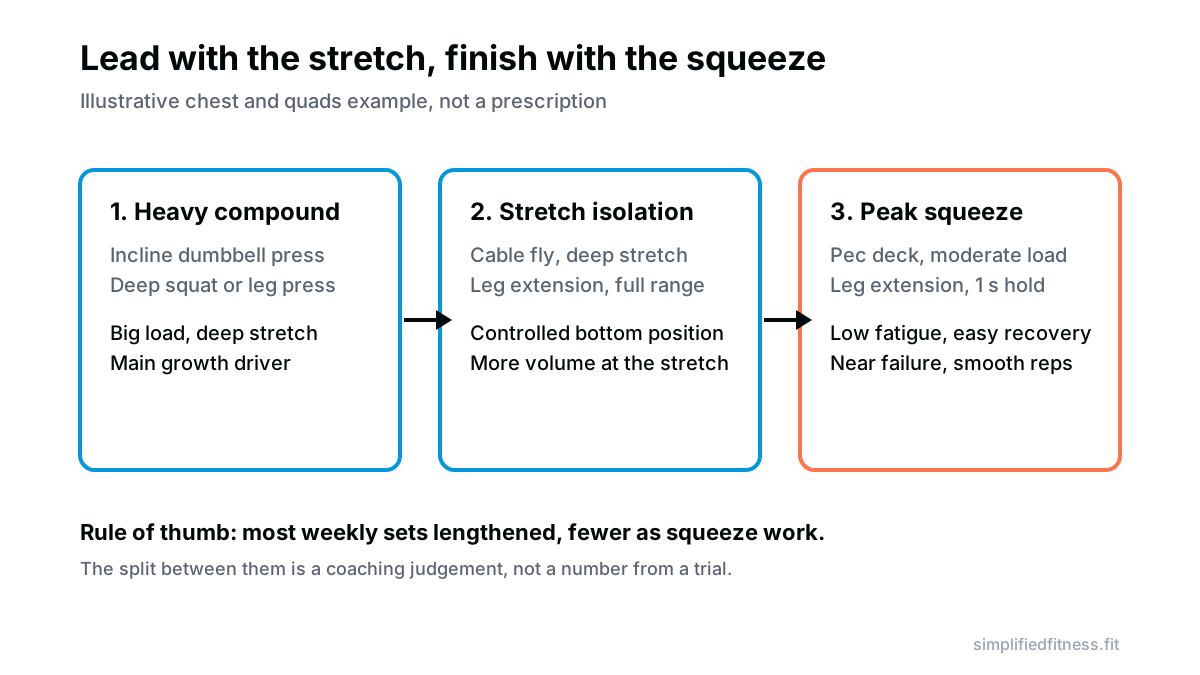
- Start with a heavy compound that stretches the target. Incline dumbbell press for chest, a deep squat or leg press for quads.
- Add an isolation that loads the stretch. A cable fly emphasising the bottom position, or a leg extension taken through its full range.
- Finish with a squeeze exercise. Pec deck for chest, a leg extension with a short pause at the top. Keep the load moderate and the reps smooth.
For a ready-made template to apply this to, see our free push day plan. If you want to check you are not stacking too many total sets, use the training volume calculator.
Turn pure squeezes into hybrids
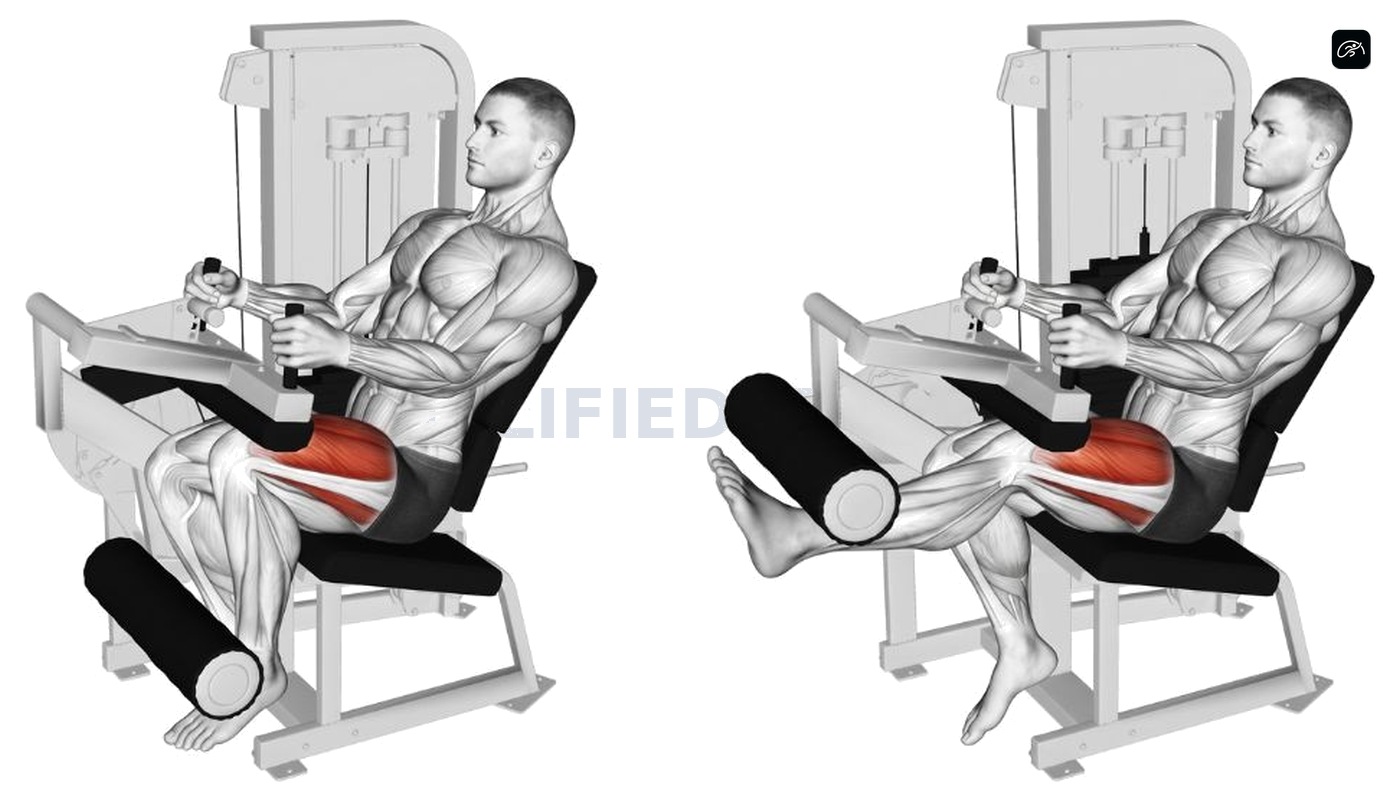
You do not have to choose. On a pec deck or leg extension, the lower half of the movement (the stretched end) is still part of the exercise.
- Lower the weight slowly for 2-3 seconds and let the muscle reach a comfortable stretch.
- Pause briefly in the stretch, then drive up.
- Add a one-second squeeze at the top if you like it.
That gives you stretched loading and a peak contraction in the same rep.
Cramps, burn and when to adjust
A cramp at the top of a leg curl or a hard burn at the squeeze is a common experience when a muscle is held tight near failure. The research on why this happens in training is thin, so the advice is practical. Slow down, shorten the hold, check your range, and make sure you are eating and drinking enough, especially if you train in hot weather. If cramps are frequent, severe, or come with swelling, weakness or dark urine, see a doctor.
A limited-equipment example
Many commercial gyms, including a lot of neighbourhood gyms in India, have one pec deck, one leg extension and a rack of dumbbells. A simple week could be incline dumbbell press and a cable or dumbbell fly with a deep stretch first, then the pec deck for two to three controlled sets. For legs, a leg press or squat to depth, then leg extensions with a full lowering phase. No special equipment needed.
Who should be cautious
- Knee pain: leg extensions load the knee in a way some people dislike. Try a shorter range, a lighter load or a different exercise, and see a physio if pain is persistent.
- Shoulder problems: very deep stretches in fly movements can bother some shoulders. Stay in a range that feels controlled.
- Beginners: you will make progress with almost any sensible setup, so consistency matters more than perfect exercise selection.
If a movement causes sharp, lingering or worsening pain, stop and speak to a doctor or physiotherapist.
The bottom line
Shortened overload is not useless, and stretch-only programming is not proven. The best current reading is that longer muscle lengths often give an edge in some muscles, the average difference across studies is small, and squeeze exercises still grow muscle when trained hard. Make stretched work the backbone, add peak contraction work as a supporting layer, and keep what you can do consistently. For more context, see the range of motion pillar and our guide to seated versus lying leg curls.
Frequently Asked Questions
Is shortened overload useless for muscle growth?
No, shortened-position exercises still build muscle. A 12-week pec deck study in untrained men saw pectoralis thickness rise by roughly 17-21%, and a 2025 meta-analysis found trivial differences in regional growth between longer and shorter muscle lengths. If you enjoy them, keep them, but do not let them replace your stretched, heavy work.
Should I stop doing pec deck flyes and leg extensions?
Not necessarily. Both are low-skill, low-fatigue isolation lifts that let you push a muscle close to failure with little risk, which makes them useful as accessories. Do them after your main compound lift and use a full, controlled stretch on the way down so they work as hybrids rather than pure squeezes.
Is training at long muscle lengths really better than short?
It often looks better, but not in every muscle. Seated versus prone leg curls grew the hamstrings more at the long length (+14% vs +9%), and overhead triceps work beat neutral-arm work, yet a 2025 meta-analysis found only trivial average differences in regional growth. Prioritise stretched positions where the evidence is strongest (hamstrings and triceps, with supportive data for quads and biceps) and do not abandon everything else.
Do squeeze exercises build muscle?
Yes, as long as the set is hard enough and you take it close to failure. Muscle growth responds to effort and total volume, and a squeeze exercise delivers those like any other. Use a load you can control for 8-15 smooth reps and stop one or two reps short of failure on most sets.
What is peak contraction training?
It means choosing exercises or techniques that make the muscle work hardest when it is fully shortened, for example a pec deck fly at the point where your hands meet. Resistance in these movements is often highest at the end of the range. The idea is to feel a strong contraction, although how much that matters for growth is still debated.
What is the difference between lengthened and shortened overload?
Lengthened overload puts the hardest resistance when the muscle is stretched, like the bottom of a preacher curl. Shortened overload puts it when the muscle is contracted, like the top of a cable curl. Most exercises can lean one way or the other, so check where the movement feels hardest.
Do pec deck flyes work the chest?
Yes. In a 12-week trial in untrained young men, the pec deck increased pectoralis major thickness (clavicular and sternocostal portions) by about 17-21%, and one set did as well as three. Because those were beginners, the same speed of growth should not be expected in advanced lifters.
Does the mind-muscle connection help hypertrophy?
Possibly, especially for single-joint exercises. In one 8-week study of untrained men, focusing on contracting the target muscle led to bigger elbow flexor growth than focusing on the lifting outcome (12.4% vs 6.9%), with similar quadriceps changes. It is a small, single study in beginners, so treat it as a useful cue and not a guarantee.
Is the mind-muscle connection worth chasing on heavy lifts?
Probably not on your heaviest compounds, where technique and load matter more. In the same study, quadriceps growth was similar with either focus, while the internal focus helped elbow flexor growth. That hints the cue matters more for small isolation lifts, so save it for curls, flyes and extensions.
Are squeeze exercises easier on the joints?
They can be. Pec deck and leg extension machines fix the path and let you use moderate loads, which many people find kinder on shoulders and knees than heavy free weights. Evidence on actual injury rates is limited, so if a movement hurts, change the range or the exercise and see a physio if the pain persists.
Can I build a good chest with only stretch-focused exercises?
You can probably get most of the way there, but there is little reason to be dogmatic. Studies suggest long-length training is at least as good as the alternatives, not that everything else fails. A mix of incline presses, stretched flyes and a pec deck finisher is easy to recover from and easy to stick to.
Why do my muscles cramp on leg extensions or leg curls?
Cramping near the fully shortened position is a common gym complaint, especially in the hamstrings on leg curls. There is no strong research on the cause in training, so try adjusting the range, slowing down, and making sure you are eating and drinking enough. If cramps are frequent, severe or come with swelling or dark urine, see a doctor.
How many peak contraction sets should I do per week?
There is no tested number. A practical starting point is two to four hard squeeze-focused sets per muscle per week, after your main stretched work, then adjust to how you recover. Use the training volume calculator to keep your total weekly sets in range.
Sources & References
Every claim above is checked against peer-reviewed research (PubMed, U.S. National Library of Medicine) or guidance from established health bodies. How we fact-check.
- Schoenfeld BJ, et al. Effects of range of motion on muscle development during resistance training interventions: A systematic review. SAGE Open Med. 2020. PMID: 32030125
- Varovic D, et al. Does Muscle Length Influence Regional Hypertrophy? A Systematic Review and Meta-Analysis. Int J Sports Med. 2025. PMID: 40570881
- Kassiano W, et al. Which ROMs Lead to Rome? A Systematic Review of the Effects of Range of Motion on Muscle Hypertrophy. J Strength Cond Res. 2023. PMID: 36662126
- Maeo S, et al. Greater Hamstrings Muscle Hypertrophy but Similar Damage Protection after Training at Long versus Short Muscle Lengths. Med Sci Sports Exerc. 2021. PMID: 33009197
- Maeo S, et al. Triceps brachii hypertrophy is substantially greater after elbow extension training performed in the overhead versus neutral arm position. Eur J Sport Sci. 2023. PMID: 35819335
- Zabaleta-Korta A, et al. Regional Hypertrophy: The Effect of Exercises at Long and Short Muscle Lengths in Recreationally Trained Women. J Hum Kinet. 2023. PMID: 37559762
- Pinto MD, et al. Pectoralis Clavicular and Sternocostal Thicknesses Increase Similarly in Response to One and Three Sets of Pec Deck Resistance Training in Untrained Young Men. J Strength Cond Res. 2025. PMID: 40266636
- Schoenfeld BJ, et al. Differential effects of attentional focus strategies during long-term resistance training. Eur J Sport Sci. 2018. PMID: 29533715

Umair Hazrami · Founder & Head Coach, Simplified Fitness
Umair Hazrami founded Simplified Fitness and the Simplified Lifter channel to cut through fitness noise. With 4+ years of consistent training and 10+ coaching clients, he writes every guide from the peer-reviewed research and links the sources so you can check them. Our editorial standards.
Educational content only, not medical advice. If you have a medical condition, are pregnant, or take medication, talk to a qualified doctor before changing your diet, supplements or training. Full disclaimer.
Keep reading
Hypertrophy
Active vs Passive Insufficiency: How Two-Joint Muscles Change Your Exercise Choice
Active vs passive insufficiency explained for lifters: why hamstrings, triceps, quads and calves grow differently depending on your second joint position.
10 min read
Hypertrophy
Squat Mobility With Long Femurs: Adapting Range of Motion to Your Hips
Squat mobility with long femurs is mostly a lever and hip-socket issue, not a flaw. Learn how to adjust depth, stance and heels without risking your hips.
10 min read
Hypertrophy
Dumbbell Pullovers vs Cable Lat Pull-ins: Training Lats at Long Muscle Lengths
Training lats at long muscle lengths: is the dumbbell pullover a lat or chest exercise, and why a cable lat pull-in may keep tension where you want it.
7 min read
Hypertrophy
Full vs Partial Range of Motion: What the Hypertrophy Research Shows
Full vs partial ROM hypertrophy explained: what two meta-analyses and recent trials found, where lengthened partials fit, and how to set your range of motion.
8 min read