Side-Lying Incline Lateral Raises: Fixing the Dumbbell Resistance Curve
The side lying lateral raise on an incline bench shifts the hardest point of a dumbbell raise toward the stretch. See the physics, setup and what research says.

TL;DR. The short answer
- A side lying lateral raise on a 30-45 degree bench tilts the arm's path, so the dumbbell is heaviest earlier in the lift (near the stretched position) instead of at the top. The geometry is simple physics, but no trial has tested this exact exercise yet.
- A standing dumbbell lateral raise is easiest at the bottom and hardest near 90 degrees, because gravity pulls straight down and the lever arm only grows as the arm rises.
- Dumbbells and cables grew the lateral deltoid by a similar amount in an 8-week trial of trained lifters (3.3-4.6% thicker), so the side-lying version is an option, not a requirement.
- Use a light dumbbell (often 3-8 kg is plenty), keep the shoulder blade down, lower for 2-3 seconds, and stop before your neck takes over.
- Any sharp shoulder pain, numbness or pain that lingers after training is a reason to see a doctor or physiotherapist, not to push through.
Part of our complete guide: Complete Shoulder, Delt & Neck Training Guide: 3D Deltoid Anatomy, Rotator Cuff & Traps
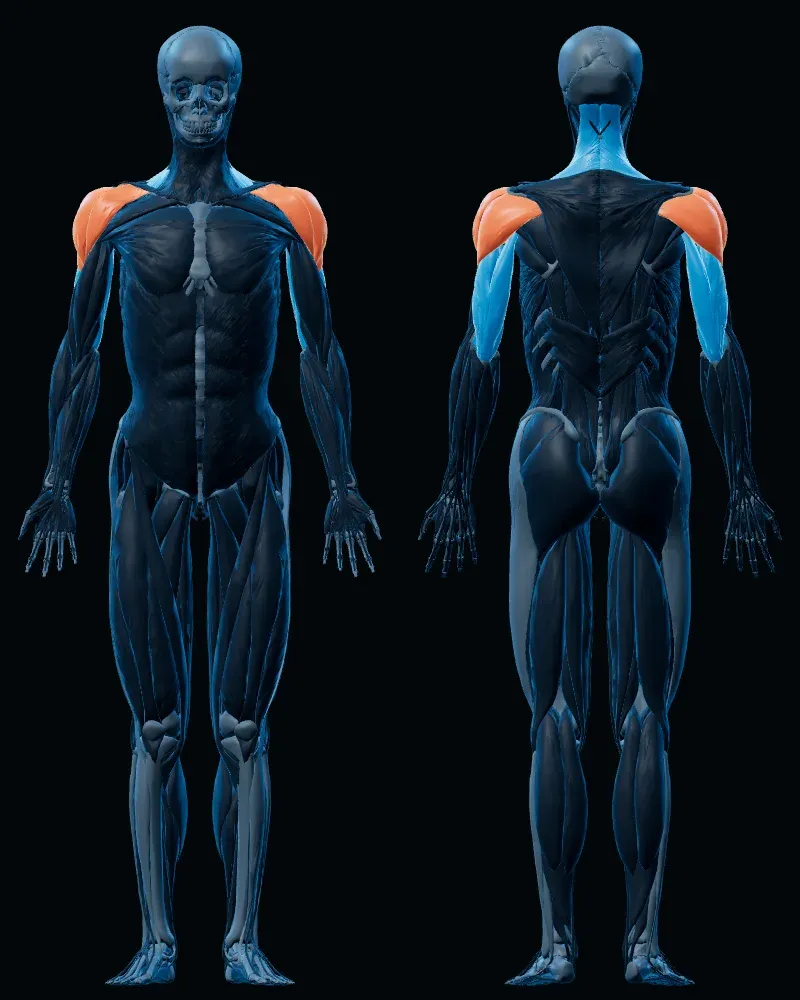
Muscles worked: shoulders
Main movers: all three heads of the deltoid
Assisting: supraspinatus, upper traps and triceps
Table of contents
The side lying lateral raise, done with a dumbbell on an incline bench, changes where the weight feels heaviest. In a standing raise the hardest point is up near shoulder height. Lying on your side with the bench tilted, the load shifts toward the lower, more stretched part of the lift. That is the whole idea, and it only needs one dumbbell and an adjustable bench.
It is part of our wider complete shoulder and delt training guide, and it is a fix for one specific complaint: the dumbbell lateral raise feels like nothing at the bottom and a grind at the top. Below is the physics, a clean setup, and an honest look at what the research does and does not say.
Why does a standing dumbbell lateral raise feel broken?
Gravity pulls a dumbbell straight down. What your shoulder muscles have to fight is the turning force (torque) of that weight, which equals the weight times its horizontal distance from the shoulder joint.
Arm hanging at your side? The dumbbell is almost directly below the joint. Horizontal distance is close to zero, so torque is close to zero. As you raise the arm, the dumbbell moves out sideways and the distance grows. At roughly 90 degrees of abduction (arm parallel to the floor) the distance is as long as your arm, and torque peaks.
So the standing raise is easy where the muscle is longest and hardest where it is shortest. That is the “broken” resistance profile people complain about.
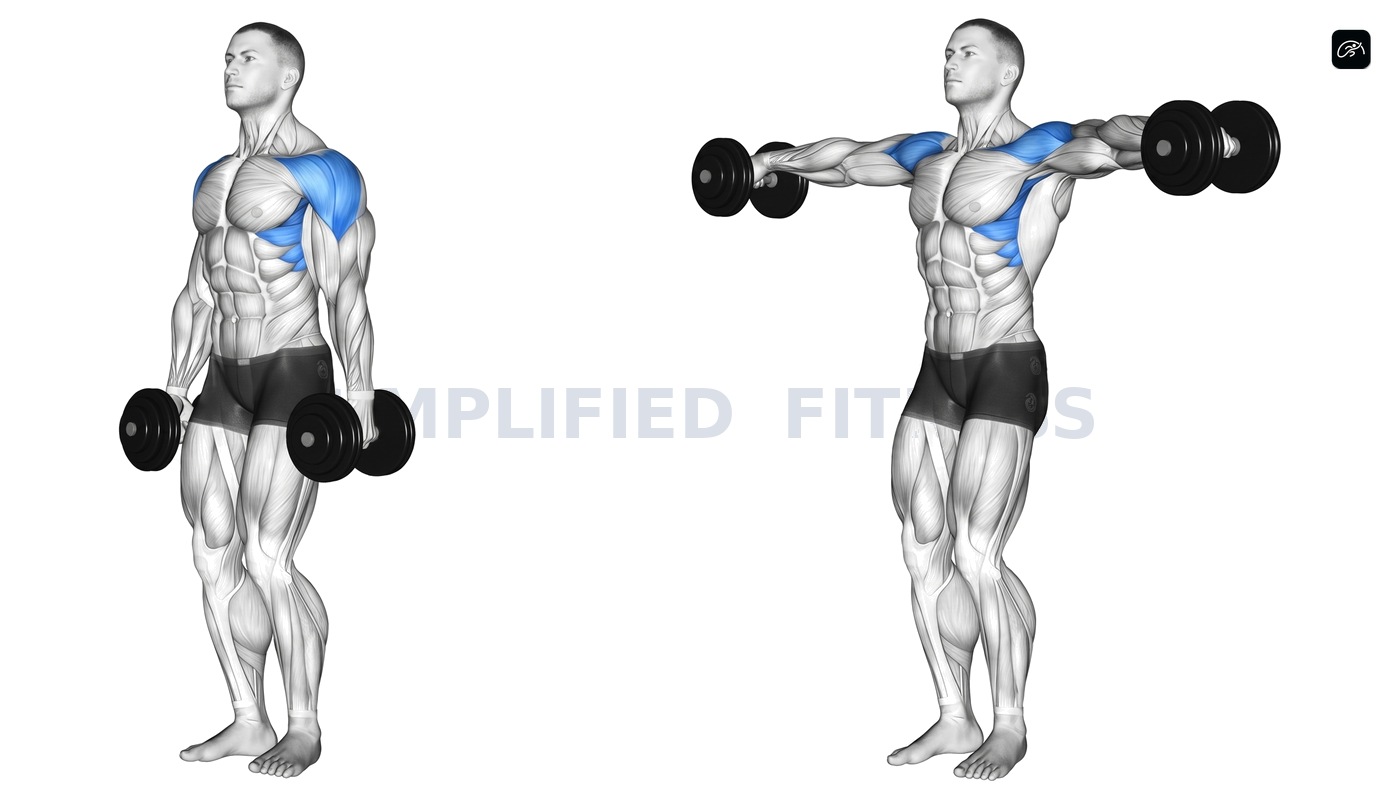
How does the side lying incline version change the curve?
Lie on your side on a bench with the back set at an angle, and your torso is no longer vertical. Your arm now starts pointing down along your body, which is already tilted away from straight-down gravity. The dumbbell begins well away from the shoulder joint, so the torque at the start is high rather than near zero.
As you lift, the arm swings toward the horizontal, torque peaks, then falls as the arm moves past it toward vertical. In this simple model the peak lands at an abduction angle roughly equal to the bench angle. A bench at 30-45 degrees puts the hardest point at about 30-45 degrees of abduction, not 90.
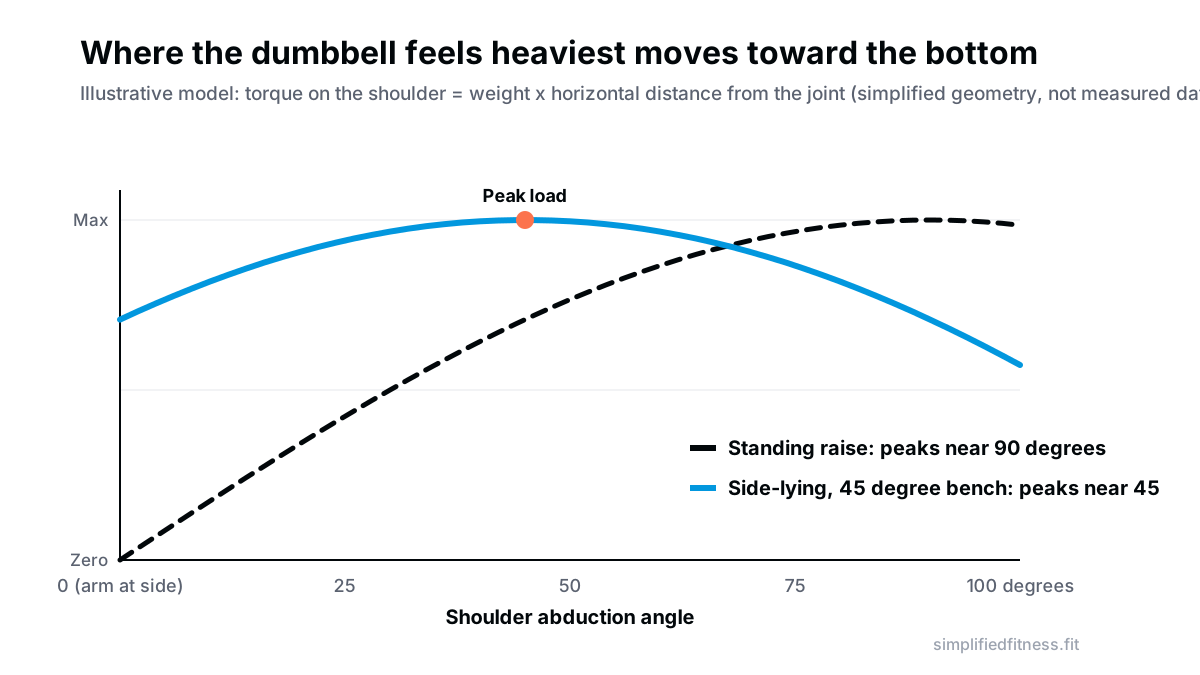
Two caveats keep this honest. First, the curve is a model: we did not measure muscle force, and the bench angle that “peaks” at a given joint angle depends on how your arm sits. Second, a heavier-feeling start is not the same thing as more muscle growth. Whether loading the lengthened position grows muscle better is a separate question, and we cover it next.
Does training at long muscle lengths build more delt?
Short answer: maybe a little, but the evidence is mixed. Here is what the better studies found.
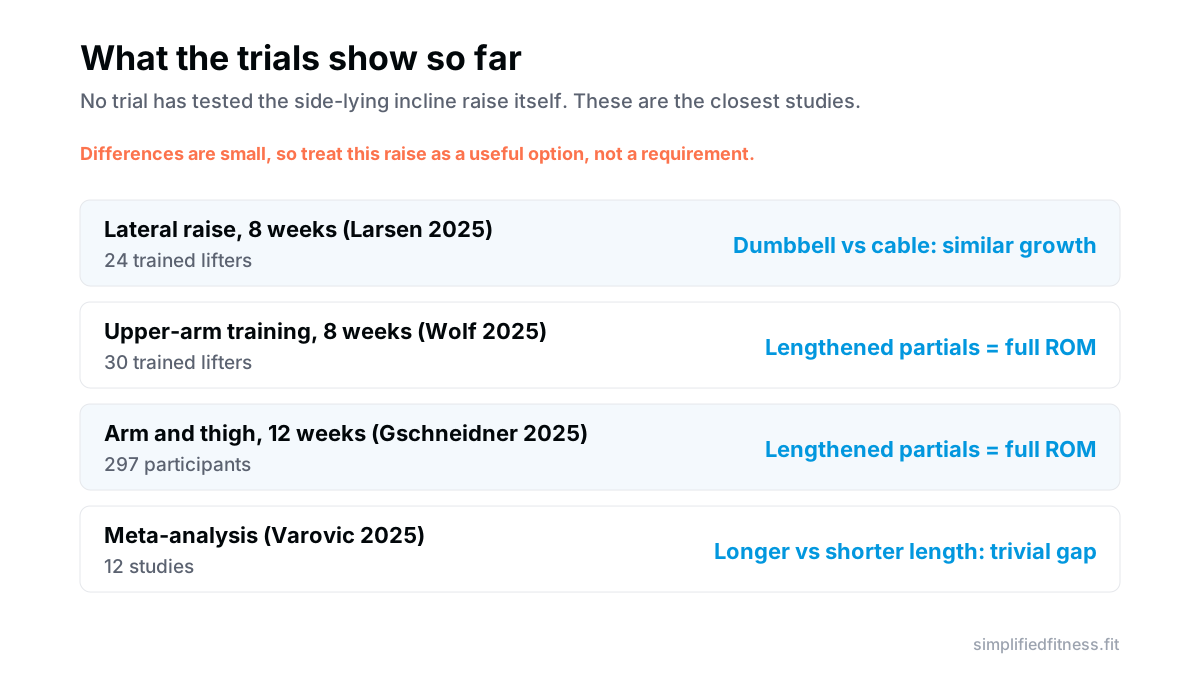
A 2020 systematic review of six range-of-motion trials concluded that full range of motion helped lower-body growth, while upper-limb research was “limited and conflicting,” so strong inferences were not possible (Schoenfeld and Grgic, 2020).
A 2025 trial in 30 resistance-trained people trained each arm with either lengthened partial reps or full range for 8 weeks. Elbow flexor and extensor growth was similar, and the authors suggested lifters seeking size should likely emphasise the stretched position, whether through full range or partials (Wolf et al., 2025).
A larger 12-week trial across 15 sites (163 in the lengthened-partial group, 134 in the full-range group) found arm and thigh muscle size changes were small and practically equivalent between the two approaches (Gschneidner et al., 2025).
Pooling twelve studies in young adults, a Bayesian meta-analysis found trivial differences in regional growth between shorter and longer mean muscle lengths, with a trend toward larger gains at longer lengths that was too small to call. The authors warn that the length differences in the included studies were modest (Varovic et al., 2025).
Why the mixed picture? Studies use different muscles, ranges, loads and trained status, and many measure only 8-12 weeks. The takeaway is cautious: do not skip the stretch, but do not expect a magic effect either. If you want to go deeper on the concept, see our guide to lengthened partials.
Dumbbells, cables or this: what does the lateral raise research say?
The nearest direct comparison is a 2025 trial in 24 resistance-trained men and women. Each person’s arms were randomly allocated to cable or dumbbell lateral raises, five sets to failure twice a week for 8 weeks, with range of motion matched. Lateral deltoid thickness rose by 3.3-4.6%, and the results supported no difference between the two (Larsen et al., 2025).
Two things to note. That trial did not include a side-lying version. And eight weeks is short. So the honest reading is that both standard options work, and the incline side-lying raise is a plausible third option that nobody has formally tested. For the full dumbbell, cable and machine comparison, see lateral deltoid optimization.
What about muscle activation? A systematic review of 33 EMG studies found abductions and horizontal abductions gave the highest middle deltoid activation, with lateral raises plus internal rotation topping the list (Rabello et al., 2024). In 10 competitive bodybuilders, medial deltoid activation was higher in a neutral lateral raise than in a flexed-elbow raise (Coratella et al., 2020). EMG shows activation, not growth, so use it to pick a clean version, not to crown a winner.
How to set up the side lying incline lateral raise
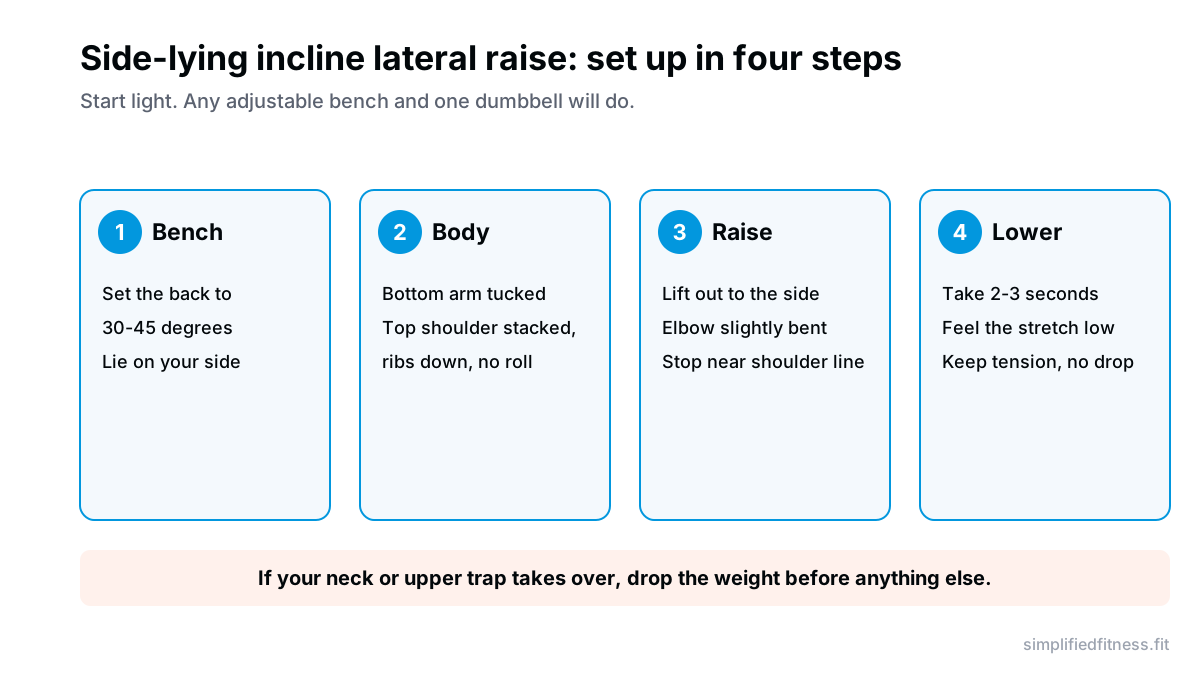
- Set the bench. Back angle around 30-45 degrees from the floor. Lower means a stretched start closer to flat; higher moves you toward a standing raise.
- Lie on your side. Bottom arm tucked under your head or across your chest. Hips and shoulders stacked so you do not roll backward.
- Start with the dumbbell low. Arm along your side, elbow soft. Pause for a beat in the stretch.
- Lift the elbow, not the hand. Raise out to the side until the arm is near shoulder line. Going much higher tends to bring the upper traps in more.
- Lower slowly. Take 2-3 seconds. Do not drop into the stretch.
Cues that help: think about pushing the elbow away from your hip, keep the neck long, and let the dumbbell travel in a smooth arc. If you are tempted to rotate the palm down like pouring a jug, read our take on the pouring pitcher myth first.
How do I program it at home or in a budget gym?
Lateral delts are a small muscle and light raises usually cause little fatigue, so spreading sets across the week tends to beat one brutal session.
- Sets and reps: 2-4 hard sets of 10-20 reps, stopping 1-3 reps short of failure. Not sure what that feels like? Use our RIR and RPE calculator.
- Frequency: once or twice per week, on a push day or a shoulder day. Our push day plan shows where lateral work usually fits.
- Pairing: swap it in for your standing raise on one session, or do it first on the day you feel the stretch matters most. Keep the other session standing or cable-based.
- Progression: add reps first, then a small jump in load. Small dumbbell steps (1 kg or fixed-pair 2 kg jumps) matter more here than on big lifts.
- Budget setup: if you have fixed dumbbells only, use micro-plates or rubber bands on one end, or add an extra slow-lowering rep instead of jumping weight.
- Volume check: if your shoulders are already getting heavy pressing work, you may not need extra sets. See the 3D shoulder protocol for weekly volume ideas.
In hot, humid weather, shorter rests mean pumped delts but sloppy form. Rest 60-90 seconds, hydrate, and stop the set when the shoulder blade starts creeping up.
Common mistakes and when to skip it
The most common mistake here is chasing the stretch with sloppy range. The aim is a controlled lengthened position, not a dive the joint cannot control. Another is going too heavy, which turns it into a shrug.
You can also skip the exercise entirely. If you already get a good delt pump from standing or cable raises, the side-lying version is optional. For a cable alternative, see cable lateral raises behind the back or cross-body.
Shoulder safety: when to see a doctor
Stop and get checked if you have sharp or pinching shoulder pain, pain that wakes you at night, numbness or tingling down the arm, or pain that lasts well beyond the day after training. Those are not signs of a good workout. A doctor or physiotherapist can look at your shoulder properly. If a pinch shows up near the top of raises, read our guide to subacromial shoulder impingement and lifting solutions.
The bottom line
The side lying lateral raise is a neat bit of free-weight physics. Tilting your body moves the hardest part of the dumbbell raise down toward the stretched position, using gear most home gyms already have. The research on stretched-position training is mixed, and nobody has tested this exact lift, so treat it as a sensible variation rather than a guaranteed upgrade. Start light, lower slowly, keep your traps quiet, and judge it by how your side delts respond over a few weeks.
Frequently Asked Questions
What is a side lying lateral raise?
It is a lateral raise done lying on your side on a bench, with a dumbbell in the top hand, instead of standing up. Because your body is tilted, gravity acts on the arm from a different angle, which changes where the lift feels hardest. Try it with a light dumbbell first and focus on lifting with the shoulder, not the neck.
Does a side lying incline lateral raise work the side delt better than a standing raise?
It may load the side delt harder in the lower, stretched part of the lift, but there is no trial showing it builds more muscle than a standing raise. The reasoning is mechanical: the arm's hardest point moves lower, where research on lengthened training is still mixed. Treat it as a useful variation and compare it with standing raises over a few weeks.
What bench angle should I use for a side lying lateral raise?
A back angle of roughly 30-45 degrees from the floor is a sensible starting range. In a simple model the hardest point of the lift lands near that same abduction angle, so a lower bench moves it closer to the stretch. Pick the angle where the top shoulder feels loaded without the upper trap or neck taking over.
Why does a normal dumbbell lateral raise feel too easy at the bottom?
At the start your arm hangs almost straight down, so the dumbbell sits close to the shoulder joint and creates very little turning force. The load only rises as the arm moves out to the side and the lever arm grows, peaking when the arm is horizontal. If the bottom feels empty, a cable, a side-lying setup or a slightly lighter weight with a slow lowering phase can all help.
Are cable lateral raises better than dumbbells?
Not clearly. An 8-week trial in 24 resistance-trained men and women, with each person's arms assigned to cable or dumbbell raises, found similar lateral deltoid growth in both. Choose whichever you can do with good form, and use the side-lying version if you only own dumbbells.
What weight should I use for side lying lateral raises?
Start much lighter than your standing raise, often 3-8 kg depending on your size and experience. The lever arm is long and your shoulder is working in an unusual position, so the same weight can feel heavier. Choose a load you can lift for 10-20 clean reps and stop 1-3 reps before failure.
How many sets and reps of side lying lateral raises should I do?
Two to four hard sets of 10-20 reps, once or twice a week, is a reasonable place to start. Many lifters find light lateral work easy to recover from, and the 8-week dumbbell versus cable trial used five sets to failure twice weekly. Add sets only if your shoulders recover well and your total weekly shoulder volume still fits your plan.
Can I do side lying lateral raises without a bench?
Yes, you can lie on a flat bench, a sofa edge or even the floor, but the incline is what changes the resistance curve. Flat side-lying makes the load highest right at the start, which can be harsh on the shoulder. If you only have a flat surface, a small wedge of cushions under your upper body is a rough substitute.
Do side lying lateral raises hurt the shoulder?
They should feel like a muscle burn in the side of the shoulder, not a pinch at the top or a sharp pain in the joint. Pain during the stretched position or lasting hours afterwards means you should lower the load or the range. If pain persists, see a doctor or physiotherapist rather than training through it.
How do I stop my traps from taking over on lateral raises?
Keep the shoulder blade resting down and back, lift the elbow rather than the hand, and use a lighter dumbbell than ego suggests. Heavy loads shrug the shoulder up, which turns the exercise into a trap movement. If your neck tightens, drop the weight by 20-30% and slow the lowering phase.
Are lengthened partials the same thing as a side lying raise?
No. Lengthened partials mean repeating only the stretched part of a range of motion, while the side-lying raise changes the direction of resistance across a normal range. They share the idea of loading the muscle when it is longer. A trained-lifter trial found lengthened partials and full range of motion gave similar upper-body growth.
Can I do side lying lateral raises at home with only dumbbells?
Yes, an adjustable bench and one dumbbell are all you need, and a chair-back or stacked cushions can stand in for a bench. Rotate between standing and side-lying raises so your joints see slightly different loading. In a hot, humid home gym, take slightly longer rests and drink plenty of water.
Sources & References
Every claim above is checked against peer-reviewed research (PubMed, U.S. National Library of Medicine) or guidance from established health bodies. How we fact-check.
- Larsen S, et al. Dumbbell versus cable lateral raises for lateral deltoid hypertrophy: an experimental study. Front Physiol. 2025. PMID: 40692697
- Wolf M, et al. Lengthened partial repetitions elicit similar muscular adaptations as full range of motion repetitions during resistance training in trained individuals. PeerJ. 2025. PMID: 39959841
- Gschneidner D, et al. The effects of lengthened-partial range of motion resistance training of the limbs on arm and thigh muscle area: A multi-site randomised trial. J Sports Sci. 2025. PMID: 41055237
- Varovic D, et al. Does muscle length influence regional hypertrophy? A systematic review and meta-analysis. Int J Sports Med. 2025. PMID: 40570881
- Schoenfeld BJ, et al. Effects of range of motion on muscle development during resistance training interventions: A systematic review. SAGE Open Med. 2020. PMID: 32030125
- Rabello R, et al. Activation of the three deltoid muscle portions during common strengthening exercises: A systematic review. J Bodyw Mov Ther. 2024. PMID: 39593452
- Coratella G, et al. An electromyographic analysis of lateral raise variations and frontal raise in competitive bodybuilders. Int J Environ Res Public Health. 2020. PMID: 32824894

Umair Hazrami · Founder & Head Coach, Simplified Fitness
Umair Hazrami founded Simplified Fitness and the Simplified Lifter channel to cut through fitness noise. With 4+ years of consistent training and 10+ coaching clients, he writes every guide from the peer-reviewed research and links the sources so you can check them. Our editorial standards.
Educational content only, not medical advice. If you have a medical condition, are pregnant, or take medication, talk to a qualified doctor before changing your diet, supplements or training. Full disclaimer.
Keep reading
Exercise Technique
3D Shoulder Protocol: Weekly Volume, Frequency (2-3x/Week) and Rep Ranges
How to build 3D shoulders: how many weekly sets, how often to train side and rear delts, and which rep ranges to use, with an 8-week plan and the research.
8 min read

Exercise Technique
Are Front Raises Necessary? Why Bench Pressers Rarely Need Direct Front Delt Work
Are front raises necessary if you bench and overhead press? See what EMG and volume research says, when they can still help, and where to spend those sets.
8 min read

Exercise Technique
Behind-the-Neck Press: Shoulder Mobility, Neck Safety and Muscle Bias
Behind the neck press safety explained: who has the shoulder mobility for it, what EMG studies show for delts, and which swaps work if you do not.
10 min read
Exercise Technique
Cable Lateral Raises: Behind-the-Back vs Cross-Body Setup, Which Is Better?
Cable lateral raise behind the back vs in front: what the research says, which setup suits most lifters, and a step-by-step guide to pulley height and cuffs.
9 min read